
More project photos (2)
The problem
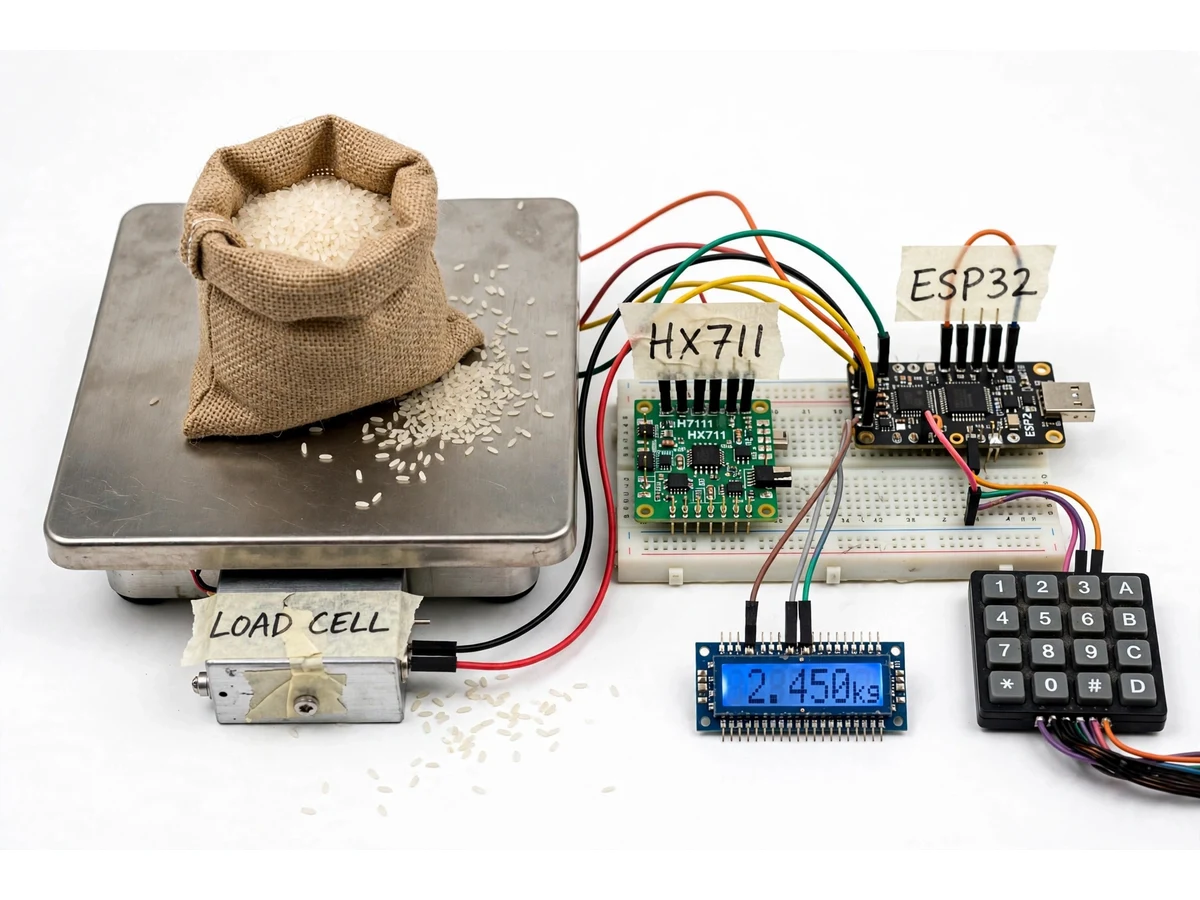
A smart weighing scale for retail shops with billing integration and cloud records is a counter-top unit that weighs loose goods, prices them per kilogram and records every sale, so a small shop can bill without mental arithmetic. The scale is built around a strain-gauge load cell under a steel platform, an HX711 amplifier, an ESP32, a 16x2 LCD and a 4x4 keypad: the shopkeeper places the goods on the platform, keys in the product code, and the display shows weight, rate and amount. Each completed weighing is sent over Wi-Fi to a cloud record with the product, weight, amount, bill number and time, so the owner can review the day's sales from anywhere instead of totalling a notebook. Small grocery and grain shops still weigh goods by hand and add up prices in their heads, which is slow at rush hour and easy to get wrong; this project replaces that routine with one weighed-and-billed step.
Strain gauges under the steel platform change resistance with the load.
Follow the working sequence
How it works
The smart weighing scale works by turning a tiny change in electrical resistance into a priced bill. The load cell's four strain gauges form a Wheatstone bridge: goods on the platform stretch the gauges, their resistance changes, and the bridge outputs a differential voltage of a few millivolts. The HX711 amplifies that signal with a gain of 128 and converts it with its 24-bit ADC, giving the ESP32 a digital count that grows with the load. The ESP32 subtracts the stored tare offset, divides by a calibration factor from a known weight, and shows the net weight on the LCD; the keypad's product code supplies the per-kg rate, so the amount is weight multiplied by rate. The ESP32 adds the item to the running bill and sends the record — product, weight, amount, bill number and timestamp — over Wi-Fi to the cloud dashboard. If Wi-Fi drops, records are held and uploaded when the connection returns.
- The shopkeeper presses the tare key with the empty platform, and the ESP32 stores the empty-platform HX711 count as the zero offset.
- Goods are placed on the steel platform; the load cell's strain gauges change resistance and the Wheatstone bridge outputs a small differential voltage.
- The HX711 amplifies the bridge signal at a gain of 128 and converts it with its 24-bit ADC at 10 samples per second, sending the count to the ESP32.
- The ESP32 subtracts the tare offset, applies the calibration factor, and averages readings until the weight is stable before showing it on the 16x2 LCD.
- The shopkeeper keys in the product code on the 4x4 keypad; the firmware looks up the stored per-kg rate and computes the amount as weight multiplied by rate.
- The item is added to the running bill with its own line, the LCD shows the running total, and the bill can be closed or started afresh from the keypad.
- The ESP32 sends the record — product, weight, amount, bill number and timestamp — over Wi-Fi to the cloud dashboard, or holds it on board and uploads it when the connection returns.
Tech stack:
- ESP32 development board
- Load cell · HX711 amplifier
- 16x2 LCD display
- 4x4 membrane keypad
- Arduino IDE · HX711 library
- Wi-Fi · HTTP cloud sync
- Cloud dashboard · record log
- 5 V regulated power supply
| Parameter | Value |
|---|---|
| Controller | ESP32 dual-core microcontroller, 240 MHz clock (datasheet value) |
| Load cell | Single-point strain-gauge load cell, 10 kg capacity (design target) |
| Amplifier / ADC | HX711, 24-bit ADC, channel A gain 128 (datasheet value) |
| Sampling rate | 10 SPS (datasheet value, RATE pin low) |
| Display | 16 x 2 character LCD with backlight |
| Keypad | 4 x 4 membrane keypad, 16 keys |
| Weighing resolution | 1 g display step (design target, after calibration) |
| Connectivity | Wi-Fi 2.4 GHz (datasheet value) |
| Power supply | 5 V DC regulated supply, approximately 1 A (design target) |
| Platform | Stainless-steel platform, approximately 200 mm x 200 mm (design target) |
| Cloud records | Weight, product, rate, amount, bill number and timestamp per weighing |
| Bill | Running total with per-item lines; receipt printing is an optional add-on |
Project features
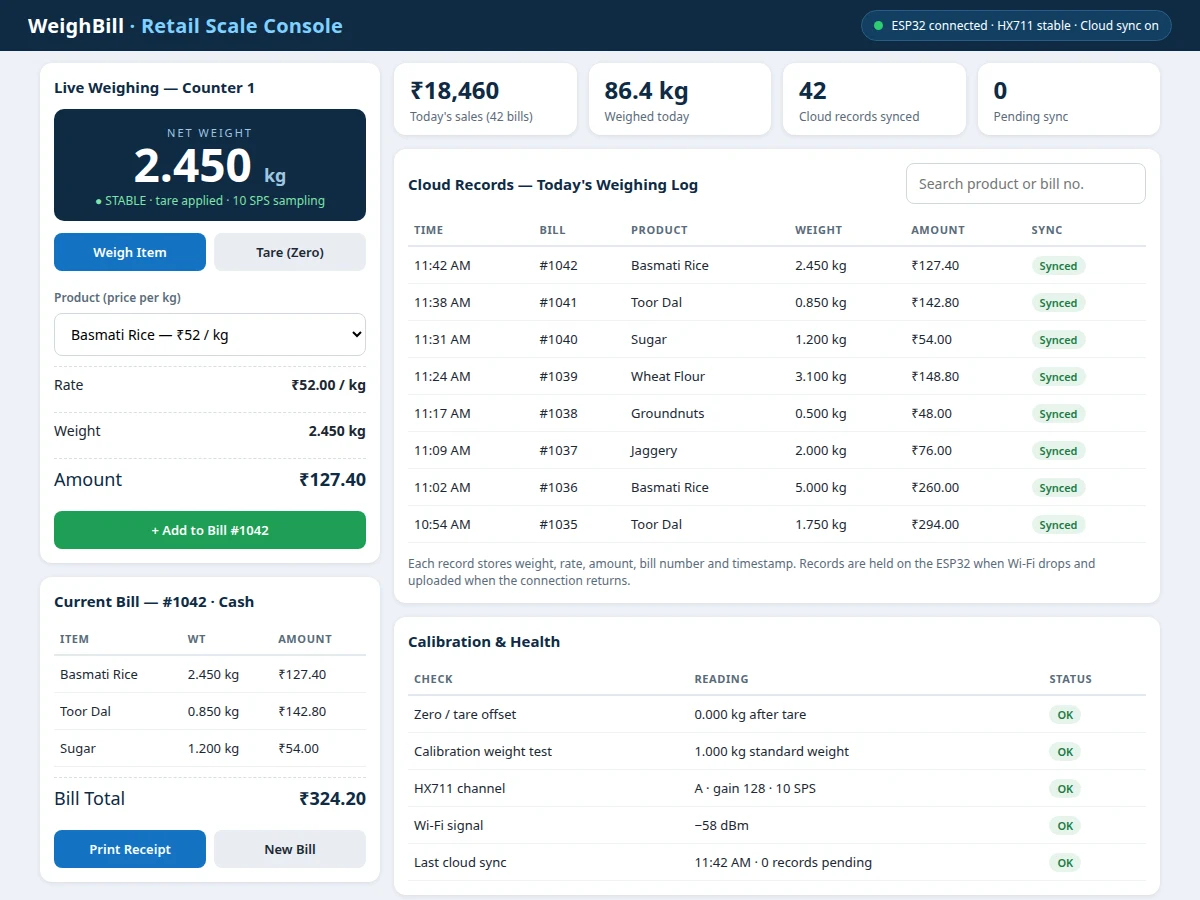
The smart weighing scale delivers four capabilities that matter at a shop counter. First, true weighed billing: the load cell and HX711 measure the goods on the platform, the keypad selects the product, and the LCD shows weight, rate and amount in one step, so the shopkeeper never multiplies in their head. Second, a running bill: each weighed item is added to the current bill with a running total, with the bill closed or restarted from the keypad. Third, a cloud record of every weighing: weight, product, rate, amount, bill number and timestamp are stored online, and the dashboard shows the day's sales, the total weight sold and the sync status of every record. Fourth, honest calibration: a tare key zeroes the empty platform, and a known-weight check lets the owner verify the scale before the day's trading. The build is documented end to end, from load-cell mounting to the cloud dashboard.
- [Load-cell weighing with tare] A single-point strain-gauge load cell under the steel platform measures the goods placed on it, and a tare key zeroes the empty platform so containers and packing do not add to the bill.
- [Keypad product selection and per-kg pricing] The 4x4 keypad selects the product and its stored per-kg rate, so the LCD shows the weight, the rate and the amount to charge in one step without mental arithmetic.
- [Running bill with item lines] Each weighed item is added to the current bill with its own line and a running total, and the bill can be closed or started afresh from the keypad for the next customer.
- [Cloud records and sales dashboard] Every completed weighing is sent over Wi-Fi to a cloud record with product, weight, amount, bill number and timestamp, and the dashboard shows the day's sales, total weight sold and sync status.
- [Offline hold and auto-sync] If Wi-Fi drops, weighing and billing keep working on the counter and the records are held on the ESP32, then uploaded automatically when the connection returns.
- [Calibration with a known weight] A buyer-run procedure calibrates the scale with a standard weight: the raw HX711 count at a known load sets the counts-per-gram factor, and the result is recorded on the supplied sheet.
- [Stable-weight detection] The firmware averages consecutive HX711 readings and marks the weight stable only when the readings settle, so the display does not flicker while goods are still being placed on the platform.
What is included
- Working weighing-scale prototype: steel platform, load cell, HX711, ESP32, LCD and keypad
- Firmware source code with tare, calibration, billing and cloud-sync routines
- Billing and cloud-records dashboard demo as a single-file web app
- Circuit diagram, wiring list and component list for the complete unit
- Buyer-run calibration procedure with a known-weight recording sheet
- Project report PDF (theory, Wheatstone bridge, HX711, billing flow, cloud records)
- PPT presentation for final review
- Viva Q&A preparation document (load cells, ADC resolution, calibration, Wi-Fi sync)
Limitations & prerequisites
- This prototype is NOT legal-for-trade and is not Weights & Measures certified; a shop cannot legally bill customers off it without certification, so it is an academic demonstration only.
- Accuracy depends on calibration with a known weight and a level, vibration-free platform; a load cell's output creeps slightly under a sustained load and drifts with temperature, so the scale must be re-tared and re-checked regularly.
- The 10 kg design-target capacity must not be exceeded; overloading can permanently damage the load cell.
- Cloud records need Wi-Fi; without it, weighing and billing keep working but records are held on the ESP32 and uploaded later, and on-board storage is limited to the controller's memory.
- Per-kg rates are entered and stored by the shopkeeper on the keypad; the base build has no barcode scanner or thermal receipt printer, which are optional add-ons.
- The dashboard demo shows the billing flow with sample data; the live prototype syncs real records only when connected to the configured cloud endpoint.
Timeline
- Build and testing: approximately 2-3 weeks (expected), including load-cell mounting, HX711 wiring, calibration and dashboard setup.
- Documentation and dispatch: approximately 1 week (expected) after the working demo is approved.
Support
- Wiring, calibration and cloud-setup guidance over WhatsApp during the build and first weighing tests.
- Report, PPT and viva Q&A included; customisation such as a receipt printer, barcode scanner or GSM fallback is quoted separately.
Frequently Asked Questions
Is this project suitable for a final-year project?
Yes — for Electronics & Telecommunication, Electrical and IoT & Embedded final-year programs, it demonstrates strain-gauge sensing, the Wheatstone bridge, 24-bit ADC conversion, embedded firmware, keypad interfacing and Wi-Fi cloud sync in one working build with a clear retail use case. The report covers the sensing principle, the HX711, the billing logic and the cloud record flow, so the viva discussion has real hardware and real code to point at.
How does the load cell actually measure weight?
Four strain gauges inside the load cell are wired as a Wheatstone bridge, so the weight pressing on the platform stretches the gauges, changes their resistance and produces a small differential voltage across the bridge that grows with the load. The HX711 amplifies that millivolt-level signal with a gain of 128 and digitises it with its 24-bit ADC, and the ESP32 converts the resulting count into kilograms using the tare offset and the calibration factor set with a known weight.
How is the scale calibrated?
Calibration is a buyer-run procedure with a standard weight: the empty platform is tared, a known weight such as a 1 kg standard is placed on the platform, and the raw HX711 count at that load sets the counts-per-gram factor stored in the firmware. The procedure and the recorded readings go on the supplied sheet, and the scale should be re-checked with the same standard weight whenever it is moved or the readings start to drift.
Does it work without Wi-Fi?
Yes for weighing and billing, no for cloud records — the scale works fully offline at the counter, and only the cloud upload needs Wi-Fi. The load cell, HX711, ESP32, LCD and keypad all work offline, so the shopkeeper can weigh goods, price them and keep a running bill with no connection at all. Cloud records are the only part that needs Wi-Fi: when the connection drops, each record is held on the ESP32 and uploaded automatically when Wi-Fi returns, so no sale is lost from the log.
Can a shop legally bill customers with this scale?
No — not as built. The prototype is an academic build with no Weights & Measures certification, so a shop cannot legally use it for trade billing, and the report and the limitations state this plainly. What it demonstrates is the complete weighing-to-billing-to-cloud chain: the same sensing, pricing and record-keeping logic a certified commercial scale uses, built with student-grade hardware and documented calibration.
Can a receipt printer, barcode scanner or more products be added?
Yes — a thermal receipt printer, a barcode scanner for product lookup, a larger product list and a GSM fallback for shops without Wi-Fi can all be added on request. Each change is quoted separately because it changes the hardware, the firmware and the dashboard. The base build — load-cell weighing, keypad billing, running bill and cloud records — is the standard package.
Components & software requirements
- ESP32 development board
- Load cell · HX711 amplifier
- 16x2 LCD display
- 4x4 membrane keypad
- Arduino IDE · HX711 library
- Wi-Fi · HTTP cloud sync
- Cloud dashboard · record log
- 5 V regulated power supply
Delivery information
Built-to-order project. Delivery timeline is shared after order confirmation based on current queue.
Support terms
Complete documentation, setup guide, and viva preparation included. Support for setup and explanation provided.
Download free synopsis (PDF)
Enter your name and WhatsApp number — the synopsis PDF downloads immediately. We may send occasional project updates on WhatsApp; no spam.