
More project photos (4)
The problem
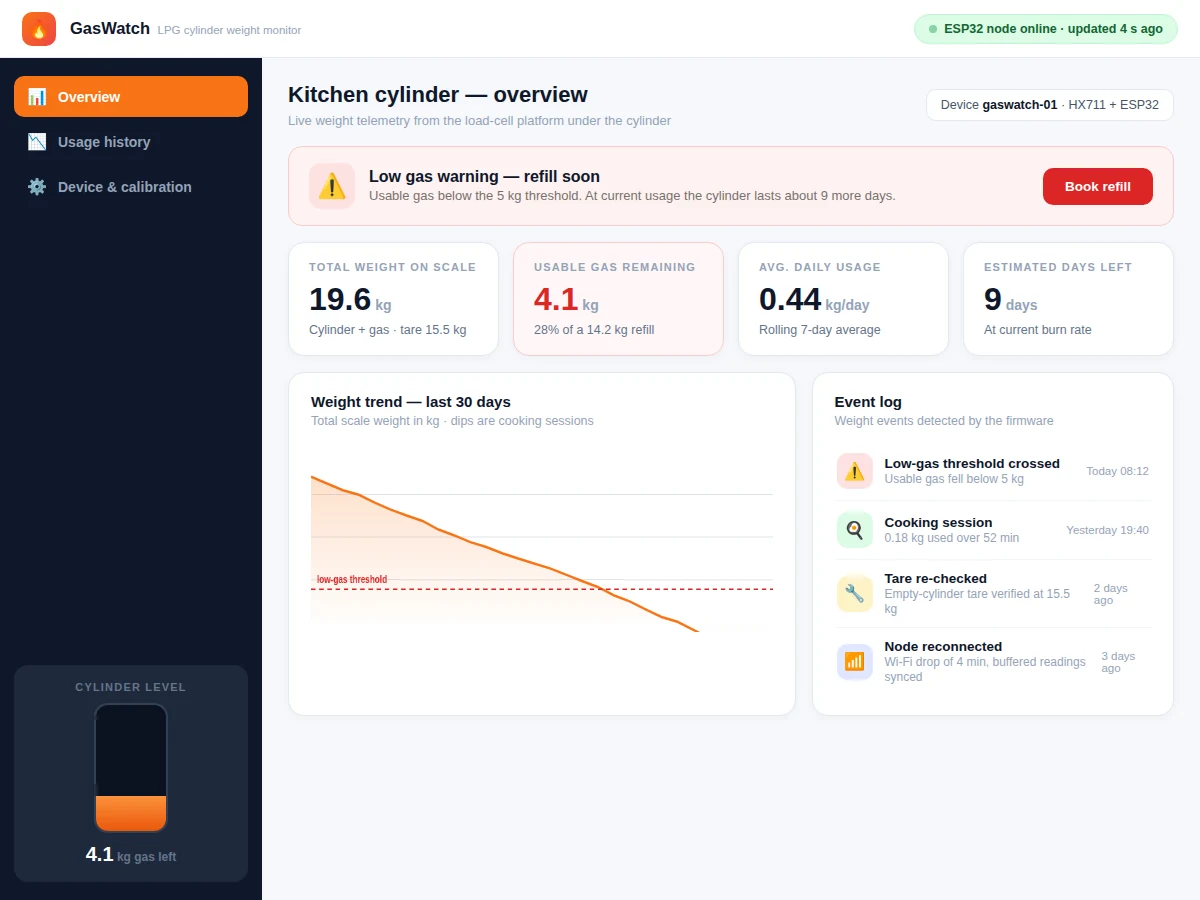
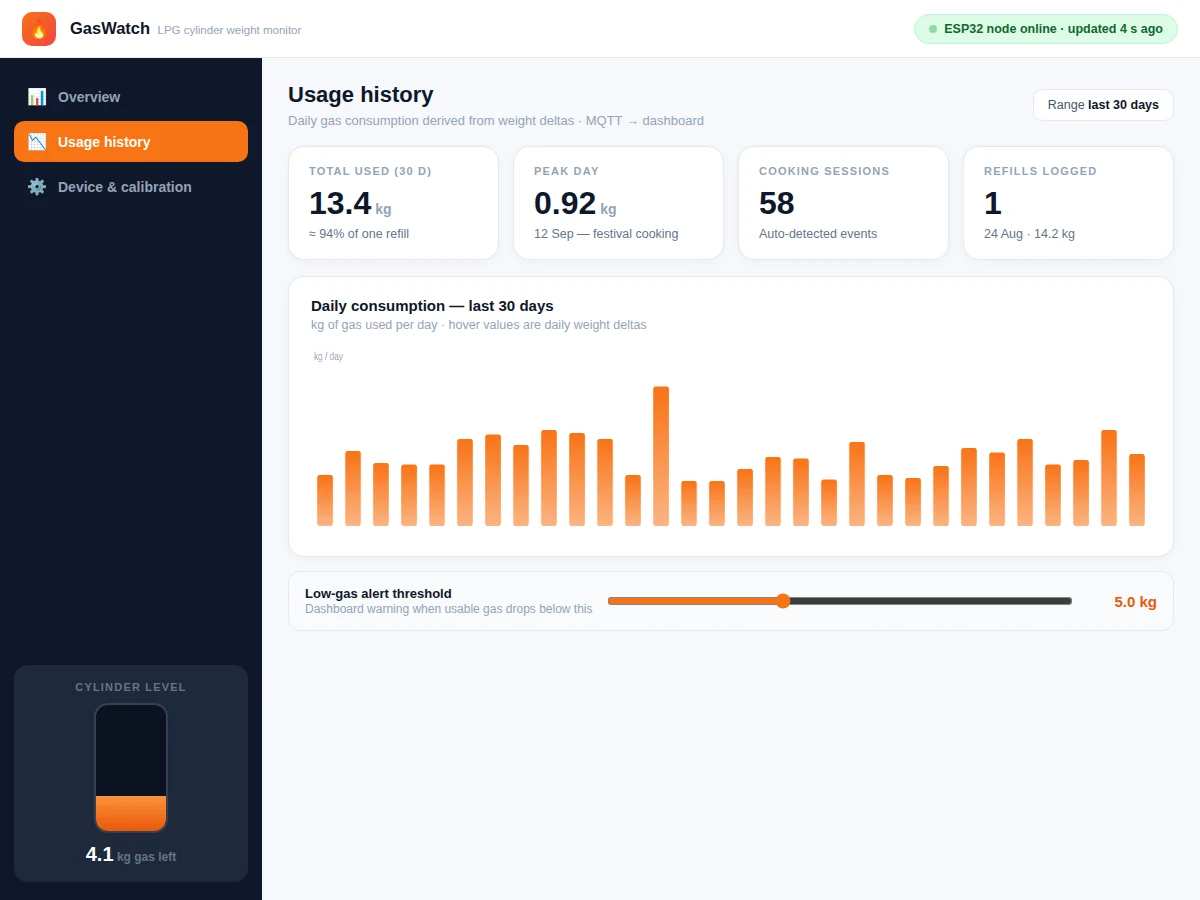
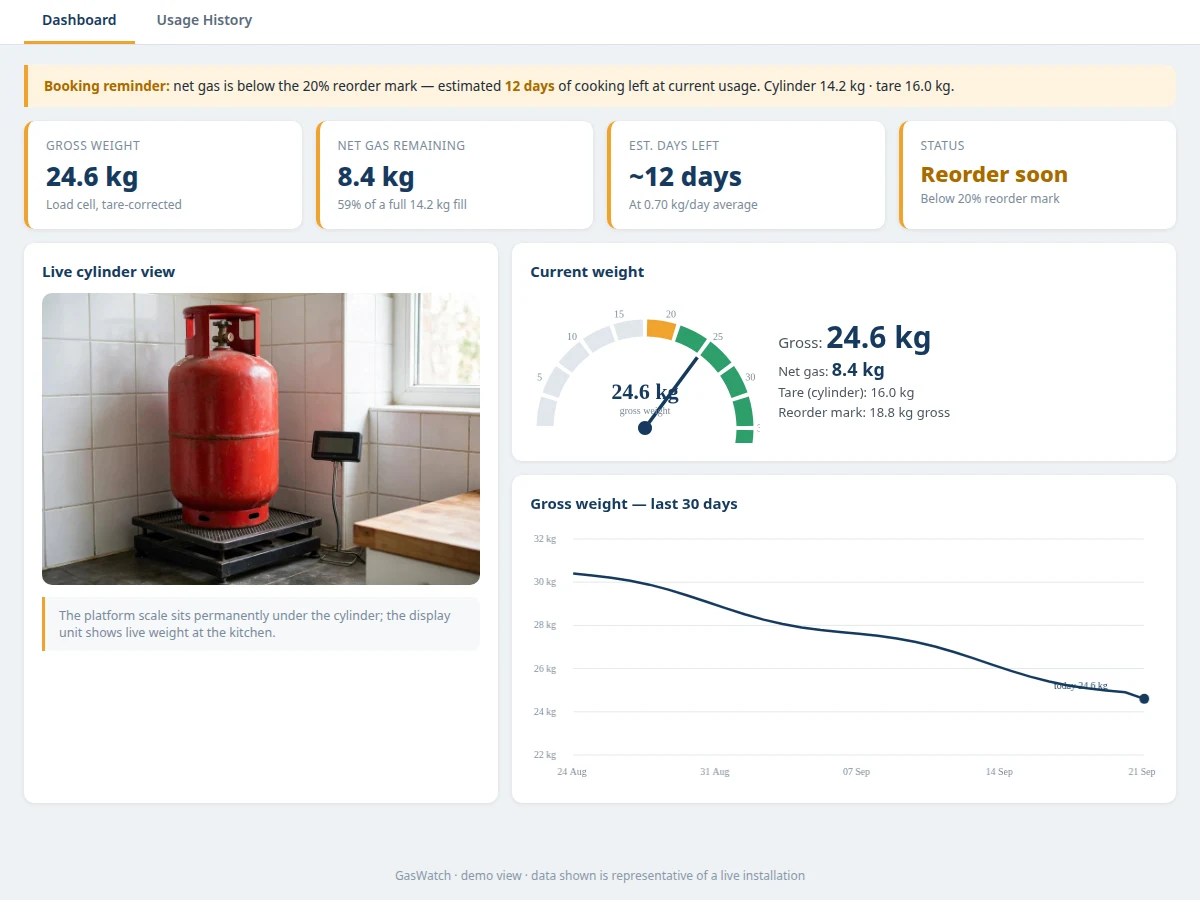
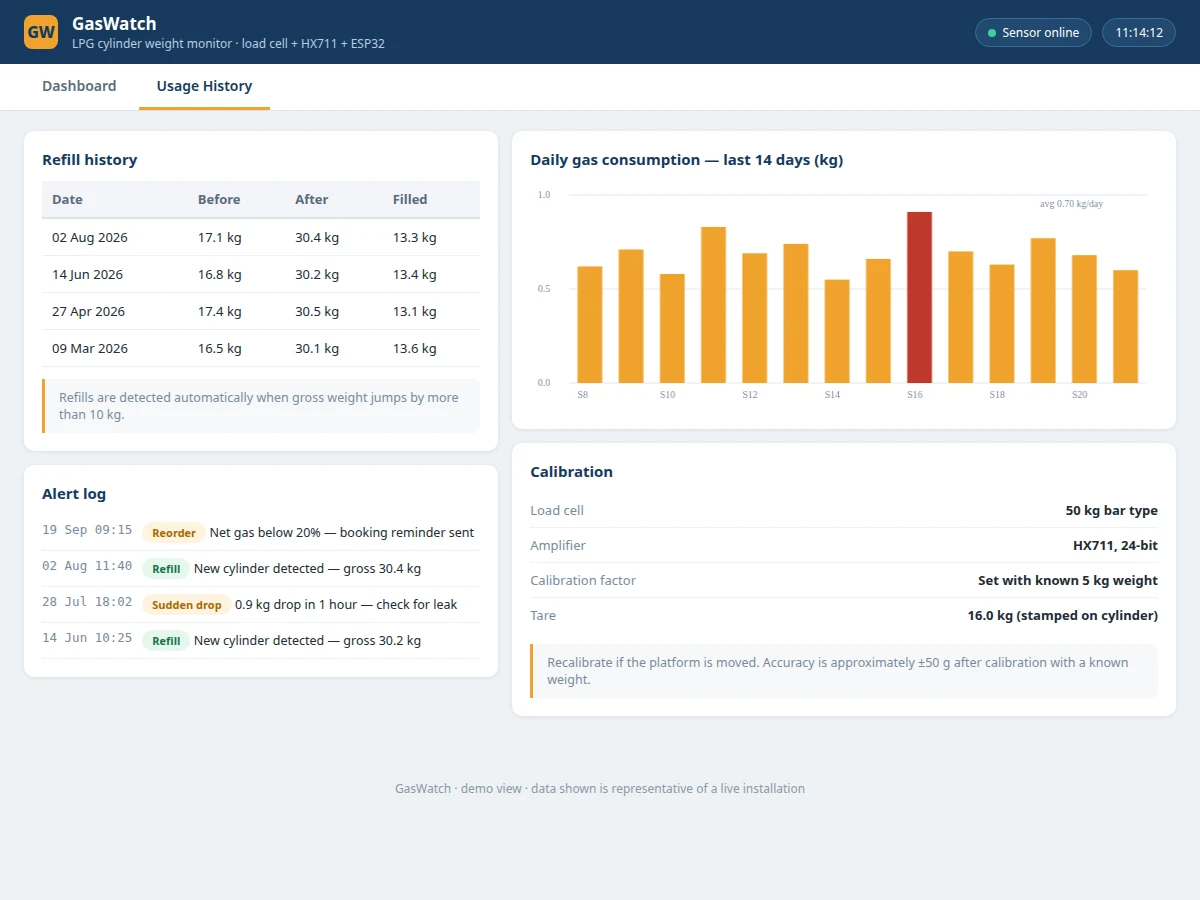
Nobody enjoys discovering the cylinder is empty halfway through cooking dinner, and shaking the cylinder to guess the remaining gas is exactly as unreliable as it sounds. Weight is the honest measurement: an LPG cylinder's tare weight is stamped on it, so gross weight minus tare equals gas remaining. This project builds a permanent weighing platform that lives under the cylinder: a 50 kg bar load cell read by a 24-bit HX711 amplifier, an ESP32 that applies calibration and tare, a 16×2 LCD for live weight at the kitchen, and a dashboard for the longer story — 30-day weight trend, daily consumption bars, automatic refill detection and an alert log. The firmware estimates days of gas left from the recent consumption rate and raises a reorder reminder when net gas crosses below 20% of a full fill. Calibration is a real procedure the buyer runs with a known weight, and the report documents the resulting accuracy instead of assuming it.
How it works
- The cylinder stands permanently on the platform; the 50 kg bar load cell flexes microscopically under the load.
- The HX711 amplifier digitizes the load cell's millivolt signal at 24-bit resolution and the ESP32 reads it over a two-wire serial interface.
- Firmware applies the buyer's calibration factor (set with a known 5 kg weight) and subtracts the configured tare to get gross and net weights.
- Readings are averaged over several samples to reject vibration noise, then shown on the local 16×2 LCD.
- The ESP32 publishes weight readings over Wi-Fi/MQTT to the dashboard's cards and 30-day trend chart.
- Daily consumption is computed from the trend; dividing net gas by the burn rate gives the estimated days remaining.
- Crossing the 20% reorder mark raises the booking reminder; a >10 kg jump is logged as a refill; abnormal drops raise a check-for-leak flag.
Tech stack:
- 50 kg bar load cell + HX711 24-bit amplifier
- ESP32 (Arduino-core firmware: averaging, tare, MQTT)
- 16×2 LCD display (I2C) for local readout
- Steel weighing platform (fabrication guide included)
- MQTT broker + web dashboard (cards, gauge, charts, alert log)
- Known-weight calibration procedure (5 kg reference)
| Parameter | Value |
|---|---|
| Load cell | 50 kg bar type, 4-wire strain gauge |
| Amplifier | HX711, 24-bit ADC, ~10 samples/sec |
| Controller | ESP32, Arduino-core firmware |
| Display | 16×2 LCD (I2C) for local live weight |
| Accuracy | Approximately ±50 g after known-weight calibration (procedure-run, not assumed) |
| Tare | Configurable; typical LPG cylinder ~16.0 kg stamped tare |
| Reorder mark | Net gas below 20% of 14.2 kg fill (configurable) |
| Connectivity | MQTT over Wi-Fi to dashboard |
| Platform | Steel plate build guide; cylinder sits permanently on it |
| Power | 5 V USB adapter for ESP32 + HX711 |
Project features
- [Continuous weight monitoring] The platform reads gross weight around the clock; the LCD shows live weight in the kitchen without opening any app.
- [Net-gas calculation] Cylinder tare (stamped on the body, typically ~16 kg) is subtracted in firmware, so every display reads in kilograms of gas remaining.
- [Reorder reminder] When net gas drops below the 20% mark, the dashboard flags "reorder soon" with an estimated-days-left figure from the recent burn rate.
- [Automatic refill detection] A gross-weight jump above 10 kg is logged as a refill event with before/after weights — no manual entry needed.
- [Consumption tracking] Daily usage bars and a 30-day trend chart show the household's real burn rate, which also feeds the days-left estimate.
- [Sudden-drop alert] An unusually fast weight drop is flagged in the alert log as a possible leak to check — a safety-adjacent feature, not a certified gas detector.
- [HX711 calibration procedure] A documented known-weight calibration sets the scale factor; the report explains the resulting accuracy instead of claiming a number.
- [Dashboard + alert log] Gross/net cards, refill history table, consumption charts and a timestamped alert log in one web view.
What is included
- Complete ESP32 firmware (sampling, averaging, tare, calibration, MQTT, LCD)
- Platform fabrication and assembly guide (load cell mounting, wiring)
- Known-weight calibration procedure
- Dashboard web app (gauge, 30-day chart, refill history, alert log)
- Project report PDF (background, load-cell theory, calibration method, evaluation)
- PPT presentation for final review
- Viva Q&A preparation document (strain gauges, HX711, calibration, tare, MQTT)
- Setup guide (assembly, first calibration, dashboard connection)
Limitations & prerequisites
- Accuracy of approximately ±50 g is achieved only after the documented known-weight calibration; an uncalibrated build is a relative indicator, not a scale.
- The platform must sit on a hard, level floor — soft or uneven flooring and knocks disturb readings, and the guide says so plainly.
- The sudden-drop flag is a prompt to check for a leak, not a certified gas-leak detector; it cannot replace one.
- Days-left is an estimate from recent burn rate; a week of heavy cooking shortens it and the dashboard shows the rate it used.
- The cylinder's stamped tare varies slightly between cylinders; entering your own cylinder's tare is part of setup.
- Wi-Fi is needed for the dashboard and remote alerts; the LCD keeps showing live weight locally without it.
Frequently Asked Questions
How does it know how much gas is left?
It weighs the whole cylinder and subtracts the tare weight stamped on the cylinder body. Gross minus tare equals kilograms of gas — no guessing, no shaking.
How accurate is it?
Approximately ±50 g after you run the documented calibration with a known 5 kg weight. The report explains the calibration math; without it, treat readings as relative.
What happens when I get a refill?
The firmware detects the >10 kg jump automatically and logs a refill event with before/after weights. You can also correct the tare if the new cylinder's stamped tare differs.
Does it detect gas leaks?
Not as a certified detector — but an abnormally fast weight drop is flagged in the alert log as a prompt to check. A proper gas sensor is a documented extension.
Can the platform handle a full cylinder?
Yes — the 50 kg load cell covers a full 14.2 kg cylinder (about 30 kg gross) with margin, and the fabrication guide covers safe mounting.
Is this project suitable for a final-year project?
Yes — for Electronics, Electrical and IoT programs. It demonstrates strain-gauge interfacing, precision ADC use, calibration metrology, embedded UI and telemetry, all strong viva material. Suitable for B.E./B.Tech final-year projects in Electronics, Electrical and IoT.
Components & software requirements
- 50 kg bar load cell + HX711 24-bit amplifier
- ESP32 (Arduino-core firmware: averaging, tare, MQTT)
- 16×2 LCD display (I2C) for local readout
- Steel weighing platform (fabrication guide included)
- MQTT broker + web dashboard (cards, gauge, charts, alert log)
- Known-weight calibration procedure (5 kg reference)
Delivery information
Built-to-order project. Delivery timeline is shared after order confirmation based on current queue.
Support terms
Complete documentation, setup guide, and viva preparation included. Support for setup and explanation provided.