
More project photos (2)
The problem
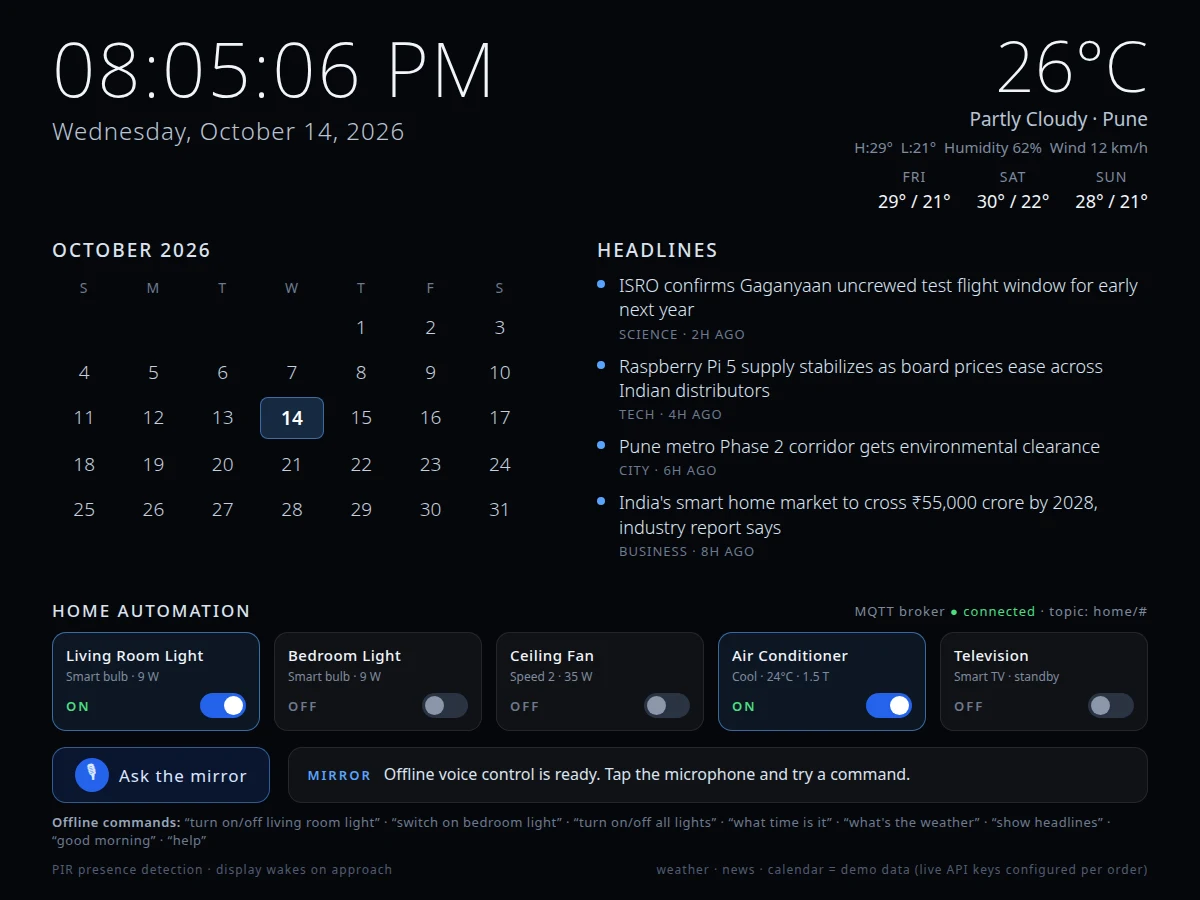
A smart mirror turns an ordinary mirror into an information display: a monitor hidden behind two-way acrylic glass shows the time, weather, calendar and news while the surface still works as a mirror. Commercial versions are expensive, closed products, and most student builds stop at a static dashboard. This project goes further by adding a voice assistant that runs entirely offline — a USB microphone feeds a Vosk speech recognizer on a Raspberry Pi 4, so spoken commands like "turn on the bedroom light" switch real home devices over MQTT with no cloud account, no subscription and no audio leaving the room. A PIR motion sensor wakes the display when someone approaches and lets it sleep when the room is empty. The build combines woodworking (the frame), embedded Linux, audio processing, sensor interfacing and a web dashboard, which makes it a strong demonstration of connected-embedded design.
How it works
- On power-up the Raspberry Pi boots Raspberry Pi OS and launches the Python backend, which loads the Vosk offline recognizer and opens the dashboard UI in fullscreen kiosk mode on the monitor behind the two-way acrylic mirror.
- The PIR sensor watches the room; when motion is detected within its approximately 3–7 m adjustable range, the backend wakes the display (design target: under 2 s) and starts an idle timer that sleeps the screen again when nobody is around.
- The dashboard renders the live clock and date from the system clock, plus weather, calendar and news widgets — static demo data ships with the build; live feeds activate once the buyer configures their API keys.
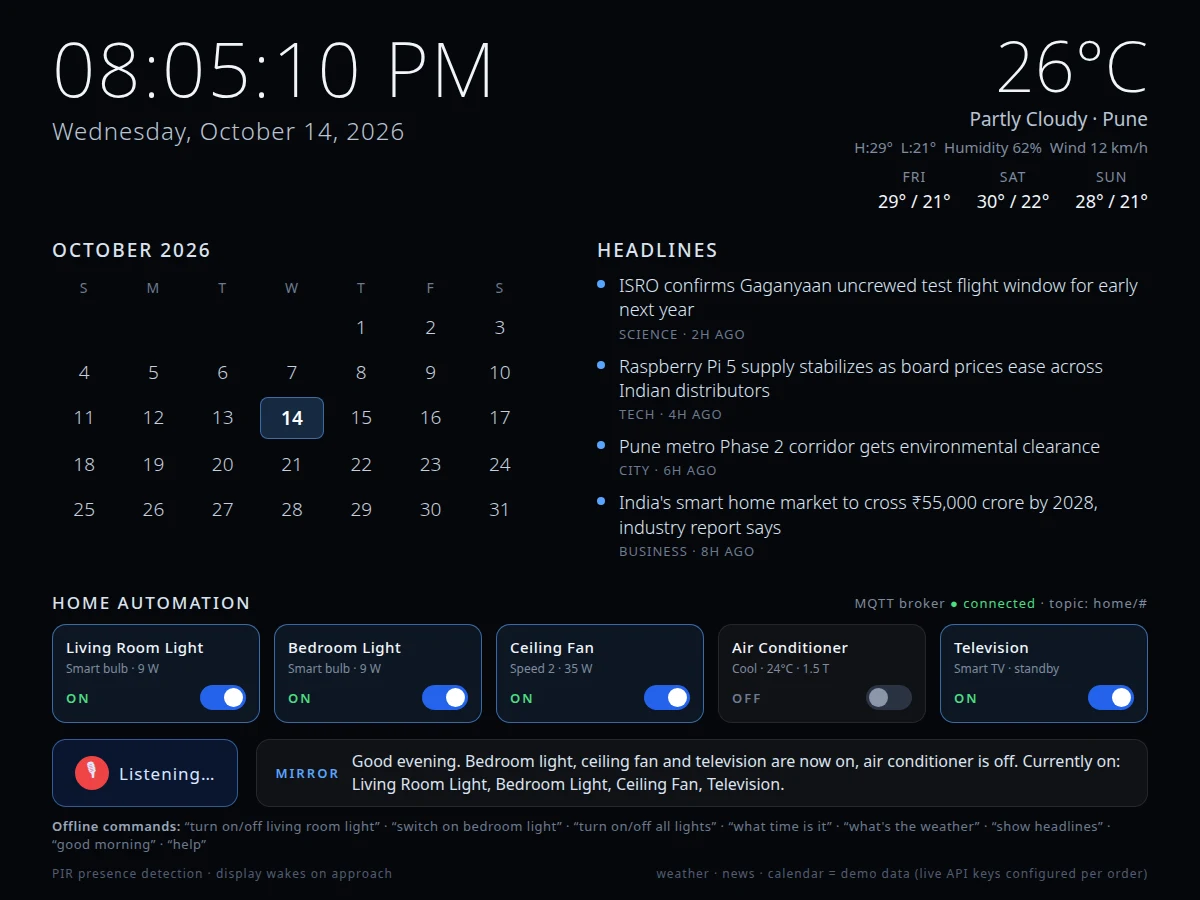
- The USB microphone streams audio to Vosk continuously; when a phrase matches the documented command set, the backend maps it to an action, for example "turn on living room light" publishes ON to the matching MQTT topic.
- A local Mosquitto MQTT broker relays the message to subscribed home devices; an ESP8266 relay demo module is included so real switching can be demonstrated even without commercial smart bulbs.
- The mirror speaks a confirmation through the USB speaker, updates the toggle state on screen, and logs the command — the full voice-to-device loop stays inside the home network.
Tech stack:
- Raspberry Pi 4 (2 GB+) · Raspberry Pi OS
- Python 3 (backend, Vosk bindings)
- Vosk offline speech recognition
- MQTT · Mosquitto broker
- HTML · CSS · JavaScript (mirror dashboard UI)
- OpenWeatherMap API (weather widget)
- PIR motion sensor · USB microphone · USB speaker
- Two-way acrylic mirror · wooden frame
| Parameter | Value |
|---|---|
| Controller | Raspberry Pi 4, 2 GB RAM minimum (design target) |
| Display | 24-inch monitor behind two-way acrylic mirror in wooden frame (design target; size configurable) |
| PIR detection range | Approximately 3–7 m, adjustable sensitivity (expected) |
| Display wake latency | Design target: under 2 s after motion detection |
| Voice recognition | Vosk small English model, offline, documented command set (implemented) |
| Microphone range | Approximately 1 m usable command distance in a quiet room (expected) |
| Connectivity | Built-in Wi-Fi; MQTT over the local network; no cloud account required |
| Device control | MQTT topics, e.g. home/light/living/set (topic map configurable) |
| Power | 5 V 3 A USB-C supply for the Pi; monitor on mains |
| Audio output | USB speaker for spoken confirmations (offline TTS) |
Project features
- [Offline voice commands (Vosk)] A USB microphone streams audio to the Vosk small English model running on the Pi; phrases from the documented command set trigger actions with no internet and no audio sent to any cloud service.
- [PIR auto-wake display] A PIR motion sensor wakes the 24-inch monitor when someone approaches and the display sleeps after a configurable idle timeout, so the mirror behaves like a real appliance instead of a PC left on.
- [Mirror dashboard widgets] Clock and date, OpenWeatherMap weather, a month calendar and RSS news headlines on a dark mirror-style web UI; static demo data ships so the UI works out of the box, and live data activates once the buyer adds API keys.
- [MQTT home-device control] Toggle switches in the dashboard publish to MQTT topics, and voice commands map to the same topics; any MQTT-capable smart plug, bulb or relay (Tasmota/ESPHome class) can subscribe and respond.
- [Spoken confirmations] The mirror answers through a USB speaker using offline text-to-speech ("Bedroom light is now on"), so every voice command gets audible feedback.
- [Configurable command vocabulary] The command list lives in a plain JSON file — add or remove phrases and their MQTT actions without touching the recognizer code.
- [Wake-word listening (optional)] The base build uses a push-to-talk button; an always-listening wake-word engine can be added as a customization for hands-free operation.
- [Cloud assistant integration (optional)] Google Assistant or Alexa style cloud skills are NOT part of the base build; they can be added on request where internet-based assistants are acceptable.
What is included
- Working framed smart-mirror prototype (wooden frame, two-way acrylic mirror, 24-inch-class monitor)
- Raspberry Pi 4 with the complete Python backend and dashboard code
- PIR motion sensor, USB microphone and USB speaker, wired and configured
- ESP8266 relay demo module showing real MQTT device switching
- Vosk offline model setup with the documented command JSON
- Wiring diagram, frame build notes and PIR/mic calibration procedure
- Project report PDF (background, voice pipeline, MQTT design, methodology)
- PPT presentation for final review
- Viva Q&A preparation document (speech recognition, MQTT, sensor interfacing, embedded Linux)
Limitations & prerequisites
- Two-way acrylic mirrors need a dim room and a bright display behind them — strong daylight on the glass washes the widgets out; this is a property of the mirror material, not a defect.
- Vosk recognizes the documented offline command set; free-form conversation and cloud-assistant skills are NOT in the base build.
- Weather and news widgets need internet and the buyer's own free API keys; the core voice and device control work fully offline.
- Speech recognition is tuned for a quiet room at approximately 1 m; background TV or music degrades it, like any offline recognizer.
- Minimum 2 GB RAM on the Pi for the recognizer plus the kiosk browser; a Pi Zero-class board cannot run this build.
- This is a student prototype, not a certified consumer appliance — mains wiring for the monitor follows standard safe practice and is documented.
Frequently Asked Questions
Is this project suitable for a final-year project?
Yes — for Electronics, E&TC and related programs. It demonstrates embedded Linux on the Raspberry Pi, offline speech recognition, PIR sensor interfacing, MQTT networking, and a full-stack web dashboard in one build.
Does the voice assistant need the internet?
No. Voice recognition runs on the Pi with Vosk and device control runs over local MQTT, so the core assistant works with no internet and no cloud account. Only the weather and news widgets need connectivity plus the buyer's free API keys.
Why a Raspberry Pi and not an Arduino?
Offline speech recognition and rendering a full-screen dashboard need an operating system and gigabytes of RAM; an Arduino-class microcontroller cannot run Vosk or a kiosk browser. The Pi is the minimum viable controller for this build.
Can it control my actual home devices?
The dashboard and voice commands publish to MQTT topics, so any MQTT-capable smart plug, bulb or relay can subscribe and respond. An ESP8266 relay module is included to demonstrate real switching; mapping additional devices is a configuration change.
Can the voice commands be changed?
Yes. Commands live in a JSON file mapping phrases to MQTT actions — add, remove or reword them without touching the recognizer code. Extending to new device types is listed as a customization.
What are the main limitations?
Bright rooms wash out the two-way mirror, Vosk handles the documented command set rather than free conversation, weather/news need buyer API keys, and the mic works best within about a meter in a quiet room. Cloud-assistant skills are optional, not included. Suitable for B.E./B.Tech final-year projects in Electronics, E&TC and IoT.
Components & software requirements
- Raspberry Pi 4 (2 GB+) · Raspberry Pi OS
- Python 3 (backend, Vosk bindings)
- Vosk offline speech recognition
- MQTT · Mosquitto broker
- HTML · CSS · JavaScript (mirror dashboard UI)
- OpenWeatherMap API (weather widget)
- PIR motion sensor · USB microphone · USB speaker
- Two-way acrylic mirror · wooden frame
Delivery information
Built-to-order project. Delivery timeline is shared after order confirmation based on current queue.
Support terms
Complete documentation, setup guide, and viva preparation included. Support for setup and explanation provided.
Download free synopsis (PDF)
Enter your name and WhatsApp number — the synopsis PDF downloads immediately. We may send occasional project updates on WhatsApp; no spam.