
More project photos (2)
The problem
In most Indian households, the LPG cylinder is replaced only after it runs out — usually discovered mid-cooking, followed by an urgent booking and a wait of one to several days. Booking platforms show no live status of how much gas is left, so families guess by shaking or lifting the cylinder, which is unreliable for a roughly 30 kg object. A second risk is leakage: LPG is heavier than air and pools near the floor, and a slow leak from a faulty regulator or hose can go unnoticed. Existing consumer options are either manual (a bathroom scale under the cylinder) or expensive distributor-side telemetry, not student- or home-friendly builds. This project closes both gaps with one low-cost unit: a 50 kg strain-gauge load cell mounted under the cylinder continuously measures the remaining gas, an MQ-2 semiconductor sensor watches the surrounding air for leaks, and an ESP32 reports both to a web dashboard over Wi-Fi. When the level crosses a configurable reorder threshold (default 15%), the system raises a booking alert well before the cylinder empties, and any suspected leak triggers an immediate local buzzer plus a remote notification.
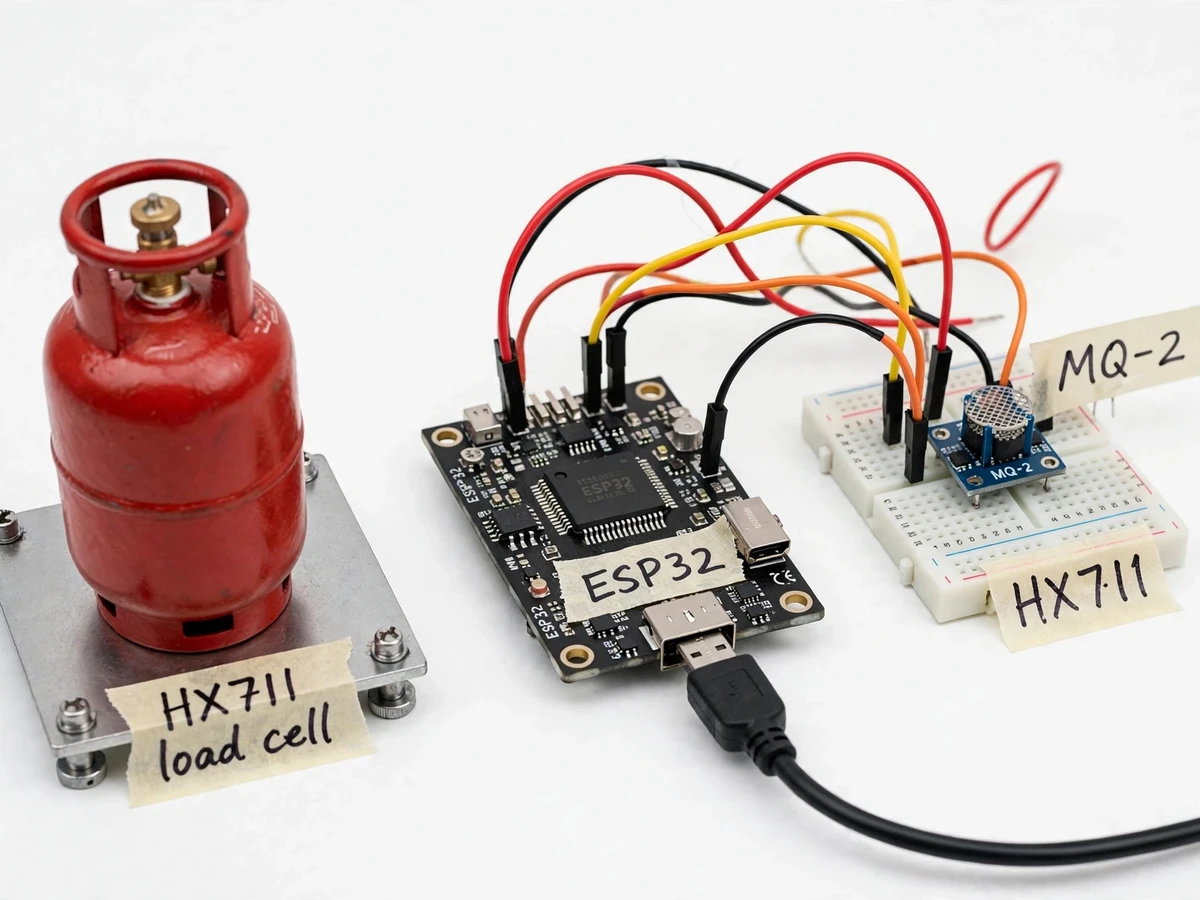
Platform under the cylinder; its strain bridge output tracks the total weight.
Follow the working sequence
How it works
- The cylinder rests on the 50 kg load-cell platform; the HX711 24-bit ADC digitizes the bridge output at 10 samples per second.
- The ESP32 converts the reading to kilograms, subtracts the stored tare (empty-cylinder) weight, and computes remaining gas as a percent of the 14.2 kg net capacity.
- Remaining gas is compared with the reorder threshold (default 15%); crossing it raises a booking alert on the dashboard and sends an SMS/WhatsApp reminder.
- The MQ-2 sensor's analog output is sampled continuously; after the mandatory 24-hour burn-in a clean-air baseline is stored, and any sustained spike beyond the trip point is treated as a suspected leak.
- A suspected leak sounds the local buzzer immediately and pushes a remote alert; the dashboard leak card switches from "No leak detected — SAFE" to a warning state.
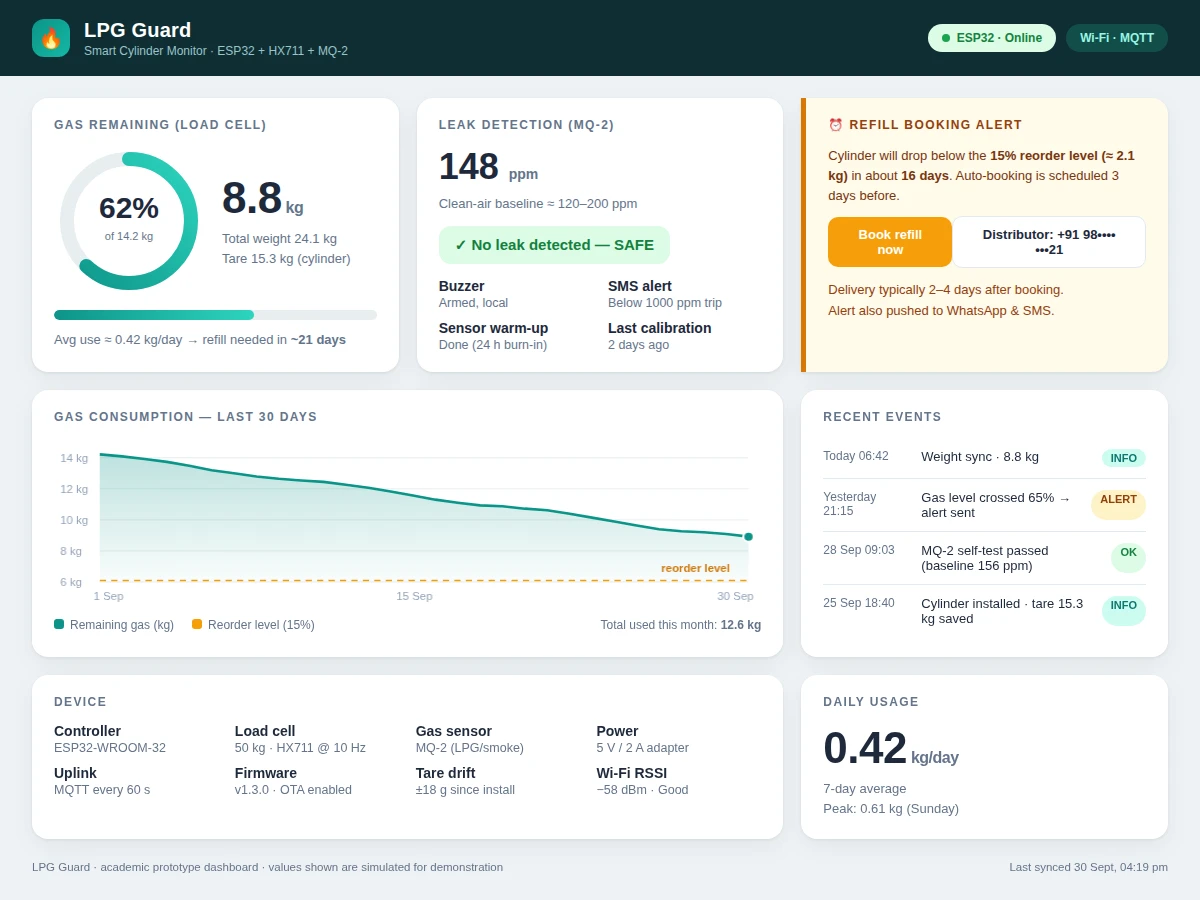
- Every 60 seconds the ESP32 publishes weight and gas readings over MQTT/Wi-Fi; the dashboard renders the live gauge, the 30-day consumption chart and the event log.
- If Wi-Fi drops, local sensing and the buzzer keep working; readings buffer on the ESP32 and sync to the dashboard when the connection returns.
Tech stack:
- ESP32-WROOM-32
- HX711 24-bit ADC · 50 kg strain-gauge load cell
- MQ-2 gas sensor module
- Arduino IDE (C/C++ firmware)
- MQTT · Wi-Fi
- HTML5 · CSS3 · JavaScript (dashboard)
- OTA firmware update
| Parameter | Value |
|---|---|
| Controller | ESP32-WROOM-32 (dual-core, 240 MHz, 2.4 GHz Wi-Fi) |
| Load cell | 50 kg strain-gauge type with HX711 24-bit ADC at 10 samples/second (design configuration) |
| Weight resolution | Approximately ±20 g after calibration (design target; depends on mounting and temperature) |
| Tare | Stored empty-cylinder weight, user-configurable (typical Indian cylinder approximately 15.3 kg) |
| Gas sensor | MQ-2 semiconductor module (responds to LPG, propane, butane; also smoke and alcohol vapour) |
| Leak trip point | Configurable; default approximately 1000 ppm estimated from the calibration curve |
| Sensor warm-up | At least 24 hours burn-in before reliable readings (per MQ-2 usage guidance) |
| Uplink | Wi-Fi 2.4 GHz, MQTT publish approximately every 60 seconds |
| Local alarm | 5 V active buzzer — works offline without Wi-Fi |
| Power | 5 V / 2 A DC adapter (design) |
| Dashboard | Single-file web app; 30-day consumption history chart |
Project features
- [Weight-based gas level tracking] The cylinder sits on a 50 kg load cell; the HX711 digitizes the strain at 10 samples/second and the ESP32 subtracts the stored tare weight to show remaining gas in kilograms and percent on the dashboard gauge.
- [Refill booking alerts] When the gas level crosses the configurable reorder threshold (default 15%, approximately 2.1 kg), the dashboard shows a booking banner and pushes an SMS/WhatsApp reminder with the distributor's contact, before the cylinder runs dry.
- [MQ-2 leak detection] The MQ-2 sensor continuously samples the air; a reading that spikes beyond the calibrated trip point raises an immediate alert, with the dashboard status card switching to a leak warning.
- [Local buzzer alarm] A 5 V active buzzer sounds on leak detection and on critically low gas, so the alert works even when Wi-Fi or the cloud is unreachable.
- [Live web dashboard] Single-file HTML/JS dashboard with a gas-level gauge, leak status card, 30-day consumption chart, recent-events log and device info — no server installation needed.
- [Configurable thresholds & calibration] Reorder level, leak trip point, tare weight and alert contacts are all adjustable; the included calibration guide walks through load-cell span calibration and MQ-2 baseline setting.
- [OTA firmware updates] Firmware can be updated over Wi-Fi, so threshold logic and alert behavior can be refined without opening the enclosure or reconnecting USB.
What is included
- Assembled and wired prototype: ESP32 board, HX711 with 50 kg load-cell platform, MQ-2 sensor module, local buzzer
- Complete ESP32 firmware source (Arduino IDE, C/C++, commented and documented)
- Circuit diagram and wiring table
- Tare + span calibration procedure for the load cell and baseline-setting guide for the MQ-2
- Web dashboard source (single-file HTML/JS) with gauge, chart and event log
- Project report PDF (background, methodology, wiring, calibration, results discussion)
- PPT presentation for final review
- Viva Q&A preparation document (strain gauges, HX711, MQ-2 behavior, MQTT, threshold logic)
- Setup and demonstration guidance
Limitations & prerequisites
- Load-cell readings drift: low-cost strain gauges exhibit creep and temperature drift — expect roughly ±50–100 g variation across temperature swings unless re-tared. The firmware re-zeroes at boot and the buyer runs the included span-calibration procedure; no accuracy is claimed as measured.
- The MQ-2 is qualitative, not a calibrated gas analyzer: the dashboard's ppm figure is estimated from a calibration curve, and the sensor cross-responds to smoke, alcohol vapour and cooking fumes, which can cause false alerts.
- The MQ-2 needs at least 24 hours of burn-in before first use; readings in the first hours are unreliable and must be ignored.
- Wi-Fi is required for the dashboard and remote alerts; the local buzzer is the only offline alert path.
- Booking alerts are reminders — actual refill booking still needs manual confirmation with the distributor; there is no automatic ordering integration with LPG distributors.
- The prototype is an academic monitoring build, not a certified gas-safety device, and must not be the only leak protection in a kitchen.
- The "days remaining" estimate assumes a steady consumption pattern; heavy cooking days will skew it.
Frequently Asked Questions
Is this project suitable for a final-year project?
Yes — for IoT & Embedded, Electronics & Telecommunication and Electrical programs. It demonstrates strain-gauge sensing and signal conditioning with the HX711, semiconductor gas sensing with the MQ-2, ESP32 firmware, MQTT telemetry and a working dashboard — all strong viva and demonstration material.
How accurate is the weight measurement?
The design target is approximately ±20 g after calibration. Low-cost load cells drift with temperature, so the firmware re-zeroes at boot and the calibration guide walks through tare and span calibration with a known weight. No accuracy figure is claimed as measured.
Does the MQ-2 really detect LPG leaks?
The MQ-2 responds to LPG, propane and butane, so it detects leak-level concentrations. It is qualitative, not a calibrated analyzer, and also reacts to smoke and alcohol vapour — the report explains the 24-hour burn-in, baseline calibration and how the trip threshold is chosen to limit false alarms.
What happens if the Wi-Fi goes down?
The local buzzer and on-board leak logic keep working offline, so safety alerting is not lost. Only the dashboard and remote alerts pause; readings buffer on the ESP32 and sync when Wi-Fi returns.
Can it automatically order a refill?
No — LPG distributors expose no open ordering API for this, so the system sends booking reminders (dashboard banner plus SMS/WhatsApp) with the distributor's number saved in settings. Automatic ordering is listed as future scope. Suitable for B.E./B.Tech final-year projects in IoT & Embedded, Electronics & Telecommunication and Electrical.
Components & software requirements
- ESP32-WROOM-32
- HX711 24-bit ADC · 50 kg strain-gauge load cell
- MQ-2 gas sensor module
- Arduino IDE (C/C++ firmware)
- MQTT · Wi-Fi
- HTML5 · CSS3 · JavaScript (dashboard)
- OTA firmware update
Delivery information
Built-to-order project. Delivery timeline is shared after order confirmation based on current queue.
Support terms
Complete documentation, setup guide, and viva preparation included. Support for setup and explanation provided.
Download free synopsis (PDF)
Enter your name and email — the synopsis PDF downloads immediately. We may send occasional project updates; no spam, unsubscribe anytime.