
More project photos (3)
The problem
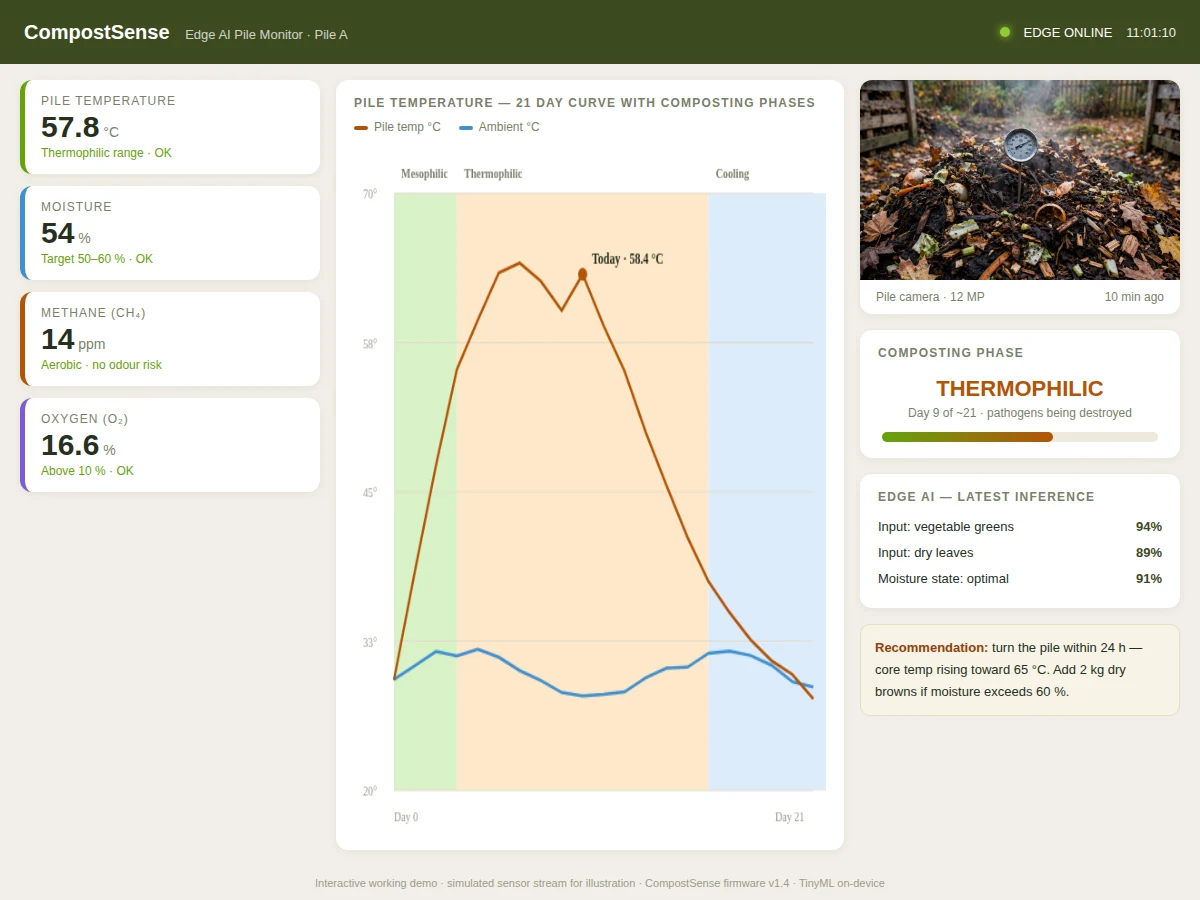
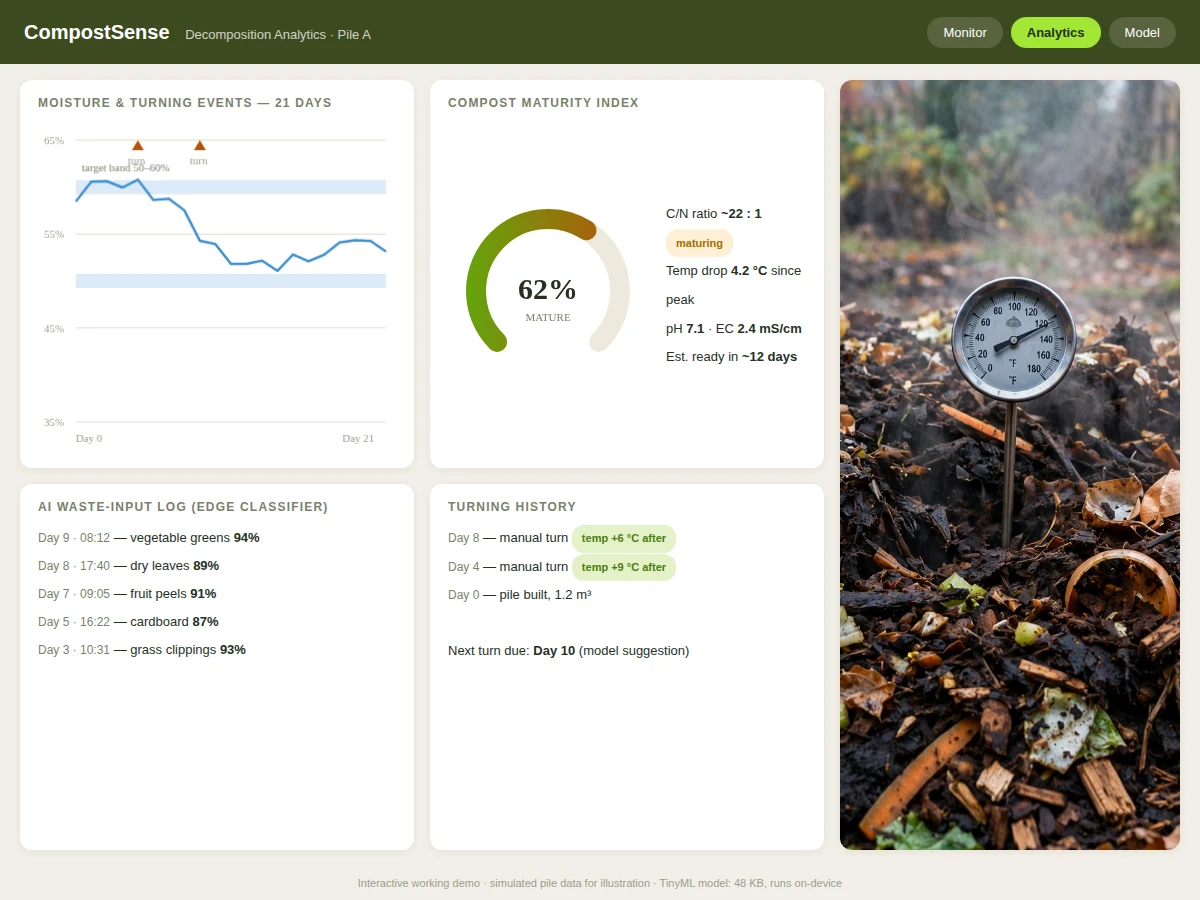
Good compost is a managed biological process: the pile must pass through mesophilic, thermophilic and curing phases, stay at 50–60 % moisture, and be turned before the core goes anaerobic and starts producing methane and odour. Most home and campus composting fails because nobody measures any of this — the pile is either too dry, too wet, or never turned. This project instruments the pile: a weatherproof ESP32-S3 node with a temperature probe, moisture sensor, methane and oxygen sensors logs the pile's vital signs around the clock, and a TinyML image classifier on the same chip identifies each bucket of waste as it is added (greens vs browns), keeping the carbon-nitrogen balance visible. The dashboard shows the 21-day temperature curve with phase bands, flags when a turn is due, and computes a maturity index from temperature drop, pH and EC trends. The student gets a real embedded-ML project — data collection, model training, quantization, on-device inference — wrapped around a genuine environmental application. Because every pile, climate and feedstock differs, the kit makes no claim about composting speed or classifier accuracy out of the box: the buyer trains and validates the model on their own waste photos and reports their own metrics.
DS18B20 measuring core pile temperature.
Follow the working sequence
How it works
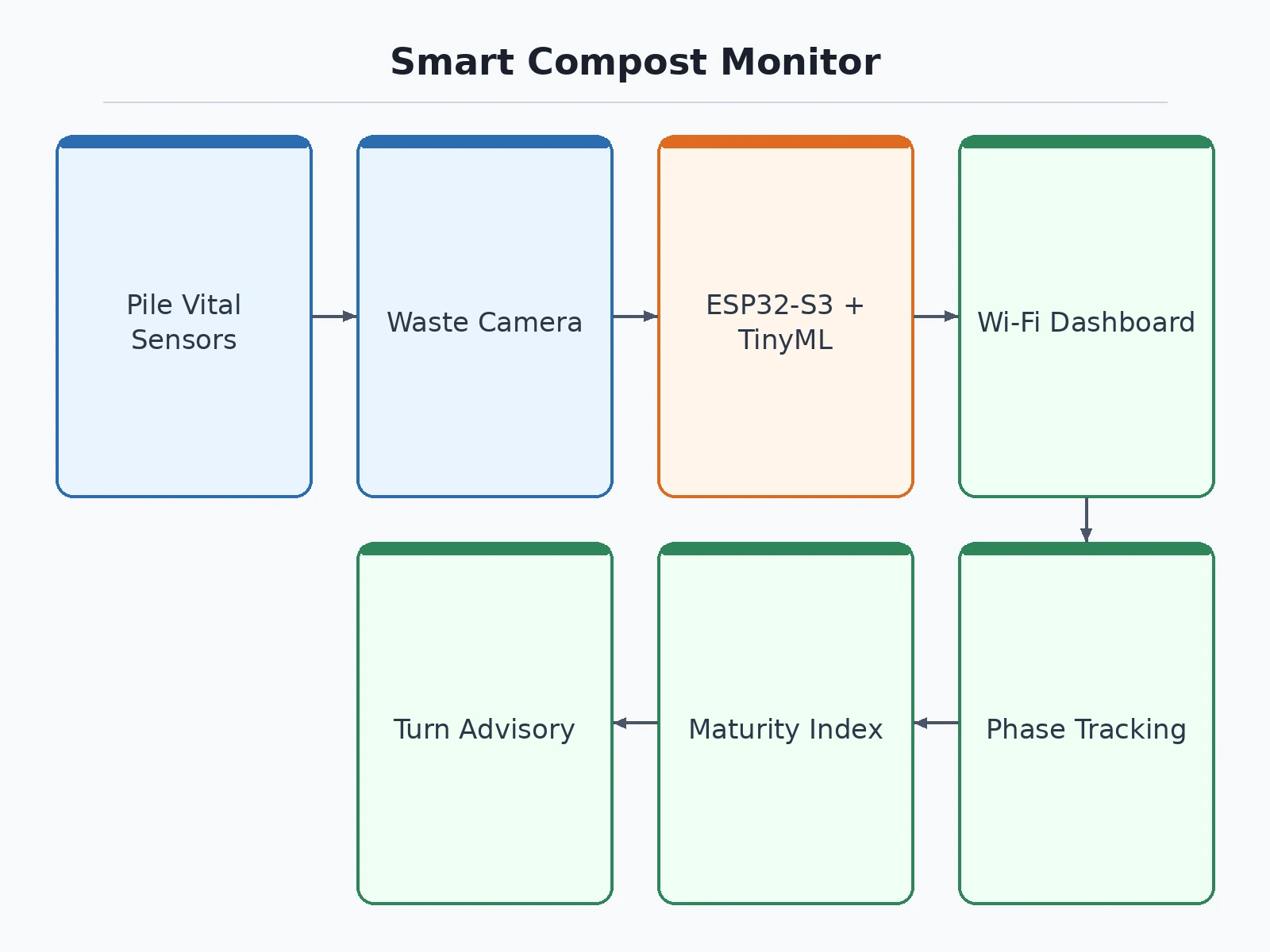
- The sensor node is installed beside the compost pile with the temperature probe in the core, moisture sensor mid-pile and gas sensors in a vented sampling head.
- Each time waste is added, the student photographs it with the node's camera; the on-device classifier labels the input and logs the greens/browns balance.
- Every 10 minutes the node samples all sensors, runs the maturity and phase logic, and pushes readings to the dashboard over Wi-Fi.
- The dashboard renders the 21-day temperature curve with phase bands, moisture trend with turning-event markers, and the current phase (mesophilic / thermophilic / cooling).
- When thresholds are crossed, the dashboard raises a turn advisory; the student turns the pile, logs the event, and watches the temperature respond.
- For the report, the student exports the logs, and trains the classifier in the provided notebook on their own labeled photos, reporting their own validation accuracy.
Tech stack:
- ESP32-S3 (TinyML inference + Wi-Fi) with camera module
- DS18B20 pile temperature probe, capacitive soil-moisture sensor
- MQ-4 methane and MQ-135 air-quality/gas sensors, oxygen sensor module
- Weatherproof enclosure with cable glands and probe leads
- TinyML image classifier (transfer-learned CNN, int8 quantized, ~48 KB)
- CompostSense web dashboard (phase tracking, maturity gauge, CSV export)
- pH and EC pocket meters for maturity measurements
| Parameter | Value |
|---|---|
| Controller | ESP32-S3 with camera; inference fully on-device |
| Model | Transfer-learned CNN, int8 quantized; buyer trains on own photos |
| Sensors | Pile temp (−55 to +125 °C probe), moisture, CH4, O2 |
| Sampling | 10-min sensor interval; event-driven waste captures |
| Dashboard | Phase curve, moisture/turn chart, maturity gauge, AI input log |
| Enclosure | Weatherproof field box; probe leads 1.5 m |
| Maturity inputs | Temp drop, pH, EC — index is an estimate, not a lab assay |
| Accuracy | Reported by buyer from own validation split; none pre-claimed |
| Power | 5 V USB / solar-ready; deep-sleep between samples |
| Output | Live dashboard, CSV logs, trained model binary |
Project features
- [On-device waste classifier] A quantized convolutional model on the ESP32-S3 classifies each waste input (vegetable greens, fruit peels, dry leaves, cardboard and more) with no cloud, no latency and no privacy concerns.
- [Pile vital-sign sensing] DS18B20 temperature probe, capacitive moisture sensor, MQ-series methane sensor and oxygen sensor capture the four variables that decide whether a pile thrives or stinks.
- [Composting-phase tracking] The dashboard plots the temperature curve against mesophilic, thermophilic and cooling phase bands, so the student can see the biology happening.
- [Turn recommendations] When core temperature climbs toward the high-60s or oxygen sags, the dashboard advises a turn within 24 hours — the single most useful composting intervention.
- [Maturity index] Temperature drop from peak, pH and EC readings combine into a 0–100 % maturity gauge with an estimated ready-date, giving the results chapter a quantitative endpoint.
- [Training notebook] A documented Python notebook covers dataset labeling, transfer learning, quantization to int8 and flashing the model — the full TinyML pipeline the student defends in the viva.
- [Weatherproof field node] IP-rated enclosure, cable glands and probe leads let the station live beside an actual compost pile or bin through the semester.
What is included
- Working smart compost monitor (ESP32-S3 node, camera, all sensors and probes, weatherproof enclosure)
- pH and EC pocket meters for maturity measurements
- TinyML training notebook (labeling guide, transfer learning, quantization, deployment)
- CompostSense dashboard source code (single-file web app, documented)
- Project report PDF (embedded-ML pipeline, compost science, buyer's validation method)
- PPT presentation for final review
- Viva Q&A preparation document (TinyML, quantization, compost phases, C/N ratio, sensor principles)
- Field installation and pile-building guide
Limitations & prerequisites
- This is an educational monitoring and learning project, not a certified compost-testing laboratory: the maturity index is an estimate from field sensors, not a lab germination assay.
- No classifier accuracy is pre-claimed: the model the buyer trains is only as good as their own labeled photo dataset; the notebook documents how to measure and report it honestly.
- Gas sensors (MQ series) are indicative, not calibrated analytical instruments — they show trends and thresholds, not certified ppm values.
- The node needs Wi-Fi reach at the pile location for the live dashboard; it logs locally when the network drops.
- Composting takes weeks per cycle; the project needs an early start and a real pile or bin the student maintains.
- pH/EC pocket meters need buffer calibration per their manuals; uncalibrated readings are meaningless.
Frequently Asked Questions
Does the AI work without internet?
Yes — the classifier is quantized and runs entirely on the ESP32-S3. The dashboard needs local Wi-Fi, but no cloud account or internet connection is required.
What accuracy will the classifier reach?
That depends on your dataset: number of photos, lighting consistency and class balance. The notebook walks you through a train/validation split so you report your own measured accuracy.
Can it monitor an existing compost pile?
Yes — the probes install into any active pile or bin. The phase tracker works best when installed at pile build (day 0), but mid-cycle installation still gives useful data.
How is this different from a simple temperature logger?
The phase logic, turning advisories, maturity index and the on-device waste classifier turn raw readings into composting decisions — that decision layer is the project.
Is the compost it helps make safe to use?
The monitor tracks process indicators only; it does not test for pathogens or contaminants. Finished compost should be used per local gardening guidance.
Is this project suitable for a final-year project?
Yes — for AI/ML, Data Science, IoT and Environmental Engineering programs. It demonstrates the full TinyML pipeline (data, training, quantization, deployment) on a real environmental problem. Suitable for B.E./B.Tech final-year projects in AI/ML, Data Science, IoT and Environmental Engineering.
Components & software requirements
- ESP32-S3 (TinyML inference + Wi-Fi) with camera module
- DS18B20 pile temperature probe, capacitive soil-moisture sensor
- MQ-4 methane and MQ-135 air-quality/gas sensors, oxygen sensor module
- Weatherproof enclosure with cable glands and probe leads
- TinyML image classifier (transfer-learned CNN, int8 quantized, ~48 KB)
- CompostSense web dashboard (phase tracking, maturity gauge, CSV export)
- pH and EC pocket meters for maturity measurements
Delivery information
Built-to-order project. Delivery timeline is shared after order confirmation based on current queue.
Support terms
Complete documentation, setup guide, and viva preparation included. Support for setup and explanation provided.
Download free synopsis (PDF)
Enter your name and WhatsApp number — the synopsis PDF downloads immediately. We may send occasional project updates on WhatsApp; no spam.