
More project photos (3)
The problem
Malls, libraries, labs and campuses all need footfall numbers — for staffing, safety limits and space planning — but manual clickers don't scale and cloud video analytics streams identifiable footage off-site with bandwidth and privacy costs. Edge AI resolves the tension: detect and count on the device, and transmit only anonymous numbers. The Jetson Nano is the classic student edge-AI board — a real CUDA-capable GPU in a classroom budget — and person detection is the canonical workload. This project builds the complete counter: a YOLOv8n model exported to TensorRT FP16 running on the Nano, centroid-based tracking across a virtual counting line for IN/OUT direction, a dashboard with live occupancy, hourly charts and overcrowding alerts, and a buyer-run counting test procedure so the accuracy in the report is measured on the student's own doorway, not claimed.
Doorway or corridor mounted camera feeding frames to the Nano.
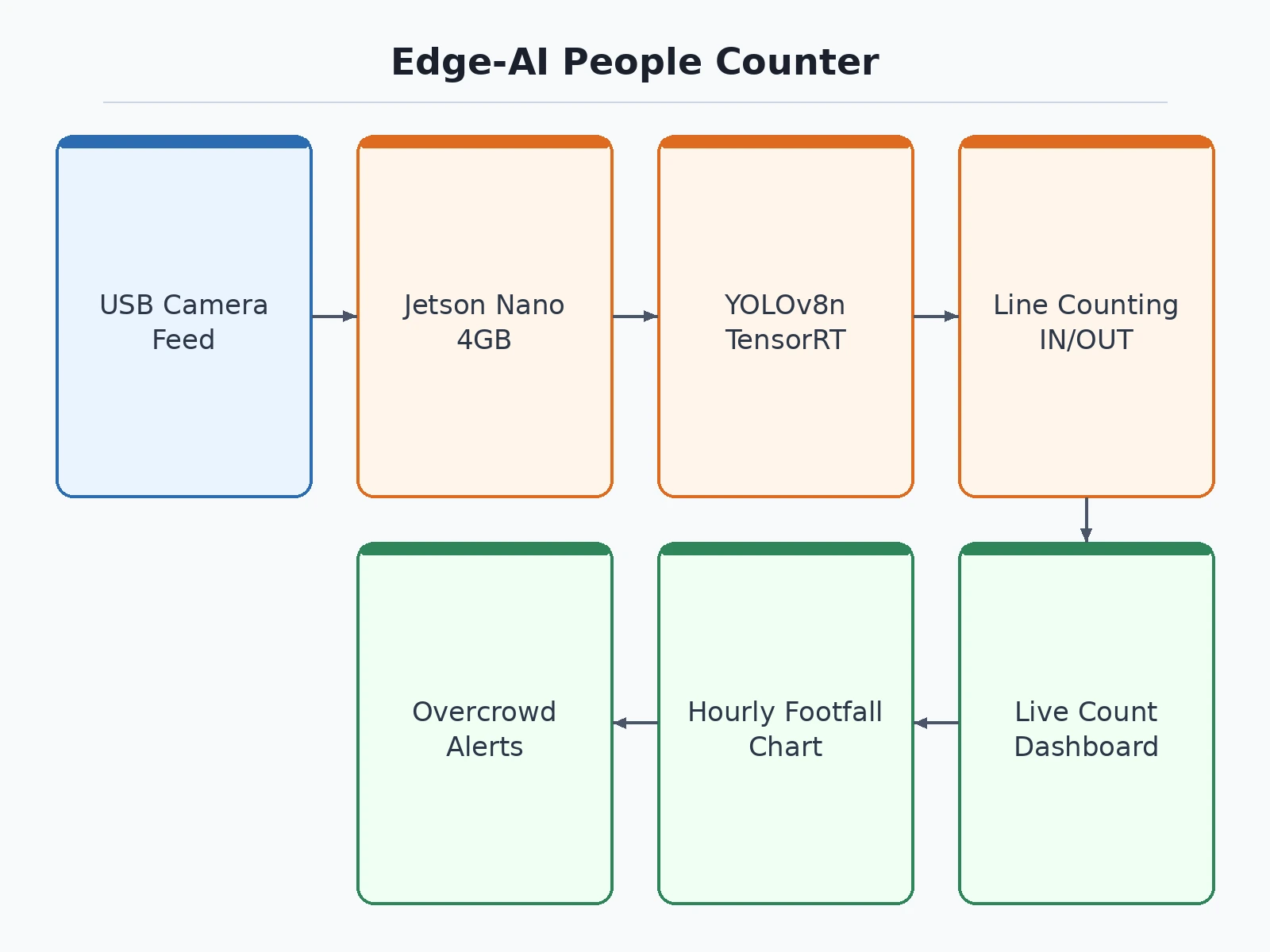
Follow the working sequence
How it works
- The camera captures frames on the Jetson Nano; each frame is preprocessed to the model's input size.
- YOLOv8n, accelerated with TensorRT FP16, detects persons and outputs bounding boxes with confidence scores each frame.
- A centroid tracker assigns persistent track IDs across frames, following each person through the scene.
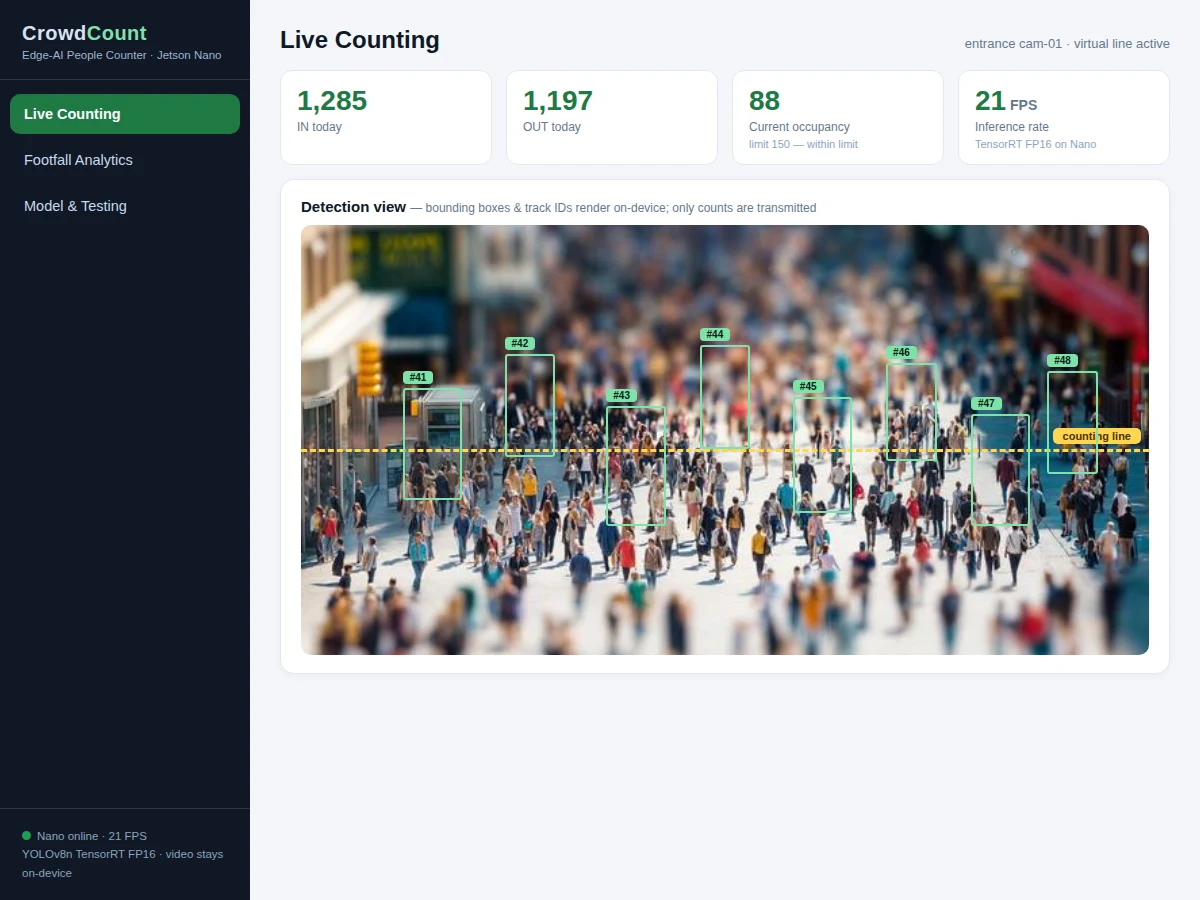
- When a track's centroid crosses the virtual counting line, the crossing direction decides IN vs OUT and the counters update.
- Counts and timestamps are published over MQTT/Wi-Fi to the dashboard; video frames stay on the device.
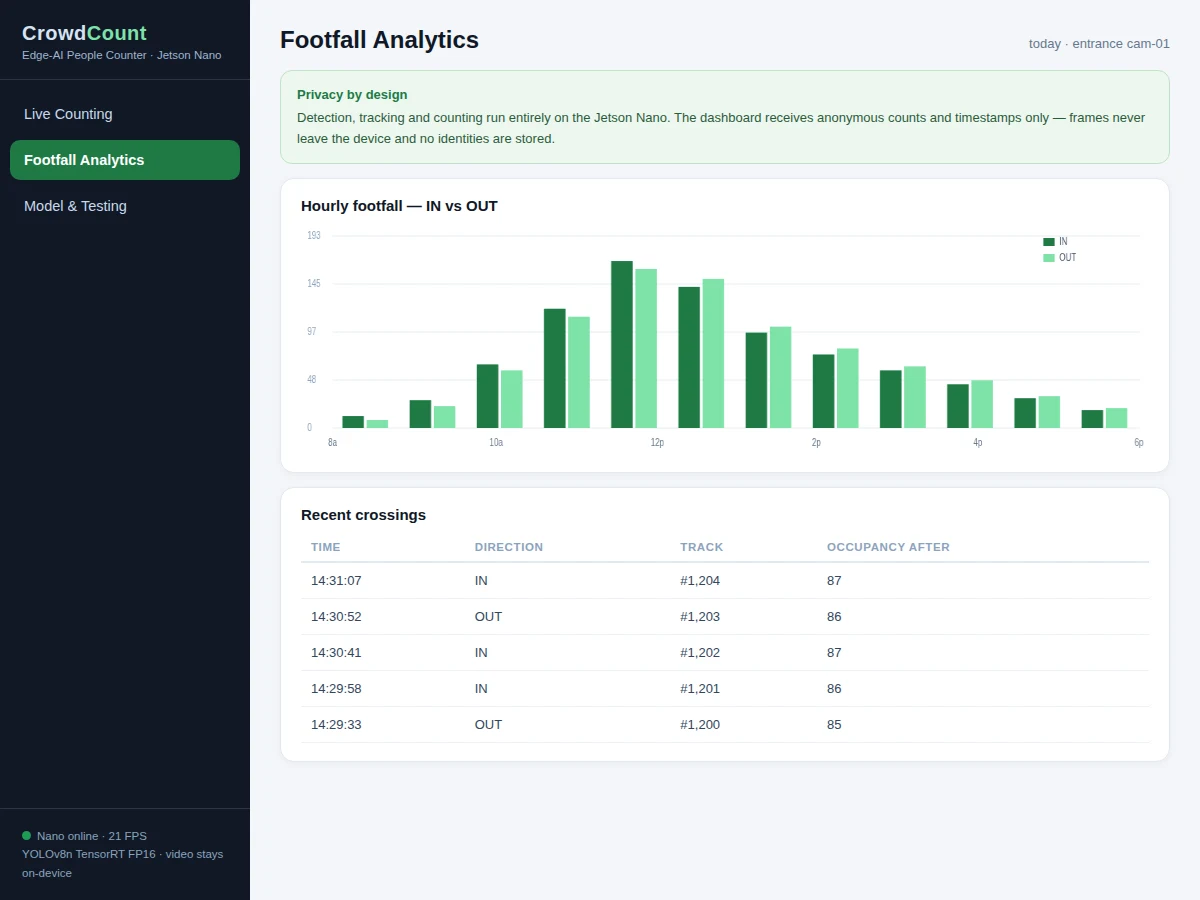
- The dashboard renders live occupancy, the hourly footfall chart and the event feed, and checks the overcrowding limit.
- The student measures accuracy with the test sheet: timed intervals of manual clicker counts compared against the system count, recorded per lighting and crowd condition.
Tech stack:
- NVIDIA Jetson Nano 4GB with camera (CSI or USB)
- YOLOv8n person detector exported to TensorRT FP16
- Python with OpenCV (capture, preprocessing, centroid tracking)
- MQTT telemetry plus web dashboard (occupancy, charts, alerts)
- COCO pre-trained weights (person class) — no training required
| Parameter | Value |
|---|---|
| Compute | NVIDIA Jetson Nano 4GB developer kit |
| Camera | CSI or USB camera, doorway/corridor mounting |
| Model | YOLOv8n exported to TensorRT FP16 |
| Detector training | Pre-trained on COCO (person class); no student training needed |
| Input | Camera frames at model input resolution |
| Output | Bounding boxes + track IDs; IN/OUT counts, occupancy |
| Tracking | Centroid tracker across virtual counting line with direction |
| Dashboard | Live occupancy, hourly footfall chart, event feed, overcrowding alerts |
| Privacy | Only anonymous counts leave the device |
| Accuracy | Measured by buyer-run test procedure; design target approx. 85–90% in controlled doorway conditions |
Dataset & Model Details
- Dataset: COCO (Common Objects in Context), official release — the detector uses the pre-trained person class only; no custom training dataset is required.
- Source: COCO official dataset; weights from the model vendor's COCO-trained release.
- Task: Object detection (person class) + multi-object tracking + line-crossing counting.
- Model: YOLOv8n (nano variant) exported to TensorRT FP16 for Jetson Nano inference.
- Input: Camera frames resized to the model input resolution. Prediction: person bounding boxes with confidence scores. Output: track IDs from the centroid tracker and IN/OUT crossing events.
- Evaluation: published COCO detection metrics belong to the vendor's release and are cited as such; the project's own counting accuracy is measured by the student with the included test-sheet procedure (manual clicker vs system count over timed intervals, across lighting and crowd conditions). Final performance depends on camera placement, mounting height, lighting, crowd density and occlusion — the report documents the measured numbers with their test conditions, never a pre-claimed figure. Design target: approximately 85–90% counting accuracy in controlled doorway conditions.
Project features
- [On-device person detection] YOLOv8n (pre-trained on the COCO person class) exported to TensorRT FP16, running entirely on the Jetson Nano — no cloud inference.
- [Virtual line counting] Each tracked person crossing the configurable counting line increments IN or OUT by direction, using centroid tracking with track IDs.
- [Live occupancy dashboard] Current occupancy, today's IN/OUT totals, an hourly footfall bar chart and a scrolling event feed.
- [Overcrowding alerts] A configurable occupancy limit raises a dashboard and optional buzzer/Telegram alert when the space exceeds it.
- [Privacy by design] Only anonymous counts and timestamps leave the device; the video frames never leave the Nano and no identities are stored.
- [Buyer-run accuracy procedure] A counting test sheet (manual clicker vs system count over timed intervals) so the report documents measured accuracy from the student's own setup.
- [Configurable zones] Counting line position, direction and dwell filters are adjustable for doorways, corridors and entrances of different widths.
What is included
- Complete Jetson Nano Python code (capture, TensorRT inference, centroid tracking, line-crossing logic, MQTT publishing)
- TensorRT export and optimization guide for YOLOv8n FP16
- Camera mounting and counting-line configuration guide
- Counting test-sheet template (manual-vs-system accuracy procedure)
- Web dashboard app (live occupancy, hourly chart, event feed, overcrowding alerts)
- Project report PDF (background, model choice, tracking design, evaluation method)
- PPT presentation for final review
- Viva Q&A preparation document (YOLO, TensorRT, tracking, edge AI, COCO, evaluation)
- Setup guide (JetPack setup, dependencies, first detection run)
Limitations & prerequisites
- Counting accuracy is measured, not guaranteed: camera angle, mounting height, lighting changes, dense crowds and occlusion all reduce it, and the report documents the measured numbers with test conditions.
- Heavy crowding with overlapping people causes missed and merged tracks — the system suits doorways and corridors, not dense unstructured crowds.
- The Jetson Nano needs a 5 V 4 A supply and active cooling under sustained inference load; thermal throttling slows the pipeline if cooling is inadequate.
- TensorRT export and JetPack setup take time and disk space on first install; the guide walks through it but it is not instant.
- Only the person class is used — the system counts people, not objects, animals or vehicles, and side-view or partially visible people count less reliably.
- Video never leaves the device by design, so remote visual verification isn't possible — monitoring is by counts and charts only.
Frequently Asked Questions
Which dataset and model are used?
The detector is YOLOv8n pre-trained on COCO (person class), exported to TensorRT FP16 for the Jetson Nano. No training dataset work is needed from the student — the project is detection deployment plus tracking and counting.
Is the counting accuracy guaranteed?
No. The design target is approximately 85–90% in controlled doorway conditions, but the actual number is measured by you with the included test-sheet procedure (manual clicker vs system count) and reported with its test conditions.
Does video go to the cloud?
No. Detection, tracking and counting all run on the Nano; only anonymous counts and timestamps are published. Frames never leave the device and no identities are stored.
What hardware do I need?
An NVIDIA Jetson Nano 4GB developer kit, a CSI or USB camera, a 5 V 4 A power supply and cooling (heatsink + fan) for sustained inference.
Can it handle crowded scenes?
Doorways and corridors, yes. Dense crowds with heavy person-overlap cause missed and merged tracks — the report states this as an explicit limitation.
Is this project suitable for a final-year project?
Yes — for Computer Science, AI/ML and Data Science programs. It demonstrates real edge-AI deployment, TensorRT optimization, multi-object tracking, honest experimental evaluation and privacy-aware design, all strong viva material. Suitable for B.E./B.Tech final-year projects in Computer Science, AI/ML and Data Science.
Components & software requirements
- NVIDIA Jetson Nano 4GB with camera (CSI or USB)
- YOLOv8n person detector exported to TensorRT FP16
- Python with OpenCV (capture, preprocessing, centroid tracking)
- MQTT telemetry plus web dashboard (occupancy, charts, alerts)
- COCO pre-trained weights (person class) — no training required
Delivery information
Built-to-order project. Delivery timeline is shared after order confirmation based on current queue.
Support terms
Complete documentation, setup guide, and viva preparation included. Support for setup and explanation provided.
Download free synopsis (PDF)
Enter your name and WhatsApp number — the synopsis PDF downloads immediately. We may send occasional project updates on WhatsApp; no spam.