
More project photos (3)

The problem
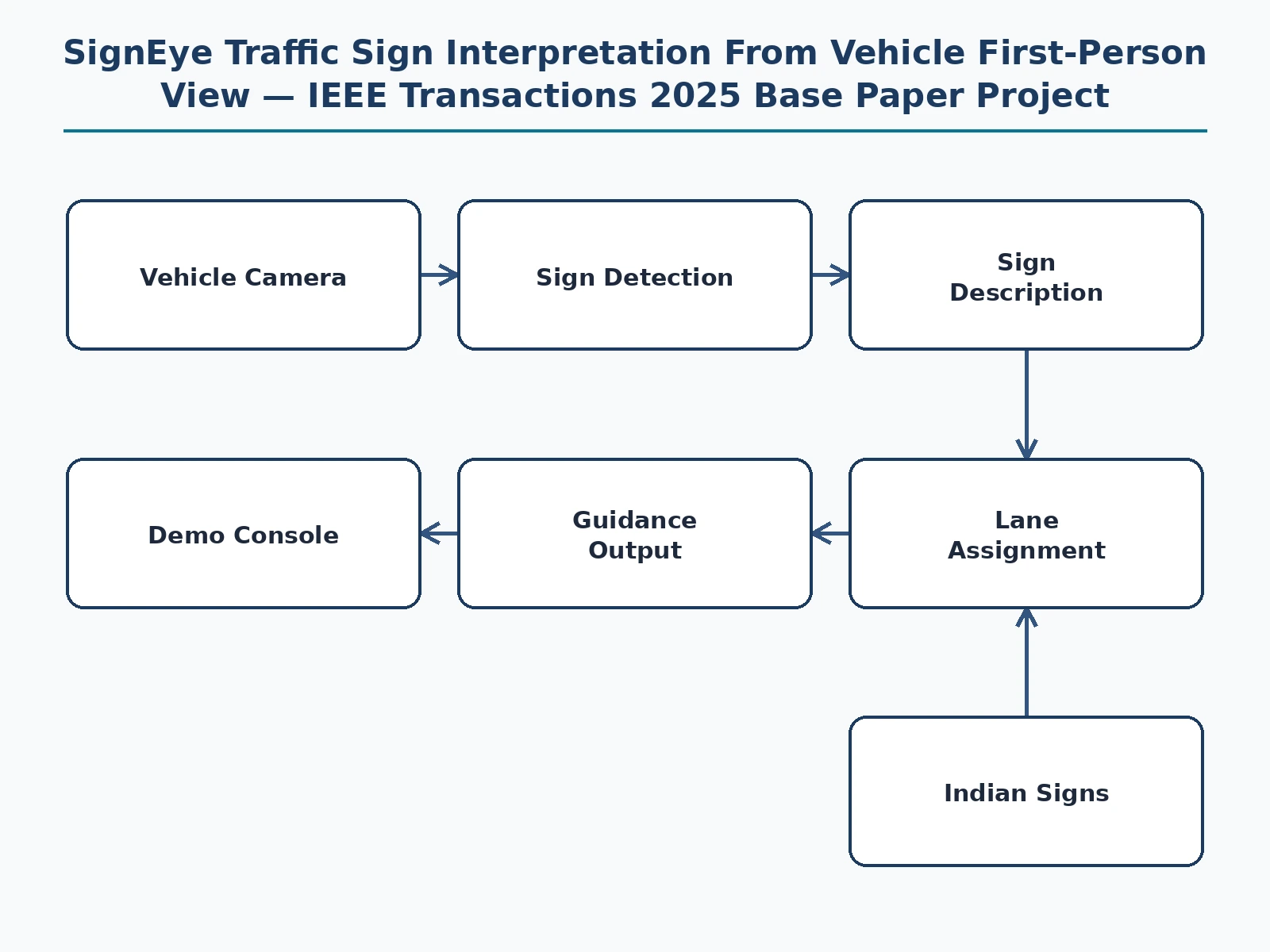
Most traffic sign systems answer a narrow question: what sign is in this cropped image? A driver needs a different answer: which signs matter for the lane I am actually in, and what do they require me to do? SignEye, published in IEEE Transactions on Intelligent Transportation Systems in 2025, tackles that fuller question. Its pipeline detects sign units in first-person-view frames, generates structured sign descriptions, and assigns each sign to the vehicle's current lane, left lane, right lane, or the road as a whole. The paper also demonstrates a traffic guidance assistant scenario built on those outputs. This project implements that pipeline for a student build, using a public sign-recognition dataset for the recognition stage and team-annotated demo frames for the lane-assignment stage, and adds a clearly separate Indian extension: an Indian traffic-sign vocabulary and a driver-guidance adaptation for left-hand traffic.
This is a built-to-order software project: the interpretation pipeline, demo console, report, presentation, and viva Q&A are prepared fresh for you. Starting price: Rs 27,000 (final price confirmed after topic, base paper and compute scope are locked).
The Problem
A driver does not see traffic signs as isolated cropped pictures. Signs appear together in a moving first-person view, at different sizes and positions, and only some govern the lane the vehicle is travelling in. A speed limit for a side lane, a warning for the lane ahead, and a direction sign for the whole road all look similar as isolated images, yet demand different responses. Conventional classification hides that distinction: it labels one cropped sign at a time and says nothing about which lane the sign applies to, so a demo built on classification alone cannot explain why a driver should obey one sign and merely note another. The interesting work is therefore not recognising a sign in a clean crop; it is reasoning from a full frame to a lane-aware, explainable instruction. SignEye addresses that gap by turning detection into structured descriptions and assigning each description to a lane or to the road. This build reproduces that reasoning chain and extends it to Indian signs and left-hand traffic.
Base paper at a glance
| Item | Detail |
|---|---|
| Paper | "SignEye: Traffic Sign Interpretation From Vehicle First-Person View", Yang et al., IEEE Transactions on Intelligent Transportation Systems, 2025, vol. 26, no. 11, pp. 19413–19425, DOI https://doi.org/10.1109/TITS.2025.3590935 |
| Method | A spatial and semantic logic-aware stepwise reasoning pipeline that detects sign units in first-person-view frames, generates structured sign descriptions, and assigns them to the vehicle's current, left, or right lane, or to the road; plus a traffic guidance assistant (TGA) scenario application |
| Dataset | Traffic-CN, the authors' own application-specific dataset (China-focused). Traffic-CN is not claimed to be publicly downloadable, and this build does not reuse it. The student build uses GTSRB (German Traffic Sign Recognition Benchmark, public, 43 classes) for the sign-recognition stage, plus team-annotated first-person-view demo frames for the lane-assignment stage |
| Authors' reported results | The authors report that traffic sign interpretation from first-person view and the guidance-assistant application are achievable with SignEye trained on their dataset. This is the paper's own qualitative finding, stated without any accuracy or metric number, and it is not this build's measured result |
| What we implement | Detection of sign units in first-person-view frames; structured sign descriptions per sign unit; assignment of each description to the current, left, or right lane, or to the road; and a guidance-assistant output generated from the descriptions and lane assignment |
| Own features | Indian traffic-sign vocabulary extension; Indian driver-guidance assistant adapted to left-hand traffic; lane-assignment visualiser (current, left, right, and road labels); structured-description output panel; comparison of the paper's vocabulary handling vs the Indian extension |
Base paper
- Paper: "SignEye: Traffic Sign Interpretation From Vehicle First-Person View", Yang et al., IEEE Transactions on Intelligent Transportation Systems, 2025, vol. 26, no. 11, pp. 19413–19425.
- DOI: https://doi.org/10.1109/TITS.2025.3590935 (IEEE Xplore document 11106397).
- Problem the paper tackles: a first-person view contains several signs at once, and a single label per cropped sign does not tell a driver which signs apply to their lane. The paper's pipeline therefore reasons stepwise from detection to description to lane assignment.
- What is implemented from the paper: detection of sign units in first-person-view frames; structured sign descriptions generated per sign unit; assignment of each description to the vehicle's current, left, or right lane, or to the road; and a traffic guidance assistant scenario application that turns descriptions and lane assignments into driver guidance.
- What is deliberately not claimed: no backbone model is named for the paper's pipeline, because baselines mentioned in the paper are not its method; and no accuracy or metric number is quoted, because none is verified for this listing. The report records only what the student's own runs actually produce.
- Paper-reported results (the paper's own findings, not this build's measured results): the authors report that traffic sign interpretation from first-person view and the guidance-assistant application are achievable with SignEye trained on their dataset. No number is attached to that finding here.
Own features
These are the student's own contribution, clearly distinct from the base paper:
- [Indian traffic-sign vocabulary extension] Indian regulatory, cautionary, and mandatory signs added alongside the paper's vocabulary, so the demo can interpret signs a student in India actually encounters. The paper's own dataset and vocabulary are not replaced or mislabelled; the extension is presented as a separate layer.
- [Indian driver-guidance assistant adapted to left-hand traffic] The paper's traffic guidance assistant idea is adapted — not copied as an own feature — to left-hand traffic: guidance text is generated for the lane the vehicle travels in under Indian road layout, with signs for other lanes reported rather than applied.
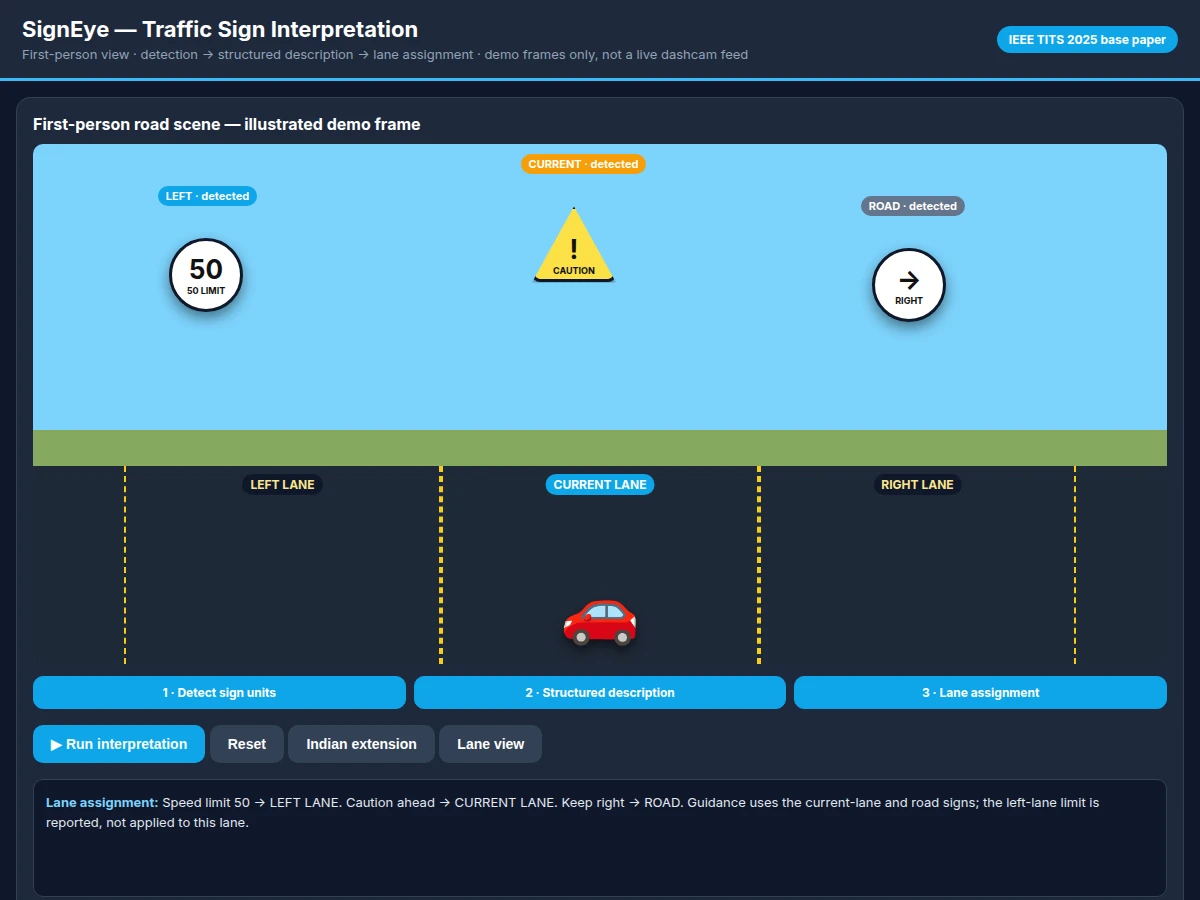
- [Lane-assignment visualiser] A demo view that colours and labels the current, left, and right lanes and the road, and places each detected sign's assignment visibly on that layout, so a reviewer can see lane reasoning instead of taking it on trust.
- [Structured-description output panel] Every detected sign unit is shown with its type, meaning, and frame position in a readable panel, giving the viva a concrete artefact to discuss beyond a single predicted label.
- [Paper vocabulary vs Indian extension comparison] A side-by-side comparison of how the paper's vocabulary handling works against the Indian extension — vocabulary source, traffic side, and lane handling — so the student's contribution is auditable, not asserted.
How it works
The pipeline runs as a stepwise chain, and each stage's output is visible in the demo so a student can explain it in a viva. First, a first-person-view frame is loaded — an illustrated demo frame in the console, or a team-annotated frame in the delivered build. Sign units are detected in the full frame and boxed individually. Each boxed unit is then recognised and turned into a structured description: sign type, meaning, and position. The descriptions are assigned to lanes by comparing each sign's frame position with the lane layout: current, left, right, or road. Finally, the guidance assistant combines the current-lane and road descriptions into driver instruction, while signs for other lanes are listed as observed but not applied. The Indian extension runs as a parallel vocabulary layer: Indian signs are recognised and described the same way, then guided under left-hand-traffic rules.
- Load a first-person-view frame (illustrated demo frame in the console; team-annotated frames in the delivered build).
- Detect sign units in the full frame and box each unit separately, rather than classifying one cropped image.
- Recognise each boxed unit using the sign-recognition stage trained on the public GTSRB dataset (43 classes, public benchmark).
- Generate a structured description for each unit: sign type, meaning, and position in the frame.
- Assign each description to the current lane, left lane, right lane, or the road, using the sign's frame position against the lane layout.
- Generate driver guidance from the current-lane and road descriptions; list other lanes' signs as observed, not applied.
- Run the Indian extension layer: recognise Indian sign vocabulary, describe it the same way, and adapt guidance to left-hand traffic.
- Display every stage — boxes, descriptions, lane labels, and guidance — in the demo console for review and viva demonstration.
Tech stack:
- Python 3 · PyTorch
- OpenCV · image processing
- HTML · CSS · JavaScript demo console
- GTSRB public benchmark · 43 classes
- Team-annotated demo frames · lane assignment
- Matplotlib · evaluation plots
- Git · Jupyter Notebook
Dataset & model details
- Dataset (paper): Traffic-CN, the authors' own application-specific dataset (China-focused). Traffic-CN is not claimed to be publicly downloadable, and this build does not reuse it.
- Dataset (student build, recognition stage): GTSRB (German Traffic Sign Recognition Benchmark, public benchmark, 43 classes, more than 50,000 labelled images in published descriptions). Used for the sign-recognition stage only; it does not supply first-person lane context.
- Dataset (student build, lane stage): Team-annotated first-person-view demo frames, labelled by the team with sign positions and lane assignments. This is the build's own demo material, not a published dataset, and it is labelled as such wherever it appears.
- Task: First-person-view traffic sign interpretation; input = a full first-person frame, output = structured descriptions per sign unit plus a lane assignment per description.
- Model: A sign-recognition classifier trained on GTSRB for the recognition stage, combined with a stepwise reasoning chain (detection, description, lane assignment) following the paper's pipeline structure. No backbone model is named for the paper's pipeline, and no backbone claim is made for it here.
- Metrics: Detection counts per frame, description completeness per sign unit, and lane-assignment agreement on the team-annotated demo frames. No accuracy figure is claimed before the student's own runs; the report records the figures those runs actually produce.
| Parameter | Value |
|---|---|
| Pipeline stages | 3 stages (detection · description · lane assignment) |
| Lane positions | 4 positions (current · left · right · road) |
| Recognition dataset | GTSRB · public benchmark · 43 classes |
| Paper dataset | Traffic-CN · authors' own dataset · China-focused (not reused) |
| Paper | IEEE Transactions on Intelligent Transportation Systems · 2025 · vol. 26 · no. 11 · pp. 19413–19425 |
| Work plan | 110 hours total (planned) |
| Demo frames | Team-annotated illustrated frames (build's own demo material) |
| Demo console | Single-file web demo · runs offline after download (expected) |
| Deliverables | 4 items (code · report · PPT · viva Q&A) |
| Starting price | Rs 27,000 (starting price · final price confirmed after topic · base paper and compute scope are locked) |
Project features
SignEye traffic sign interpretation delivers seven working capabilities: sign-unit detection in full frames, structured descriptions, lane assignment, guidance output, an Indian sign extension, a left-hand-traffic guidance adaptation, and a demo console a reviewer can operate. The pipeline works on a whole first-person frame rather than a pre-cropped sign, so detection must find several sign units at different positions and sizes. Each unit then becomes a structured description — sign type, meaning, and position — instead of a bare class name. Lane assignment places that description where it belongs: current lane, left lane, right lane, or road. A guidance output combines the current-lane and road descriptions into plain driver instruction, while other lanes' signs are reported without being applied. The Indian extension adds Indian sign vocabulary and left-hand-traffic guidance on top, and the demo console lets a reviewer run the whole chain on illustrated frames and inspect each step.
- [Full-frame sign-unit detection] Detects several sign units in one first-person-view frame at different positions, instead of classifying a single pre-cropped sign image.
- [Structured sign descriptions] Turns each detected unit into a structured description covering sign type, meaning, and position in the frame, readable by a reviewer and usable as guidance input.
- [Lane assignment] Assigns every description to the current lane, left lane, right lane, or the road, so only the signs governing the vehicle's lane drive immediate guidance.
- [Guidance-assistant output] Generates plain driver guidance from the current-lane and road descriptions, following the paper's traffic guidance assistant scenario idea.
- [Indian sign vocabulary extension] Adds Indian regulatory, cautionary, and mandatory signs as a separate, clearly labelled extension layer, distinct from the paper's vocabulary.
- [Left-hand-traffic guidance adaptation] Adapts guidance generation to left-hand traffic, so lane relevance is judged under Indian road layout rather than the paper's original setting.
- [Interactive demo console] A working web demo (the console shown on this page) that steps through detection, description, and lane assignment on illustrated frames and shows the Indian extension panel.
What is included
- Complete sign-interpretation pipeline source code (detection, structured description, lane assignment, guidance output, Indian extension layer)
- Interactive demo console (the web demo shown on this page) with lane-assignment visualiser and Indian extension panel
- Project report PDF (background, base paper, methodology, experiments, limitations)
- PPT presentation for final review
- Viva Q&A preparation document (SignEye pipeline, lane assignment, GTSRB vs Traffic-CN, Indian extension, limitations)
- Starting price: Rs 27,000 (final price confirmed after topic, base paper and compute scope are locked)
- Specific next step: message on WhatsApp for a quotation stating scope (SignEye pipeline plus Indian extension), starting price Rs 27,000, and delivery under the 110-hour work plan as a built-to-order project
Work plan & timeline
Total work plan: 110 hours, split across six phases. Phase 1, base-paper study and environment setup: 15 hours — reading the SignEye paper, setting up Python, PyTorch, and OpenCV, and reproducing the stepwise pipeline structure. Phase 2, detection and recognition: 25 hours — full-frame sign-unit detection and the GTSRB recognition stage. Phase 3, description and lane assignment: 25 hours — structured descriptions per sign unit and lane assignment against the lane layout. Phase 4, Indian extension and guidance: 15 hours — Indian sign vocabulary, left-hand-traffic guidance adaptation, and the vocabulary comparison. Phase 5, evaluation and report: 15 hours — evaluation on team-annotated demo frames, diagrams, and the full project report. Phase 6, presentation and viva preparation: 15 hours — PPT, demo walkthrough, and the viva Q&A document.
Support
Support covers setup help for the delivered code, a walkthrough of the pipeline and the demo console, and fixes for defects in the delivered code. Guidance is also provided for adapting the report and presentation to the student's college format and for answering guide questions about the base paper, the lane-assignment method, and the student's own contribution. Support does not cover re-running experiments on the student's personal machine beyond the setup walkthrough, and it does not invent results for experiments that were not run.
Limitations & prerequisites
- The demo uses illustrated and team-annotated frames, not live dashcam deployment; behaviour on real dashcam video is untested and is not claimed.
- The Indian sign set is team-annotated demo material, not a published Indian dataset, so its coverage is limited to the signs the team annotated.
- Traffic-CN, the paper's own dataset, is not reused in this build, so the build's results are not directly comparable to the paper's dataset-specific findings.
- No accuracy figure is claimed before the student's own runs; any figure in the final report comes only from those runs on the stated data.
- Lane assignment depends on visible lane layout in the frame; occluded, unmarked, or poorly lit roads reduce its reliability, and this is measured rather than hidden in evaluation.
- This is not a certified driver-assistance system and must not be presented as one; it is a degree-project interpretation pipeline and demo.
- Final quality figures depend on the dataset subset, hyperparameters, and hardware used, and are recorded only after the student's runs.
Frequently Asked Questions
Is this project suitable as a degree project?
Yes, it fits Computer Science, IT and AI & Machine Learning programmes. It demonstrates full-frame detection, structured description generation, lane-aware reasoning, and a guidance-assistant output, together with a distinct Indian extension — a strong base-paper story with a genuine viva discussion. The work plan totals 110 hours across paper study, pipeline build, Indian extension, evaluation, report, and presentation.
What is the base paper, and what is implemented from it?
The base paper is SignEye, "Traffic Sign Interpretation From Vehicle First-Person View", IEEE Transactions on Intelligent Transportation Systems, 2025 (DOI 10.1109/TITS.2025.3590935). Implemented from it: sign-unit detection in first-person-view frames, structured sign descriptions, lane assignment to current, left, right, or road, and a traffic guidance assistant scenario output.
Which datasets are used, and is Traffic-CN reused?
No — Traffic-CN is the authors' own China-focused dataset and is not claimed to be publicly downloadable, so this build does not reuse it. The recognition stage uses GTSRB, a public benchmark with 43 classes; the lane-assignment stage uses team-annotated first-person-view demo frames, labelled as the build's own demo material.
How is this different from ordinary sign classification?
Ordinary classification labels one cropped sign image. SignEye interpretation works on a full first-person frame, describes every sign unit in structured form, and assigns each description to a lane or to the road, so guidance can distinguish signs that govern the vehicle's lane from signs that merely appear in the frame.
What will I receive, and can it be customised?
You receive the pipeline source code, the interactive demo console, the project report, the presentation, and the viva Q&A document. Customisation is realistic: a different sign vocabulary, additional Indian signs, a different demo frame set, or a college-specific report format can be developed on request.
Is the base paper included?
Yes, the full citation with DOI link is on the page, and the implementation follows that paper.
What is the base paper vs the own features?
The base paper is the published method being implemented — stepwise detection, structured description, and lane assignment plus the guidance-assistant scenario. The own features are the team's additional contribution, listed separately on the page — the Indian traffic-sign vocabulary extension, the Indian driver-guidance assistant adapted to left-hand traffic, the lane-assignment visualiser, the structured-description output panel, and the paper-vs-Indian-extension comparison.
Can my guide approve this paper?
The paper is a recent IEEE Transactions paper with a verifiable DOI, which is what guides check; final approval always rests with the student's own guide and college.
Do you give Phase-1 and Phase-2 documents?
Yes: abstract, literature survey, and review decks in Phase-1; full build, report, and viva preparation in Phase-2.
How do I get a quotation?
Message on WhatsApp for a quotation stating scope (SignEye pipeline plus Indian extension), starting price Rs 27,000, and delivery under the 110-hour work plan as a built-to-order project. The final price is confirmed after topic, base paper, and compute scope are locked.
Components & software requirements
- Python 3 · PyTorch
- OpenCV · image processing
- HTML · CSS · JavaScript demo console
- GTSRB public benchmark · 43 classes
- Team-annotated demo frames · lane assignment
- Matplotlib · evaluation plots
- Git · Jupyter Notebook
Dataset & model details
- Dataset (paper): Traffic-CN, the authors' own application-specific dataset (China-focused). Traffic-CN is not claimed to be publicly downloadable, and this build does not reuse it.
- Dataset (student build, recognition stage): GTSRB (German Traffic Sign Recognition Benchmark, public benchmark, 43 classes, more than 50,000 labelled images in published descriptions). Used for the sign-recognition stage only; it does not supply first-person lane context.
- Dataset (student build, lane stage): Team-annotated first-person-view demo frames, labelled by the team with sign positions and lane assignments. This is the build's own demo material, not a published dataset, and it is labelled as such wherever it appears.
- Task: First-person-view traffic sign interpretation; input = a full first-person frame, output = structured descriptions per sign unit plus a lane assignment per description.
- Model: A sign-recognition classifier trained on GTSRB for the recognition stage, combined with a stepwise reasoning chain (detection, description, lane assignment) following the paper's pipeline structure. No backbone model is named for the paper's pipeline, and no backbone claim is made for it here.
- Metrics: Detection counts per frame, description completeness per sign unit, and lane-assignment agreement on the team-annotated demo frames. No accuracy figure is claimed before the student's own runs; the report records the figures those runs actually produce.
Delivery information
Built-to-order project. Delivery timeline is shared after order confirmation based on current queue.
Support terms
Complete documentation, setup guide, and viva preparation included. Support for setup and explanation provided.
Download free synopsis (PDF)
Enter your name and WhatsApp number — the synopsis PDF downloads immediately. We may send occasional project updates on WhatsApp; no spam.