
More project photos (3)
The problem
An automated vehicle that only knows where other vehicles are right now is always one step behind: by the time a neighbour brakes or changes lanes, the reaction window is already shrinking. The paper by Benrachou, Glaser, Elhenawy and Rakotonirainy, published in IEEE Transactions on Intelligent Transportation Systems in 2025, tackles this by predicting trajectories for every agent in the scene at once. Its model treats traffic as a graph, integrates weighted Distance Graph Attention Networks (wDGAT) with dynamic attention assignment and Multi-Head Attention (MHA)-based Transformers to learn multi-headed social interaction patterns, and preserves those patterns throughout the learning pipeline. It is validated on the public NGSIM US-101 and I-80 highway datasets, and the authors report the lowest prediction error over a 5-second horizon against the state-of-the-art methods they compare with. This project implements that model for a student build, evaluated on the same public NGSIM highway datasets, and adds a clearly separate Indian contribution: heterogeneous mixed traffic (two-wheelers, autos, pedestrians) as graph nodes, and a collision-risk alert and lane-change advisory layer built on top of the forecast.
This is a built-to-order software project: the trajectory-prediction model, demo console, report, presentation, and viva Q&A are prepared fresh for you. Starting price: Rs 28,000 (final price confirmed after topic, base paper and compute scope are locked).
The Problem
Collision avoidance, lane-change decisions, and safe following distances all depend on a question no sensor can answer directly: where will the other vehicles be in a few seconds? A vehicle that only tracks current positions must brake harder, change lanes later, and leave larger safety margins than one that can anticipate. The hard part is that vehicles do not move independently — a car brakes because the car ahead braked, a driver changes lanes because the adjacent lane is faster, and a two-wheeler filters through gaps that cars cannot use. Models that extrapolate each vehicle on its own miss exactly these interactions, and models that flatten all neighbours into one hidden state lose track of which neighbour mattered. The paper's answer is to keep the interaction structure explicit: traffic becomes a graph, distance-weighted attention scores every neighbour, dynamic assignment updates those scores as the scene changes, and multi-head transformers carry several interaction patterns forward together. The student build reproduces that reasoning chain on public highway data, then faces the variant the paper does not cover: Indian mixed traffic, where two-wheelers, autos, and pedestrians share the road with cars and where a forecast is only useful to a student demonstrator if it ends in a plain-language advisory.
Base paper at a glance
| Item | Detail |
|---|---|
| Paper | "Graph-Based Spatial-Temporal Attentive Network for Vehicle Trajectory Prediction in Automated Driving", Djamel Eddine Benrachou, Sebastien Glaser, Mohammed Elhenawy and Andry Rakotonirainy, IEEE Transactions on Intelligent Transportation Systems, 2025, vol. 26, no. 9, pp. 13109–13130, DOI https://doi.org/10.1109/TITS.2025.3588855 |
| Method | A multi-agent trajectory prediction algorithm that integrates weighted Distance Graph Attention Networks (wDGAT) with dynamic attention assignment and Multi-Head Attention (MHA)-based Transformers to learn multi-headed social interaction patterns, preserving that information throughout the learning pipeline |
| Dataset | The public NGSIM highway datasets: US-101 (southbound, Los Angeles) and I-80 (eastbound, Emeryville), collected under the US Federal Highway Administration's Next Generation Simulation program from synchronised roadside video, with vehicle positions recorded every one-tenth of a second. The student build is evaluated on these same public datasets; no Indian traffic dataset is claimed |
| Authors' reported results | The authors report that their approach consistently achieves the lowest prediction error over a 5-second horizon, and that, compared with state-of-the-art models, it reduces the average prediction root-mean-square error over a five-second time horizon by 40% and achieves a median performance gain of 20% on large-scale public datasets. These are the paper's own reported figures, labelled as such, and they are not this build's measured result; the student build's own figures come only from its runs on NGSIM US-101 and I-80 |
| What we implement | The traffic graph from past trajectories; the weighted distance graph attention layer with dynamic attention assignment; the multi-head attention transformer stage; multi-agent forecasting over a 5-second horizon; and RMSE evaluation on the public NGSIM US-101 and I-80 datasets |
| Own features | Heterogeneous Indian mixed traffic (two-wheelers, autos, pedestrians) as graph nodes; and a collision-risk alert plus lane-change advisory layer on top of the forecast. The Indian adaptation is a demonstrated scenario layer in the demo console, not a validated model on Indian traffic data, and no Indian dataset is claimed |
Base paper
- Paper: "Graph-Based Spatial-Temporal Attentive Network for Vehicle Trajectory Prediction in Automated Driving", Djamel Eddine Benrachou, Sebastien Glaser, Mohammed Elhenawy and Andry Rakotonirainy, IEEE Transactions on Intelligent Transportation Systems, 2025, vol. 26, no. 9, pp. 13109–13130.
- DOI: https://doi.org/10.1109/TITS.2025.3588855 (IEEE Xplore document 11112800; institutional record: https://eprints.qut.edu.au/259392/ — the repository record is not the DOI record and is not conflated with it here).
- Problem the paper tackles: automated vehicles navigating dynamic, interactive driving scenarios must consider the spatio-temporal layout of surrounding traffic, including social interactions among agents, to predict trajectories accurately.
- What is implemented from the paper: the multi-agent trajectory predictor; the traffic graph over agents; weighted Distance Graph Attention Networks (wDGAT) with dynamic attention assignment; Multi-Head Attention (MHA)-based Transformers for multi-headed social interaction patterns; multi-agent forecasting over a 5-second horizon; and evaluation on the public NGSIM US-101 and I-80 highway datasets.
- What is deliberately not claimed: no result beyond the paper's own headline figures is quoted, because no other number from the paper is verified for this listing; the 40% RMSE reduction and 20% median gain are quoted only as the authors' reported figures, never as a promise for the student build; and NGSIM data is named only as the public evaluation dataset, never as Indian traffic data.
- Paper-reported results (the paper's own findings, not this build's measured results): the authors report that their approach consistently achieves the lowest prediction error over a 5-second horizon, and that, compared with state-of-the-art models, it reduces the average prediction root-mean-square error over a five-second time horizon by 40% and achieves a median performance gain of 20% on large-scale public datasets. No other accuracy, latency, or metric number is attached to that finding here, and the student build's report records only the figures its own NGSIM runs actually produce.
Own features
These are the student's own contribution, clearly distinct from the base paper:
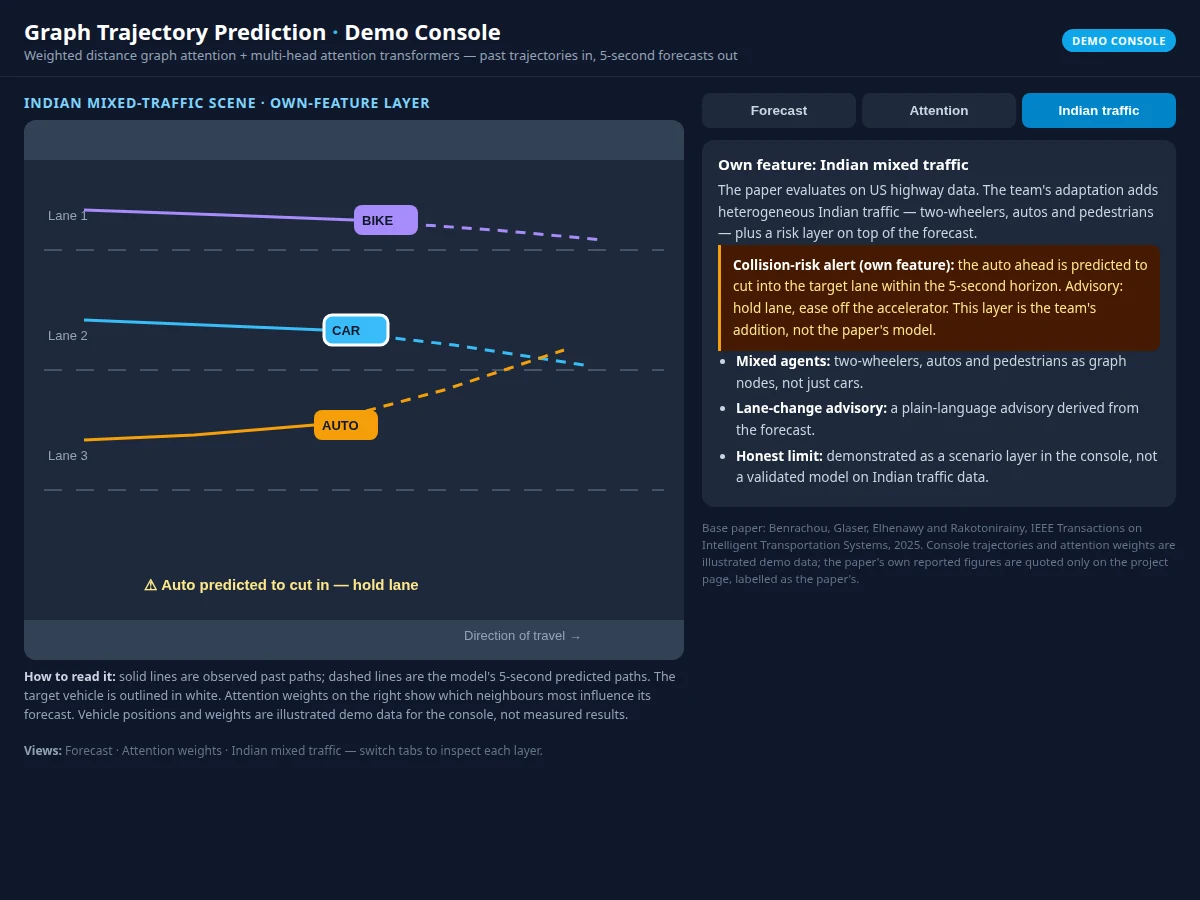
- [Indian mixed traffic as graph nodes] The paper evaluates on US highway data with cars and trucks. The adaptation layer adds two-wheelers, autos, and pedestrians as graph nodes with their own motion behaviour, so the demo scenarios cover the heterogeneous traffic a student in India actually sees. This is presented as a demonstrated scenario layer in the console, not as a validated model on Indian traffic data, and no Indian dataset is claimed.
- [Collision-risk alert and lane-change advisory] A risk layer sits on top of the forecast: when a neighbour's predicted path cuts into the target vehicle's lane or closes dangerously fast within the 5-second horizon, the console raises a plain-language alert with an advisory (for example, hold lane and ease off). The paper predicts trajectories; it does not add this advisory layer.
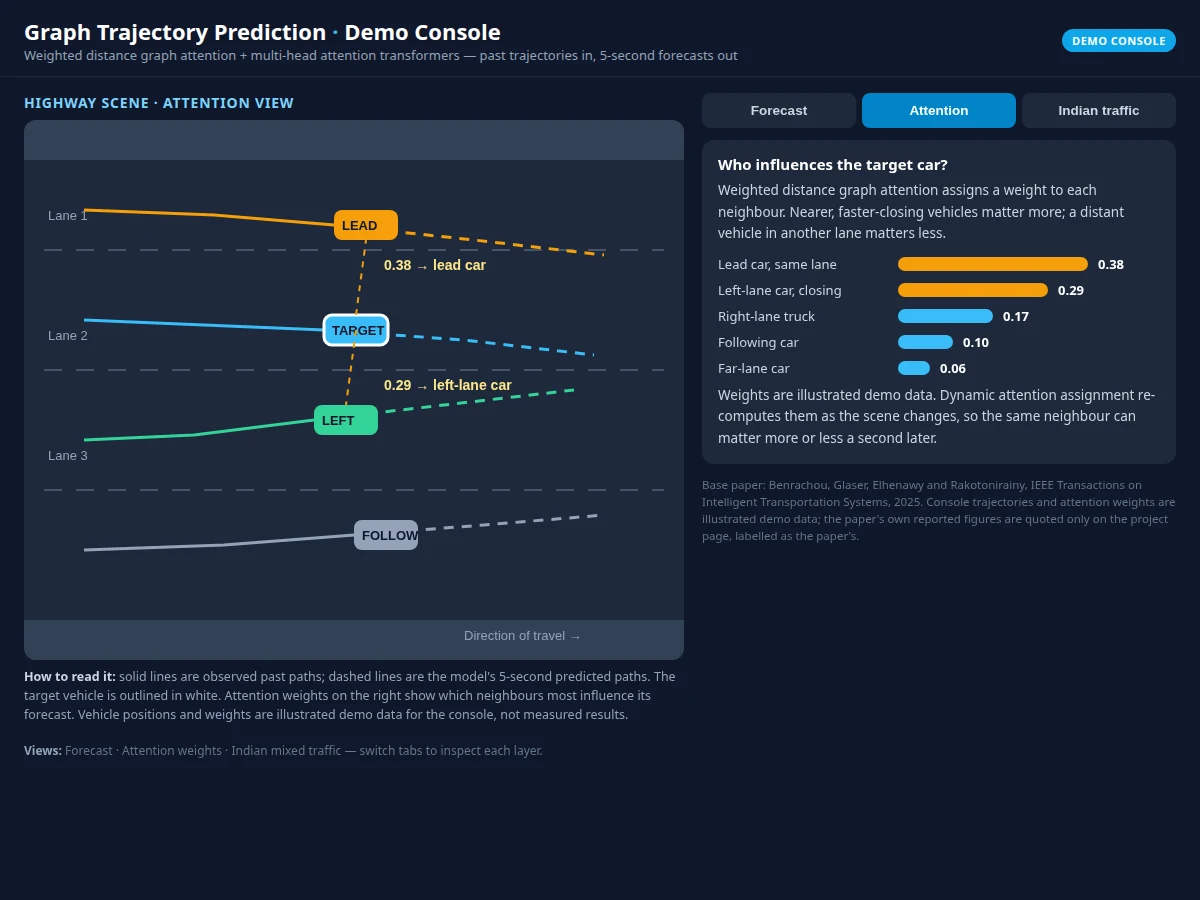
- [Interactive trajectory demo console with visible attention weights] A demo that shows the highway scene, past tracks as solid lines, forecasts as dashed lines, and the attention weight of each neighbour, so a reviewer can see which neighbour drives the forecast instead of taking it on trust.
How it works
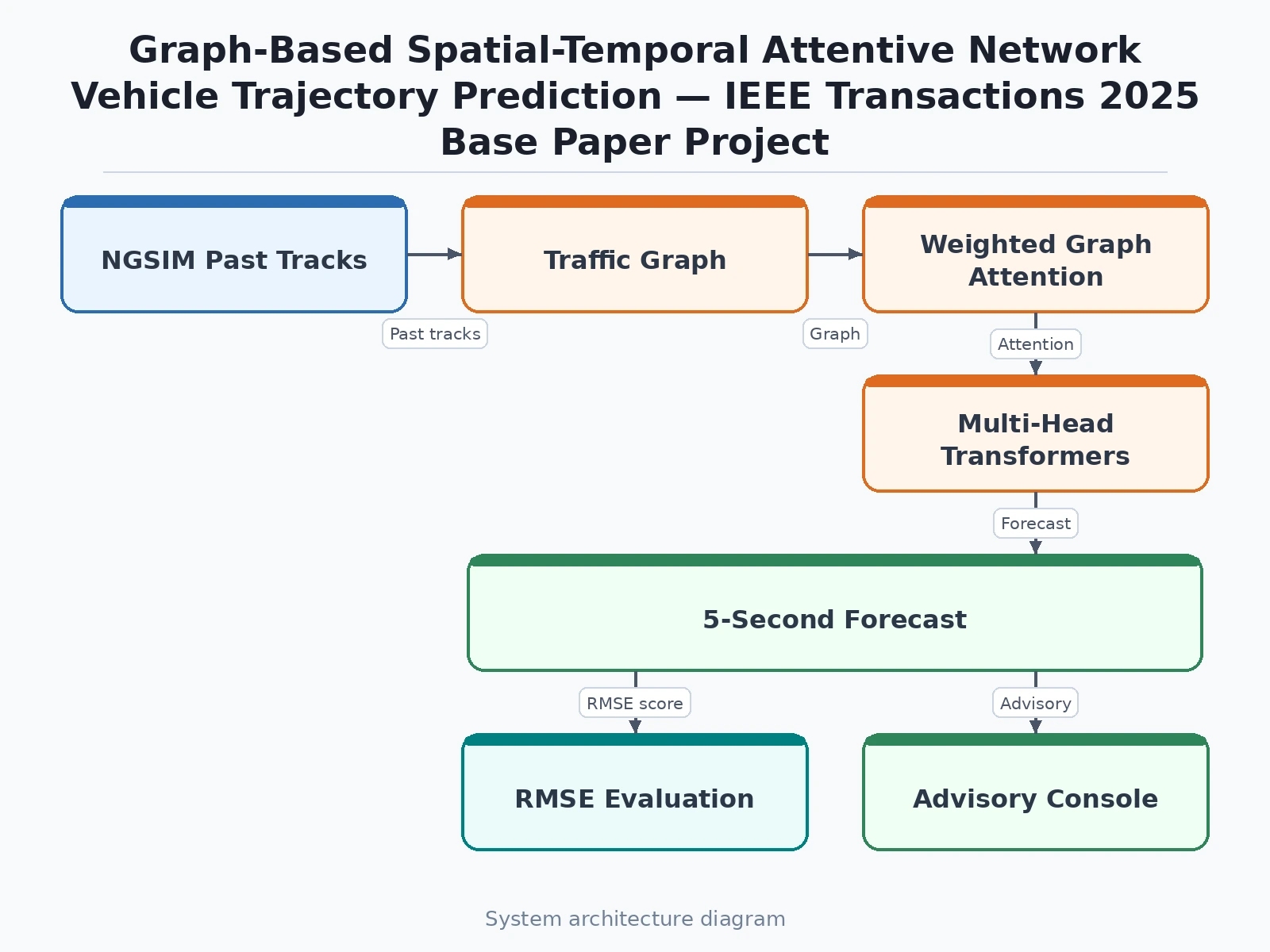
The pipeline runs as a visible chain, and each stage's output is shown in the demo so a student can explain it in a viva. First, past trajectories for all vehicles on a highway section are loaded — in the student build's evaluation, the public NGSIM US-101 and I-80 datasets supply the tracks. A traffic graph is built over the vehicles, with edges between vehicles that can influence each other. The weighted distance graph attention layer scores every neighbour, and dynamic attention assignment updates those scores as the scene evolves. The multi-head attention transformer stage combines the weighted interactions over time into a forecast for every agent over a 5-second horizon. The console draws past tracks as solid lines and forecasts as dashed lines, lists each neighbour's attention weight, and, in the Indian layer, adds mixed agents and the collision-risk advisory.
- Load past trajectories for all vehicles on a highway section (NGSIM US-101 and I-80 for evaluation; illustrated mixed-traffic scenarios for the Indian demo layer).
- Build the multi-agent traffic graph: one node per vehicle, edges between vehicles that can influence each other.
- Run weighted distance graph attention (wDGAT): score each neighbour by distance and motion.
- Apply dynamic attention assignment: update the weights as the scene changes over time.
- Run the multi-head attention transformer stage: combine the weighted interactions into multi-headed social interaction patterns.
- Generate a forecast for every agent over a 5-second horizon.
- Draw past tracks as solid lines and forecasts as dashed lines in the demo console.
- Display each neighbour's attention weight, so the reviewer sees which vehicle drives the forecast.
- Evaluate with prediction error (RMSE) on NGSIM US-101 and I-80 splits, and record only the figures the student's own runs produce.
- Show the Indian adaptation panel: two-wheelers, autos, and pedestrians as graph nodes, plus the collision-risk alert and lane-change advisory, kept distinct from the paper's US-highway setting.
Tech stack:
- Python 3 · PyTorch · Hugging Face Transformers
- Weighted distance graph attention · multi-head attention transformers
- NGSIM US-101 public dataset · NGSIM I-80 public dataset
- NetworkX · graph construction
- HTML · CSS · JavaScript demo console
- Matplotlib · evaluation plots
- Pandas · NumPy data handling
- Git · Jupyter Notebook
Dataset & model details
- Dataset (paper and student build): The public NGSIM highway datasets — US-101 (southbound, Los Angeles) and I-80 (eastbound, Emeryville) — collected under the US Federal Highway Administration's Next Generation Simulation program from networks of synchronised digital video cameras, with the precise location of each vehicle recorded every one-tenth of a second. The student build evaluates on these same public datasets, and its results are its own and are not presented as the paper's results.
- Dataset (Indian adaptation): Indian mixed-traffic scenarios (two-wheelers, autos, pedestrians) shown in the demo console as an illustrated scenario layer. The adaptation is demonstrated on illustrated demo scenarios in the console, not on a published Indian dataset, and it is labelled as such wherever it appears. No Indian dataset is claimed.
- Task: Multi-agent vehicle trajectory prediction; input = past trajectories of all vehicles in a highway scene, output = a predicted trajectory for every agent over a 5-second horizon.
- Model: The paper's graph-based spatial-temporal attentive network — a traffic graph, weighted Distance Graph Attention Networks (wDGAT) with dynamic attention assignment, and Multi-Head Attention (MHA)-based Transformers that learn multi-headed social interaction patterns. No architecture detail beyond the paper's description is claimed for it here.
- Metrics: Prediction error measured as root-mean-square error (RMSE) over the 5-second horizon, as reported by the paper; the student build's report records only the figures its own NGSIM runs actually produce, and no figure is claimed before those runs.
| Parameter | Value |
|---|---|
| Model | Graph-based spatial-temporal attentive network · wDGAT with dynamic attention assignment plus MHA-based Transformers (paper's model) |
| Input | Past trajectories of all vehicles in a highway scene (paper's design) |
| Forecast horizon | 5 seconds (paper's horizon) |
| Datasets | NGSIM US-101 · NGSIM I-80 · both public highway datasets |
| Output | 1 forecast per agent · every agent in the scene |
| Paper | IEEE Transactions on Intelligent Transportation Systems · 2025 · vol. 26 · no. 9 · pp. 13109–13130 |
| Paper-reported result | Lowest prediction error over a 5-second horizon in the paper's experiments · 40% lower average prediction RMSE over 5 seconds and 20% median gain vs state-of-the-art models (paper's own reported figures · not this build's result) |
| Work plan | 110 hours total (planned) |
| Demo console | Single-file web demo · runs offline after download (expected) |
| Deliverables | 4 items (code · report · PPT · viva Q&A) |
| Starting price | Rs 28,000 (starting price · final price confirmed after topic · base paper and compute scope are locked) |
Project features
Graph-based trajectory prediction delivers seven working capabilities: a multi-agent traffic graph, weighted distance graph attention, dynamic attention assignment, multi-head attention transformers, a 5-second multi-agent forecast, RMSE evaluation on public highway data, and an Indian mixed-traffic advisory console, all visible in a demo a reviewer can operate. Past tracks enter as a graph, so no neighbour's influence is flattened away before the model sees it. Attention weights say which neighbour matters, dynamic assignment updates those weights as the scene changes, and the transformer stage carries several interaction patterns forward together. The forecast covers every agent, not just one target car, and the two own-feature layers then make the system demonstrable in an Indian setting: mixed agents on the road, and a forecast that ends in a readable advisory.
- [Multi-agent traffic graph] Builds a graph over all vehicles in the scene from their past trajectories, so interactions are modelled explicitly instead of being flattened into one vehicle's history.
- [Weighted distance graph attention (wDGAT)] Scores each neighbour by distance and motion, so a near, fast-closing vehicle influences the forecast far more than a distant vehicle in another lane.
- [Dynamic attention assignment] Re-computes attention weights as the scene changes, so the same neighbour can matter more or less a second later.
- [Multi-head attention transformers] Learn multi-headed social interaction patterns and preserve them through the pipeline, instead of mixing every interaction into a single hidden state.
- [5-second multi-agent forecast] Predicts a trajectory for every agent in the scene over the paper's 5-second horizon, shown as dashed paths against the solid past tracks.
- [RMSE evaluation on NGSIM] Scores forecasts with prediction error (root-mean-square error) on the public NGSIM US-101 and I-80 highway datasets, and reports only the figures the student's own runs produce.
- [Indian mixed-traffic advisory console] Shows two-wheelers, autos, and pedestrians as graph nodes, raises a collision-risk alert when a predicted path cuts into the target lane, and gives a plain-language lane-change advisory, keeping the team's contribution visibly separate from the paper.
What is included
- Complete trajectory-prediction pipeline source code (traffic graph construction, wDGAT layer, dynamic attention assignment, multi-head attention transformer stage, multi-agent forecasting, Indian adaptation layer, advisory layer)
- Interactive demo console (the web demo shown on this page) with highway scene view, forecast tab, attention-weights tab, and Indian mixed-traffic tab
- Project report PDF (background, base paper, methodology, experiments, limitations)
- PPT presentation for final review
- Viva Q&A preparation document (graph attention, dynamic assignment, multi-head attention, NGSIM evaluation, Indian adaptation, advisory layer, limitations)
- Starting price: Rs 28,000 (final price confirmed after topic, base paper and compute scope are locked)
- Specific next step: message on WhatsApp for a quotation stating scope (graph-based spatial-temporal attentive trajectory prediction on NGSIM data plus Indian mixed-traffic adaptation plus collision-risk and lane-change advisory), starting price Rs 28,000, and delivery under the 110-hour work plan as a built-to-order project
Work plan & timeline
Total work plan: 110 hours, split across six phases. Phase 1, base-paper study and environment setup: 15 hours — reading the Benrachou et al. paper, setting up Python, PyTorch, and the NGSIM data pipeline. Phase 2, traffic graph and attention layers: 25 hours — graph construction, the wDGAT layer, and dynamic attention assignment. Phase 3, transformer stage and forecasting: 25 hours — multi-head attention transformers, multi-agent forecasting over a 5-second horizon, and RMSE evaluation on NGSIM US-101 and I-80. Phase 4, Indian adaptation and advisory layer: 15 hours — mixed-traffic graph nodes and the collision-risk alert and lane-change advisory. Phase 5, evaluation and report: 15 hours — NGSIM evaluation, diagrams, and the full project report. Phase 6, presentation and viva preparation: 15 hours — PPT, demo walkthrough, and the viva Q&A document.
Support
Support covers setup help for the delivered code, a walkthrough of the model and the demo console, and fixes for defects in the delivered code. Guidance is also provided for adapting the report and presentation to the student's college format and for answering guide questions about the base paper, graph attention, and the student's own contribution. Support does not cover re-running experiments on the student's personal machine beyond the setup walkthrough, and it does not invent results for experiments that were not run.
Limitations & prerequisites
- The student build evaluates on NGSIM US-101 and I-80 only, so its figures are not comparable to the paper's results and must not be presented as reproducing the paper's 40% RMSE reduction or 20% median gain.
- The paper's setting is US highway traffic; it does not represent Indian mixed traffic, and the Indian adaptation is a demonstrated scenario layer, not a validated model on Indian traffic data.
- No Indian dataset is claimed, and the advisory layer is demonstrated in the console, not presented as a safety-certified driving assistance system.
- Forecasts are only as good as the past tracks: noisy, missing, or occluded trajectories degrade them, and this is measured rather than hidden in evaluation.
- The forecast horizon is 5 seconds: behaviour beyond that horizon is not predicted, and longer-horizon claims are not made.
- No accuracy figure is claimed before the student's own runs; any figure in the final report comes only from those runs on NGSIM US-101 and I-80.
- Final quality figures depend on the dataset split, hyperparameters, and hardware used, and are recorded only after the student's runs.
- This is an academic prototype for trajectory prediction research; it is not a certified autonomous-driving or driver-assistance system and must not be deployed in a real vehicle.
Frequently Asked Questions
Is this project suitable as a degree project?
Yes, it fits Computer Science, IT, AI & Machine Learning, and Electronics programmes. It demonstrates a graph-based trajectory predictor, weighted distance graph attention with dynamic assignment, and multi-head attention transformers, evaluated on public highway data, together with a distinct Indian mixed-traffic adaptation and an advisory layer — a strong base-paper story with a genuine viva discussion. The work plan totals 110 hours across paper study, graph and attention layers, transformer forecasting, adaptation, evaluation, report, and presentation.
What is the base paper, and what is implemented from it?
The base paper is the Benrachou et al. paper, "Graph-Based Spatial-Temporal Attentive Network for Vehicle Trajectory Prediction in Automated Driving", IEEE Transactions on Intelligent Transportation Systems, 2025 (DOI 10.1109/TITS.2025.3588855). Implemented from it: the multi-agent traffic graph, weighted Distance Graph Attention Networks with dynamic attention assignment, Multi-Head Attention-based Transformers, multi-agent forecasting over a 5-second horizon, and evaluation on the public NGSIM US-101 and I-80 datasets.
Which datasets are used, and does the build use Indian traffic data?
No — the paper and the student build both use the public NGSIM US-101 and I-80 highway datasets, collected under the US Federal Highway Administration's Next Generation Simulation program. The Indian mixed-traffic layer is a demonstrated scenario layer in the demo console, not a dataset, and no Indian dataset is claimed.
How is this different from an LSTM-only or Kalman trajectory model?
An LSTM-only model leans on one vehicle's own history and blurs neighbour influence into a single hidden state, and a Kalman-style model extrapolates each vehicle on its own with no interaction modelling. This model keeps interactions explicit as a graph, weights each neighbour by distance and motion, updates those weights dynamically, and carries several interaction patterns forward with multi-head attention.
What will I receive, and can it be customised?
You receive the trajectory-prediction pipeline source code, the interactive demo console, the project report, the presentation, and the viva Q&A document. Customisation is realistic: a different NGSIM split, additional mixed-traffic scenarios, extra advisory rules, or a college-specific report format can be developed on request.
Is the base paper included?
Yes, the full citation with DOI link is on the page, and the implementation follows that paper.
What is the base paper vs the own features?
The base paper is the published method being implemented — the graph-based spatial-temporal attentive network with wDGAT, dynamic attention assignment, and multi-head attention transformers. The own features are the team's additional contribution, listed separately on the page — Indian mixed traffic (two-wheelers, autos, pedestrians) as graph nodes, and the collision-risk alert plus lane-change advisory layer.
Can my guide approve this paper?
The paper is a recent IEEE Transactions paper with a verifiable DOI, which is what guides check; final approval always rests with the student's own guide and college.
Do you give Phase-1 and Phase-2 documents?
Yes: abstract, literature survey, and review decks in Phase-1; full build, report, and viva preparation in Phase-2.
How do I get a quotation?
Message on WhatsApp for a quotation stating scope (graph-based spatial-temporal attentive trajectory prediction on NGSIM data plus Indian mixed-traffic adaptation plus collision-risk and lane-change advisory), starting price Rs 28,000, and delivery under the 110-hour work plan as a built-to-order project. The final price is confirmed after topic, base paper, and compute scope are locked.
Components & software requirements
- Python 3 · PyTorch · Hugging Face Transformers
- Weighted distance graph attention · multi-head attention transformers
- NGSIM US-101 public dataset · NGSIM I-80 public dataset
- NetworkX · graph construction
- HTML · CSS · JavaScript demo console
- Matplotlib · evaluation plots
- Pandas · NumPy data handling
- Git · Jupyter Notebook
Dataset & model details
- Dataset (paper and student build): The public NGSIM highway datasets — US-101 (southbound, Los Angeles) and I-80 (eastbound, Emeryville) — collected under the US Federal Highway Administration's Next Generation Simulation program from networks of synchronised digital video cameras, with the precise location of each vehicle recorded every one-tenth of a second. The student build evaluates on these same public datasets, and its results are its own and are not presented as the paper's results.
- Dataset (Indian adaptation): Indian mixed-traffic scenarios (two-wheelers, autos, pedestrians) shown in the demo console as an illustrated scenario layer. The adaptation is demonstrated on illustrated demo scenarios in the console, not on a published Indian dataset, and it is labelled as such wherever it appears. No Indian dataset is claimed.
- Task: Multi-agent vehicle trajectory prediction; input = past trajectories of all vehicles in a highway scene, output = a predicted trajectory for every agent over a 5-second horizon.
- Model: The paper's graph-based spatial-temporal attentive network — a traffic graph, weighted Distance Graph Attention Networks (wDGAT) with dynamic attention assignment, and Multi-Head Attention (MHA)-based Transformers that learn multi-headed social interaction patterns. No architecture detail beyond the paper's description is claimed for it here.
- Metrics: Prediction error measured as root-mean-square error (RMSE) over the 5-second horizon, as reported by the paper; the student build's report records only the figures its own NGSIM runs actually produce, and no figure is claimed before those runs.
Delivery information
Built-to-order project. Delivery timeline is shared after order confirmation based on current queue.
Support terms
Complete documentation, setup guide, and viva preparation included. Support for setup and explanation provided.
Download free synopsis (PDF)
Enter your name and WhatsApp number — the synopsis PDF downloads immediately. We may send occasional project updates on WhatsApp; no spam.