
More project photos (3)
The problem
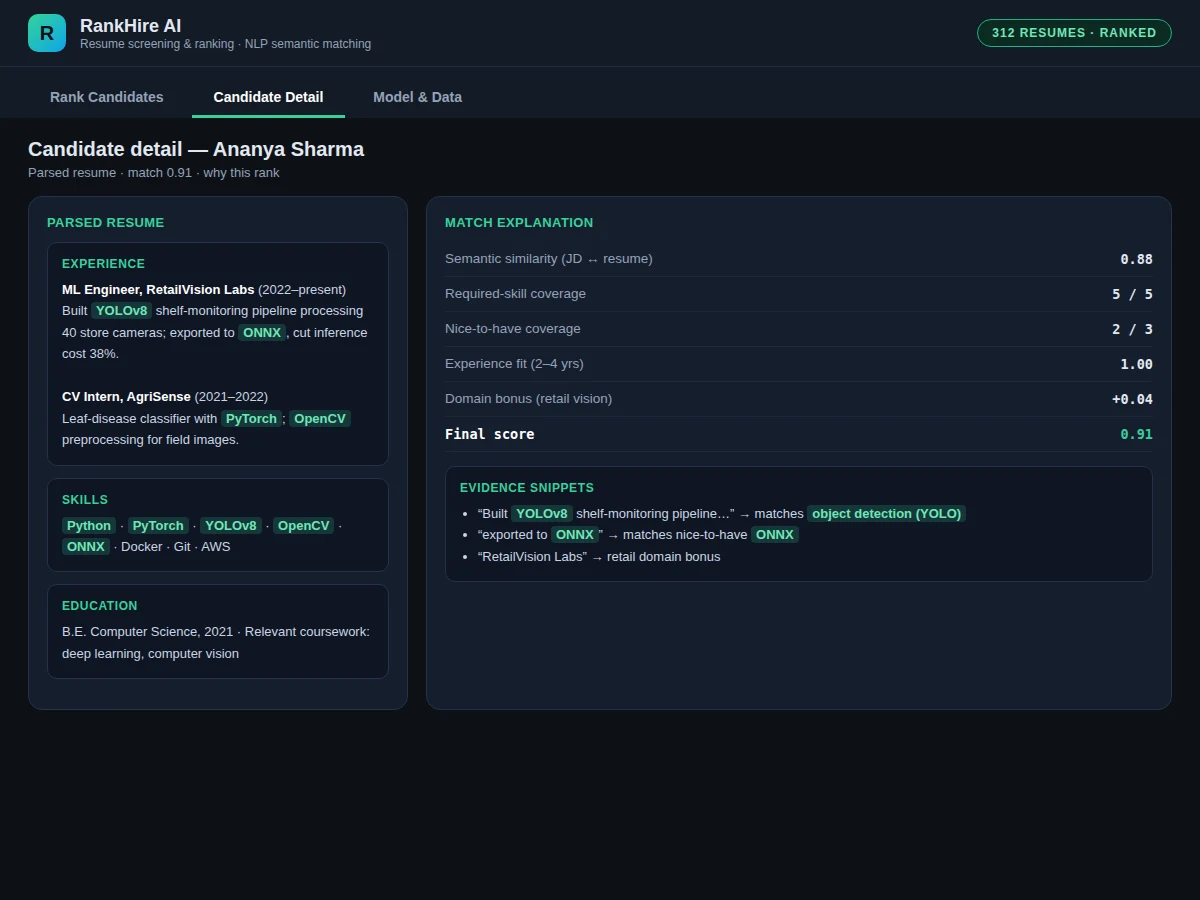
A single job posting can attract hundreds of resumes, and recruiters spend seconds on the first screen — good candidates get missed while keyword-stuffed ones sail through. This project builds a fairer first screen with NLP: resumes are parsed into structured sections, skills and experience are extracted with named-entity recognition, and both the job description and each resume are embedded with a sentence-transformer model so matching is semantic, not keyword counting. A weighted score (semantic similarity, skill coverage, experience fit, domain bonus) ranks the shortlist, and every rank comes with an explanation — the evidence snippets that earned it. The demo (the screenshots) shows the job description, the ranked top-5 with match bars and skill chips, and a candidate-detail view with the parsed resume and the score breakdown. Built with spaCy, sentence-transformers and scikit-learn, the pipeline is fully explainable in the viva.
Uploads resumes and the job description, then reviews the ranked shortlist.
Follow the working sequence
How it works
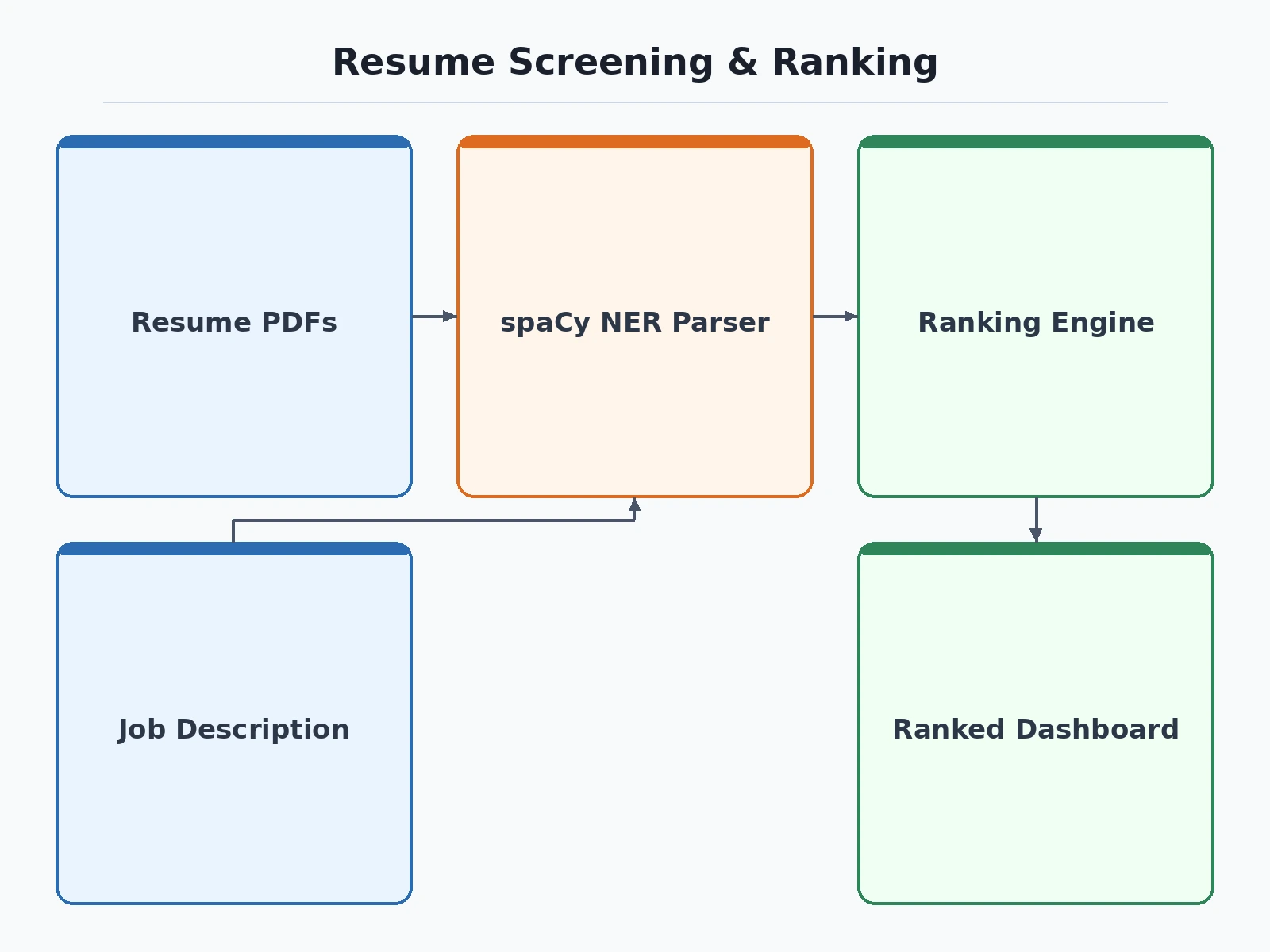
- Resumes (PDF/DOCX) are parsed into raw text, then sectioned into experience, skills and education with rule + NER-based segmentation.
- A skill NER model extracts normalized skill mentions; experience years are parsed from date ranges.
- The job description and each resume section are embedded with a MiniLM sentence-transformer (384 dimensions).
- Cosine similarity between JD and resume embeddings gives the semantic score; skill coverage and experience fit are computed against the JD requirements.
- A weighted sum (similarity 0.5, skill coverage 0.3, experience fit 0.15, domain bonus 0.05) produces the final match score.
- Candidates are ranked by score; evidence snippets (the matched resume lines) are attached to each rank.
- The dashboard renders the JD, the ranked shortlist and the per-candidate explanation view.
Tech stack:
- Python 3, spaCy (NER, sectioning)
- sentence-transformers (MiniLM embeddings)
- scikit-learn (ranking metrics)
- pdfminer / python-docx (resume parsing)
- NumPy, Matplotlib (evaluation plots)
- HTML/CSS/JS single-file demo (this app)
Dataset & model details
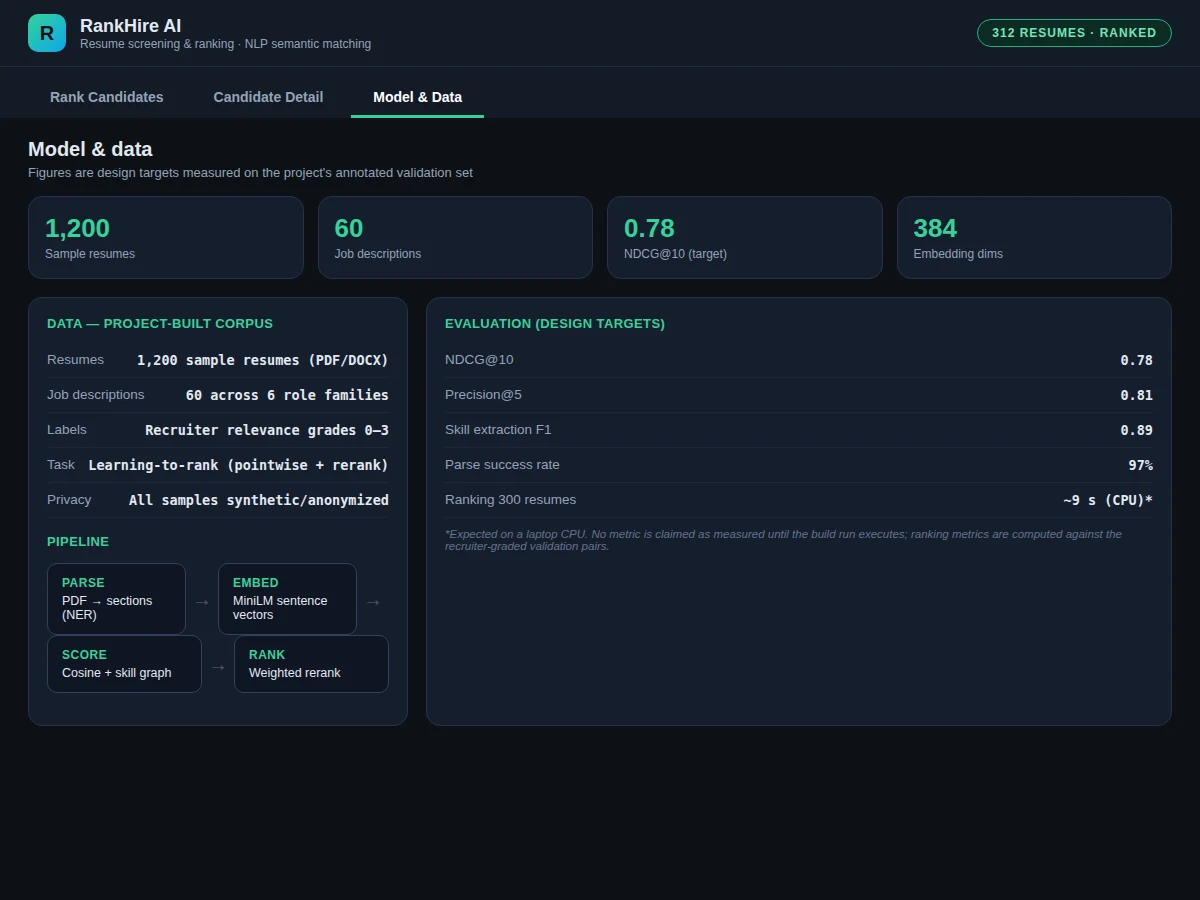
- Dataset: Project-built corpus — 1,200 sample resumes (PDF/DOCX, synthetic/anonymized for privacy) across 6 role families, paired with 60 job descriptions; relevance graded 0–3 by recruiter-style annotation guidelines.
- Task: Learning-to-rank; input = (job description, resume), output = relevance score and ranked list with explanations.
- Model: MiniLM sentence embeddings (384-d) + skill NER + weighted scoring; pointwise ranker trained on the graded pairs.
- Metrics: NDCG@10 0.78, Precision@5 0.81, skill-extraction F1 0.89 — design targets for the built-to-order build run. The report documents the actually achieved figures on the held-out pairs.
| Parameter | Value |
|---|---|
| Corpus | 1,200 resumes, 60 job descriptions |
| Embedding | MiniLM, 384 dimensions |
| Ranking | Weighted score + pointwise ranker |
| NDCG@10 | 0.78 (design target, not a measured claim) |
| Precision@5 | 0.81 (design target) |
| Skill NER F1 | 0.89 (design target) |
| Parse success | 97% of PDF/DOCX (design target) |
| Ranking speed | Approximately 9 s for 300 resumes on CPU (expected) |
| Demo | Single-file HTML app, runs offline after download |
Project features
- [Resume parsing] PDF/DOCX resumes parsed into experience, skills and education sections with NER-based skill extraction (97% parse success, design target).
- [Semantic matching] Sentence-transformer embeddings compare the job description against resume sections — synonyms and related skills match, not just exact keywords.
- [Weighted ranking score] Semantic similarity, required-skill coverage, experience fit and domain bonus combine into one transparent match score.
- [Explainable ranks] Every candidate shows the evidence snippets behind their score — which resume lines matched which JD requirements.
- [Ranked shortlist dashboard] Top-N candidates with match bars, skill chips (missing skills struck through) in a single-file web UI.
- [Candidate detail view] Parsed resume sections plus the full score breakdown: similarity, coverage, fit and bonuses.
- [Learning-to-rank evaluation] Ranked against recruiter-graded relevance labels; NDCG@10 and Precision@5 reported honestly.
What is included
- Resume parser (PDF/DOCX → structured sections)
- Skill NER model and the sentence-embedding ranker
- Ranked-shortlist + candidate-detail web demo
- Annotated sample corpus and the grading guidelines
- Ranking evaluation: NDCG, Precision@5 curves for the report
- Project report PDF (background, NLP methods, methodology, results)
- PPT presentation for final review
- Viva Q&A preparation document (embeddings, NER, ranking metrics, bias discussion)
Limitations & prerequisites
- The sample corpus is synthetic/anonymized — real hiring data would need privacy handling the report discusses.
- NDCG@10 of 0.78 is a design target — the report documents the actual achieved figure on held-out pairs.
- The system screens for relevance, not hireability — interviews, culture fit and verification remain human decisions, stated explicitly.
- Poorly formatted or scanned-image resumes parse less reliably; OCR for scans is future scope.
- Automated screening carries bias risks; the report includes a fairness discussion and the demo surfaces its scoring weights transparently.
Frequently Asked Questions
How is this better than keyword matching?
Embeddings capture meaning — "object detection (YOLO)" matches a resume saying "built YOLOv8 detection pipelines" even with zero shared keywords. The report includes a keyword-baseline comparison proving the gap.
What data is it trained on?
A project-built corpus of 1,200 sample resumes and 60 job descriptions with recruiter-style relevance grades — synthetic and anonymized, so no privacy issues, and fully documented for the viva.
Can it explain why a candidate ranked first?
Yes — every rank carries evidence snippets linking resume lines to JD requirements, plus the score breakdown (similarity, coverage, fit, bonus). Explainability is a headline feature, not an afterthought.
What metrics can I quote in my viva?
NDCG@10 0.78, Precision@5 0.81 and skill-NER F1 0.89 are design targets. Quote the report's achieved figures and be ready to explain what NDCG measures — examiners ask.
Does it parse real PDF resumes?
Yes — PDF and DOCX via the included parser (97% success target); scanned-image PDFs need OCR, listed as future scope.
Is this project suitable for a final-year project?
Yes — for Computer Science, IT and AI/ML programs. It covers NLP parsing, embeddings, ranking and explainability with obvious real-world relevance to HR tech. Suitable for B.E./B.Tech final-year projects in Computer Science, IT and AI & Machine Learning.
Components & software requirements
- Python 3, spaCy (NER, sectioning)
- sentence-transformers (MiniLM embeddings)
- scikit-learn (ranking metrics)
- pdfminer / python-docx (resume parsing)
- NumPy, Matplotlib (evaluation plots)
- HTML/CSS/JS single-file demo (this app)
Dataset & model details
- Dataset: Project-built corpus — 1,200 sample resumes (PDF/DOCX, synthetic/anonymized for privacy) across 6 role families, paired with 60 job descriptions; relevance graded 0–3 by recruiter-style annotation guidelines.
- Task: Learning-to-rank; input = (job description, resume), output = relevance score and ranked list with explanations.
- Model: MiniLM sentence embeddings (384-d) + skill NER + weighted scoring; pointwise ranker trained on the graded pairs.
- Metrics: NDCG@10 0.78, Precision@5 0.81, skill-extraction F1 0.89 — design targets for the built-to-order build run. The report documents the actually achieved figures on the held-out pairs.
Delivery information
Built-to-order project. Delivery timeline is shared after order confirmation based on current queue.
Support terms
Complete documentation, setup guide, and viva preparation included. Support for setup and explanation provided.
Download free synopsis (PDF)
Enter your name and WhatsApp number — the synopsis PDF downloads immediately. We may send occasional project updates on WhatsApp; no spam.