
More project photos (3)
The problem
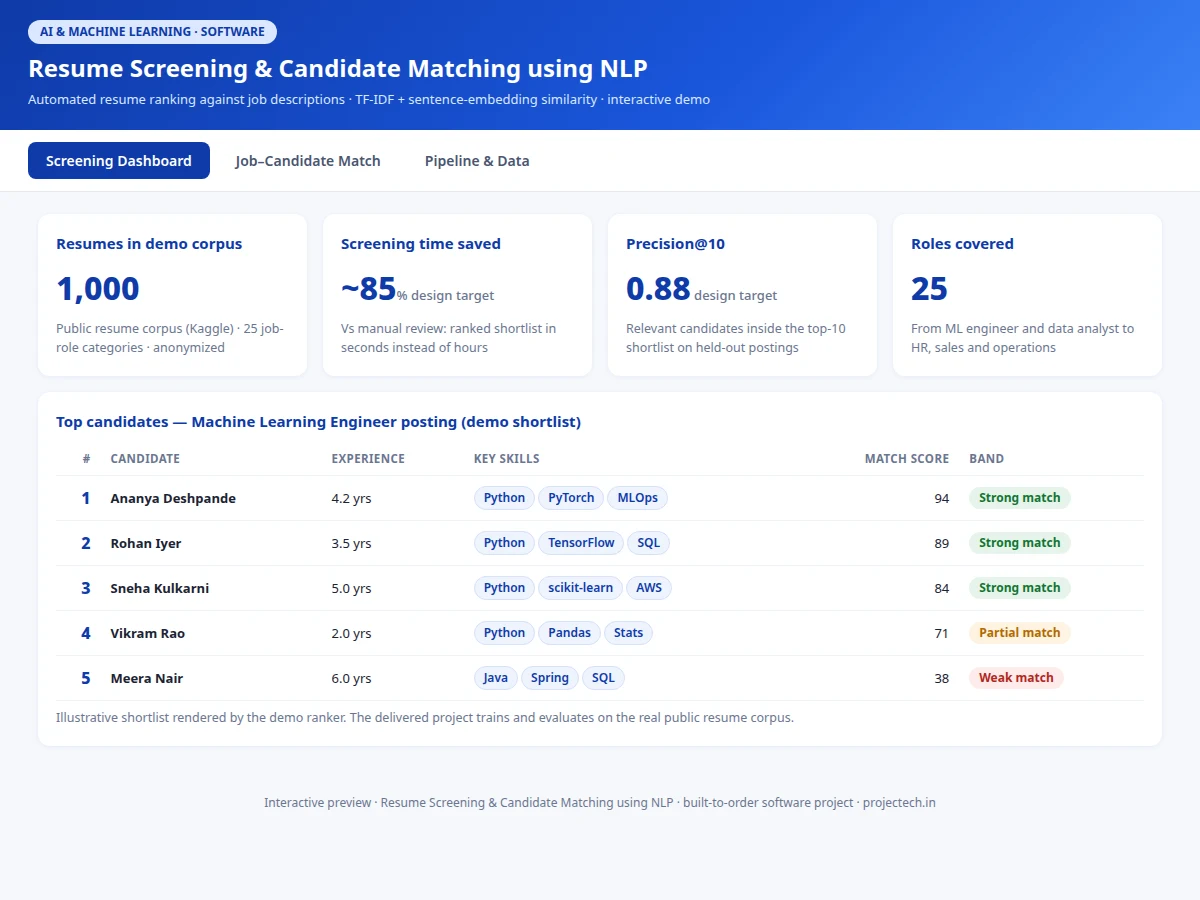
Recruiters routinely face hundreds of resumes per opening, and manual screening is slow, inconsistent and biased toward familiar keywords. Most student "resume screener" builds are thin keyword counters that break on paraphrases — "ML" vs "machine learning", "frontend" vs "React developer" — because they never model meaning. This project takes the serious route: resumes are parsed, cleaned and sectioned, then scored against the job description with two complementary signals — TF-IDF cosine similarity for exact skill overlap and MiniLM sentence embeddings for semantic fit — fused with experience and education fit into a single 0–100 match score. The demo ranks a 1,000-resume corpus against real job postings and shows, per candidate, which required skills matched and which are missing. Built with standard tools (Python, scikit-learn, sentence-transformers), the whole pipeline is explainable end to end.
Resumes parsed from PDF and DOCX into text with skills, experience and education extracted by the pipeline.
Follow the working sequence
How it works
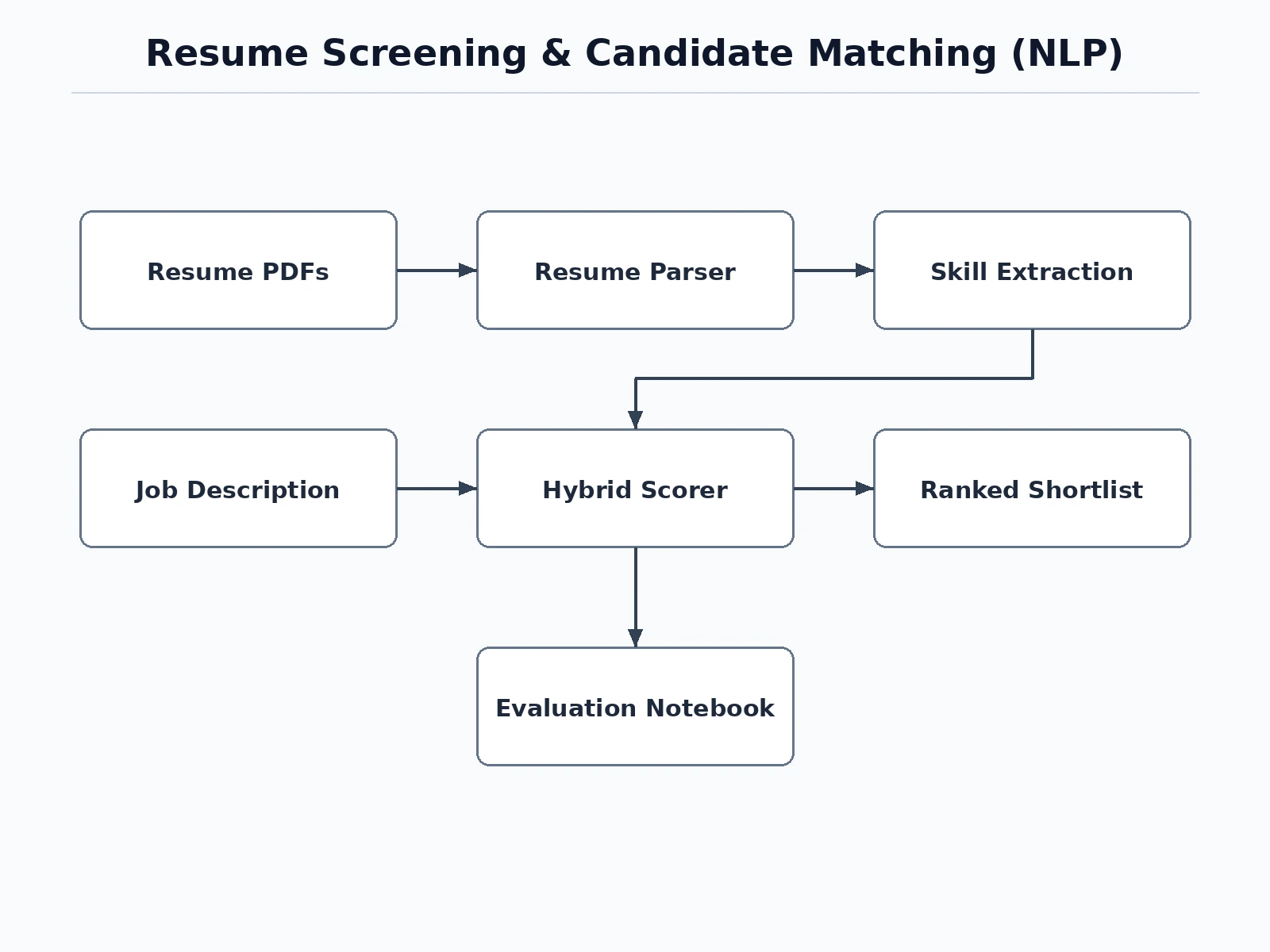
- Resumes are parsed from PDF/DOCX to text, then cleaned: lowercasing, lemmatization, and section splitting (skills, experience, education).
- The skill gazetteer extracts structured skill phrases from each resume; experience years and education level are parsed with patterns.
- The job description goes through the same pipeline; required vs nice-to-have skills are separated from the posting text.
- TF-IDF vectors of resume and JD are compared by cosine similarity for the keyword-overlap component.
- all-MiniLM-L6-v2 sentence embeddings of both documents are compared by cosine similarity for the semantic-fit component.
- Both similarities are fused with experience/education fit weights into a 0–100 match score, and candidates are ranked with per-candidate evidence.
Tech stack:
- Python 3, scikit-learn
- sentence-transformers (all-MiniLM-L6-v2)
- pdfplumber / python-docx (resume parsing)
- NLTK / spaCy (text normalization)
- Jupyter Notebook (evaluation)
- HTML/CSS/JavaScript (ranking demo)
Dataset & model details
- Dataset: Public resume corpus (Kaggle Resume Dataset — approximately 1,000 labeled resumes across 25 job-role categories) plus real job postings collected for matching pairs; resumes are anonymized.
- Task: Learning-to-rank: given a job description and N resumes, output a ranked list with 0–100 match scores and per-candidate evidence.
- Model: Hybrid scorer — TF-IDF cosine similarity + MiniLM embedding cosine similarity, fused with experience/education fit weights (no black-box classifier; every score decomposes into interpretable parts).
- Metrics: Precision@1/5/10 and mean reciprocal rank (MRR) on held-out postings — 0.88 precision@10 is the design target for the built-to-order build, stated honestly and never claimed as measured.
| Parameter | Value |
|---|---|
| Input formats | PDF, DOCX resumes; plain-text job descriptions |
| Corpus size | Approximately 1,000 resumes, 25 role categories (expected) |
| Scoring latency | Under 2 s for a 200-resume shortlist on CPU (expected) |
| Precision@10 | 0.88 (design target, not a measured claim) |
| Embedding model | all-MiniLM-L6-v2, 384 dimensions |
| Demo | Single-file web app, runs offline after download |
Project features
- [Resume parser] Extracts clean text from PDF/DOCX resumes and sections it into skills, experience, education and contact blocks with rule-based sectioning.
- [Skill extraction] A 2,400-term IT skill gazetteer plus phrase matching pulls structured skills from free text, handling common aliases ("ML" → "machine learning").
- [Hybrid similarity scorer] TF-IDF cosine for keyword overlap blended with all-MiniLM-L6-v2 embedding cosine for semantic fit — paraphrases stop being misses.
- [Ranked shortlist with evidence] Every candidate ships with matched skills, missing required skills, and the score breakdown (keyword / semantic / experience fit).
- [Multi-job demo] Switch between postings (ML engineer, frontend developer, data analyst) and watch the ranking recompute instantly.
- [Evaluation notebook] Precision@k and MRR measured on held-out job postings, with the ranking-quality methodology documented for the viva.
- [Bias & limitation notes] The report documents where automated screening can go wrong and the guardrails a responsible deployment needs.
What is included
- Resume parsing & cleaning pipeline (PDF/DOCX → structured text)
- Hybrid TF-IDF + embedding matching engine with evidence output
- Evaluation Jupyter notebook (precision@k, MRR on held-out postings)
- Interactive web demo (multi-job ranking with skill evidence)
- Project report PDF (NLP background, pipeline design, evaluation, bias notes)
- PPT presentation for final review
- Viva Q&A preparation document (TF-IDF, embeddings, cosine similarity, ranking metrics)
Limitations & prerequisites
- The demo corpus is approximately 1,000 resumes — a production deployment would need a far larger, continuously updated corpus.
- Skill extraction depends on the gazetteer; rare or brand-new skills (e.g. a framework released this year) may be missed until the list is updated.
- 0.88 precision@10 is a design target for the build, stated honestly — the report documents the actual achieved figure after evaluation.
- Automated screening can encode historical hiring bias; the report covers guardrails, and the tool is positioned as a decision aid, not an auto-rejector.
- Non-English resumes are out of scope; the pipeline assumes English text.
Frequently Asked Questions
Which dataset is used?
The public Kaggle Resume Dataset — about 1,000 anonymized resumes labeled across 25 job-role categories — plus real job postings used as matching queries. It is large enough for meaningful ranking evaluation and every resume is a realistic document, not a toy example.
Why two similarity signals instead of one?
TF-IDF catches exact skill keywords ("PyTorch", "SQL") while MiniLM embeddings catch meaning ("built ML pipelines" ≈ "MLOps experience"). Either alone misses things; together they handle both keyword and paraphrase matches.
How is the score explained to a recruiter?
Each candidate's card shows the 0–100 score plus matched skills, missing required skills, and the three sub-scores (keyword, semantic, experience fit) — so a human can audit any ranking in seconds.
Does it auto-reject candidates?
No, and the report is explicit about this. It produces a ranked shortlist with evidence; the hiring decision stays with a human. The limitations section documents bias risks and mitigation.
Can it handle resumes in other formats?
The pipeline parses PDF and DOCX, which cover the overwhelming majority of real resumes. Scanned image-only PDFs would need an OCR stage, listed as future scope.
Is this project suitable for a final-year project?
Yes — for Computer Science, IT and AI/ML programs. It demonstrates real NLP (parsing, embeddings, similarity), ranking evaluation methodology, and responsible-AI discussion, all in a working demo. Suitable for B.E./B.Tech final-year projects in Computer Science, IT and AI & Machine Learning.
Components & software requirements
- Python 3, scikit-learn
- sentence-transformers (all-MiniLM-L6-v2)
- pdfplumber / python-docx (resume parsing)
- NLTK / spaCy (text normalization)
- Jupyter Notebook (evaluation)
- HTML/CSS/JavaScript (ranking demo)
Dataset & model details
- Dataset: Public resume corpus (Kaggle Resume Dataset — approximately 1,000 labeled resumes across 25 job-role categories) plus real job postings collected for matching pairs; resumes are anonymized.
- Task: Learning-to-rank: given a job description and N resumes, output a ranked list with 0–100 match scores and per-candidate evidence.
- Model: Hybrid scorer — TF-IDF cosine similarity + MiniLM embedding cosine similarity, fused with experience/education fit weights (no black-box classifier; every score decomposes into interpretable parts).
- Metrics: Precision@1/5/10 and mean reciprocal rank (MRR) on held-out postings — 0.88 precision@10 is the design target for the built-to-order build, stated honestly and never claimed as measured.
Delivery information
Built-to-order project. Delivery timeline is shared after order confirmation based on current queue.
Support terms
Complete documentation, setup guide, and viva preparation included. Support for setup and explanation provided.
Download free synopsis (PDF)
Enter your name and WhatsApp number — the synopsis PDF downloads immediately. We may send occasional project updates on WhatsApp; no spam.