
More project photos (3)
The problem
Screening resumes by hand is slow and inconsistent, and plain keyword search is worse: it rewards a resume that repeats one buzzword and ignores whether the candidate covers the role as a whole. This project builds a transparent alternative — a system that turns a job description and each resume into TF-IDF vectors, ranks the resumes by cosine similarity to the role, and shows exactly why each resume landed where it did. Every score comes with highlighted matched keywords and a list of missing skills, so the reviewer never has to take a number on trust. The demo is a single HTML file that runs offline in a browser, with a built-in sample set for trying the ranking immediately. The shortlist threshold is adjustable, and the final decision always stays with the human reviewer — the system ranks and explains, it never hires or rejects on its own.
This is a built-to-order software project: the ranking demo, sample resume set, documentation and the complete report are prepared fresh for you.
The Problem
Recruiters hiring for one opening often face hundreds of resumes, and reading every document in full costs hours while two reviewers can still order the same pile differently. Keyword search does not fix this: it rewards a resume that repeats one buzzword and ignores whether the candidate covers the role as a whole. The Resume Screening System with NLP and Cosine Similarity answers this with an explainable first pass. A recruiter pastes a job description and resume text, and the system converts both into TF-IDF vectors, ranks every resume by cosine similarity to the role, and shows the score, the matched keywords, and the missing skills for each candidate. Nothing is hidden behind a black-box model, and no hiring decision is automated: the shortlist goes to a human reviewer, who makes the final call.
How it works
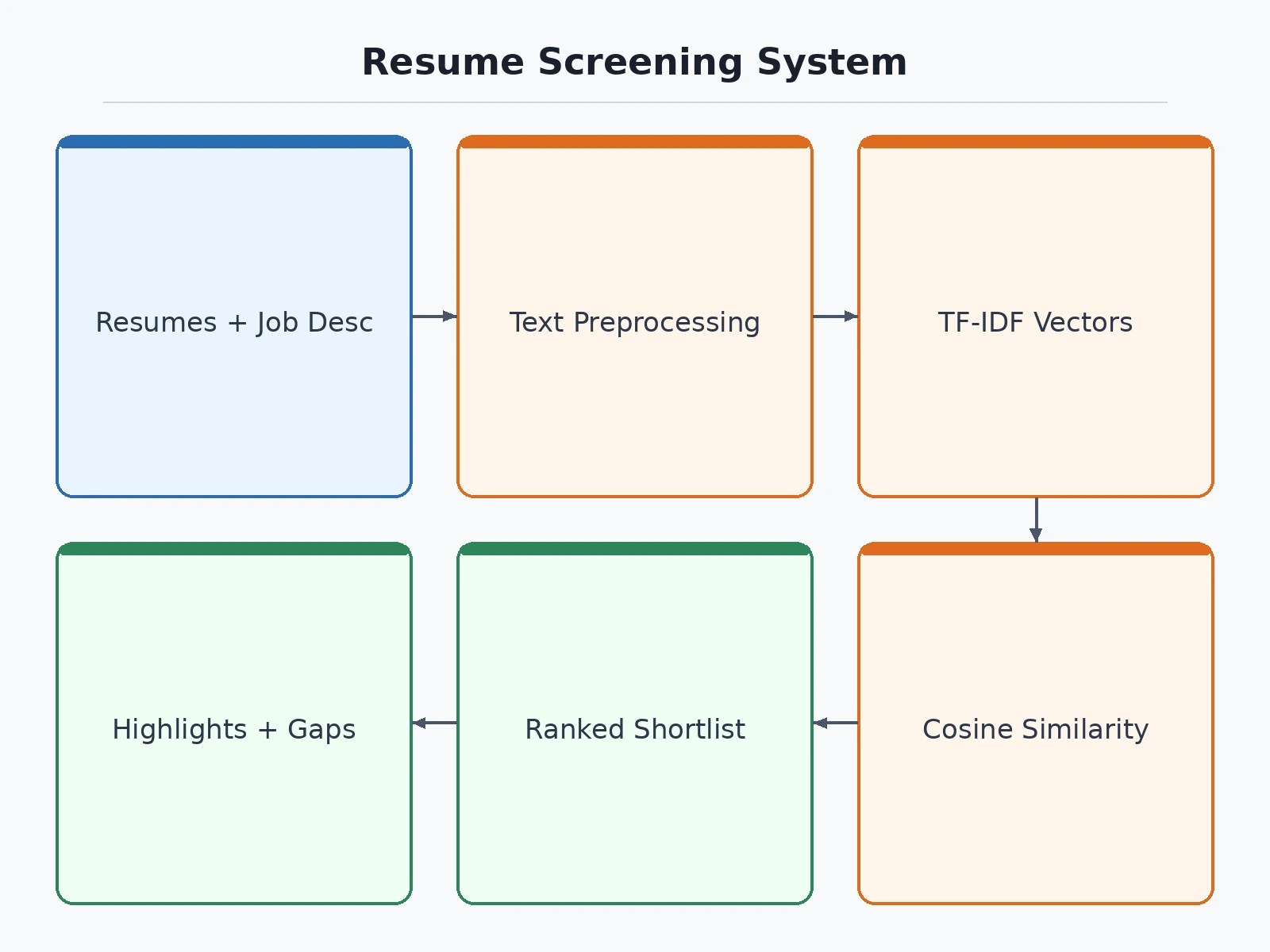
The pipeline starts with plain text: a job description and one or more resumes, pasted or uploaded as .txt files. Each document is lowercased, split into tokens, and stripped of common stopwords that carry no role information. Inverse document frequency is computed over the resume corpus, turning each document into a TF-IDF vector in which rare, role-specific terms weigh more than words appearing everywhere. The system then measures the cosine similarity between the job-description vector and every resume vector, producing a score from 0 to 1 for each candidate. Resumes are sorted by score, compared against an adjustable shortlist threshold, and displayed with matched keywords highlighted and missing keywords listed, so the reviewer sees exactly why each resume ranked where it did. Because every step is visible in the demo, the ranking can be checked by hand for any single resume.
- The reviewer pastes the job description and sets the shortlist threshold (default 0.20).
- Resumes are added by pasting text, uploading .txt files, or picking from the built-in 5-resume sample set.
- Each document is lowercased, tokenized, and stripped of a stopword list of common English words.
- Inverse document frequency is computed over the resume corpus only, and the job description is treated as the query weighted with that corpus IDF.
- Every document becomes a TF-IDF vector, and cosine similarity is computed between the job-description vector and each resume vector.
- Resumes are sorted by score, marked shortlisted or for review against the threshold, and shown with highlighted matches and missing keywords.
Tech stack:
- JavaScript (TF-IDF · cosine similarity in the browser)
- HTML5 · CSS3 (single-file demo)
- Python 3 (report tooling only)
- Text preprocessing (tokenization · stopword removal)
- TF-IDF vectorization
- Cosine similarity ranking
- Browser File API (.txt upload)
- reportlab (abstract PDF)
Dataset & model details
- Method: TF-IDF vectorization + cosine similarity ranking. This is an unsupervised ranking method, NOT a trained classifier: there is no training phase, no learned weights, and no model file.
- Training dataset: None. No labeled resume data is used, and no training run exists — so no accuracy, precision, or recall figure is claimed anywhere for this project.
- Demo data: A small built-in sample set of 5 resumes for a Junior Python Developer role, written for the demo and labeled as demo data in the demo itself. These are not real applicants.
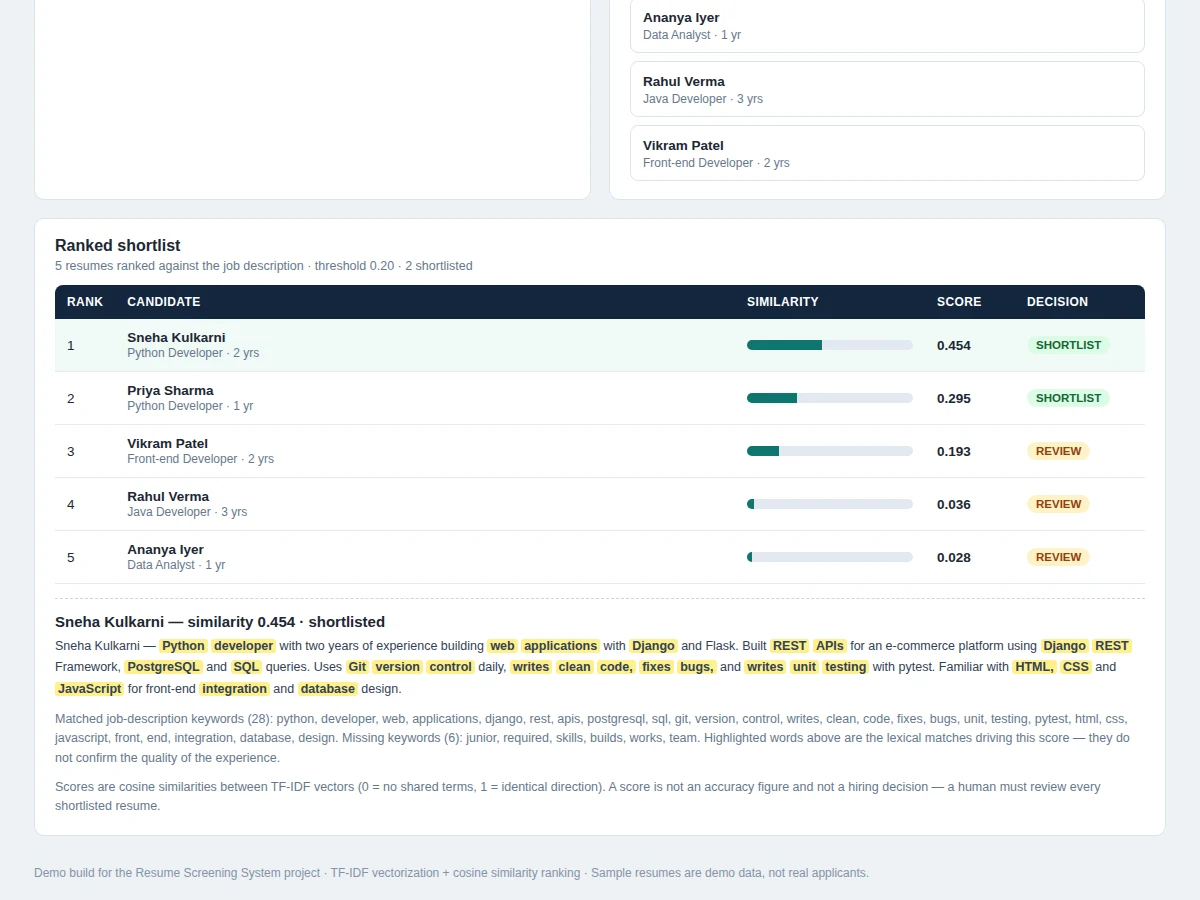
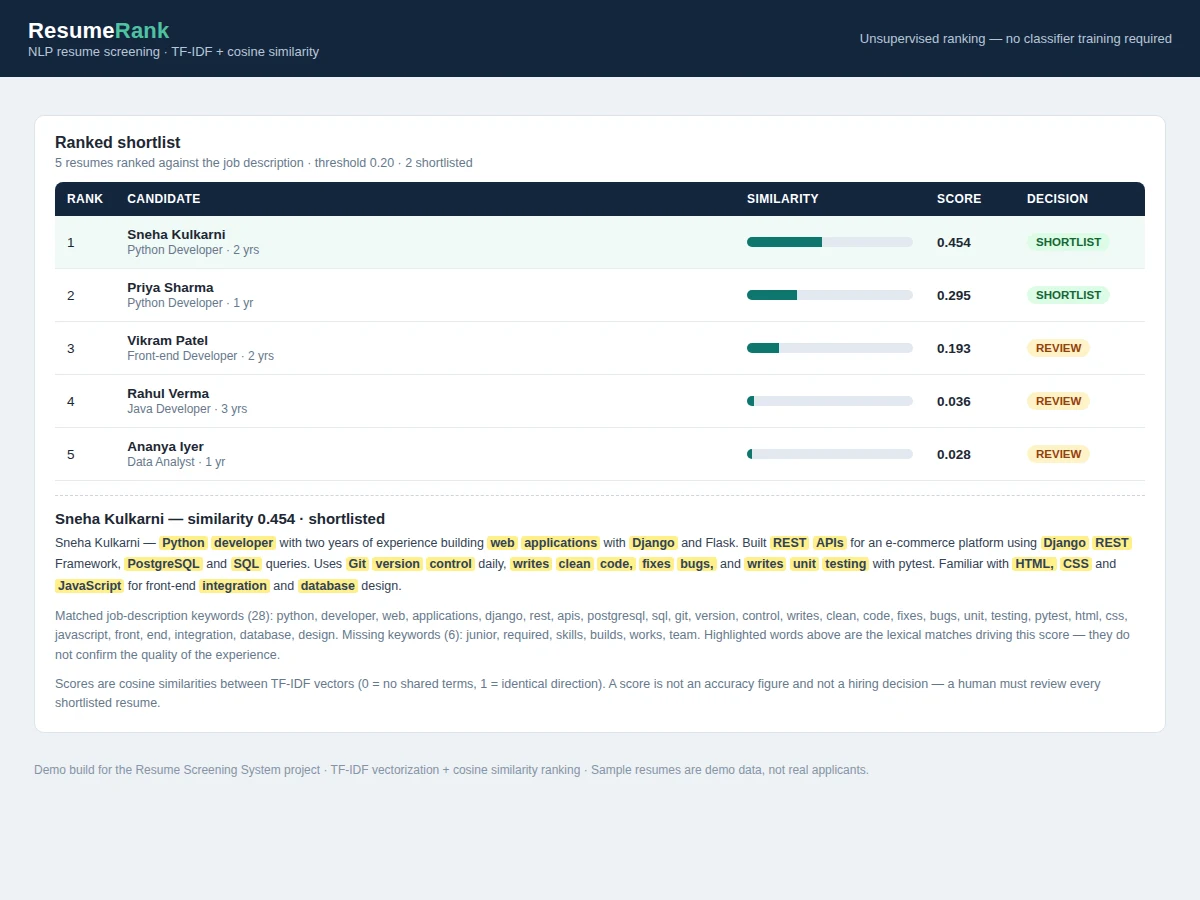
- Measured demo result: On the built demo, the 5 sample resumes score 0.454 (Sneha Kulkarni), 0.295 (Priya Sharma), 0.193 (Vikram Patel), 0.036 (Rahul Verma), and 0.028 (Ananya Iyer). At the default threshold of 0.20, exactly 2 of 5 are shortlisted. These are demo similarity scores, not accuracy figures.
- Builder note (preprocessing choice): A stopword list of common English words (a, the, and, with, for, and similar) is removed before vectorization, because such words appear in nearly every document and would otherwise dilute every score. IDF is computed over the resume corpus only, with the job description treated as the query — this keeps role terms from being down-weighted by their own presence in the corpus, which is the standard query treatment in a vector-space model.
| Parameter | Value |
|---|---|
| Input format | Plain text paste or .txt file upload |
| Sample resumes | 5 resumes (built-in demo set) |
| Ranking method | TF-IDF vectors + cosine similarity (unsupervised, no training) |
| Score range | 0 to 1 (cosine similarity scale, not a percentage) |
| Default threshold | 0.20 (adjustable from 0 to 0.50) |
| Top demo score | 0.454 (measured demo result, strongest sample resume) |
| Shortlisted at default | 2 of 5 resumes (measured demo result) |
| Matched keywords, top resume | 28 keywords (measured demo result) |
| Runtime | Browser only, offline after download (Approximate: instant for small resume sets) |
| Demo file | Single HTML file (Approximate: under 100 KB) |
Project features
The system is built around four capabilities that matter most to a reviewer. First, ranked shortlisting: every resume gets a similarity score against the job description, so the strongest lexical matches rise to the top instead of the longest documents. Second, transparency: matched keywords are highlighted inside each resume and missing keywords are listed beside it, so no score has to be taken on trust. Third, control: an adjustable shortlist threshold lets the reviewer decide how strict the cut is, rather than accepting a fixed cutoff. Fourth, zero setup: the whole demo is one HTML file that runs offline in a browser, with a built-in five-resume sample set for trying it immediately. The demo also covers the practical side: resumes can be pasted, uploaded as .txt files, or loaded from the sample set, and the entire system runs offline with no server to install.
- [Ranked shortlist with similarity scores] Every resume is scored from 0 to 1 against the job description and sorted best-first, with a score bar and a shortlist/review decision per candidate. — Implemented.
- [Matched-keyword highlighting] Clicking a ranked resume highlights the job-description keywords inside its text, so the reviewer sees the evidence behind the score. — Implemented.
- [Missing-skill gaps] Each resume detail view lists the job-description keywords it does not mention, turning the ranking into a usable review checklist. — Implemented.
- [Adjustable shortlist threshold] A slider moves the shortlist cutoff (default 0.20), so the reviewer controls how strict the shortlist is. — Implemented.
- [Paste, upload, and sample resumes] Resumes can be pasted as text, uploaded as .txt files, or picked from the built-in 5-resume sample set, which is labeled as demo data. — Implemented.
- [Single-file offline demo] The whole system is one HTML/CSS/JS file that runs in a browser with no server, installation, or internet connection after download. — Implemented.
- [Batch folder import and report export] Import a folder of resumes at once and export the ranked shortlist as a report. — Optional add-on.
- [Semantic matching with embeddings] Match synonyms (for example, "JS" with "JavaScript") using word embeddings instead of exact tokens. — Future scope.
What is included
- Single-file working demo (paste + .txt upload + 5-resume sample set + ranked shortlist + keyword highlighting)
- Project report PDF (background, TF-IDF and cosine similarity theory, methodology, demo results, limitations)
- PPT presentation for final review
- User guide for running the demo and changing the job description, resumes, and threshold
- Abstract PDF
- Source code with comments explaining preprocessing, IDF computation, and cosine similarity
Limitations & prerequisites
- Cosine similarity ranks lexical overlap only: it does not understand experience quality, seniority, or project impact, and it cannot verify any claim written in a resume.
- Synonyms are missed: "JS" does not match "JavaScript", so a resume written entirely in synonyms can score low even when the candidate is relevant; semantic matching is listed as future scope.
- Scores are not accuracy: the top demo score of 0.454 is a similarity score on a 0 to 1 scale, not 45.4% accuracy, and there is no labeled test set to evaluate against.
- Scores can be gamed: repeating job-description keywords raises a score, so keyword stuffing inflates a ranking without adding real experience.
- Human review is mandatory: no hiring decision is automated, and every shortlisted resume must be read by a reviewer before any candidate is contacted.
- Input and language limits: the core demo accepts pasted text and .txt files only (no PDF or Word upload), and its stopword list and tokenizer assume English text.
Frequently Asked Questions
How does the TF-IDF and cosine similarity ranking actually work?
Each document is turned into a TF-IDF vector, where words that are frequent in one document but rare across the resume set weigh the most. Cosine similarity then measures the angle between the job-description vector and each resume vector, giving a score from 0 to 1. Resumes are sorted by that score, so the closest lexical matches to the role appear first, with matched keywords highlighted for inspection.
Is this a trained machine learning classifier?
No, it is an unsupervised ranking method with no training phase, no learned weights, and no training dataset. TF-IDF weights are computed directly from the resumes supplied at run time, and cosine similarity is a fixed geometric comparison, not a learned model. That is also why the project claims no accuracy figure: with no labeled data, there is nothing to measure accuracy against.
What does a score like 0.454 mean?
It means the resume's TF-IDF vector points fairly closely toward the job-description vector, on a scale where 0 means no shared terms and 1 means identical direction. It is a similarity score, not a percentage and not an accuracy figure, so 0.454 does not mean the candidate is 45.4% suitable. The score is useful for ordering resumes and for showing which keywords matched, not for judging a person.
Can it read PDF resumes or match synonyms?
Not in the core demo, which accepts pasted text and .txt files only and matches exact tokens after stopword removal. A resume in PDF or Word format, or one that uses only synonyms such as "JS" for "JavaScript", will score lower than it deserves. Both gaps are documented honestly: PDF/Word text extraction is an optional add-on, and semantic matching with embeddings is listed as future scope.
Is this project suitable for a final-year project?
Yes, it fits final-year work in Computer Science, IT, and AI & Machine Learning because it combines text preprocessing, vector-space modeling, and an evaluated demo into one complete, explainable system that a student can build, test, and defend without expensive data or hardware. The report documents the method, the demo results, and the limitations, so the work can be explained end to end. The method is small enough to implement from scratch yet rich enough to discuss honestly, including its limits around synonyms and lexical-only matching.
Components & software requirements
- JavaScript (TF-IDF · cosine similarity in the browser)
- HTML5 · CSS3 (single-file demo)
- Python 3 (report tooling only)
- Text preprocessing (tokenization · stopword removal)
- TF-IDF vectorization
- Cosine similarity ranking
- Browser File API (.txt upload)
- reportlab (abstract PDF)
Dataset & model details
- Method: TF-IDF vectorization + cosine similarity ranking. This is an unsupervised ranking method, NOT a trained classifier: there is no training phase, no learned weights, and no model file.
- Training dataset: None. No labeled resume data is used, and no training run exists — so no accuracy, precision, or recall figure is claimed anywhere for this project.
- Demo data: A small built-in sample set of 5 resumes for a Junior Python Developer role, written for the demo and labeled as demo data in the demo itself. These are not real applicants.
- Measured demo result: On the built demo, the 5 sample resumes score 0.454 (Sneha Kulkarni), 0.295 (Priya Sharma), 0.193 (Vikram Patel), 0.036 (Rahul Verma), and 0.028 (Ananya Iyer). At the default threshold of 0.20, exactly 2 of 5 are shortlisted. These are demo similarity scores, not accuracy figures.
- Builder note (preprocessing choice): A stopword list of common English words (a, the, and, with, for, and similar) is removed before vectorization, because such words appear in nearly every document and would otherwise dilute every score. IDF is computed over the resume corpus only, with the job description treated as the query — this keeps role terms from being down-weighted by their own presence in the corpus, which is the standard query treatment in a vector-space model.
Delivery information
Built-to-order project. Delivery timeline is shared after order confirmation based on current queue.
Support terms
Complete documentation, setup guide, and viva preparation included. Support for setup and explanation provided.
Download free synopsis (PDF)
Enter your name and WhatsApp number — the synopsis PDF downloads immediately. We may send occasional project updates on WhatsApp; no spam.