
More project photos (2)
The problem
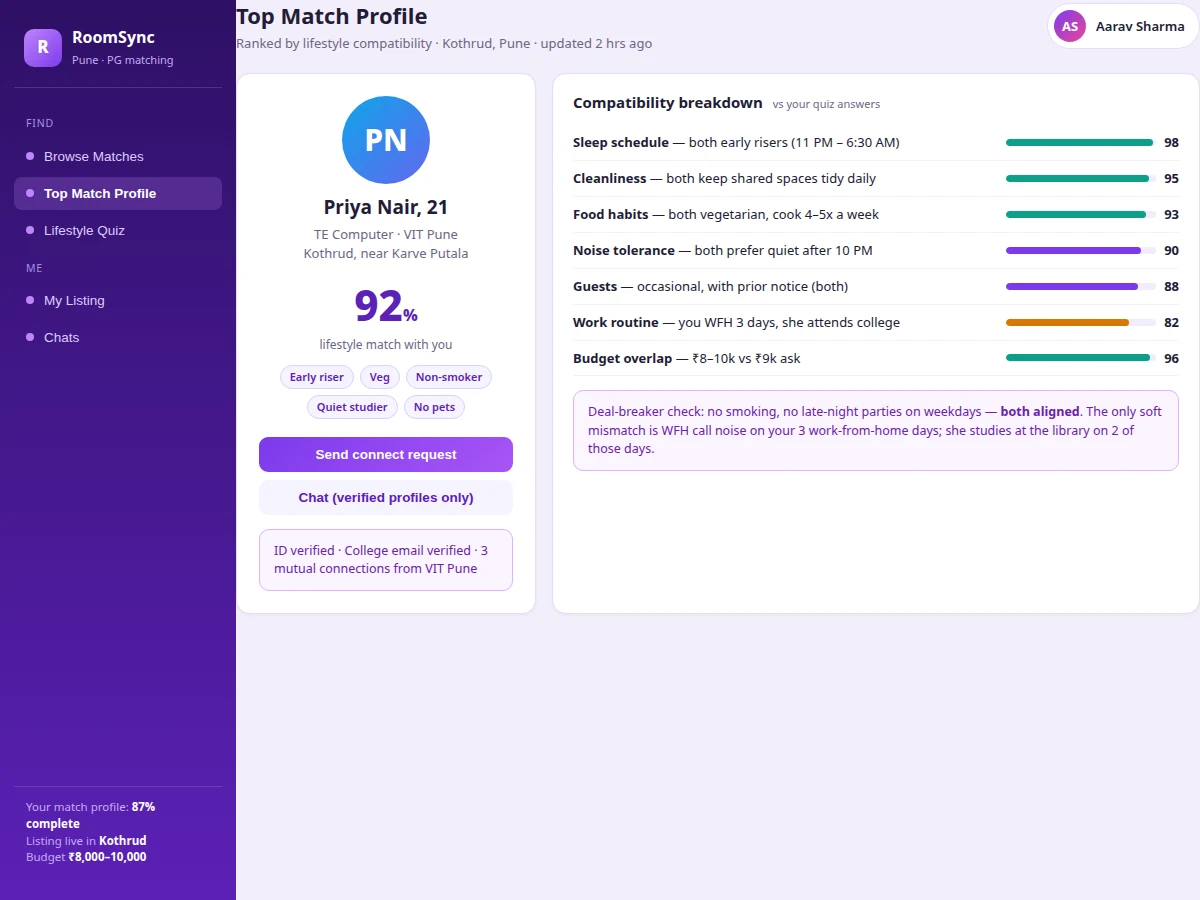
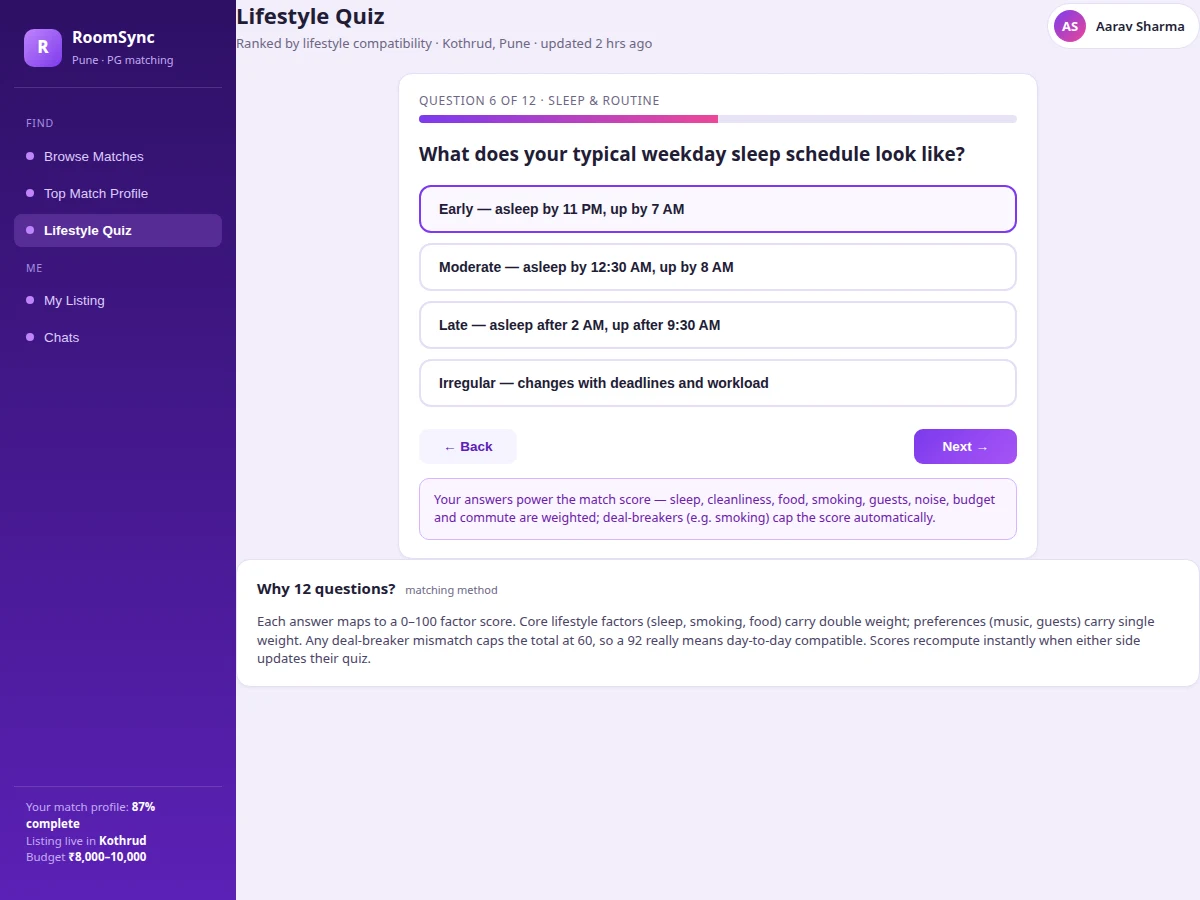
Students relocating to cities like Pune for college or a first job face the same ritual: broker WhatsApp forwards, rushed flat visits, and a roommate chosen on gut feel. The expensive failures are lifestyle mismatches — a night owl paired with an early riser, a smoker with someone who cannot stand it, incompatible food habits in a shared kitchen. Existing listing sites show rooms, not people, and profile-based apps leave compatibility to chat vibes. This project builds RoomSync, a roommate-matching web app centered on a lifestyle quiz. Twelve questions map answers to factor scores across sleep, cleanliness, food, smoking, guests, noise, work routine and budget. Core lifestyle factors carry double weight, preferences single weight, and any deal-breaker mismatch caps the total — so a 92 genuinely means day-to-day compatible. Browse views rank candidates by score with filters; each profile shows a factor-by-factor compatibility breakdown with the honest soft mismatches called out.
How it works
- A new user completes the 12-question lifestyle quiz; each answer maps to a 0–100 factor score across the lifestyle dimensions.
- Factor scores are weighted — core lifestyle factors double, preferences single — and any deal-breaker mismatch (e.g. smoking) caps the total at 60.
- The user publishes a listing with area, budget range and move-in date; the match profile completeness percentage drives how prominently it ranks.
- Browse Matches ranks all candidates by compatibility score with filter chips for budget, diet, smoking, sleep, WFH-friendliness and area.
- Opening a profile shows the full compatibility breakdown: per-factor bars with explanations and the deal-breaker check calling out soft mismatches.
- The user sends a connect request; on acceptance, verified-profile chat unlocks with ID and college-email verification badges visible.
- When either side updates their quiz, all affected scores recompute and the ranking refreshes immediately.
Tech stack:
- HTML5 · CSS3 · vanilla JavaScript (ES6)
- Single-file front-end app (no build step)
- browser localStorage persistence
- SVG score-ring + bar components
- Quiz state machine (12 steps)
- Responsive CSS Grid/Flexbox layout
| Parameter | Value |
|---|---|
| App format | Single-file web app, runs offline after download (design) |
| Data storage | Browser localStorage; no server or install required for the demo |
| Seeded dataset | 6 candidate profiles with full quiz answers in the demo |
| Quiz | 12 questions across 8 lifestyle dimensions |
| Scoring | Weighted 0–100; deal-breaker cap at 60 (documented method) |
| Filters | Budget, diet, smoking, sleep, WFH, area chips |
| Multi-user | Single-user demo; real matching service needs a backend (future scope) |
Project features
- [12-question lifestyle quiz] Sleep, cleanliness, food, smoking, guests, noise, work routine and budget are captured in a guided quiz with a progress tracker and a documented scoring method.
- [Weighted compatibility scoring] Core factors (sleep, smoking, food) carry double weight, preferences single; any deal-breaker mismatch caps the total at 60, so high scores are trustworthy.
- [Ranked match browsing] Candidates are ranked by lifestyle compatibility with match-score rings, filterable by budget, diet, smoking, sleep schedule, WFH-friendliness and area.
- [Factor-by-factor breakdown] Each profile shows per-factor scores with plain-language explanations (both early risers, 11 PM – 6:30 AM) and a deal-breaker check with soft mismatches named.
- [My listing management] Users publish their own listing with area, budget range and move-in date, and see their match-profile completeness driving visibility.
- [Verified-profile chat] Connect requests and chat are restricted to ID-verified, college-email-verified profiles with mutual connections shown, keeping the social layer safer.
- [Score recomputation] Scores recompute instantly when either side updates their quiz, so the ranking always reflects current answers on both sides.
What is included
- Complete RoomSync web app source code (single-file HTML/CSS/JS)
- Seeded demo dataset (candidate profiles with quiz answers, listings)
- Matching-algorithm documentation (weights, deal-breaker rules, worked example)
- Project report PDF (background, scoring methodology, data model, screenshots)
- PPT presentation for final review
- Viva Q&A preparation document
- User manual
- Installation/deployment guide
Limitations & prerequisites
- Compatibility scores model lifestyle fit from quiz answers — they are a screening aid, not a guarantee of a good living relationship.
- The demo runs single-user with seeded profiles; a real service needs user accounts, verification infrastructure and moderation (future scope).
- Verification badges are demo representations; real ID/college-email verification needs backend services.
- Scores are only as honest as the quiz answers; the app cannot detect misrepresentation.
- The app does not handle payments, agreements or broker interactions — it introduces compatible people.
Frequently Asked Questions
How does the compatibility score actually work?
Each quiz answer maps to a 0–100 factor score. Core lifestyle factors — sleep, smoking, food — carry double weight; preferences like music and guests carry single weight. Any deal-breaker mismatch, such as smoking, caps the total at 60 regardless of other factors. The method is documented in the app itself, and scores recompute instantly when either side updates their quiz.
Why cap the score on deal-breakers instead of just lowering it?
Because some mismatches are not compensable. A 95 on cleanliness does not fix a smoking deal-breaker for a non-smoker. The cap guarantees that a high score really means day-to-day compatible, which is exactly the trust the app is selling.
How is this different from a flat-listing site?
Listing sites show rooms; RoomSync matches people. Filters are lifestyle-first (sleep schedule, diet, smoking, WFH-friendliness) rather than price-and-area-first, and every candidate carries a scored, explainable breakdown instead of just photos and a phone number. The deal-breaker check goes further than any listing filter: it refuses to hide a fundamental mismatch behind an otherwise attractive profile.
What keeps the platform safe?
Connect requests and chat are restricted to verified profiles — ID verified and college-email verified — with mutual connections shown before contact. The demo represents this as a profile-trust layer; a production build would add reporting and moderation.
Is this project suitable for a final-year project?
Yes — for Computer Science, IT and Web Development programs. It combines a documented scoring algorithm, quiz state management, ranked search with faceted filters, profile trust design and a genuinely relatable user problem, giving the student both a solid codebase and a strong viva story. Suitable for B.E./B.Tech final-year projects in Computer Science, IT and Web Development.
Components & software requirements
- HTML5 · CSS3 · vanilla JavaScript (ES6)
- Single-file front-end app (no build step)
- browser localStorage persistence
- SVG score-ring + bar components
- Quiz state machine (12 steps)
- Responsive CSS Grid/Flexbox layout
Delivery information
Built-to-order project. Delivery timeline is shared after order confirmation based on current queue.
Support terms
Complete documentation, setup guide, and viva preparation included. Support for setup and explanation provided.