
More project photos (3)

The problem
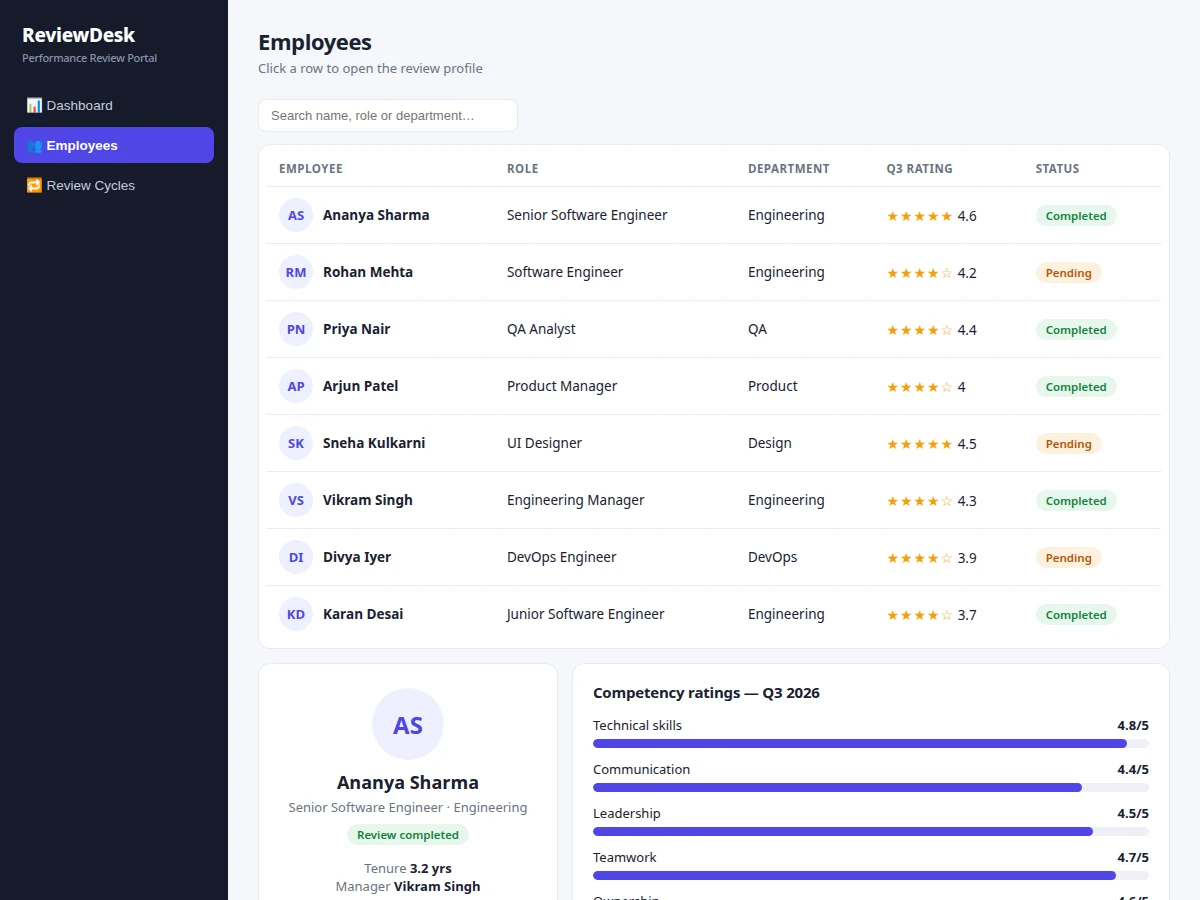
In many small and mid-size companies the appraisal process still runs on spreadsheets, email threads and memory. Goals live in documents, ratings in spreadsheets and feedback in email — so nothing is attributable, deadlines slip silently, and HR cannot answer basic questions like which departments rate consistently or whose review is overdue without days of manual collation. The deeper cost is fairness: when there is no enforced process, self-reviews arrive after manager reviews or never at all, and ratings reflect recency and rhetoric more than performance. A dedicated portal replaces this with a structured, auditable workflow where every step of the review cycle is a tracked state, every rating is attributable to a role, and every stakeholder sees exactly the information their role permits. This project builds that portal as a multi-role Django application backed by PostgreSQL: HR creates quarterly cycles and watches completion, managers clear a pending-review queue with competency ratings and comments, and employees track goals and their own ratings. Django's built-in authentication, permission system and ORM make it a natural fit for exactly this kind of data-driven internal tool, and the build exercises all three seriously.
Creates review cycles, runs calibration and finalizes ratings.
How it works
- HR creates a review cycle (e.g. Q3 2026) with stage dates and assigns employees; the cycle opens in the goal-setting stage.
- Employees log in to their dashboard, set quarterly goals with progress tracking, and later submit self-reviews with competency self-ratings.
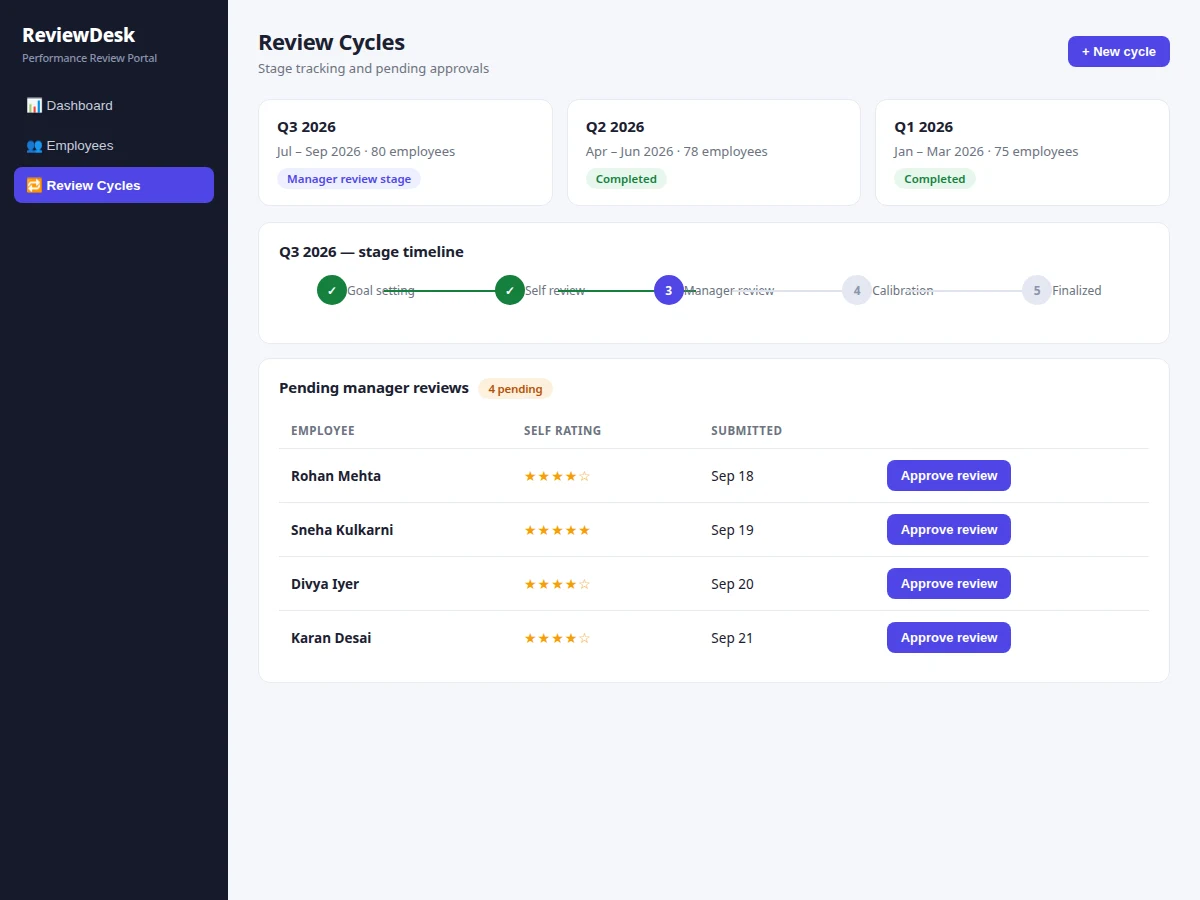
- The cycle advances to manager review; each manager sees a pending-review queue limited to their own reports.
- Managers adjust competency ratings, write comments and approve each review with one click; the queue and completion percentages update live.
- HR runs calibration, comparing rating distributions across departments to catch outlier patterns before finalizing.
- The cycle is finalized and ratings lock; the dashboard archives the cycle and HR can open the next one.
Tech stack:
- Python 3.10, Django 4.x/5.x (MVT, auth, permissions, class-based views)
- PostgreSQL 13+ (SQLite acceptable for local demo)
- Django ORM (aggregation queries for analytics, migrations for schema)
- HTML, CSS and vanilla JavaScript (Django templates, no frontend build step)
- pip + virtualenv, Git
| Parameter | Value |
|---|---|
| Framework | Django 4.x/5.x, MVT pattern |
| Database | PostgreSQL 13+; schema covers employees, departments, cycles, goals, reviews, ratings |
| Roles | Admin/HR, Manager, Employee — enforced via Django auth + permissions |
| Review stages | Goal setting → self review → manager review → calibration → finalized (enforced state machine) |
| Rating scale | 1–5 across 5 competencies, with manager comments |
| Analytics | Completion %, average rating by department, overdue alerts — live ORM aggregations |
| Demo data | Seed script: departments, employees, 2 completed cycles + 1 live cycle |
| Input | Browser-based; role login |
| Output | Dashboards, review records, rating history per employee |
Project features
- [Role-based access control] Three roles — Admin/HR, Manager and Employee — enforced with Django's authentication and permission system, so employees see only their own data and managers see only their reports.
- [Review cycle state machine] Cycles move through enforced stages — goal setting, self review, manager review, calibration, finalization — and a review cannot be manager-approved before the self-review is submitted.
- [Goal tracking] Employees set quarterly goals with progress percentages; managers see goal completion alongside ratings when writing reviews.
- [Competency ratings] Five competencies (technical skills, communication, leadership, teamwork, ownership) rated on a 1–5 scale with manager comments per review.
- [Pending-review queue] Managers get a working queue of submitted self-reviews with one-click approve, so nothing waits in an inbox.
- [HR analytics dashboard] Completion percentages, average rating by department, overdue-review alerts and a recent-activity feed, all from live aggregation queries.
- [Seeded demo data] A seed script loads realistic demo content — departments, employees, two completed cycles and one live cycle — so every screen is demonstrable immediately after setup.
- [Audit-friendly records] Every rating and approval is timestamped and attributable, giving HR a trustworthy history instead of scattered spreadsheets.
What is included
- Complete Django source code (models, views, templates, forms, seed script)
- Database schema with migrations and realistic seed data
- Project report PDF (data model, cycle state machine, permission design, analytics queries)
- PPT presentation for final review (live demo narrative)
- Viva Q&A preparation document (Django auth, ORM aggregation, class-based views, migrations)
- Setup guide (environment, database, seed data, creating your first cycle)
Advantages
- Three roles - Admin/HR, Manager and Employee - enforced with Django's authentication and permission system mean employees see only their own data and managers see only their reports.
- The review cycle state machine enforces stages - goal setting, self review, manager review, calibration, finalization - and a review cannot be manager-approved before the self-review is submitted.
- Employees set quarterly goals with progress percentages, managers see goal completion alongside ratings, and five competencies (technical skills, communication, leadership, teamwork, ownership) are rated on a 1 to 5 scale with manager comments per review.
- Managers work a pending-review queue of submitted self-reviews with one-click approve, so nothing waits in an inbox.
- The HR analytics dashboard aggregates completion percentages, average rating by department, overdue-review alerts and a recent-activity feed from live queries, and every rating and approval is timestamped and attributable.
- A seed script loads realistic demo content - departments, employees, two completed cycles and one live cycle - so every screen is demonstrable immediately after setup.
Disadvantages
- This is an internal HR tool prototype, not a certified HRMS: payroll, attendance and statutory compliance modules are not part of the build.
- Email and push reminders for deadlines are a documented future-scope item; the demo surfaces overdue reviews on the dashboard instead.
- Rating fairness depends on honest manager input - the system records and surfaces ratings but cannot verify their objectivity, and calibration tooling is analytics, not an automated correction.
- The frontend is server-rendered Django templates; a separate mobile app or PWA is future scope.
- Multi-company and tenant support is not implemented; the data model assumes a single organization.
Limitations & prerequisites
- This is an internal HR tool prototype, not a certified HRMS: payroll, attendance and statutory compliance modules are not part of the build.
- Email/push reminders for deadlines are a documented future-scope item; the demo surfaces overdue reviews on the dashboard instead.
- Rating fairness depends on honest manager input — the system records and surfaces ratings but cannot verify their objectivity; calibration tooling is analytics, not an automated correction.
- The frontend is server-rendered Django templates; a separate mobile app or PWA is future scope.
- Multi-company/tenant support is not implemented; the data model assumes a single organization.
Frequently Asked Questions
Is the database included?
Yes. The PostgreSQL schema ships as Django migrations, and a seed script loads realistic demo data — departments, employees and three review cycles — so every screen works immediately after setup.
Does the project contain an admin panel?
Yes, two layers: Django's built-in admin for data management, plus a custom HR dashboard with cycle management, completion tracking and department analytics.
Can more roles or modules be added?
Yes. The permission design extends cleanly — a peer-reviewer role for 360-degree feedback or an HR-analytics module are realistic customizations.
Can it be hosted online?
Yes. It is a standard Django + PostgreSQL application and deploys to any VPS or platform supporting Python; hosting and domain costs are separate from the project itself.
Is this project suitable for a final-year project?
Yes — it suits Computer Science, Information Technology and related branches, demonstrating authentication and authorization, relational data modeling, workflow state machines and ORM analytics in one build.
What will I receive with the project?
Complete Django source code, migrations plus seed data, the project report, PPT presentation, viva Q&A document and a setup guide. Suitable for B.E./B.Tech final-year projects in Computer Science, Information Technology and related branches.
Components & software requirements
- Python 3.10, Django 4.x/5.x (MVT, auth, permissions, class-based views)
- PostgreSQL 13+ (SQLite acceptable for local demo)
- Django ORM (aggregation queries for analytics, migrations for schema)
- HTML, CSS and vanilla JavaScript (Django templates, no frontend build step)
- pip + virtualenv, Git
Delivery information
Built-to-order project. Delivery timeline is shared after order confirmation based on current queue.
Support terms
Complete documentation, setup guide, and viva preparation included. Support for setup and explanation provided.
Download free synopsis (PDF)
Enter your name and WhatsApp number — the synopsis PDF downloads immediately. We may send occasional project updates on WhatsApp; no spam.