
More project photos (2)
The problem
Sharing documents is routine — offer letters, onboarding records, medical forms, legal filings — and most of them carry Aadhaar numbers, PAN numbers, phone numbers, email addresses or bank details. Drawing a black rectangle over text in a PDF editor does not remove it: the text layer usually survives underneath, and anyone who copies the page can read what was supposedly hidden. True redaction deletes the text objects themselves and paints the region opaque. Meanwhile, compliance workflows need proof of what was done: who opened the file, what was found, what was removed, and when. The available answers are cloud services that require uploading sensitive documents to someone else's servers, or expensive enterprise suites. There is no simple, offline, student-buildable desktop tool that combines transparent PII detection with genuine redaction and a verifiable audit trail — that is the gap this project fills.
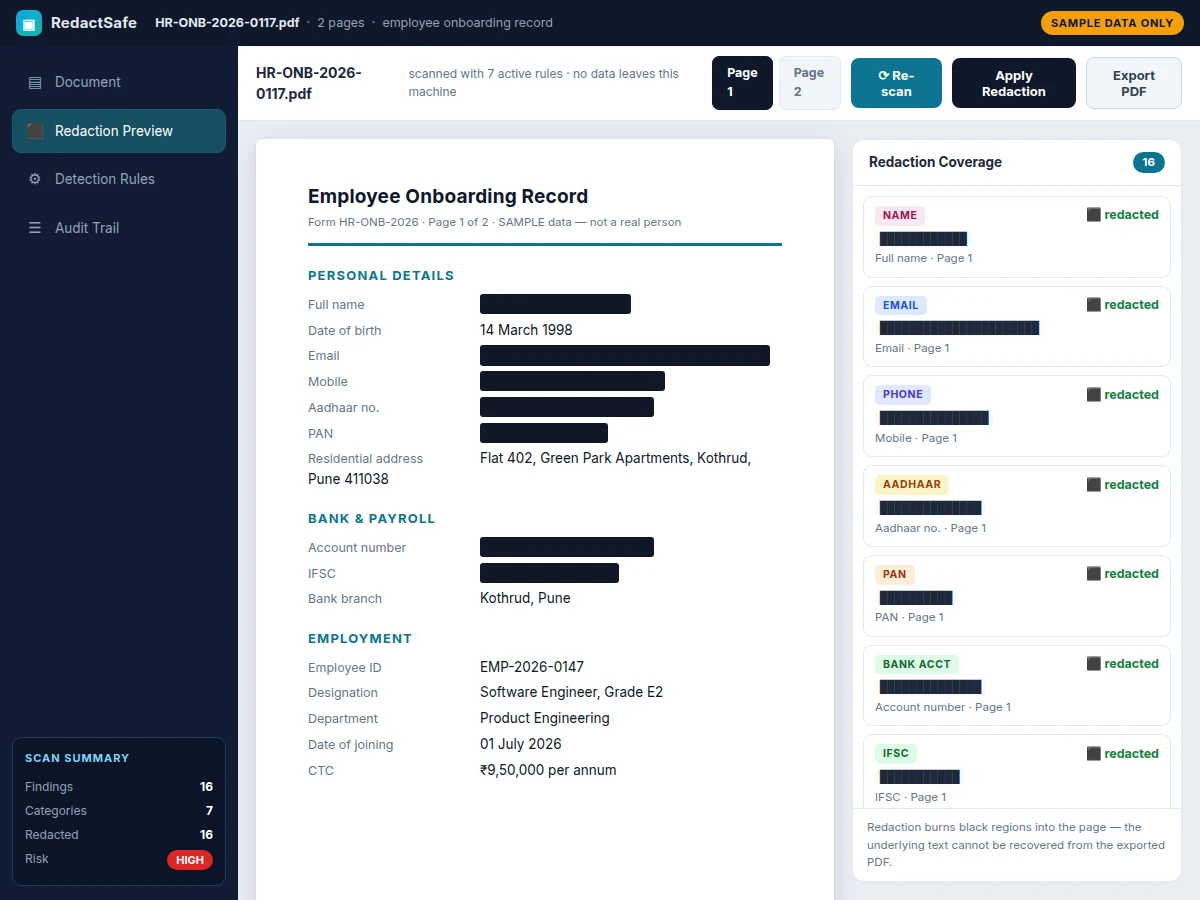
Opens a local PDF, reviews highlighted findings, and confirms the redaction.
Follow the working sequence
How it works
- The tool opens a PDF locally and extracts the text layer page by page — no upload, no network call.
- The rule engine runs all enabled regex and dictionary patterns over the text, producing a finding list with category, matched value and page location.
- The document view renders the page with findings highlighted in amber; the inspector lists each finding with its rule, value and field label.
- On approval, the redaction pass deletes each finding's underlying text objects and paints opaque black regions in their place.
- The preview view shows redaction coverage before export; the buyer confirms, then the export step writes the redacted PDF with a hash manifest.
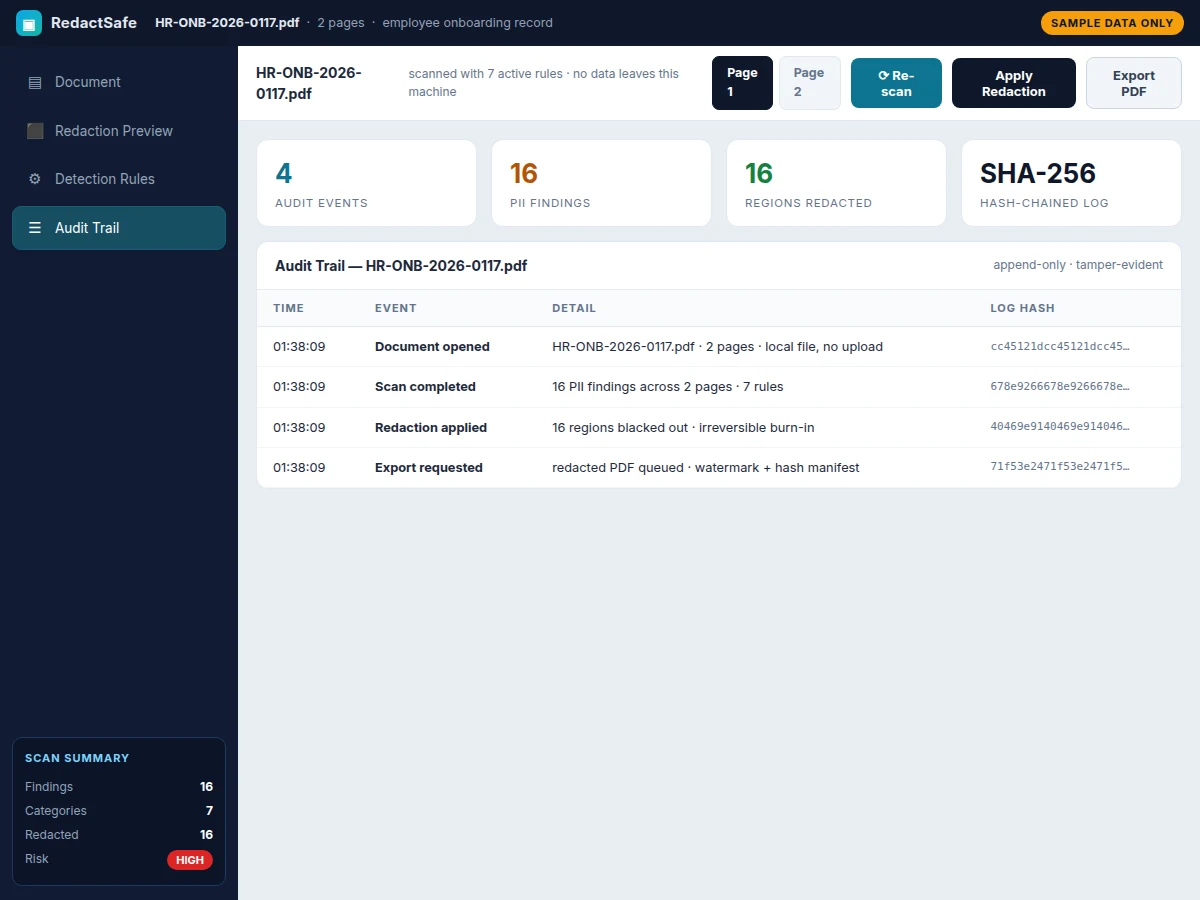
- The audit module logs open, scan, redaction and export events into the hash-chained table, and the buyer verifies correctness with a copy-paste extraction test on the exported file.
Tech stack:
- Python 3.10+
- PyMuPDF (PDF text extraction and object removal)
- Regular expressions + offline name dictionary (detection engine)
- SHA-256 hash-chained audit log
- Electron (desktop shell) or Tkinter/PyQt (alternative UI)
- HTML5 + CSS3 + JavaScript (reference demo UI)
- Synthetic sample PDFs (SAMPLE PII test data)
- Git
| Parameter | Value |
|---|---|
| Detection rules | 7 rules (regex + name dictionary) |
| PII categories | 7 — email, phone, Aadhaar, PAN, bank account, IFSC, person names |
| Detection recall | Approximately 95% on well-formed fields (design target, not measured) |
| Scan speed | Approximately 1–2 seconds per page on a mid-range laptop (expected) |
| Audit integrity | SHA-256, hash-chained, append-only |
| Export | Redacted PDF + hash manifest |
| Platforms | Windows, macOS, Linux |
| RAM | Approximately 4 GB (design target) |
| Network | None — fully offline operation |
Project features
- [Rule-based PII detection] Seven transparent rules find emails, Indian mobile numbers, Aadhaar-style numbers (with Verhoeff checksum validation), PAN-style identifiers, bank account numbers, IFSC codes and person names — every rule is inspectable, no black-box model.
- [True irreversible redaction] The tool deletes the underlying PDF text objects and paints opaque black regions, so copy-pasting from the exported file recovers nothing — verified with a before/after extraction check.
- [Redaction preview with coverage] Before exporting, the preview view shows exactly which regions are blacked out and lists every redacted finding by category, page and field label.
- [Hash-chained audit trail] Every document-open, scan, redaction and export event is appended to a tamper-evident log, each entry SHA-256-hashed and chained to the previous one so silent edits are detectable.
- [Rule management view] All seven detection rules are listed with their patterns, categories and actions, each individually toggleable so the buyer can see and control exactly what gets flagged.
- [Synthetic test documents] Ships with sample PDFs containing clearly-marked SAMPLE PII (16 findings across the 2-page demo document), so testing and the viva demo need no real personal data.
- [Export with hash manifest] The export step writes the redacted PDF together with a hash manifest that ties the file to its audit-log entries.
What is included
- Working desktop PDF redaction tool (open, scan, preview, redact, export)
- Detection rule engine: 7 documented regex + dictionary rules with Verhoeff validation for Aadhaar-style numbers
- Hash-chained audit-trail module with export manifest
- Synthetic sample PDFs with clearly-marked SAMPLE PII for testing and demos
- Reference single-file HTML/CSS/JS demo of the full UI
- Project report PDF (background, redaction theory, rule design, methodology, verification procedure)
- PPT presentation for final review
- Viva Q&A preparation document (regex design, PDF internals, true vs fake redaction, audit-log hashing)
Timeline
- Built-to-order delivery in approximately 2–3 weeks from order confirmation (expected), covering the build, rule tuning, testing, documentation and the viva kit.
Support
- Approximately 30 days of post-delivery support over WhatsApp and email for installation help, demo walkthrough and viva preparation (expected scope).
Limitations & prerequisites
- Detection is pattern-based: recall of approximately 95% on well-formed fields is a design target, honestly stated — no measured benchmark is claimed.
- Person-name detection uses an offline dictionary, not an ML name-entity model, so unusual spellings or names outside the dictionary may be missed.
- The current build processes text-based PDFs; handwritten or scanned image PDFs need an OCR stage, which is listed as future scope.
- Aadhaar-style numbers get Verhoeff checksum validation; other 12-digit sequences are flagged on pattern alone and may include false positives.
- The tool redacts and logs — it does not encrypt the PDF, manage user identities, or control who can open the file.
- The audit log proves the sequence of actions, not the identity of the operator; per-user login is future scope.
Frequently Asked Questions
How does it detect PII without machine learning?
It uses seven transparent rules: regular expressions for emails, Indian mobile numbers, Aadhaar-format numbers, PAN-format identifiers, bank account numbers and IFSC codes, plus an offline Indian-name dictionary. Every rule is inspectable and toggleable, which makes the detection logic easy to explain in a viva.
Is the redaction truly irreversible?
Yes. Fake redaction paints a black box over visible text while the text layer survives underneath. This tool deletes the underlying PDF text objects and then paints the region opaque, so copying text out of the exported file recovers nothing — the buyer verifies this with a before/after extraction test.
What is the hash-chained audit trail?
Every document-open, scan, redaction and export event is appended to a log, and each entry carries a SHA-256 hash computed from the previous entry's hash. Any attempt to edit or delete an entry breaks the chain, making tampering detectable on inspection.
Which PII formats are covered?
Seven categories: email addresses, Indian mobile numbers, Aadhaar-style 12-digit numbers with Verhoeff checksum validation, PAN-style identifiers, bank account numbers near bank keywords, IFSC codes, and person names from an offline dictionary. Rules can be toggled and new patterns added.
Is this project suitable for a final-year project?
Yes — for Computer Science and IT programs. It combines regex engineering, PDF internals, desktop UI design and security engineering (irreversible redaction plus hash-chained audit logging) in one coherent, demonstrable system with honest, well-scoped limitations.
Components & software requirements
- Python 3.10+
- PyMuPDF (PDF text extraction and object removal)
- Regular expressions + offline name dictionary (detection engine)
- SHA-256 hash-chained audit log
- Electron (desktop shell) or Tkinter/PyQt (alternative UI)
- HTML5 + CSS3 + JavaScript (reference demo UI)
- Synthetic sample PDFs (SAMPLE PII test data)
- Git
Delivery information
Built-to-order project. Delivery timeline is shared after order confirmation based on current queue.
Support terms
Complete documentation, setup guide, and viva preparation included. Support for setup and explanation provided.
Download free synopsis (PDF)
Enter your name and email — the synopsis PDF downloads immediately. We may send occasional project updates; no spam, unsubscribe anytime.