
More project photos (2)
The problem
Hiring still runs on a patchwork of portals, spreadsheets and email threads. Job seekers apply into a black box and rarely learn where their application stands, while small employers manage candidates in inboxes and lose good people to slow follow-up. Existing portals also hide salary ranges and give employers no shared pipeline, so screening, interviews and offers happen with no single source of truth. This project builds a two-sided job board that fixes the coordination problem directly: a seeker portal with transparent salary ranges and live application tracking, and an employer side with a dashboard and a kanban-style applicant tracking board over the same data. Because both roles interact through one REST API with JWT authentication, the build demonstrates the complete request lifecycle students are expected to master — data modelling, API design, auth, role-gated UI and state management.
Searches jobs, applies with a resume upload and tracks every application.
Follow the working sequence
How it works
- A visitor opens the seeker portal and searches jobs; the Express API applies keyword, location, type and work-mode filters in MongoDB and returns matching openings.
- Opening a job shows the full detail page — description, responsibilities, requirements, salary range and company info.
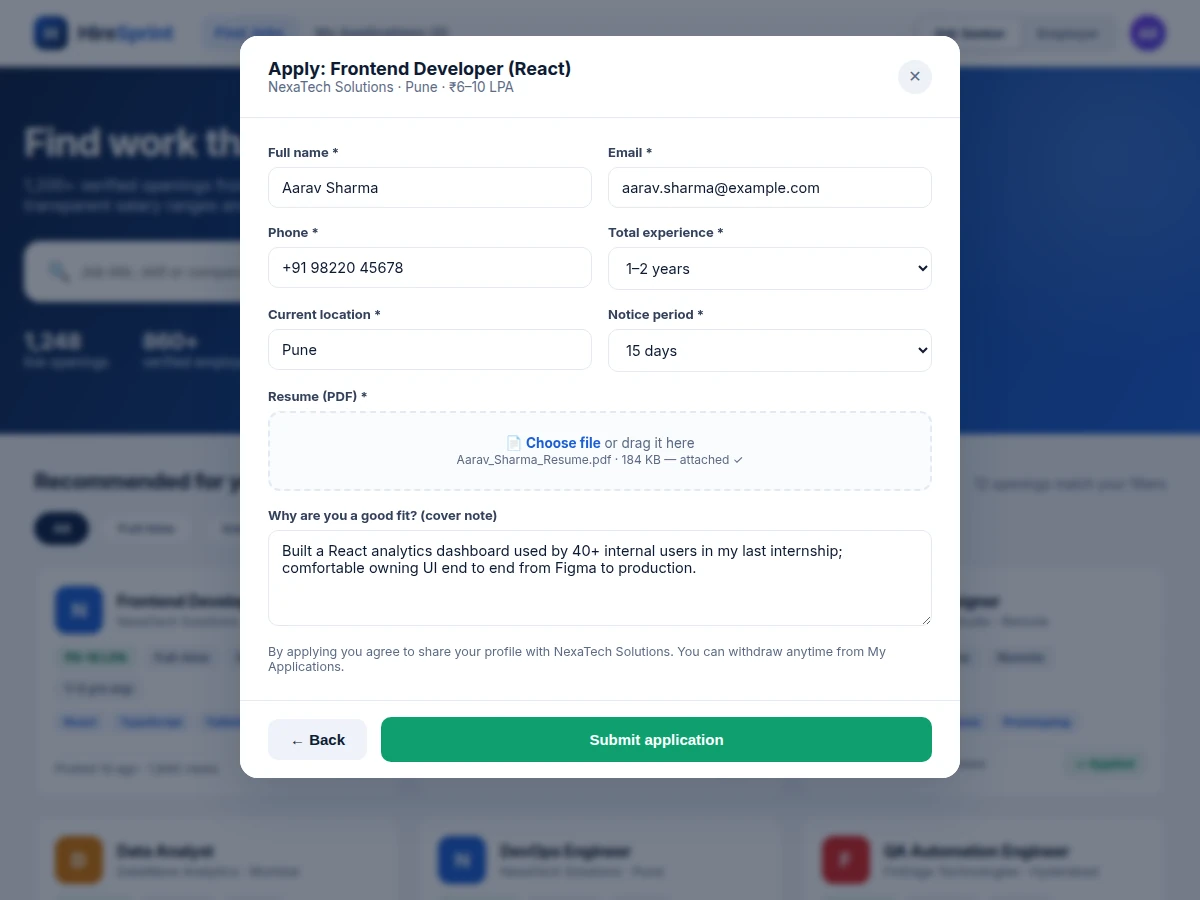
- The seeker submits the apply form with a resume upload; the server validates the file, stores it, and creates an application record plus a pipeline event at stage "Applied", returning an application ID.
- The application appears instantly in the seeker's My Applications tracker as a stepper with a timeline.
- The employer signs in (JWT, employer role) to the dashboard: KPIs, hiring funnel and alerts computed from live application data.
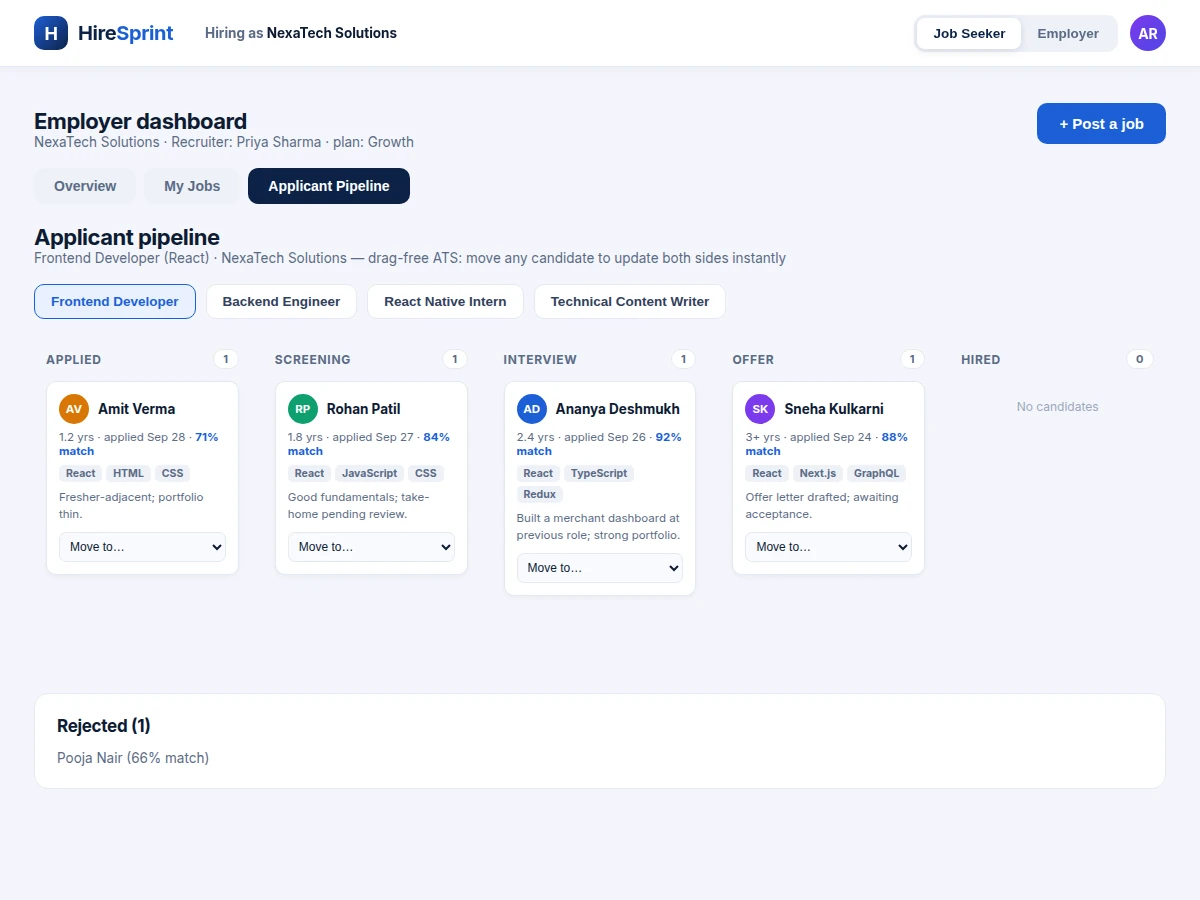
- In the applicant pipeline board, the employer moves candidate cards across stages; each move writes a pipeline event.
- The seeker's tracker reflects the new stage on next view — the two-sided ATS loop that is the heart of the project. Skill-match scores are computed by a configurable keyword/skill-overlap rule, not a machine-learning model.
Tech stack:
- MongoDB (Mongoose ODM)
- Express.js (REST API)
- React 18 + Vite (frontend)
- Node.js 18+ (runtime)
- JSON Web Tokens (auth)
- bcryptjs (password hashing)
- Multer (resume uploads)
- Axios (API client)
| Parameter | Value |
|---|---|
| Architecture | Three-tier MERN: React SPA → Express REST API → MongoDB |
| Authentication | JWT access tokens, bcrypt-hashed passwords, role middleware |
| User roles | Job seeker, Employer (role-gated API + UI) |
| API style | Versioned REST endpoints for auth, jobs, applications, pipeline |
| File uploads | Resume PDF, size-limited, validated and stored server-side |
| Application pipeline | Applied → Screening → Interview → Offer → Hired (+ Rejected pool) |
| Candidate scoring | Rule-based skill/keyword overlap (configurable; not ML) |
| Demo seed data | 12 realistic jobs, 14 candidates across pipeline stages (seeded) |
| Deployment target | VPS or Node-compatible PaaS; MongoDB local or Atlas (hosting costs buyer's) |
| API response | Design target: p95 under 300 ms on local dev hardware (not a measured claim) |
Project features
- [Job search & filtering] Keyword, location, job-type and work-mode filters applied server-side, with detailed job pages showing salary range, responsibilities, requirements and company info.
- [One-click apply flow] Profile form, resume PDF upload with validation, cover note and an application ID for every submission — designed to complete in about two minutes.
- [Live application tracking] Every application renders as a stage stepper (Applied → Screening → Interview → Offer → Hired) with a dated timeline; seekers can withdraw anytime.
- [Employer dashboard] Hiring KPIs, a visual hiring funnel and "needs attention" alerts for candidates stalled in a stage too long.
- [Kanban applicant pipeline (ATS)] Employers move candidate cards across stages; each card shows experience, skills, a skill-match score and recruiter notes, with a separate rejected pool.
- [Job post management] Publish, edit, renew and deactivate openings with per-job applicant and view counts.
- [JWT role-based authentication] Separate seeker and employer roles enforced on both the API and the UI; passwords hashed, routes protected by middleware.
What is included
- Complete MERN source code (React client + Express API, documented)
- MongoDB schema definitions and demo seed script (12 jobs, 14 candidates)
- REST API documentation with all endpoints and auth rules
- Setup and deployment guide (local + VPS/PaaS)
- Project report PDF (background, architecture, methodology, modules)
- PPT presentation for final review
- Viva Q&A preparation document (MERN concepts, JWT, REST design, ATS workflow)
Limitations & prerequisites
- The base build has no real email/SMS notifications — stage changes reflect in-app; notifications are a listed customization.
- Candidate skill-match scores are rule-based keyword overlap, not machine learning; there is no resume parsing — resumes are uploaded and stored, not auto-read.
- Interview scheduling and calendar integration are not included in the base build (future scope).
- Hosting, domain and MongoDB Atlas costs are the buyer's; the project ships deployment-ready, not deployed.
- The base build seeds one employer workspace; multi-tenant hardening for many employers is a customization.
- No payment gateway is integrated; featured/paid job posts are future scope.
Frequently Asked Questions
What is the main technology used?
The MERN stack throughout: MongoDB with Mongoose for data, Express.js for the REST API, React 18 (Vite) for the frontend, and Node.js as the runtime. Authentication uses JSON Web Tokens with bcrypt-hashed passwords and role middleware, so the same concepts appear in the code, the report and the viva Q&A.
Is the database included?
Yes. You receive the complete MongoDB schema definitions plus a seed script that loads 12 realistic jobs and 14 candidates spread across pipeline stages, so every screen — search, apply, tracker, dashboard, kanban — is demonstrable immediately after setup, on day one.
Can it be hosted online?
Yes. The API is a standard Node.js app deployable to any VPS or Node-compatible PaaS, and the React build serves as static files; MongoDB can run locally or on Atlas. Hosting, domain and database-service charges are the buyer's and are not part of the project cost.
Does it use AI for candidate matching?
No, and the page does not claim otherwise. Candidate skill-match scores come from a configurable rule that compares the candidate's listed skills against the job's required skills. It is transparent and explainable, which is also easier to defend in a viva than a black-box scorer.
Can more roles or modules be added?
Yes. Realistic customizations include an admin role for platform moderation, email notifications on stage changes, interview scheduling with calendar integration, resume parsing to pre-fill forms, and featured paid job posts. Each is scoped separately based on technical feasibility and timeline.
Is this project suitable for a final-year project?
Yes — for Web Development, Computer Science and IT programs. It demonstrates full-stack development end to end: data modelling, REST API design, JWT authentication, role-based access, file uploads and a genuinely two-sided workflow, all of which map directly to standard viva questions. Suitable for B.E./B.Tech final-year projects in Web Development, Computer Science and IT.
Components & software requirements
- MongoDB (Mongoose ODM)
- Express.js (REST API)
- React 18 + Vite (frontend)
- Node.js 18+ (runtime)
- JSON Web Tokens (auth)
- bcryptjs (password hashing)
- Multer (resume uploads)
- Axios (API client)
Delivery information
Built-to-order project. Delivery timeline is shared after order confirmation based on current queue.
Support terms
Complete documentation, setup guide, and viva preparation included. Support for setup and explanation provided.
Download free synopsis (PDF)
Enter your name and email — the synopsis PDF downloads immediately. We may send occasional project updates; no spam, unsubscribe anytime.