
More project photos (3)
The problem
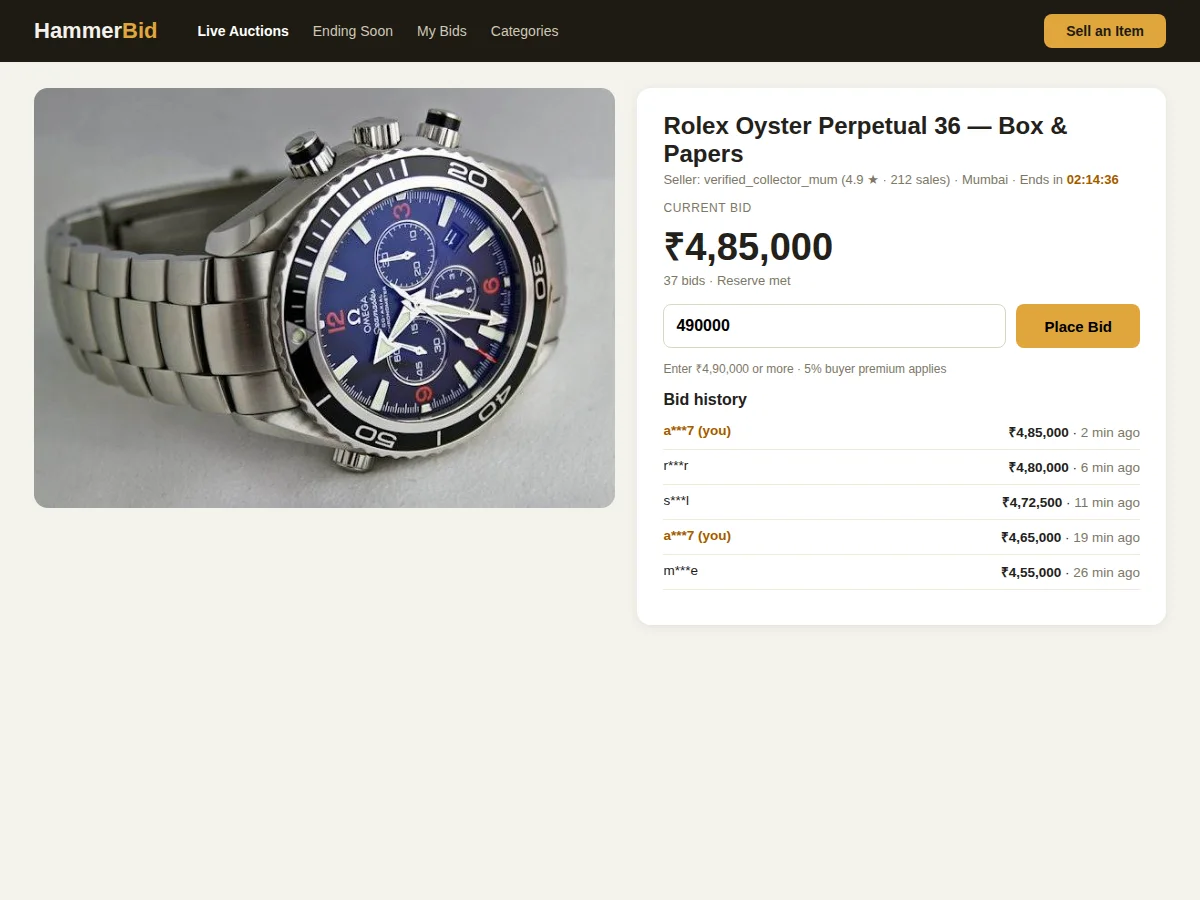
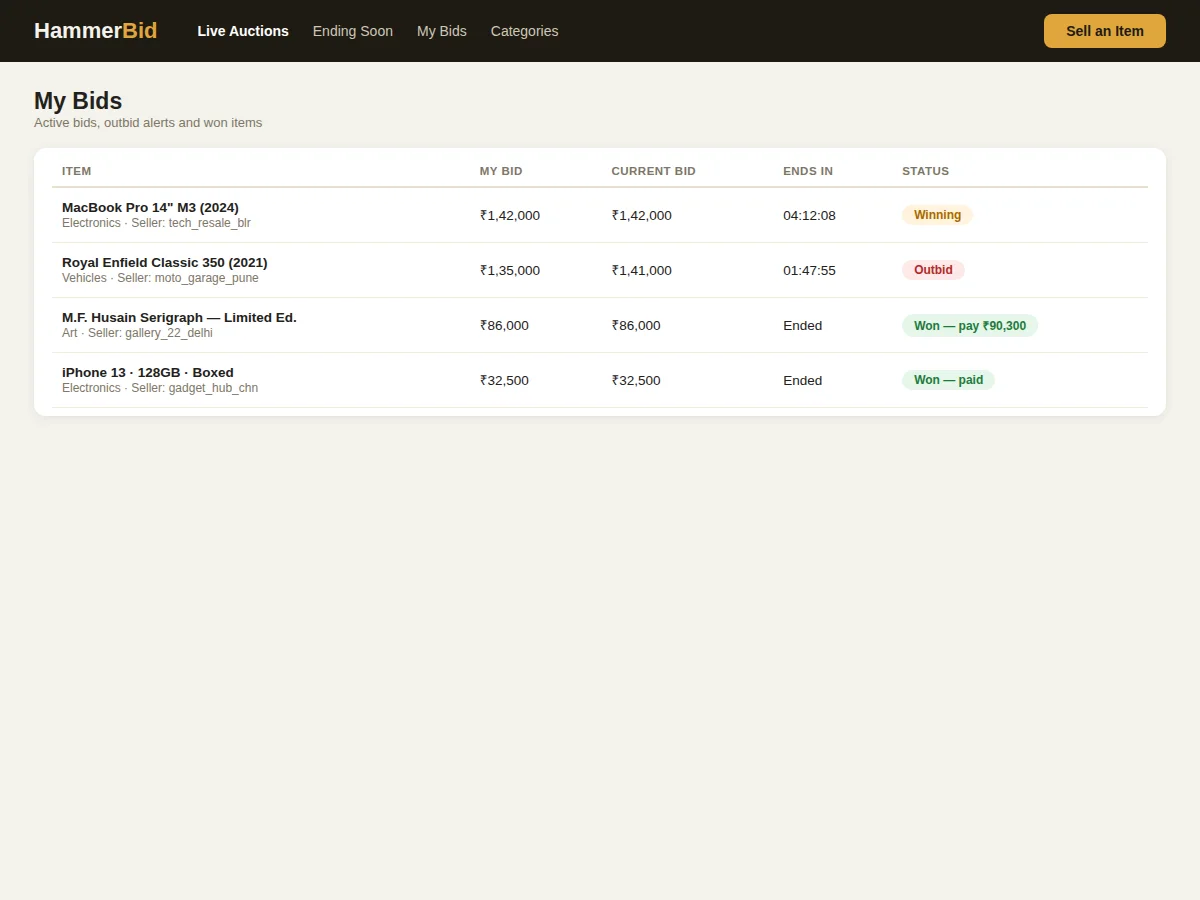
Selling used goods, collectibles and surplus inventory online usually means fixed-price listings where sellers guess the price and buyers haggle in chat — auctions discover the true market price instead. But running one needs real-time bid updates, strict time rules and trust that the winner actually pays. This project builds the complete loop: sellers list items with photos, starting price, reserve price and duration; bidders place bids that broadcast live to every viewer; countdown timers close auctions with anti-sniping extensions; and the winner pays through an escrow-style hold before the seller ships. The engineering focus is the concurrency problem — many bids arriving in the same second are ordered fairly and accepted exactly once.
Lists items and ships to the winner.
Follow the working sequence
How it works
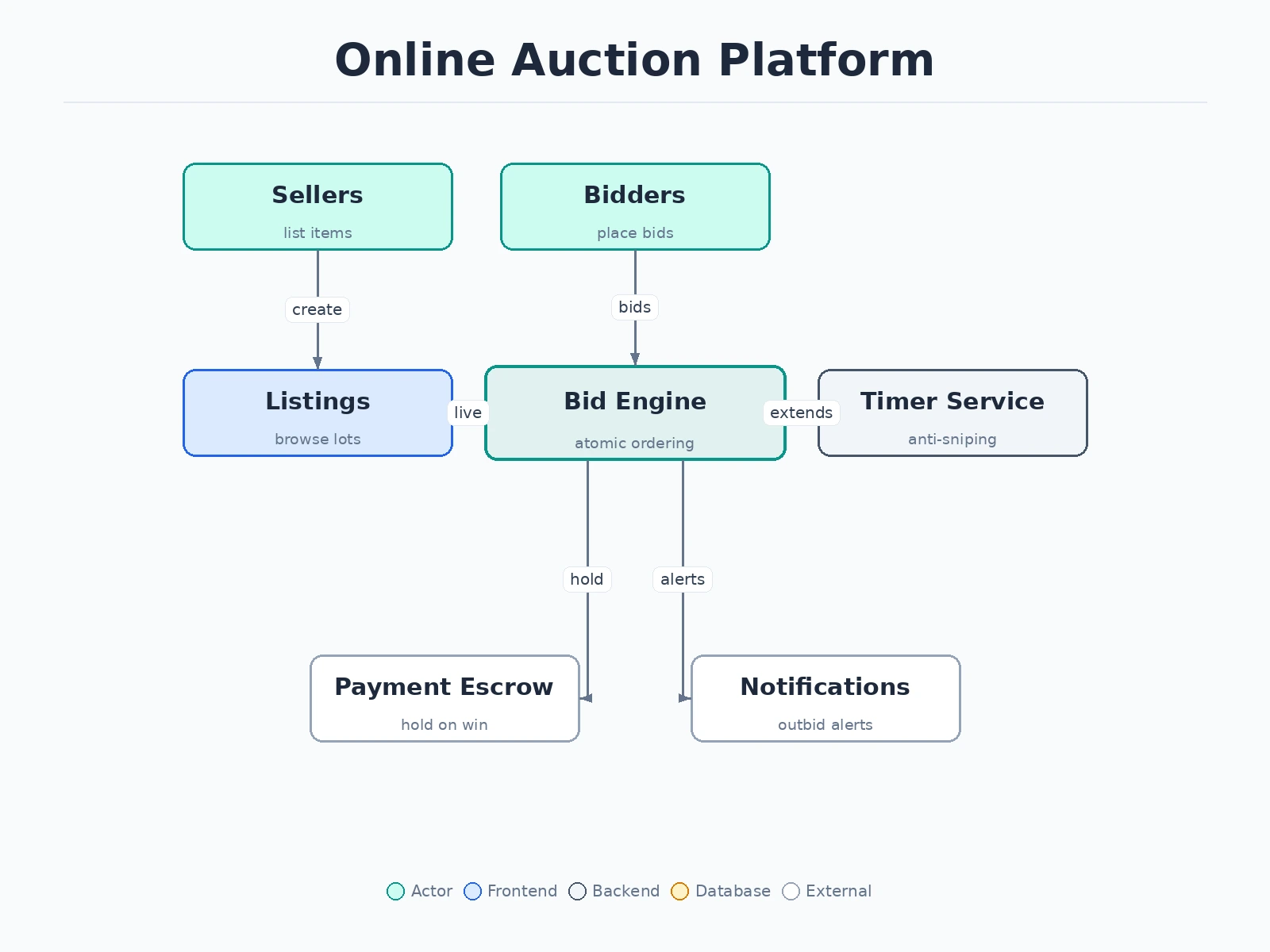
- A seller creates a listing with photos, description, starting bid, optional reserve price and duration.
- When the auction goes live, bidders join its real-time room and place bids.
- The bid engine atomically checks each bid against the current high bid before accepting, then broadcasts the new price.
- Proxy bids auto-increment on a bidder's behalf up to their hidden maximum.
- A bid in the closing window extends the auction, defeating last-second sniping.
- At close, the scheduler declares the winner (if reserve is met), creates the payment hold and notifies both parties; the seller ships and confirms to release funds.
Tech stack:
- Next.js 14 frontend on Node.js 18+
- Socket.io WebSocket rooms per auction
- MongoDB (listings, bids, users, orders)
- Atomic find-and-modify bid acceptance
- Scheduler for auction closing and extensions
- Payment gateway sandbox for hold/release flow
- JWT authentication
| Parameter | Value |
|---|---|
| Bid ordering | Atomic compare-and-set; exactly-once acceptance |
| Real-time latency | Sub-second broadcast on local network (design target) |
| Anti-sniping window | 5 minutes extension (configurable) |
| Reserve price | Hidden from bidders; enforced at close |
| Payment | Sandbox holds; live mode needs merchant account |
| Deployment | Self-hosted Node.js server |
Project features
- [Real-time bidding] WebSocket rooms per auction broadcast every bid, price change and close event to all viewers instantly.
- [Atomic bid engine] Bids pass through an atomic compare-and-set on the current high bid — concurrent bids are ordered, losers get clean rejections, the price never goes backwards.
- [Proxy auto-bidding] Bidders set a hidden maximum; the engine auto-increments on their behalf up to that ceiling.
- [Anti-sniping] Bids in the final minutes extend the auction by a fixed window, so last-second sniping cannot steal items.
- [Reserve prices] Sellers set a hidden minimum; the item sells only if bidding reaches it, protecting the seller.
- [Escrow-style payment hold] The winner's payment is held on close and released to the seller after shipment confirmation.
- [Trust features] Public bid history on every listing, seller verification, and two-sided ratings after each sale.
What is included
- Complete source code (Next.js app, bid engine, Socket.io layer, seed listings)
- Bid-engine design document (concurrency approach, state transitions)
- Setup guide (local run, gateway sandbox, deployment notes)
- Project report PDF (background, real-time architecture, concurrency design, testing notes)
- PPT presentation for final review
- Viva Q&A preparation document (WebSockets, atomic operations, auction theory, escrow flows)
Limitations & prerequisites
- Payment holds run in gateway sandbox mode — live collection needs a merchant account and compliance review.
- The demo ships with sample listings and simulated bidders; real traffic needs production hardening.
- Shill-bidding detection is rule-based (visible history); statistical fraud detection is future scope.
- Image uploads are local in the demo; production needs object storage.
- Very high bid concurrency (thousands/second) would need a dedicated message queue beyond this build.
- Shipping and logistics are coordinated between buyer and seller, not fulfilled by the platform.
Frequently Asked Questions
How are simultaneous bids handled fairly?
Each bid goes through an atomic database operation that only succeeds if it beats the current high bid at that exact instant — the database itself orders them, so there are no ties or overwrites.
What is proxy bidding?
You enter your maximum; the system bids the smallest increment needed to keep you ahead, up to your ceiling, without revealing it.
What happens if the reserve price is not met?
The item does not sell — no winner is declared and no payment is taken.
How does anti-sniping work?
Any bid placed in the final 5 minutes pushes the end time out by 5 minutes, giving others a fair chance to respond.
Is the payment real?
The demo uses sandbox mode. The hold-then-release flow is fully implemented and works with live keys after merchant onboarding.
Is this project suitable for a final-year project?
Yes — for Computer Science, IT and related programs. It demonstrates real-time systems, concurrency control, state machines and payment-flow design. Suitable for B.E./B.Tech final-year projects in Computer Science, IT and Web Development.
Components & software requirements
- Next.js 14 frontend on Node.js 18+
- Socket.io WebSocket rooms per auction
- MongoDB (listings, bids, users, orders)
- Atomic find-and-modify bid acceptance
- Scheduler for auction closing and extensions
- Payment gateway sandbox for hold/release flow
- JWT authentication
Delivery information
Built-to-order project. Delivery timeline is shared after order confirmation based on current queue.
Support terms
Complete documentation, setup guide, and viva preparation included. Support for setup and explanation provided.
Download free synopsis (PDF)
Enter your name and WhatsApp number — the synopsis PDF downloads immediately. We may send occasional project updates on WhatsApp; no spam.