
More project photos (2)
The problem
FirstAid+ is an offline-first Android app that puts step-by-step first-aid guidance and one-tap emergency calling in the pocket of anyone carrying a phone, with zero dependence on the internet. In India, the minutes before an ambulance arrives often decide outcomes — yet most bystanders freeze because they do not know the correct first response, and few can recall the right helpline number under stress. Existing first-aid resources are usually web pages or videos that fail exactly where they are needed most: highways, villages, basements and disaster zones with no signal. FirstAid+ stores 24 complete first-aid guides — bleeding, burns, fractures, CPR, choking, snake bite, heatstroke and more — in an on-device Room database with instant full-text search, alongside a verified directory of Indian emergency numbers. A hold-to-confirm SOS button runs a loud 3-second countdown before dialling 112, preventing pocket dials while staying usable in panic. The build demonstrates real Android engineering: offline storage, runtime permissions, foreground services and Material 3 UI.
Opens a first-aid guide or taps the SOS button in an emergency.
Follow the working sequence
How it works
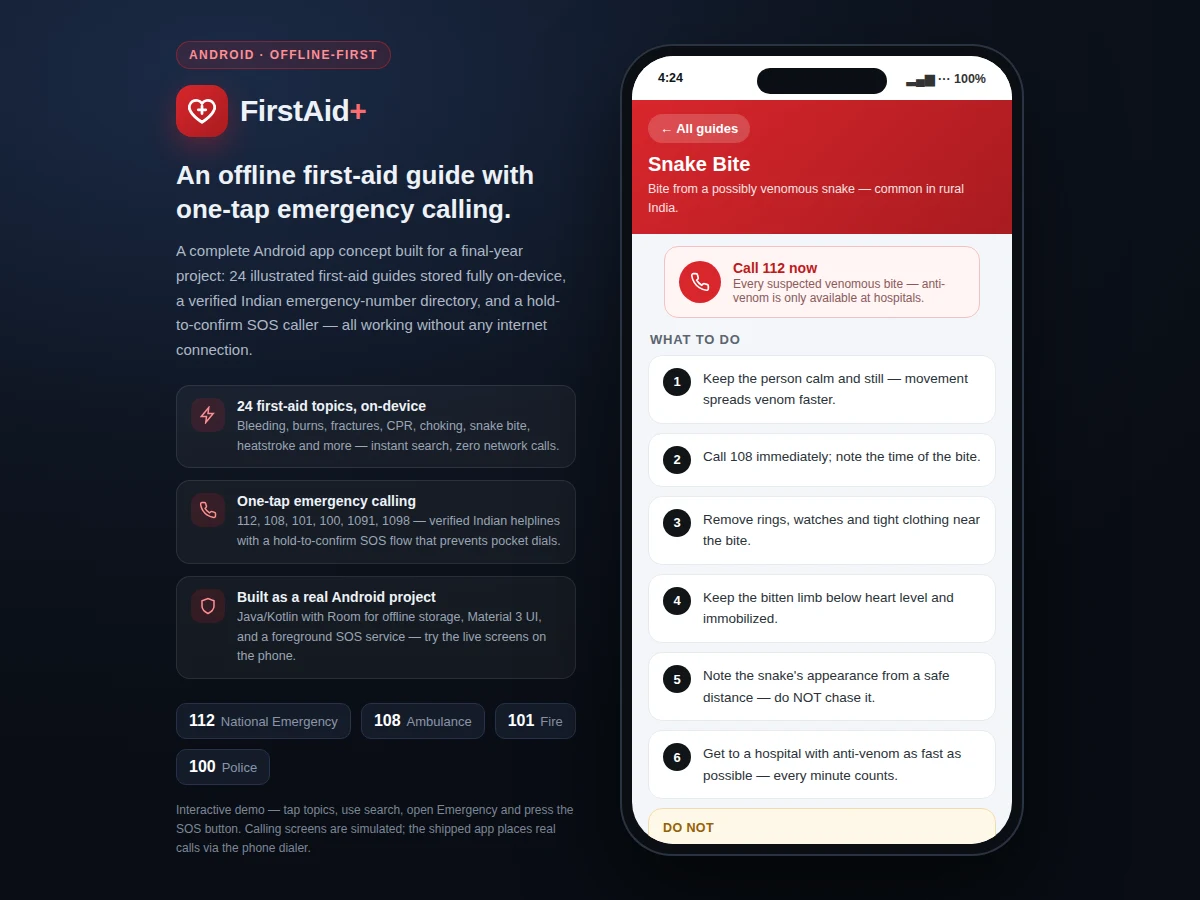
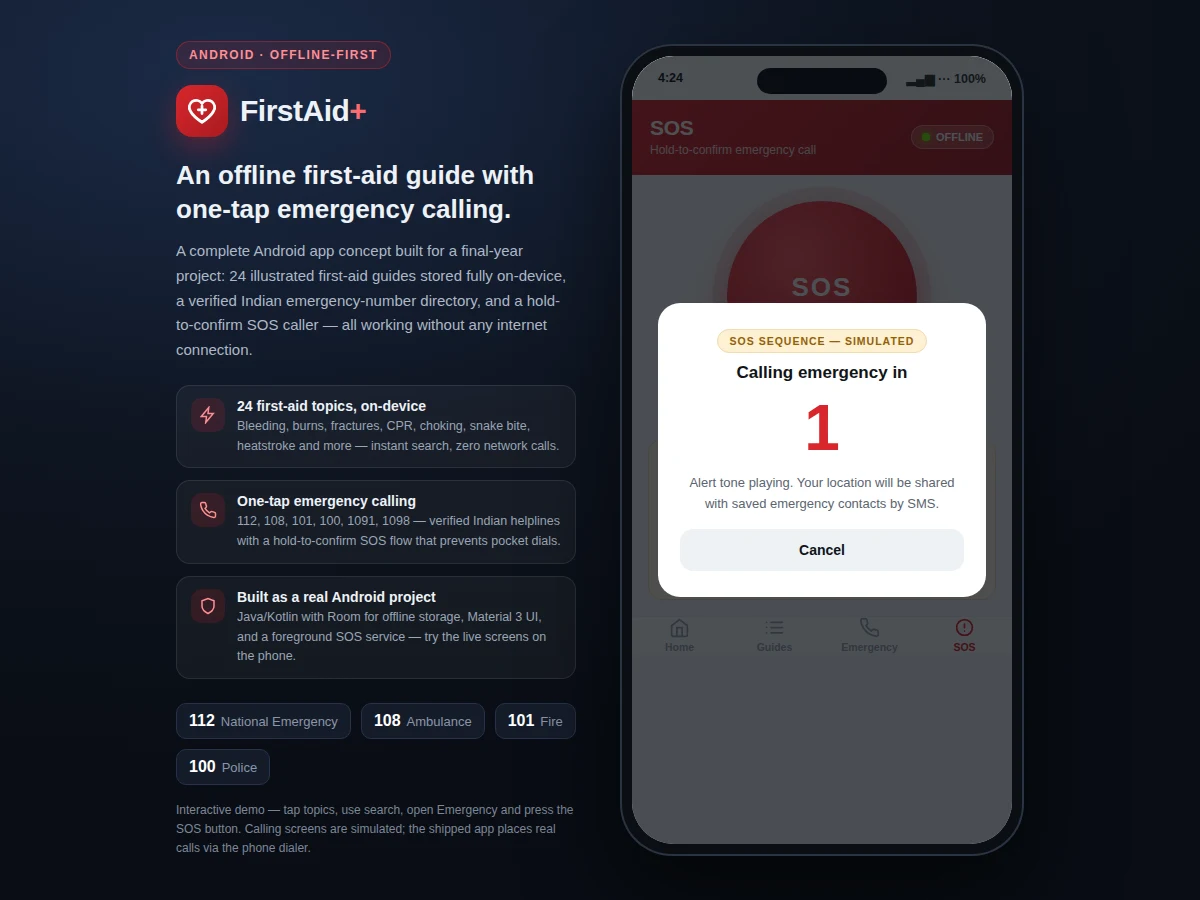
FirstAid+ is an offline-first system: all content is compiled into the app at build time, so the emergency path never touches the network. On first launch the app seeds its Room (SQLite) database with the 24 first-aid topics — 135 numbered steps and 51 warnings — and the verified emergency-number directory. The user browses by category (Bleeding, Burns, Bones, Breathing, Bites, Medical, Accidents, Environment) or types into search, which filters the full corpus instantly on-device. Opening a topic renders its steps, "do not" list and a context-aware "Call 112 now" strip stating exactly when to call. Tapping a helpline fires an ACTION_CALL intent through the phone dialer. The SOS tab requires a deliberate 2-second press-and-hold, then plays a loud tone through a 3-second countdown with a Cancel button, and finally dials 112 — optionally sending a GPS location SMS to saved contacts. Only the call and SMS steps need a cellular signal; everything else works in airplane mode.
- On first launch, the app seeds its Room (SQLite) database with 24 first-aid topics and the verified emergency-number directory — no download, no account, no internet.
- The home screen shows urgent guides and category chips; tapping a card or typing in search filters the on-device corpus instantly.
- Opening a topic renders numbered action steps, the "do not" warnings, and a "Call 112 now" strip with the exact trigger condition for that emergency.
- The Emergency tab lists 112, 108, 101, 100, 1091 and 1098; tapping a number fires an ACTION_CALL intent through the phone dialer.
- The SOS tab requires a deliberate 2-second press-and-hold, which starts a loud 3-second countdown with a visible Cancel button.
- If the countdown completes, the app dials 112 and (optionally) sends a GPS location SMS to up to 3 saved emergency contacts.
- A foreground service keeps the SOS path alive even with the screen locked, and runtime permission screens explain each grant in plain language.
- All guides and numbers work fully offline; only the actual call and SMS steps require a cellular signal.
Tech stack:
- Kotlin
- Android SDK · Android Studio
- Room (SQLite) offline database
- Material 3 UI components
- Fused Location Provider
- Foreground Service API
- AndroidX Navigation
- Gradle build system
| Parameter | Value |
|---|---|
| First-aid topics | 24 (shipped in v1) |
| Numbered action steps | 135 (counted in the content build) |
| "Do not" warnings | 51 (counted in the content build) |
| Emergency numbers | 6 verified Indian helplines (112, 108, 101, 100, 1091, 1098) |
| Content bundle | Approximately 42.5 KB single file (measured in the demo build) |
| Installed app size | Under 25 MB (design target) |
| Minimum Android version | API 26 — Android 8.0 (design target) |
| SOS hold duration | 2 seconds (configurable) |
| SOS countdown | 3 seconds with alert tone (configurable) |
| Saved SOS contacts | Up to 3 (configurable) |
| Offline capability | 100% of guides and numbers; calls and SMS need a cellular signal |
Project features
FirstAid+ is built around four capabilities that work together in a real emergency: an offline library of 24 first-aid guides with instant search, a verified Indian emergency-number directory with tap-to-call, a hold-to-confirm SOS flow with a loud countdown that prevents accidental dials, and an optional location SMS to saved contacts when SOS fires. Every guide follows the same trusted structure — numbered action steps, a "do not" list of common harmful mistakes, and a clear call-112 trigger — so a panicking user never has to interpret prose. The entire content set ships in the app's Room database at install time, which means the guides open in milliseconds with no network, and the search filters all 24 topics as the user types. The SOS path is deliberately physical: press and hold for two seconds, hear the alert tone, watch the countdown, cancel any time.
- [Offline first-aid library] 24 complete guides (bleeding, burns, fractures, CPR, choking, snake bite, heatstroke and more) stored in an on-device Room database with full-text search — every guide opens with no internet.
- [Verified emergency-number directory] 112, 108, 101, 100, 1091 and 1098 with plain-language labels; tapping a number fires the phone dialer directly — cellular signal is enough, internet is not required.
- [Hold-to-confirm SOS] Press-and-hold for 2 seconds, then a loud 3-second countdown with a Cancel option before the app dials 112 — designed so a pocket press can never place a call.
- [Location SMS to saved contacts] Optional: when SOS fires, the app sends the GPS location by SMS to up to 3 pre-saved emergency contacts (implemented; contacts are configured in settings).
- [Structured guide format] Every topic carries numbered action steps, a "do not" list of common harmful mistakes (51 counted in the build), and an explicit call-112 trigger condition.
- [Material 3 Android UI] Clean, large-touch-target interface with category filters and severity tags (urgent / careful / basic) so the right guide is reachable in two taps.
- [Configurable content] Optional customization: guides, numbers and languages are data-driven, so a college can add regional-language content or a local hospital directory on request.
What is included
- Complete Kotlin source code as an Android Studio project
- Room database with all 24 first-aid topics and emergency numbers pre-seeded
- Signed debug APK plus release-build instructions
- Project report PDF (background, architecture, database design, SOS flow, testing)
- PPT presentation for the final review
- Viva Q&A preparation document (Room, services, permissions, Material 3)
- Setup and user guide
Limitations & prerequisites
- This project is an academic prototype and is not a certified medical device — the guides support, but never replace, professional medical help.
- Guide content is reviewed from standard first-aid references, but it is not a substitute for certified first-aid training; techniques should be learned hands-on where possible.
- The call and SOS features need an active SIM and a cellular signal — they do not work in a signal dead zone, while all guides keep working offline.
- Location SMS depends on a GPS fix (typically 10–30 m accuracy outdoors; weak or unavailable indoors), so it is a best-effort aid, not a tracking guarantee.
- Emergency numbers are India-specific (112, 108, 101, 100, 1091, 1098); other countries need the directory reconfigured.
- Guides are text-based with illustrations — offline video demonstrations are not in v1 and are listed as optional customization.
- Coverage is limited to 24 common emergencies; rare conditions and detailed wound care are out of scope.
Frequently Asked Questions
Does the app really work without internet?
Yes. All 24 first-aid guides, the search index and the emergency-number directory live in an on-device Room database, so everything except the actual phone call works in airplane mode. The design target was set deliberately: the content corpus measured just 42.5 KB in the demo build, so the installed app stays under 25 MB.
How does the SOS feature avoid accidental calls?
It requires a deliberate 2-second press-and-hold, then plays a loud alert tone through a 3-second countdown with a large Cancel button before dialling 112. A single tap, a pocket press or a lock-screen bump cannot trigger a call — the flow was designed so panic, not accidents, drives it.
Is this project suitable for a final-year project?
Yes, for Computer Engineering, IT and Computer Science programs. It demonstrates offline-first architecture with Room, runtime permissions, foreground services, Material 3 UI design and a genuinely useful emergency workflow — a combination that gives strong viva material beyond a basic CRUD app.
Which emergency numbers are included?
Six verified Indian helplines: 112 (national emergency), 108 (ambulance), 101 (fire), 100 (police), 1091 (women helpline) and 1098 (child helpline). Each carries a plain-language label so a stressed user picks the right one, and the directory is data-driven so numbers can be reconfigured for other regions.
Can the app be customized for my college or region?
Yes. Guides, numbers and categories are data-driven, so regional-language content, a local hospital directory, campus emergency contacts or offline video demonstrations can be added on request. The base build ships the 24 English topics and the six Indian helplines described above.
What will I receive with this project?
The complete Kotlin source as an Android Studio project, the pre-seeded Room database, a signed debug APK with release-build instructions, the project report PDF, a review PPT, a viva Q&A document and a setup guide — everything needed to build, demo and defend the project.
Components & software requirements
- Kotlin
- Android SDK · Android Studio
- Room (SQLite) offline database
- Material 3 UI components
- Fused Location Provider
- Foreground Service API
- AndroidX Navigation
- Gradle build system
Delivery information
Built-to-order project. Delivery timeline is shared after order confirmation based on current queue.
Support terms
Complete documentation, setup guide, and viva preparation included. Support for setup and explanation provided.
Download free synopsis (PDF)
Enter your name and WhatsApp number — the synopsis PDF downloads immediately. We may send occasional project updates on WhatsApp; no spam.