
More project photos (2)

The problem
Compost units, nurseries and small construction sites separate usable fines from coarse lumps by hand — shaking a manual sieve is slow, dusty, tiring, and the grading changes from batch to batch with the operator. Motorized trommels used in industry solve this properly but are large, expensive machines, far out of reach for a college project or a small unit. This project builds a compact motorized trommel sieve: a rotating cylindrical drum wrapped in interchangeable wire-mesh panels, inclined a few degrees and carried on support rollers over a fabricated MS-angle frame. A small single-phase gear motor turns the drum through a chain or belt reduction at low RPM. Material fed in at the high end through a hopper tumbles and travels down the drum as it rotates; fines fall through the mesh into a collection tray below and oversize discharges at the low end. Unlike a vibrating or hand-shaken sieve, the rotating drum grades continuously in a single pass with far less mesh blinding, and there is no vibrator to tune.
How it works
- Material (dry compost, sand or small aggregate) is poured into the feed hopper at the high end of the drum; the operator feeds in small, steady batches to avoid overloading the mesh.
- The 0.25–0.5 HP single-phase gear motor runs through the chain or belt reduction, rotating the drum at approximately 10–20 RPM (design target).
- Rotation tumbles the material against the mesh; particles smaller than the mesh openings fall through into the collection tray directly beneath the drum.
- The 3–5 degree drum incline makes the remaining material travel axially toward the low end with no pusher mechanism needed.
- With two mesh zones on the drum (for example 5 mm followed by 10 mm panels), fines drop through the first section and mid-size particles through the second, giving up to three graded fractions.
- Oversize material discharges from the low end of the drum into its own tray for reprocessing or disposal.
- Mesh panels are unbolted and swapped to change the grading sizes; the drive tension is re-set on the slotted motor mount and grading resumes.
| Parameter | Value |
|---|---|
| Drum diameter | Approximately 300–400 mm (design) |
| Drum length | Approximately 600–900 mm (design) |
| Drum inclination | 3–5 degrees (design) |
| Drum speed | Approximately 10–20 RPM (design target) |
| Mesh panels | Interchangeable wire mesh, e.g. 5 mm and 10 mm (configurable) |
| Motor | 0.25–0.5 HP single-phase gear motor with chain/belt reduction |
| Frame | Welded MS-angle frame with support roller assembly |
| Throughput | Approximately 30–60 kg/h on dry compost/sand (design target; depends on feed moisture and mesh condition) |
| Power supply | Single-phase 230 V AC (proper earthing required) |
| Graded fractions | 2–3 size fractions per pass (design) |
Project features
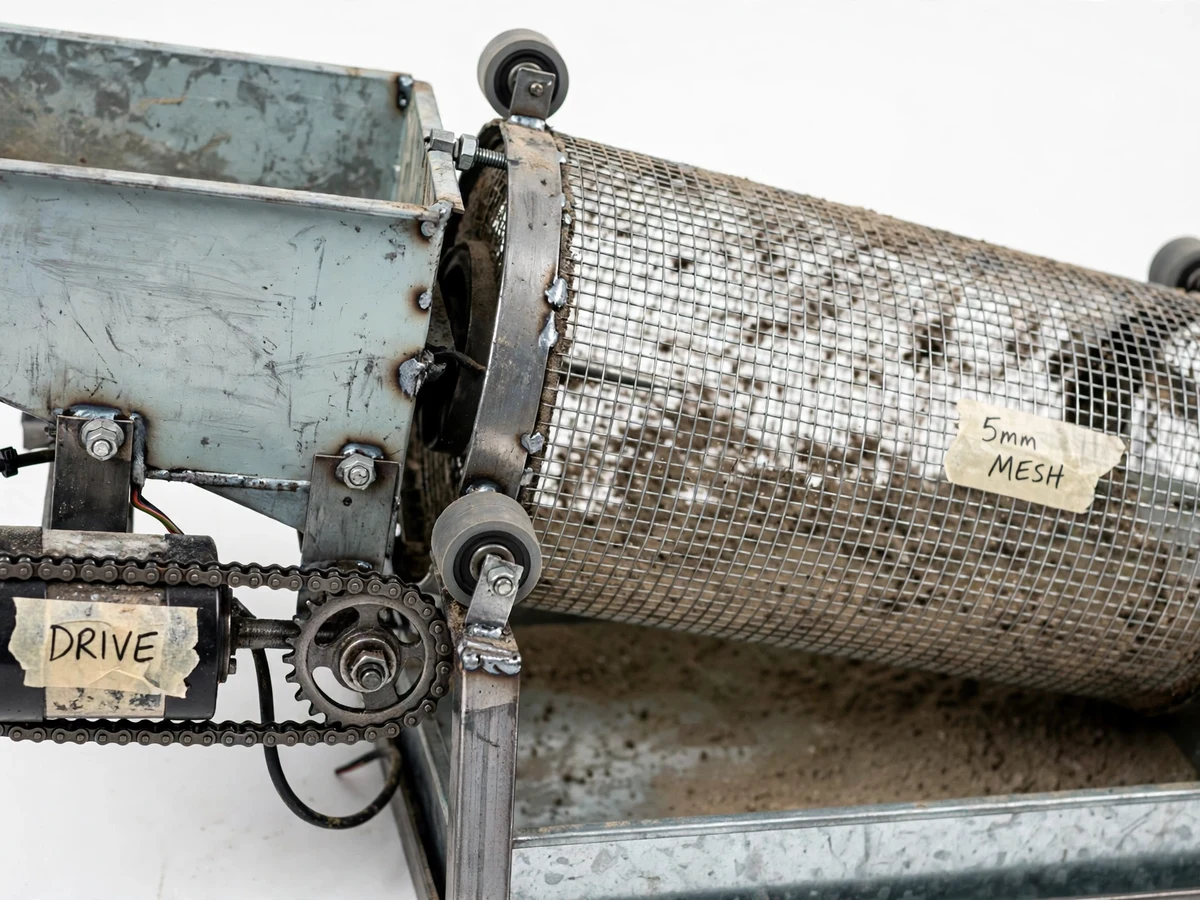
- [Interchangeable mesh panels] The drum is wrapped in wire-mesh panels (for example 5 mm and 10 mm) that unbolt for swapping, so the grading size changes without rebuilding the drum. Panels are labelled with masking-tape tags showing their mesh size.
- [Continuous rotary grading] The inclined rotating drum feeds and grades material in one continuous pass: fines fall through the mesh into the tray below while oversize exits at the low end. There is no hand shaking and no batch-by-batch reloading of a static sieve.
- [Low-speed gear-motor drive] A 0.25–0.5 HP single-phase gear motor drives the drum through a chain or belt reduction at approximately 10–20 RPM (design target) — slow enough to tumble material for grading instead of flinging it.
- [Inclined drum on support rollers] The drum sits at a 3–5 degree incline on support rollers mounted to the frame; the incline drives axial travel of the material toward the low end, so no external pusher mechanism is needed.
- [Feed hopper and collection trays] A sheet-metal hopper at the high end gives steady feeding, and separate trays collect fines under the drum and oversize at the discharge end — the build grades into 2–3 size fractions per pass.
- [Fabricated MS-angle frame] A rigid welded MS-angle frame carries the drum rollers, motor mount and hopper, with handwritten masking-tape labels on the mesh size and drive parts — built to the look of real student workshop fabrication.
- [Adjustable drive tensioning] The motor sits on a slotted mounting plate so belt or chain tension can be set at assembly and re-tensioned as it stretches in service.
What is included
- Fabricated working prototype (frame, drum, mesh panels, motor, drive, hopper, collection trays)
- Fabrication drawings with dimensions of the frame, drum and drive layout
- Component list with sizes and sourcing notes
- Assembly and alignment procedure (drum levelling, roller setup, drive tensioning)
- Operating procedure and safety notes
- Project report PDF (background, design calculations, fabrication, testing)
- PPT presentation for final review
- Viva Q&A preparation document (trommel theory, drive sizing, grading performance)
Limitations & prerequisites
- Throughput is a design target that depends on feed moisture, mesh condition and operator feed rate; it is not a measured industrial figure.
- Wet or clayey material blinds the mesh quickly; such feeds need pre-drying before grading.
- Wire-mesh panels wear in regular use and need periodic replacement.
- The single-phase motor must be earthed properly; the build includes basic safety notes but is not a certified electrical installation.
- Prototype-level noise and vibration are expected; this is not an industrial certified screener.
- Sieving dry material generates dust; the unit should run in a ventilated area.
Frequently Asked Questions
How is a trommel sieve different from a vibrating sieve?
A vibrating sieve shakes the material; a trommel rotates an inclined drum so the material tumbles through the mesh. The drum grades continuously in a single pass with far less mesh blinding, runs quieter, and is mechanically simpler — there is no vibrator motor to tune and no sprung suspension to maintain.
What materials can it grade, and how fast?
Dry compost, sand, soil and small aggregate grade well. Throughput is approximately 30–60 kg/h (design target); the actual rate depends on feed moisture, mesh condition and how steadily the operator feeds the hopper. Wet or clayey material needs pre-drying or it blinds the mesh.
Can the mesh size be changed?
Yes. The drum is wrapped in wire-mesh panels that unbolt for swapping — 5 mm and 10 mm panels are supplied in the base build. With two mesh zones on the drum the unit grades up to three size fractions in one pass.
What power supply does it need?
A normal single-phase 230 V AC wall socket. The 0.25–0.5 HP gear motor is a small load, but it must be earthed properly — the safety notes cover wiring precautions for the student's workshop demo.
Is this project suitable for a final-year project?
Yes — for Mechanical, Production and Industrial Engineering programs. It demonstrates machine design (drum, frame, drive sizing), real workshop fabrication, power transmission through chain/belt reduction, and experimental evaluation of grading performance and throughput.
Can it be customized?
Realistic options include an extra mesh zone for more fractions, a larger drum, a variable-speed drive for RPM control, a dust cover or collection hood, and a wheeled base for moving the unit around the workshop.
Delivery information
Built-to-order project. Delivery timeline is shared after order confirmation based on current queue.
Support terms
Complete documentation, setup guide, and viva preparation included. Support for setup and explanation provided.
Download free synopsis (PDF)
Enter your name and email — the synopsis PDF downloads immediately. We may send occasional project updates; no spam, unsubscribe anytime.