
More project photos (2)
The problem
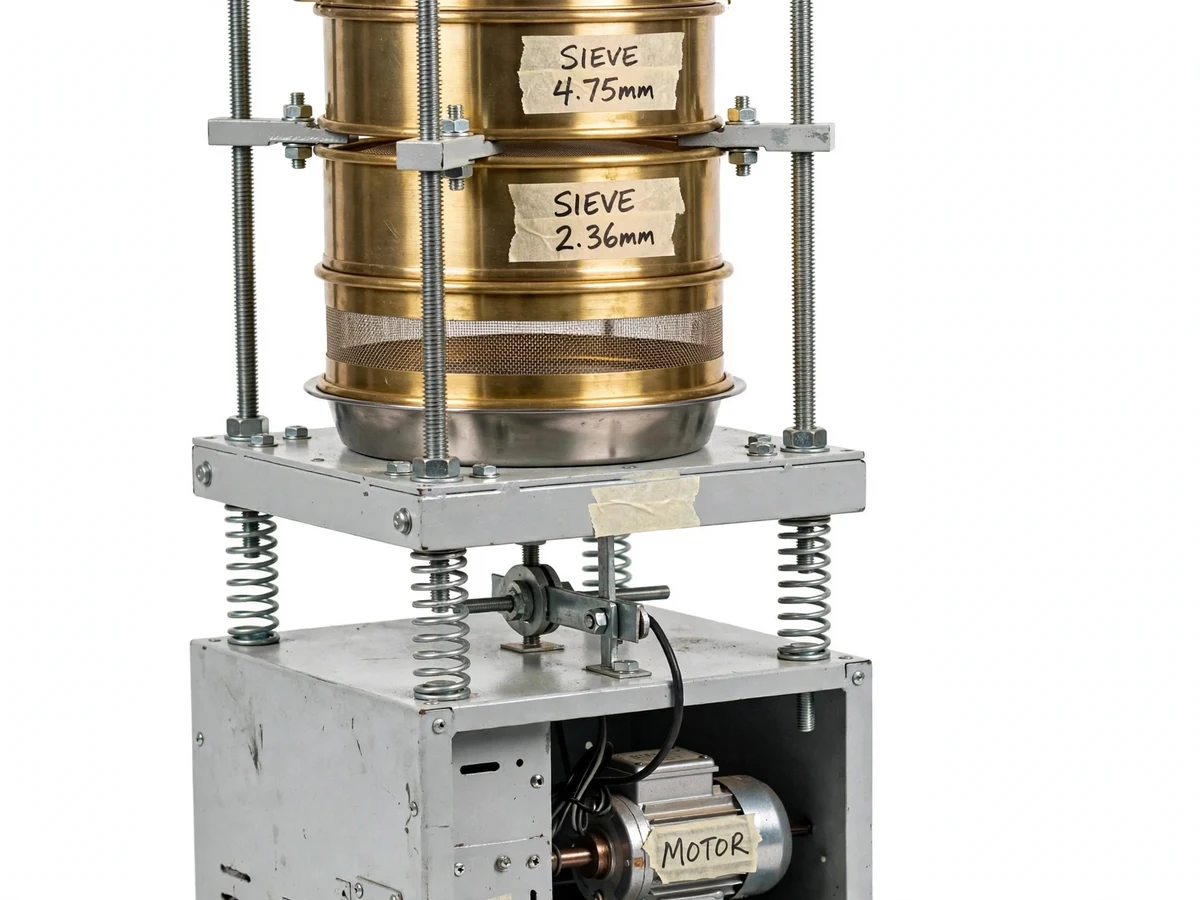
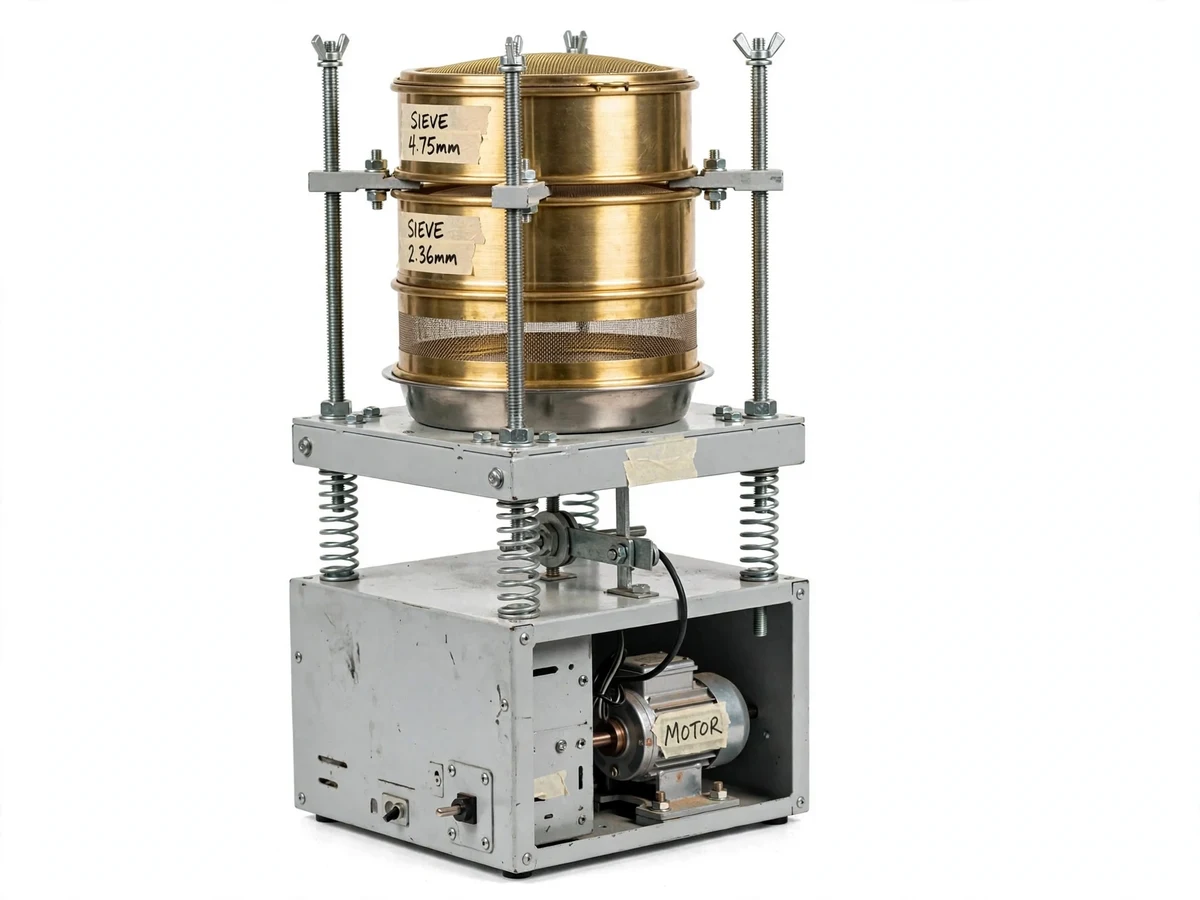
Concrete strength, filter design and road bases all depend on one thing: the particle-size distribution of the sand and aggregate going into them. The sieve analysis is the standard way to measure it, and every construction-materials lab teaches it — usually by hand-shaking sieves for ten minutes, which is tiring, inconsistent and hard to standardize across a class. A motorized sieve shaker solves exactly this: it clamps the standard sieve stack and shakes it with a repeatable rotary-tapping motion for a timed run, so results depend on the sample, not on who shook it. This project fabricates such a machine: a motor with an eccentric drive vibrates a spring-suspended platform carrying the sieve nest (4.75 mm down to pan), a timer controls the run, and the student performs the full analysis — weighing, percentage retained, cumulative passing, gradation curve and fineness modulus — from their own machine's output.
How it works
- The sand sample is washed, oven-dried, quartered down to the test quantity and weighed on the balance.
- The sieve nest is stacked coarsest-on-top down to the pan, the sample is poured onto the top sieve, and the lid and clamp plate are locked.
- The timer is set (10 minutes per the standard procedure) and the motor is started; the eccentric drives the spring-suspended platform in its shaking motion.
- At the timer cut-off, the nest is unclamped and each sieve's retained fraction is brushed out and weighed separately.
- Percentage retained, cumulative percentage retained and percentage passing are computed for each sieve size in the workbook.
- The gradation curve is plotted on semi-log paper and the fineness modulus is calculated; the sample is classified into its grading zone.
- The run is repeated on a second sample (e.g. a different sand source) and the two gradation curves are compared in the report.
Tech stack:
- Fabricated MS base cabinet and sieve platform
- Single-phase motor with eccentric drive and link
- Coil spring suspension set
- Brass test sieves: 4.75 mm, 2.36 mm, 1.18 mm, 600 µm, 300 µm + pan and lid
- Adjustable run timer
- Clamp plate with wing-nut fasteners
- Digital weighing balance 0–5 kg (instrument spec)
- Gradation workbook and fabrication drawings
| Parameter | Value |
|---|---|
| Sieve sizes | 4.75 mm, 2.36 mm, 1.18 mm, 600 µm, 300 µm + pan (standard set) |
| Drive | Single-phase motor, eccentric rotary-tapping motion (expected) |
| Run timer | Adjustable, up to 30 min (instrument spec) |
| Sample size | Approximately 1–2 kg per run (procedure) |
| Platform | Spring-suspended, approximately 300 × 300 mm (design target) |
| Balance | 0–5 kg digital, 1 g resolution (instrument spec) |
| Output | Gradation curve + fineness modulus from student weighings |
Project features
- [Motorized eccentric drive] A single-phase motor with an eccentric and connecting link gives the platform a repeatable rotary-tapping motion — the standard shaker action, without hand fatigue.
- [Standard sieve nest] Brass test sieves (4.75 mm, 2.36 mm, 1.18 mm, 600 µm, 300 µm) plus lid and receiving pan clamp as a nest, matching the sizes used in the syllabus test.
- [Spring-suspended platform] The sieve platform rides on coil springs, isolating vibration from the base and giving the free, consistent motion the analysis assumes.
- [Timer-controlled runs] An adjustable timer ends each run at the set duration, so every test in the report uses the same shaking time.
- [Quick sieve clamping] A top clamp plate with wing nuts locks the nest in seconds and releases it for weighing between runs.
- [Gradation workbook] Weighing tables, percentage-retained and cumulative-passing calculations, semi-log gradation plotting sheets and a fineness-modulus worked example.
- [Sample preparation guide] Washing, oven-drying and quartering procedure so the tested sample is representative — the step most student reports skip.
What is included
- Complete motorized sieve shaker (assembled and tested)
- Standard brass sieve nest with pan and lid
- Digital weighing balance
- Sample preparation and test procedure manual
- Gradation calculation workbook with plotting sheets
- Fabrication drawings of the shaker
- Project report PDF (theory, procedure, readings, analysis)
- PPT presentation for final review
- Viva Q&A preparation document (gradation, fineness modulus, grading zones)
Limitations & prerequisites
- The machine performs the standard sieve analysis; it does not measure particle shape (flakiness/elongation need separate gauges) or fines below 75 µm (needs wet sieving).
- Results depend on proper sample preparation — an unwashed or damp sample biases the fines fraction, which the manual addresses explicitly.
- The eccentric gives a fixed shaking amplitude; it cannot reproduce every commercial shaker's motion profile, so cross-lab comparison needs the same procedure.
- Sieve meshes wear with abrasive aggregates; the manual covers mesh inspection and the wear limit.
- The balance and oven-drying step assume access to a basic lab oven or a documented sun-drying alternative.
Frequently Asked Questions
What does the student actually measure?
The weight of sand retained on each sieve after a timed shaking run — every later number (percentages, gradation curve, fineness modulus) is computed from these weighings.
Why motorized instead of hand shaking?
Hand shaking varies with the operator; the motorized eccentric gives every run the same motion and duration, which is the entire point of a standard test.
What is the fineness modulus?
A single number summarizing the gradation, computed from the cumulative percentages — the workbook includes a fully worked example.
Can two sand sources be compared?
Yes, and the report is built around it: two samples, two gradation curves, and a discussion of which suits concrete or plaster work better.
Does it handle coarse aggregate too?
The supplied nest covers sand sizes; larger sieves for coarse aggregate can be added on request since the platform accepts standard sieve diameters.
Is this project suitable for a final-year project?
Yes — for Mechanical and Civil programs. It is a working test machine producing standard engineering test data from the student's own procedure. Suitable for B.E./B.Tech final-year projects in Mechanical and Civil Engineering.
Components & software requirements
- Fabricated MS base cabinet and sieve platform
- Single-phase motor with eccentric drive and link
- Coil spring suspension set
- Brass test sieves: 4.75 mm, 2.36 mm, 1.18 mm, 600 µm, 300 µm + pan and lid
- Adjustable run timer
- Clamp plate with wing-nut fasteners
- Digital weighing balance 0–5 kg (instrument spec)
- Gradation workbook and fabrication drawings
Delivery information
Built-to-order project. Delivery timeline is shared after order confirmation based on current queue.
Support terms
Complete documentation, setup guide, and viva preparation included. Support for setup and explanation provided.