
More project photos (3)
The problem
A person rarely gives a robot one clean instruction and then stays silent. In a home or a small ward, someone changes their mind mid-sentence, waves the robot over, corrects themselves, or points somewhere else while the robot is already moving, and most student robots cannot cope with that at all. They run one fixed routine: drive to a point, follow a line, or stop at an obstacle. When the instruction changes halfway through, they either ignore the change, finish the old job first, or need a full restart. That gap between a single-command demo and a robot that can be interrupted politely is exactly what social-robotics research is trying to close, and it is a gap a student can demonstrate honestly at tabletop scale without pretending to have built a thinking machine.
The idea surfaced again in late October 2026, when Krafton subsidiary Ludo Robotics unveiled Ludi 0.2 at the Bay Area Robotics Symposium at UC Berkeley on 30 October 2026. Ludi is described by the company as robot AI for social intelligence: reading human intent, gestures, feedback and social cues, keeping context when tasks change mid-stream, and linking movement with interaction. The reported example is a robot heading to fetch a drink that switches to another beverage when the person changes the instruction mid-task. Those are company-reported improvements only: no independent benchmarks were disclosed, and Ludi 1.0 is a planned future foundation model, not a build a student can reproduce. This project translates the headline honestly: a small wheeled robot that accepts a mid-task change, asks for confirmation, re-plans, and logs the switch, using fixed rules rather than a language model.
How it works
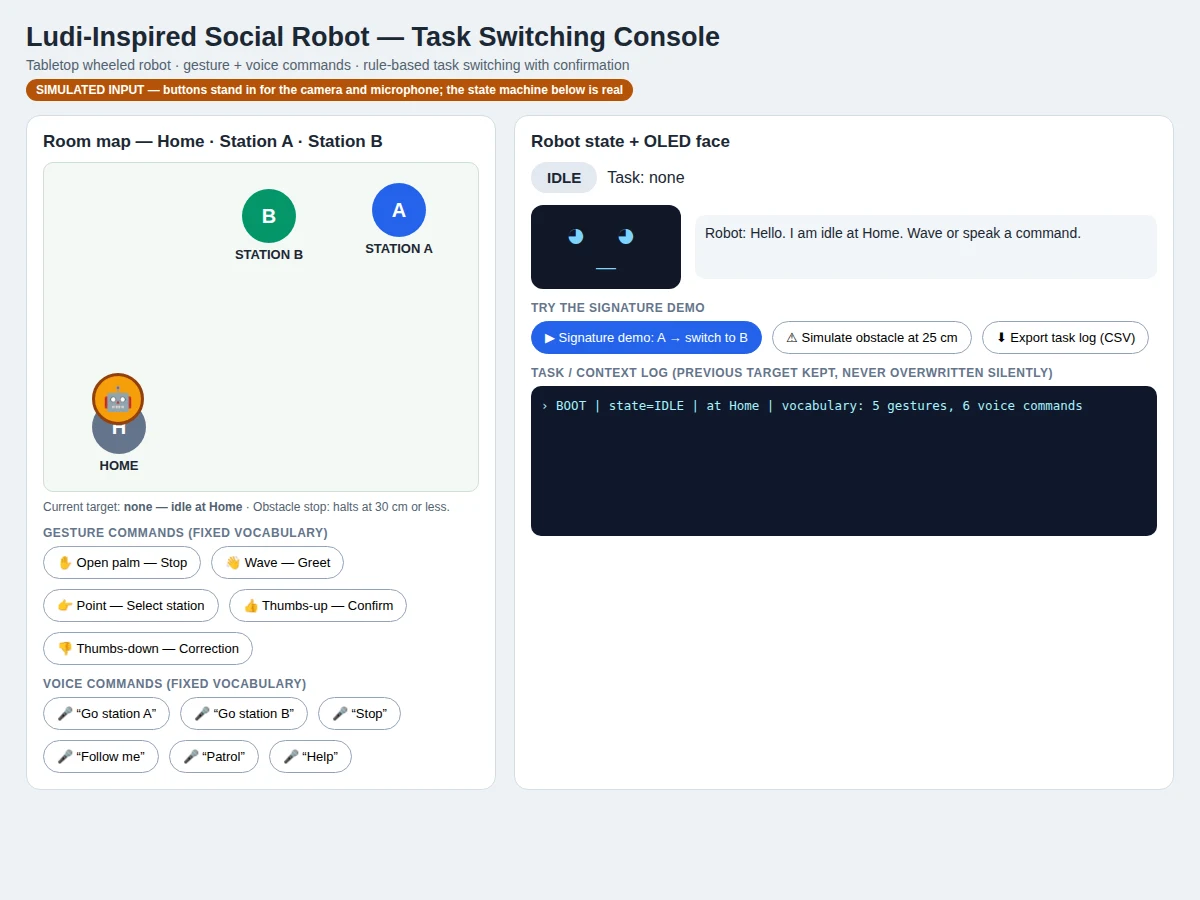
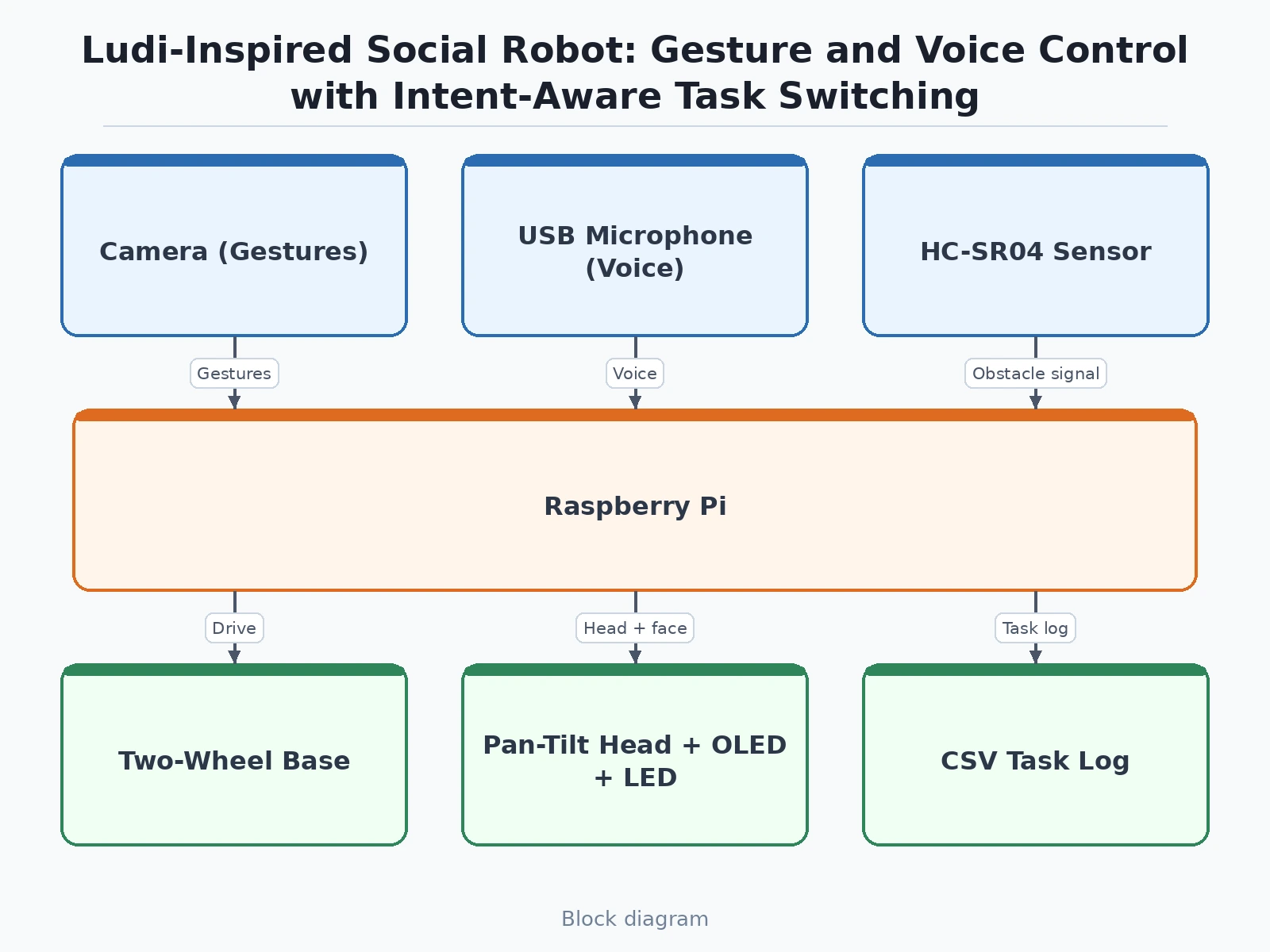
The end-to-end mechanism runs from a person gesturing or speaking to a robot that pauses, asks, re-plans, and logs the change. The Pi camera watches for hands while the microphone listens for keywords, and both inputs feed the same fixed-vocabulary mapper, so a gesture and a voice command mean the same thing regardless of which channel delivered them. The state machine decides what happens next: a new command during a task moves the robot from working to clarifying, the head turns toward the person, the OLED face shows a questioning expression, and the speaker asks for confirmation. A thumbs-up confirms the switch and the robot re-plans toward the new station while writing both targets to the log; a thumbs-down keeps the old target and asks again. An obstacle inside the stop zone halts the base in any state, and an input that matches nothing in either vocabulary triggers a clarification prompt instead of a guessed action.
- The builder assembles the two-wheel base, mounts the pan-tilt head with its camera, OLED face, LED ring, microphone, and speaker, fits the HC-SR04 sensor at the front, and wires the drive motors through the TB6612FNG driver to the Raspberry Pi.
- The builder calibrates the system: each of the five gestures is tested in good light, each of the six voice commands is tested in a quiet room, the three floor points Station A, Station B, and Home are marked, and the obstacle stop is checked by placing an object at 30 cm.
- For the idle demonstration, the builder starts the robot at Home, shows the listening face and LED state, and waves to get its attention so the head turns toward the person.
- For the go-to-station demonstration, the builder says go station A or points at Station A, and watches the robot drive toward it while the face shows the working expression.
- For the signature switch demonstration, the builder interrupts the robot en route to Station A by waving or saying go station B, watches it pause and ask for confirmation on the OLED face and speaker, confirms with a thumbs-up, and watches it re-plan toward Station B.
- For the correction and ambiguity demonstration, the builder gives a thumbs-down after a switch request to show the old target is kept, then gives an unmatched gesture or unclear word to show the robot asking for clarification instead of guessing.
- The builder exports the CSV task log, points to the rows showing the previous target, the new target, the command source, and the confirmation result, and reports honestly in the report which commands were recognised first time and which needed a repeat.
Tech stack:
- Raspberry Pi 5 · quad-core host and task state machine
- Pi Camera Module 3 · hand tracking camera input
- MediaPipe hand tracking · on-device gesture landmark detection
- Vosk offline keyword spotting · USB microphone voice commands
- SG90 pan-tilt head · 2 servos plus OLED face and speaker
- LED ring · coloured state and attention signalling
- HC-SR04 obstacle stop · 30 cm safety halt
- TB6612FNG differential drive · 2 DC gear motors and wheels
| Parameter | Value |
|---|---|
| Build type | Tabletop hybrid hardware and software build · wheeled base plus gesture and voice control software (design target) |
| Controller | Raspberry Pi 5 · Broadcom BCM2712 quad-core Cortex-A76 up to 2.4 GHz · 5 V 5 A supply (Datasheet value) |
| Camera | Pi Camera Module 3 · Sony IMX708 12 MP · 4608 by 2592 pixels · phase-detection autofocus (Datasheet value) |
| Gesture tracking | MediaPipe hand tracking on the Pi · 21 hand landmarks per frame · fixed vocabulary of 5 gestures (design target) |
| Voice input | USB microphone · Vosk offline keyword spotting · fixed vocabulary of 6 voice commands · no internet needed for recognition (design target) |
| Pan-tilt head | 2 SG90 servos · about 1.8 kg·cm torque · about 0.1 s per 60 degrees at 4.8 V · 0 to 180 degrees range (Datasheet value) |
| Face display | 128 by 64 pixel OLED · I2C · expressions for idle · listening · working · clarifying · stopped (design target) |
| Obstacle sensor | HC-SR04 · 2 cm to 400 cm measuring range · 40 kHz · 5 V supply (Datasheet value) |
| Safety stop | Base halts when an obstacle is at 30 cm or less · resumes only on a new command after the path is clear (design target) |
| Drive | TB6612FNG dual motor driver · 1.2 A continuous per channel · 3.2 A peak per channel (Datasheet value) |
| Demo speed | Indoor drive speed capped at 0.25 m per s (design target) |
| Tasks | 3 tasks · Go-to-Station · Follow-Me · Patrol loop (design target) |
| Stations | 3 marked floor points · Station A · Station B · Home (design target) |
| Task log | CSV log · task · command source · previous target · new target · confirmation result (design target) |
| Trend reference | Ludi 0.2 unveiled 30 October 2026 at the Bay Area Robotics Symposium · UC Berkeley · company-reported social-intelligence claims only · no independent benchmarks disclosed · Ludi 1.0 is a planned future model · reported figures only · never claimed for this build |
| Builder note | On the prototype, dim room light dropped hand-tracking confidence and noisy rooms confused the keyword spotter, so demonstrations run in good light and a quiet room, the vocabulary stays short on purpose, and every task change needs a thumbs-up confirmation, and the report states both limits plainly · noted as a builder observation |
Project features
This robot combines four capabilities that make a complete social-interaction prototype rather than a remote-controlled car with a camera on top. First, two input channels work side by side: a fixed gesture vocabulary read from the camera and a fixed voice vocabulary spotted offline, so a person can interrupt the robot by waving, pointing, or speaking without touching it. Second, task switching is a designed behaviour, not an accident: a mid-task change pauses the base, triggers a spoken and on-screen confirmation, and only then re-plans, so the robot never silently abandons one job for another. Third, the robot shows its state instead of hiding it: the pan-tilt head turns toward the person, the OLED face changes expression, and the LED ring signals listening, working, clarifying, or stopped. Fourth, every switch is logged with its previous target, new target, command source, and confirmation result, so the claim that context survives the switch is backed by a file the examiner can read.
- [Fixed gesture vocabulary] Five hand gestures read by MediaPipe on the Pi: open palm means stop, wave means get attention or greet, point means select a station, thumbs-up means confirm, and thumbs-down means correction — implemented in the base build.
- [Offline voice commands] Six voice commands spotted on-device by Vosk with a USB microphone: go station A, go station B, stop, follow me, patrol, and help, with no internet connection needed for recognition — implemented in the base build.
- [Rule-based task switching] A state machine with idle, listening, working, clarifying, and stopped states accepts a new command mid-task, pauses the base, and re-plans only after confirmation, so a change of instruction never silently overwrites the current job — implemented in the base build.
- [Confirmation before re-planning] When a mid-task change arrives, the OLED face and a spoken line ask the person to confirm, and a thumbs-up confirms while a thumbs-down triggers a correction prompt, so ambiguous input produces a question rather than a guess — implemented in the base build.
- [Context task log with CSV export] Every task, command source, previous target, new target, and confirmation result is written to a CSV log, so the demonstration can show that the robot remembered the old target while switching to the new one — implemented in the base build.
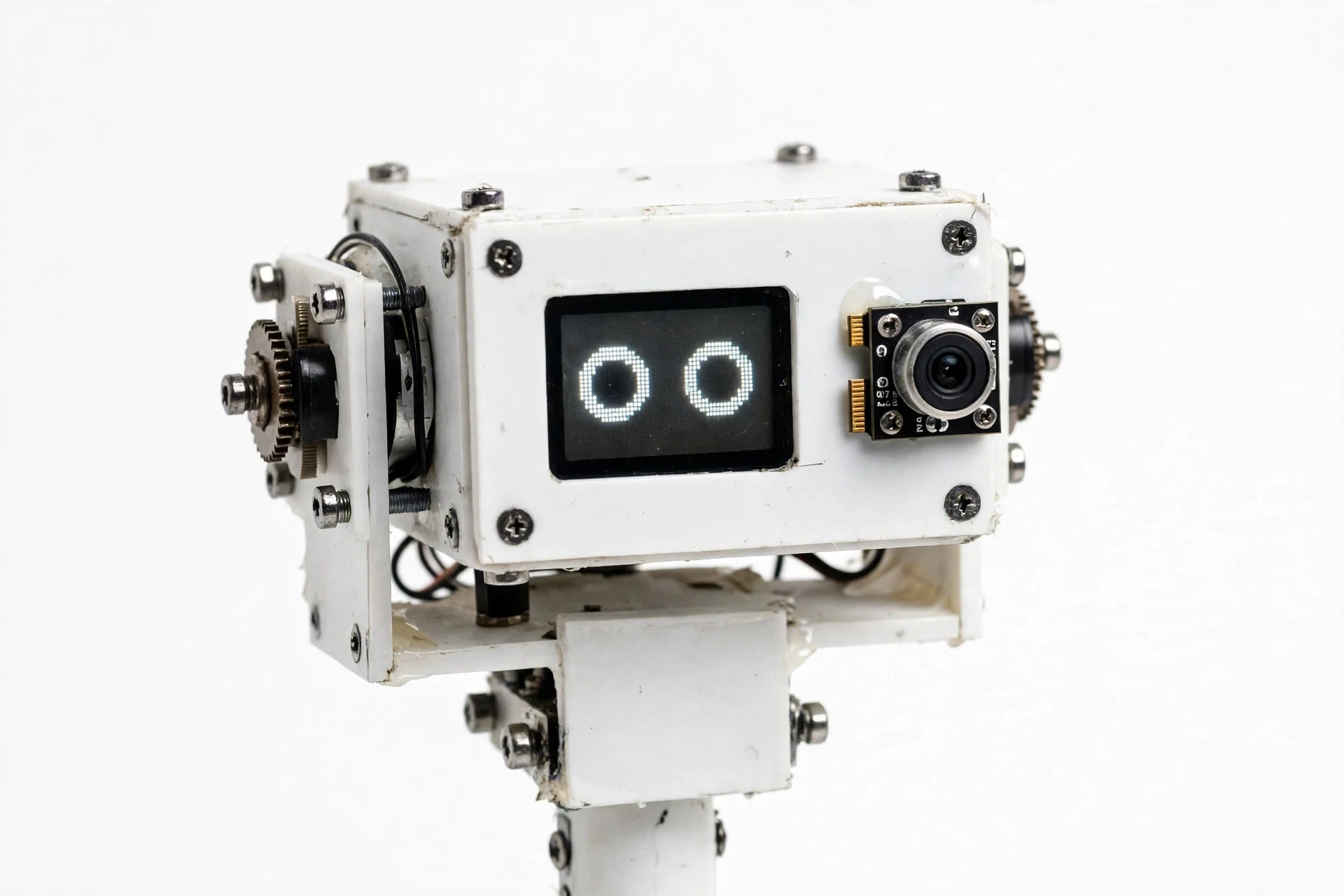
- [Expressive pan-tilt head and face] Two SG90 servos aim the head at the person, a 128 by 64 pixel OLED face changes expression with the robot state, and an LED ring signals listening, working, clarifying, or stopped at a glance — implemented in the base build.
- [Obstacle stop and capped indoor speed] An HC-SR04 sensor halts the base whenever an obstacle is at 30 cm or less, and the drive speed is capped for indoor demonstration, so an interrupted robot stops safely instead of driving on — implemented in the base build.
- [Face-based person identification] Future scope only, not implemented: recognising a specific person by face so Follow-Me tracks one individual in a crowd, listed as an extension rather than a claimed feature, since the base build tracks the centre of the nearest detected person and cannot identify anyone.
What is included
- Complete fabricated tabletop social robot (two-wheel base, pan-tilt head, Pi Camera Module 3, OLED face, LED ring, USB microphone, speaker, HC-SR04 sensor, TB6612FNG driver, Raspberry Pi board)
- Gesture and voice control software (MediaPipe hand tracking, Vosk offline keyword spotting, task state machine, confirmation prompts, CSV task logging, control dashboard)
- Setup and calibration guide (gesture testing procedure, voice testing procedure, station marking, obstacle-stop check, task-log reading worksheet)
- Project report PDF (social robotics background, fixed-vocabulary design, state machine design, task-switching demonstration results, honest recognition observations)
- PPT presentation for final review
- Viva Q&A preparation document (social cues versus rule-based mapping, gesture and voice vocabularies, state machines, confirmation design, Ludi comparison limits, follow-me limits)
Limitations & prerequisites
- Intent is a rule-based mapping, not understanding: the robot matches a fixed gesture or voice vocabulary to a task, so it does not understand free speech, unseen gestures, or the meaning behind a command, and anything outside both vocabularies triggers a clarification prompt instead of an action.
- Fixed vocabularies only: five gestures and six voice commands are the whole input language, and adding a new command means adding and testing a new mapping, not teaching the robot a new concept.
- No arm and no carrying: the robot is a tabletop wheeled base with a pan-tilt head, so it cannot pick up, carry, or fetch any object, and the drink-fetching example reported for Ludi is a reference only, never a capability of this build.
- Camera needs good light: hand tracking degrades in dim rooms, backlight, or cluttered backgrounds, so demonstrations need controlled indoor lighting and a clear view of the person's hand.
- Follow-Me is centre-tracking, not person identification: the robot follows the centre of the nearest detected person and cannot tell one person from another, so it can latch onto the wrong person if someone steps in front.
- Indoor flat floors only: the small wheels, capped speed, and ultrasonic stop suit a flat indoor demo area, and the build is not designed for outdoors, slopes, thick carpet, or uneven ground.
- Not a care or medical device: the robot is an academic demonstration of interaction and task switching, and it must not be presented as assistance, supervision, therapy, or safety equipment for any person.
- This is an academic prototype, not a certified product: bench electronics need supervision, small parts and moving wheels need care around children, and battery handling needs supervision, correct polarity, and a protected holder where a battery pack is used.
Frequently Asked Questions
Is this a good choice for a final-year project?
Yes, for AI and Machine Learning, Electronics, and IoT programs, because it combines embedded hardware, computer vision, offline speech recognition, state-machine design, and a demonstration an examiner can interrupt and watch recover. It gives a clear review thread: how a fixed vocabulary maps to tasks, why confirmation beats guessing, how context survives a mid-task switch in a log file, and where rule-based mapping stops and real understanding would begin.
Does this robot really understand what a person intends?
No, and the report says so plainly: intent here means a rule-based mapping from a fixed gesture or voice vocabulary to a task, not comprehension of free speech or unseen gestures. Ludi's reported direction is a foundation model for social intelligence, which this student build deliberately does not claim; the honest contribution is showing that a small, inspectable rule system can still handle interruptions gracefully, with clarification instead of guessing.
How does the mid-task switch demonstration work?
The robot starts driving toward Station A, and while it is en route the person waves or says go station B. The base pauses, the head turns toward the person, the OLED face shows a questioning expression, and the speaker asks for confirmation. A thumbs-up confirms the switch, the robot re-plans toward Station B, and the CSV log records both the previous target and the new target, so the examiner can see context was kept rather than discarded.
Why does the robot ask for confirmation instead of just switching?
Because both input channels can be misread: a hand shape can be ambiguous in poor light, and a keyword spotter can mishear a word in a noisy room. Acting on a misread command would send the robot to the wrong station, while asking costs one gesture and makes the error visible. Confirmation turns recognition uncertainty into a visible design decision, which is a stronger review point than a robot that always looks certain and is sometimes wrong.
What happens when something blocks the robot's path?
The HC-SR04 sensor measures the distance ahead, and whenever an obstacle is at 30 cm or less the base halts in any state and the face shows the stopped expression. The robot does not steer around the obstacle on its own; the person clears the path and gives a new command, which keeps the safety behaviour simple, testable, and honest about what the build can and cannot do.
Can this robot carry things or work outdoors?
No to both. There is no manipulator arm and no carrying platform, so the build cannot pick up or deliver any object, and the reported drink-fetching example for Ludi is a reference only. The small wheels, camera-based tracking, and ultrasonic stop suit a flat indoor demo area in good light, and outdoor light, uneven ground, and wind would break the gesture tracking and the drive assumptions the build relies on.
Components & software requirements
- Raspberry Pi 5 · quad-core host and task state machine
- Pi Camera Module 3 · hand tracking camera input
- MediaPipe hand tracking · on-device gesture landmark detection
- Vosk offline keyword spotting · USB microphone voice commands
- SG90 pan-tilt head · 2 servos plus OLED face and speaker
- LED ring · coloured state and attention signalling
- HC-SR04 obstacle stop · 30 cm safety halt
- TB6612FNG differential drive · 2 DC gear motors and wheels
Delivery information
Built-to-order project. Delivery timeline is shared after order confirmation based on current queue.
Support terms
Complete documentation, setup guide, and viva preparation included. Support for setup and explanation provided.
Download free synopsis (PDF)
Enter your name and WhatsApp number — the synopsis PDF downloads immediately. We may send occasional project updates on WhatsApp; no spam.