
More project photos (3)
The problem
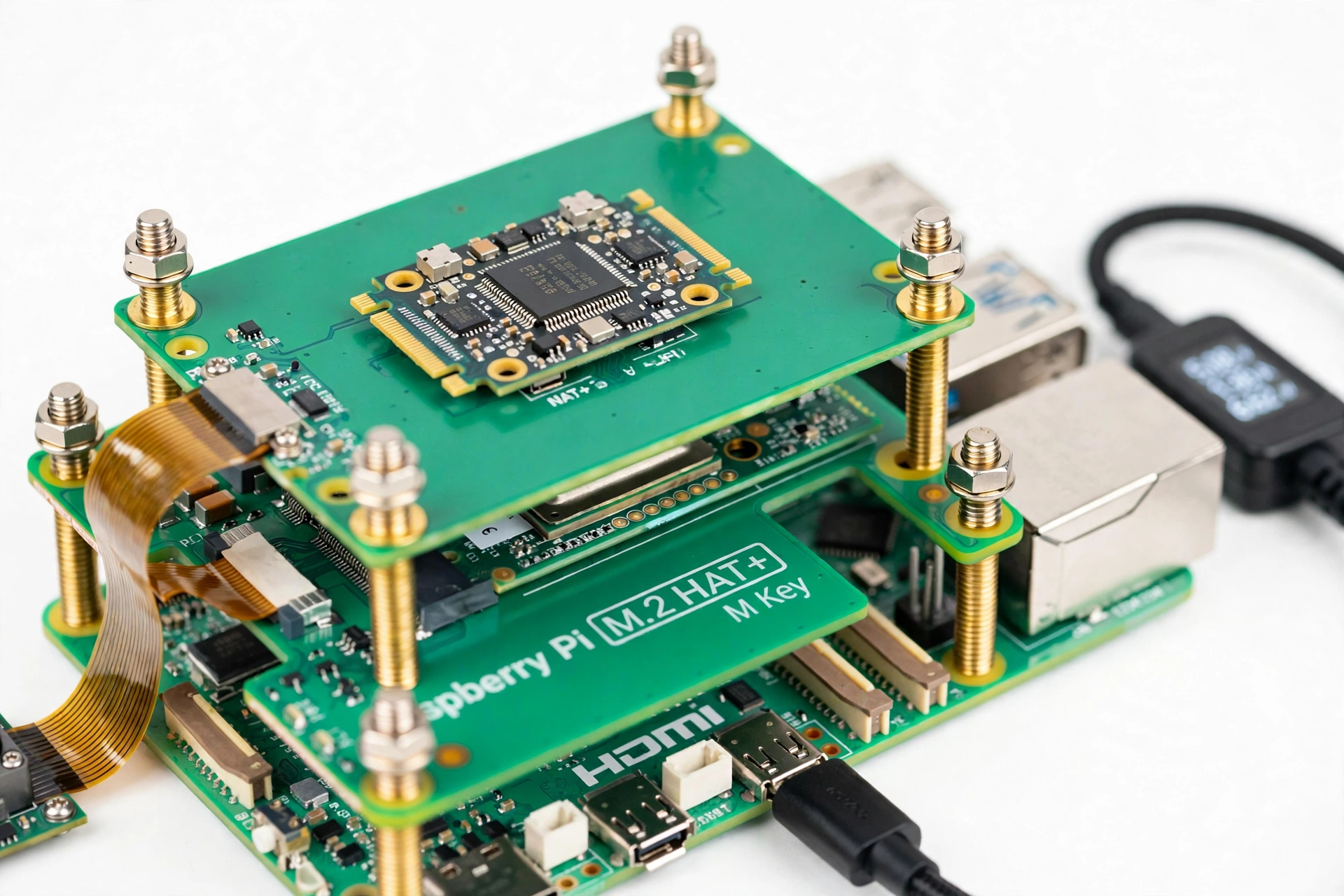
An Edge AI Inference Accelerator is a small computer that runs neural networks locally, without sending data to the cloud. This build pairs a Raspberry Pi 5 with a Hailo-class M.2 NPU module (up to 26 TOPS INT8 at about 2.5 W) that runs a quantized TinyLlama 1.1B chat model and YOLOv8n object detection offline. The problem it solves is the cloud dependency of modern AI: an always-online pipeline leaks private data, adds latency, and fails the moment the network does — a deal-breaker for anything on a drone, a doorbell camera, or a field sensor. This build demonstrates the edge-AI alternative at bench scale: quantized models split between the NPU (vision and compute-heavy layers) and the Pi's CPU (layers the NPU's op set can't run), with honest, student-measured numbers for speed and power instead of vendor claims. The rig runs off a standard 5 V supply at under 20 W total (Expected) and costs under ₹20,000 (Approximate).
Qualcomm's October 2026 announcement sets the reference: Hexagon-NPU-based inference accelerators, from add-in cards to full liquid-cooled racks, with PCIe scale-up, Ethernet scale-out, and 160 kW of rack power. The AI200 card carries up to 768 GB of LPDDR and is commercially available from 2026; the AI250, available 2027, uses near-memory computing claimed to deliver more than 10x effective memory bandwidth at lower power. The same announcement brought the Dragonfly C1000 CPU — custom Oryon cores in a 250+ core-count chiplet claimed at 2x performance-per-watt, available 2028, with a multi-year Meta deployment deal — plus a Saudi-backed Humain plan to deploy 200 MW of capacity starting 2026; Qualcomm shares jumped roughly 11% on the news. This build borrows none of the datacenter hardware and all of the idea: a dedicated inference accelerator bolted onto a general-purpose host, measured honestly at watts-per-token on a student budget.
How it works
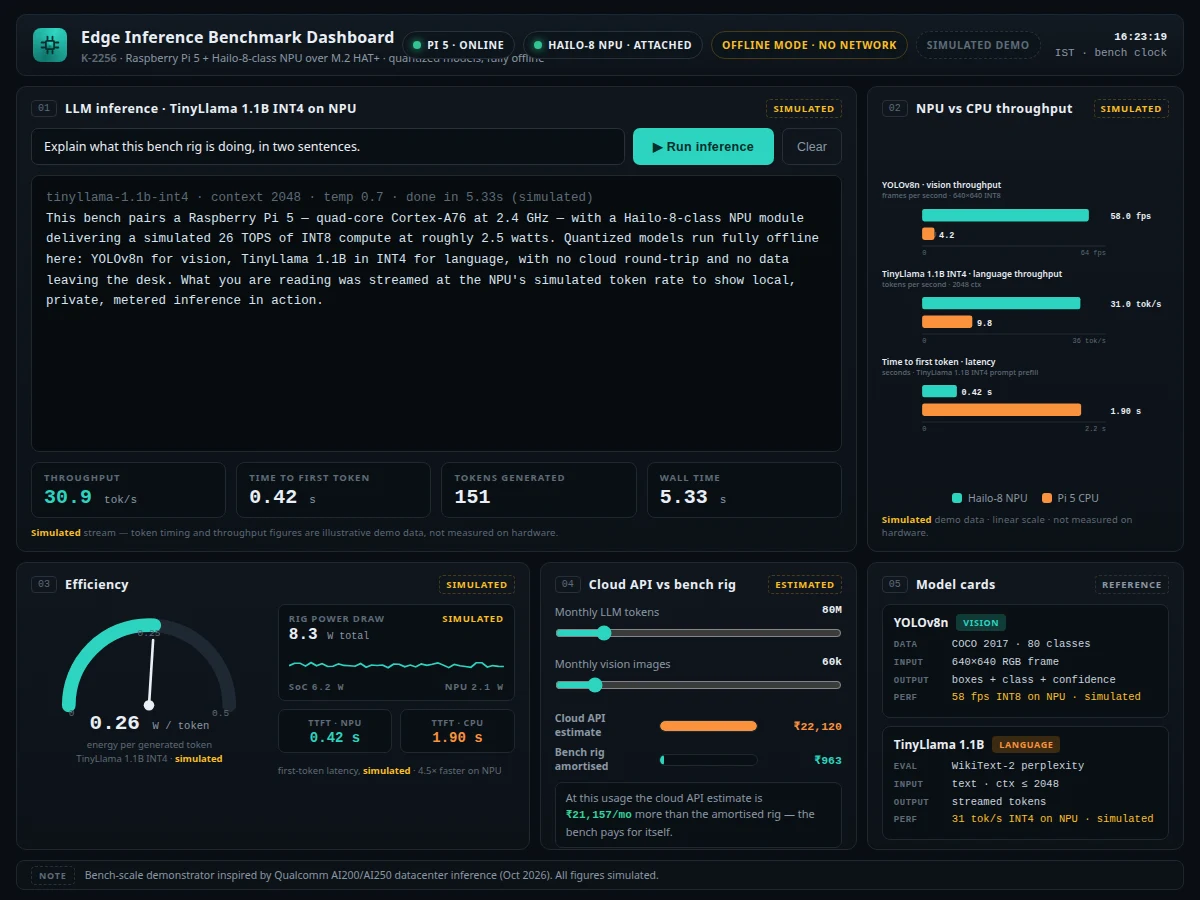
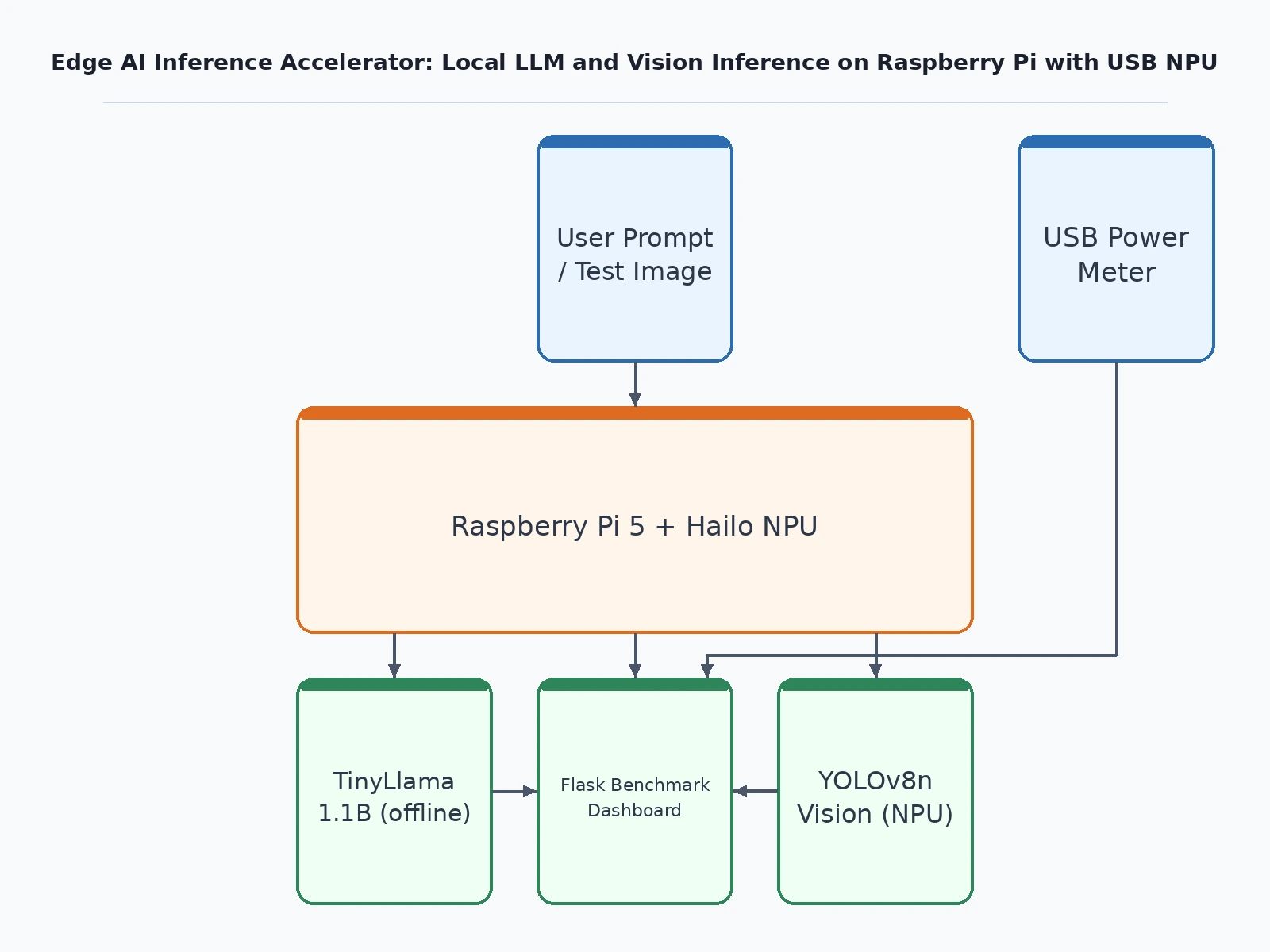
An inference run flows through the rig like this. A prompt or an image enters the Flask dashboard, which routes it to the right pipeline: text goes to the quantized TinyLlama 1.1B model, images go to YOLOv8n. The Hailo Dataflow Compiler has already mapped each model's supported layers onto the NPU at build time — inside the Hailo-8, each neural-network layer gets its own dedicated compute-and-memory block, so activations flow through the chip in a pipeline instead of shuttling weights in and out of DRAM, and that is where the watts-per-token win comes from. Supported layers execute on the NPU at up to 26 TOPS INT8; layers outside the NPU's op set fall back to the Pi 5's quad-core Cortex-A76 cores. An inline USB power meter measures actual watts during the run, and the dashboard reports tokens/sec, time-to-first-token, watts/token and the NPU-vs-CPU speedup — every number measured on the bench rig by the student, never taken from a datasheet.
- Power on and bring-up: the M.2 NPU module is detected only at boot — the Pi 5's PCIe link trains once at power-on, so reseat-and-reboot is part of the bring-up checklist; the dashboard confirms the HailoRT device is visible before any model loads.
- Honest naming note: the title's "USB NPU" is this Hailo-class M.2 module on the official M.2 HAT+ — an add-in peripheral, not soldered silicon — plus the inline USB power metering; the build does not use a USB-stick NPU.
- Models are prepared once: TinyLlama 1.1B chat is quantized to INT4/INT8 via llama.cpp/ONNX; YOLOv8n is compiled to INT8 through the Hailo Dataflow Compiler, which maps each supported layer onto its own dedicated compute-and-memory block on the chip.
- A prompt or an image enters the Flask dashboard, which routes text to the LLM pipeline and images to the vision pipeline; one Python inference stack (HailoRT + ONNX Runtime) drives both.
- Supported layers execute on the NPU at up to 26 TOPS INT8 (manufacturer spec); layers outside the NPU's op set fall back to the Pi 5's quad-core Cortex-A76 @ 2.4 GHz cores (manufacturer spec).
- The inline USB power meter measures actual watts during the run while the dashboard samples latency.
- The dashboard reports tokens/sec, time-to-first-token, watts/token and the NPU-vs-CPU speedup; perplexity on WikiText-2 and mAP@0.5 on COCO val are recorded as buyer-measured design targets — every figure measured on the bench rig, never a vendor claim.
Tech stack:
- Raspberry Pi 5 (BCM2712 · quad-core Cortex-A76 @ 2.4 GHz)
- Hailo-8 NPU module (26 TOPS INT8 · ~2.5 W · M.2)
- Quantized LLM inference (TinyLlama 1.1B · INT4/INT8)
- YOLOv8n object detection (COCO-trained · INT8 on NPU)
- Inference benchmark dashboard (Flask · live telemetry)
- USB power meter (inline · watts/token measurement)
- Python inference stack (HailoRT · ONNX Runtime)
- 3D-printed NPU carrier enclosure
| Parameter | Value |
|---|---|
| Compute host | Raspberry Pi 5: Broadcom BCM2712, quad-core Arm Cortex-A76 @ 2.4 GHz, PCIe interface for the M.2 HAT+ (manufacturer spec) |
| NPU accelerator | Hailo-8 class M.2 module on the M.2 HAT+: up to 26 TOPS (INT8) at ~2-2.5 W (manufacturer spec) |
| Vision model | YOLOv8n (Ultralytics), trained and evaluated on COCO 2017: 80 object classes, object detection task; input 640x640 RGB image; output bounding boxes + class scores |
| Vision metric | mAP@0.5 on COCO val — reported as buyer-measured design target, no claimed figure |
| LLM | TinyLlama 1.1B chat, quantized to INT4/INT8 (llama.cpp/ONNX); input token sequence; output next-token probabilities |
| LLM metric | Perplexity on WikiText-2 — reported as buyer-measured design target, no claimed figure |
| Reference accelerators | Qualcomm AI200 (up to 768 GB LPDDR, available 2026) and AI250 (near-memory computing, claimed >10x effective memory bandwidth, available 2027); 160 kW liquid-cooled racks; PCIe scale-up, Ethernet scale-out (October 2026 press) |
| Rig cost | Sub-₹20,000 (Approximate) |
| Rig power | < 20 W total on a standard 5 V supply (Expected) |
| Upgrade path | Hailo-10H: up to 40 TOPS (INT4) with 8 GB LPDDR4 on module (manufacturer spec) — future scope, not in the base build |
Project features
The accelerator's capabilities are four. First, offline LLM chat: a TinyLlama 1.1B chat model quantized to INT4/INT8 runs fully on the bench rig — prompt in, answer out, no network call anywhere in the loop. Second, NPU vision: YOLOv8n (trained and evaluated on COCO 2017, 80 object classes) compiled through the Hailo Dataflow Compiler runs on the NPU at up to 26 TOPS INT8 (manufacturer spec), streaming bounding boxes at rates a Pi CPU alone cannot reach. Third, honest benchmarking: a Flask dashboard reports tokens/sec, time-to-first-token, watts/token and NPU-vs-CPU speedup for every run, all measured by the student on the bench rig with an inline USB power meter — never vendor claims. Fourth, hybrid execution: quantized layers the NPU's op set supports run on the accelerator; unsupported layers fall back to the Pi's quad-core Cortex-A76 cores, so real models run end to end instead of only in a demo script.
- [Offline LLM chat — TinyLlama 1.1B] The chat model is quantized to INT4/INT8 (llama.cpp/ONNX) and runs end to end on the bench rig — prompt in, answer out, with no network call anywhere in the loop. Input is a token sequence, output is next-token probabilities, and perplexity on WikiText-2 is reported as a buyer-measured design target.
- [YOLOv8n vision on the NPU] YOLOv8n (Ultralytics), trained and evaluated on COCO 2017's 80 object classes, is compiled through the Hailo Dataflow Compiler to INT8 and runs on the NPU at up to 26 TOPS (manufacturer spec). Input is a 640x640 RGB image; output is bounding boxes plus class scores.
- [Live benchmark dashboard] A Flask web dashboard serves the demo UI and reports tokens/sec, time-to-first-token, watts/token and NPU-vs-CPU speedup for every run — every number measured on the bench rig, never taken from a vendor claim.
- [Inline USB power metering] A USB power meter sits inline on the rig's 5 V supply and measures real watts during each inference run, so the watts/token figures are measured, not estimated.
- [Hybrid NPU + CPU execution] Layers the NPU's op set supports run on the accelerator; unsupported layers fall back to the Pi 5's quad-core Cortex-A76 @ 2.4 GHz cores (manufacturer spec), so real models run end to end instead of only in a demo script.
- [INT4/INT8 quantization pipeline] The build scripts take the base models through quantization — llama.cpp/ONNX for the LLM, Dataflow Compiler INT8 for vision — with a documented accuracy check: perplexity and mAP@0.5 measured as design targets, not claimed.
- [3D-printed NPU carrier enclosure] The M.2 HAT+ and NPU module mount in a 3D-printed carrier enclosure (print files included) that holds the add-in peripheral mechanically secure on the bench.
Documented future scope (not included in the base build):
- [Future scope — Hailo-10H upgrade path] The Hailo-10H (up to 40 TOPS INT4 with 8 GB LPDDR4 on the module — manufacturer spec) is the documented upgrade path for small language and vision-language models; it is not part of the base build.
What is included
- Assembled rig: Raspberry Pi 5, M.2 HAT+ with the Hailo-class NPU module, 3D-printed carrier enclosure, inline USB power meter
- Quantized model pipeline: TinyLlama 1.1B (INT4/INT8) and YOLOv8n (INT8, NPU-compiled) with build scripts and a quantization tuning guide
- Flask inference benchmark dashboard with the working demo UI (tokens/sec, time-to-first-token, watts/token, NPU-vs-CPU speedup)
- Wiring diagram, assembly layout and bring-up checklist (including the boot-only PCIe detection note)
- 3D-print files for the NPU carrier enclosure
- Component list with Indian supplier sourcing notes for the Pi 5, M.2 HAT+ and NPU module
- Project report PDF (edge-AI architecture, quantization, NPU dataflow, benchmark methodology)
- PPT presentation for final review
- Viva Q&A preparation document (quantization trade-offs, NPU vs CPU execution, watts/token, LLM vs vision pipelines)
Limitations & prerequisites
- Inference only: the NPU is an inference accelerator — no model training happens on this rig. Training-grade hardware is a different machine class; this build measures inference, honestly.
- Quantization costs accuracy: only INT4/INT8 quantized models run on the NPU, and quantization trades accuracy for speed and power. The report states the trade-off plainly — perplexity on WikiText-2 and mAP@0.5 on COCO val, measured as design targets, never claimed numbers.
- Limited op set: layers the Hailo Dataflow Compiler cannot map fall back to the Pi 5's CPU, which caps the speedup on models with many unsupported ops.
- Memory caps model size: the Pi 5's RAM limits the LLM to the TinyLlama 1.1B class; larger models need the Hailo-10H upgrade path, which is documented future scope, not part of the base build.
- Benchmark honesty: every speedup and watts/token figure is measured on the bench rig by the builder with the inline USB power meter — the build never quotes vendor speedups as its own; the meter itself adds a small measurement overhead.
- Builder note (design note, not a measurement): the M.2 NPU module is detected only at boot — the Pi's PCIe link trains once at power-on, so reseat-and-reboot is part of the bring-up checklist; this came out of the bench build.
- Naming honesty: the title's "USB NPU" means a Hailo-class M.2 NPU module on the official M.2 HAT+ (an add-in peripheral, not soldered silicon) plus inline USB power metering — the build does not use a USB-stick NPU.
Frequently Asked Questions
Is this project suitable for a final-year project?
Yes — for AI & Machine Learning, Electronics/E&TC and related programs. It combines a real quantized LLM pipeline, NPU-accelerated vision on YOLOv8n, a Flask benchmark dashboard with student-measured numbers, and an honest limitations section — exactly the mix examiners probe in a viva. Every spec is either datasheet-sourced or explicitly labeled as a design target, so there is nothing to defend that wasn't measured.
The bench rig costs under ₹20,000 (Approximate) and runs on a standard 5 V supply.
How close does this get to Qualcomm's AI200 and AI250?
Not close in scale — that is the honest answer. Qualcomm's October 2026 announcement covers Hexagon-NPU-based inference accelerators from add-in cards to full liquid-cooled racks at 160 kW of rack power; the AI200 card carries up to 768 GB of LPDDR, and the AI250 uses near-memory computing claimed at more than 10x effective memory bandwidth.
This build borrows the idea, not the hardware: a dedicated inference accelerator on a budget. The transferable engineering is the architecture — host plus dedicated accelerator — and the measurement discipline of watts-per-token.
What does quantization cost in accuracy?
Quantization shrinks model weights from 32-bit floats to INT4/INT8 integers, which is what lets a 1.1B-parameter model fit and run on a ~2.5 W NPU — but it costs some accuracy. This build measures the trade-off honestly: perplexity on WikiText-2 for the LLM and mAP@0.5 on COCO val for vision, both reported as design targets measured on the bench rig, never as claimed numbers.
The viva Q&A walks through why the trade-off is acceptable for edge deployment.
Can the NPU run any model?
No — the NPU is inference-only and has a limited op set. The Hailo Dataflow Compiler maps supported layers onto the chip's dedicated compute-and-memory blocks; layers it cannot map — some activations, exotic ops — fall back to the Pi 5's quad-core Cortex-A76 cores, which caps the speedup on those models.
No training happens on this rig — the NPU accelerates inference only, and the limitations section documents exactly which layer types fall back.
What do I actually get to measure?
You measure the numbers that matter for edge AI: tokens/sec, time-to-first-token, watts/token and NPU-vs-CPU speedup, all reported live on the Flask dashboard. An inline USB power meter measures real watts during each run, so every figure is buyer-measured on the bench rig — the build never quotes vendor speedups as its own. The rig's total draw stays under 20 W (Expected) on a standard 5 V supply.
Can it run larger models later?
Not on the base build — the Pi 5's memory caps model size, so TinyLlama 1.1B-class models are the honest ceiling for this rig. The documented upgrade path is the Hailo-10H: up to 40 TOPS (INT4) with 8 GB of LPDDR4 on the module (manufacturer spec), aimed at small language and vision-language models — listed as future scope, not included in the base build.
Components & software requirements
- Raspberry Pi 5 (BCM2712 · quad-core Cortex-A76 @ 2.4 GHz)
- Hailo-8 NPU module (26 TOPS INT8 · ~2.5 W · M.2)
- Quantized LLM inference (TinyLlama 1.1B · INT4/INT8)
- YOLOv8n object detection (COCO-trained · INT8 on NPU)
- Inference benchmark dashboard (Flask · live telemetry)
- USB power meter (inline · watts/token measurement)
- Python inference stack (HailoRT · ONNX Runtime)
- 3D-printed NPU carrier enclosure
Delivery information
Built-to-order project. Delivery timeline is shared after order confirmation based on current queue.
Support terms
Complete documentation, setup guide, and viva preparation included. Support for setup and explanation provided.
Download free synopsis (PDF)
Enter your name and WhatsApp number — the synopsis PDF downloads immediately. We may send occasional project updates on WhatsApp; no spam.