
More project photos (3)
The problem
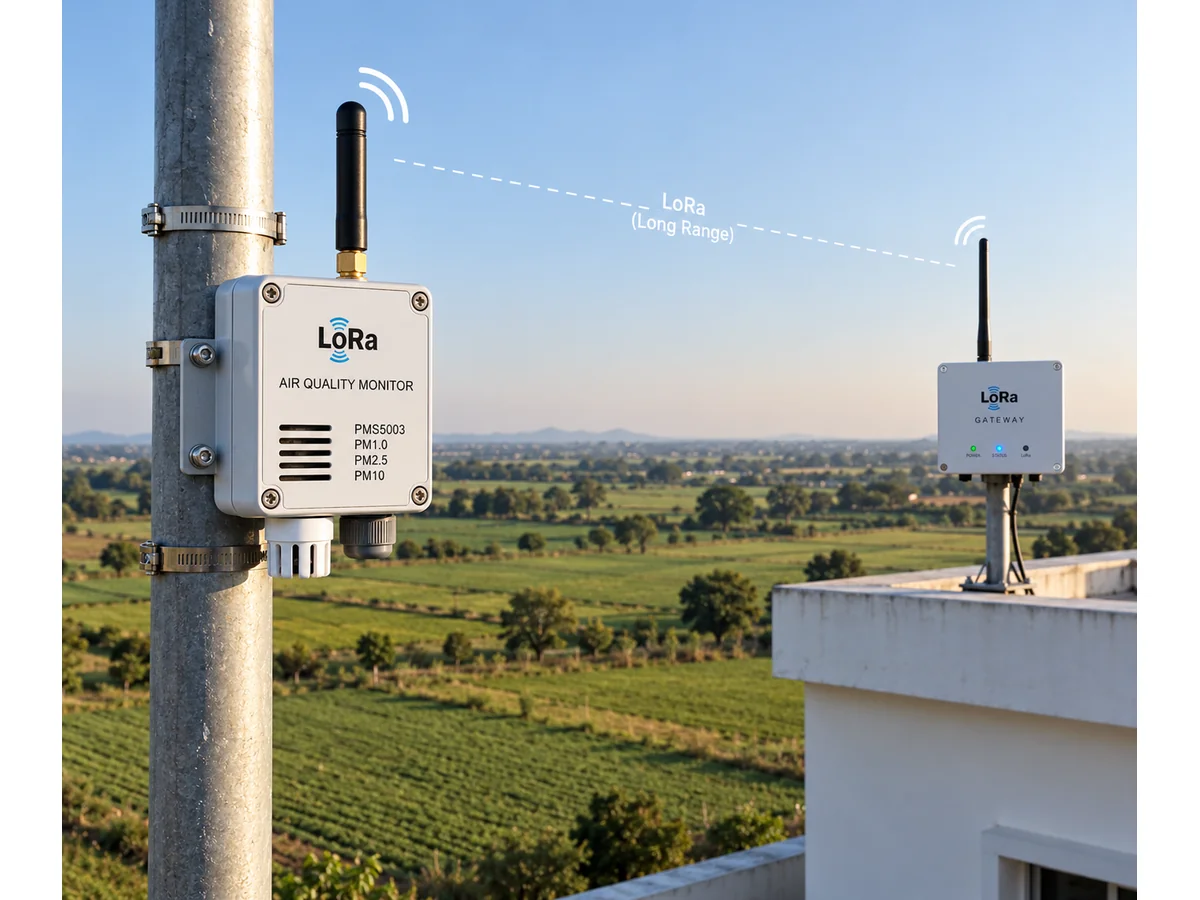
Air-quality monitoring is essential for public health, agriculture, and industrial compliance, yet conventional IoT monitors depend on WiFi or cellular connectivity at every sensing point — a requirement that fails in farms, construction sites, and remote industrial zones where no network infrastructure exists. This LoRa-based monitor decouples the sensing site from the network: a low-power ESP32 sensor node measures PM2.5, gas pollutants and temperature/humidity, and transmits compact packets over LoRa radio to a gateway up to several kilometers away, which forwards them to a cloud dashboard.
Measures particulate matter in the air.
Follow the working sequence
How it works
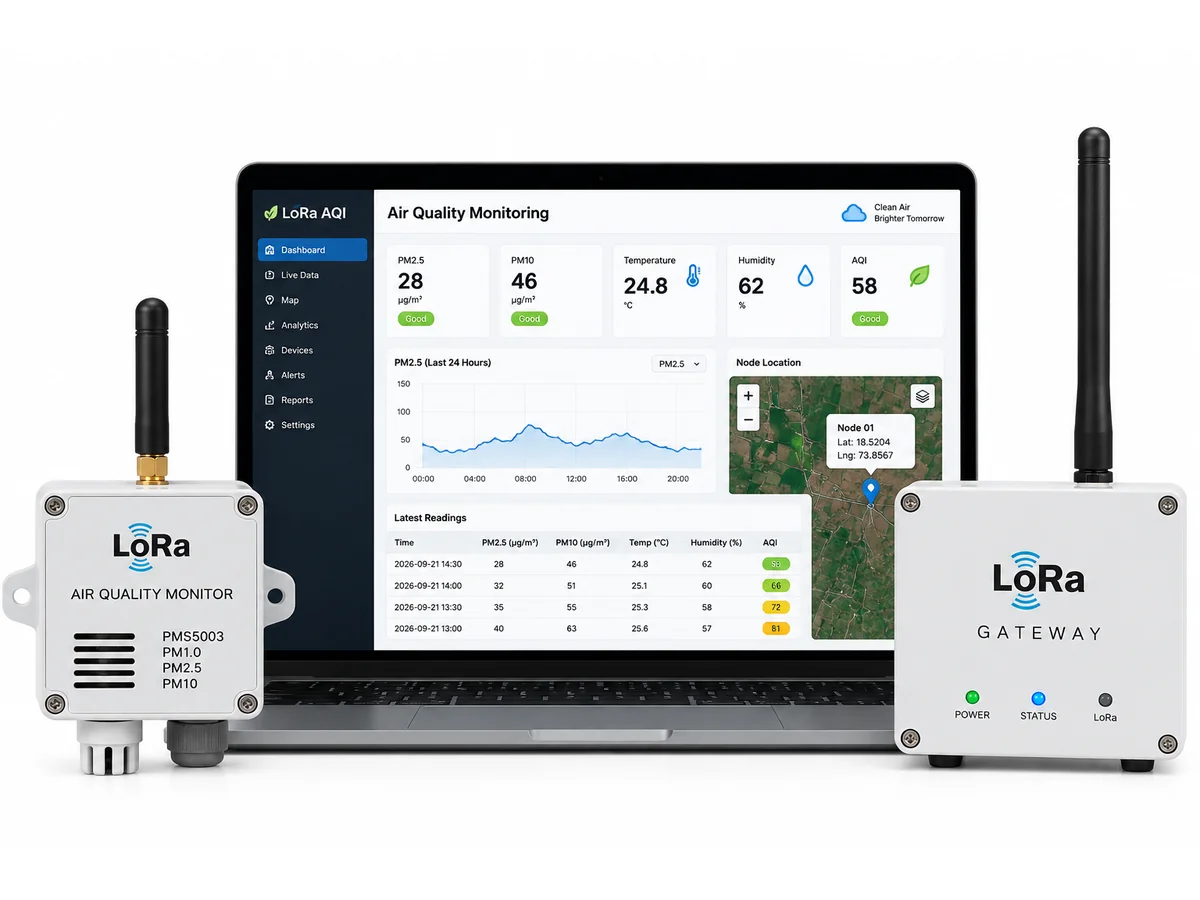
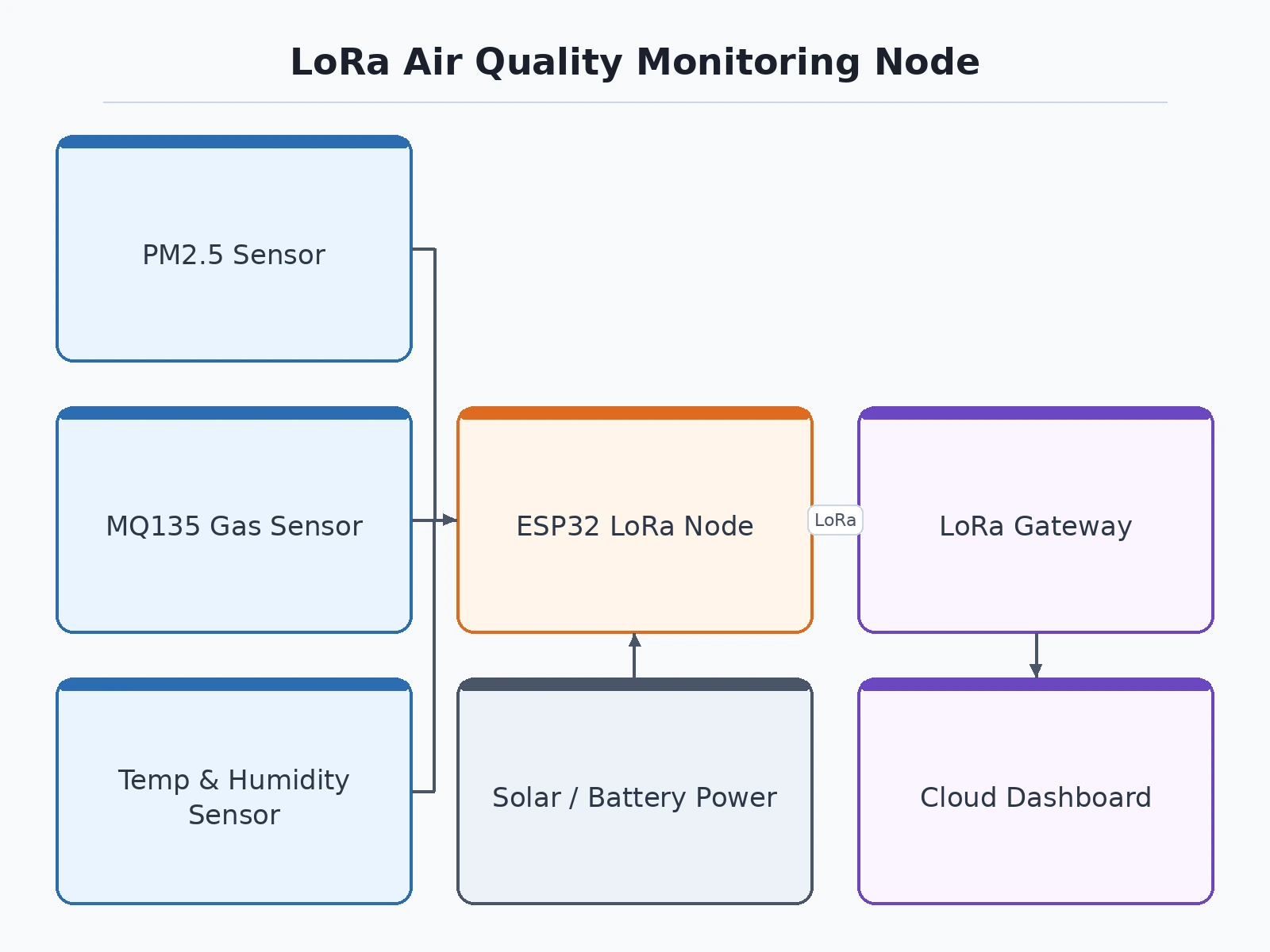
The ESP32 sensor node reads air-quality data from the PM sensor, gas sensor (MQ135), and DHT22 temperature/humidity sensor, packs it into a compact LoRa packet, and transmits it to the LoRa gateway — typically several kilometers away in open line-of-sight. The gateway, connected to WiFi or Ethernet, forwards the data to a cloud dashboard where it is logged, charted, and visualized in real time. Threshold alerts can notify the user when pollution levels cross safe limits. Multiple nodes can be deployed across a site, each with a unique node ID, all reporting to a single gateway.
Project features
- Long-range LoRa communication — transmits sensor data up to several kilometers without WiFi or cellular at the sensing site
- Multi-parameter sensing: PM2.5 particulate matter, gas pollutants (MQ135), plus temperature and humidity
- LoRa gateway aggregates data from one or multiple sensor nodes and pushes it to a cloud dashboard
- Low-power node design suitable for battery or solar operation in remote locations
- Real-time cloud dashboard with live graphs, location-tagged readings, and threshold alerts
- Scalable architecture — add more nodes across a campus, farm, or industrial zone with no extra network infrastructure
- Ideal for farms, campuses, industrial zones, construction sites, and rural areas where WiFi is unavailable
What is included
- Sensor node firmware (ESP32 + LoRa) and gateway firmware, with full source code
- Wiring / connection diagram for node and gateway
- Complete project report PDF (introduction, literature, design, results, conclusion)
- Presentation PPT for demo and viva
- Viva Q&A preparation set covering LoRa, sensors, and networking concepts
- Guidance on setup, calibration, and live demonstration
Advantages
- Long-range LoRa communication transmits sensor data over kilometers with no Wi-Fi or cellular needed at the sensing site.
- Multi-parameter sensing — PM2.5 particulate matter, gas pollutants (MQ135), plus temperature and humidity in one node.
- LoRa gateway aggregates data from one or multiple sensor nodes and pushes it to a cloud dashboard with live graphs and threshold alerts.
- Low-power node design suitable for battery or solar operation in remote farms, campuses and industrial zones.
- Scalable architecture — add more nodes across a site with no extra network infrastructure.
Disadvantages
- LoRa is low-bandwidth — it sends small periodic readings, not live high-resolution streams or images.
- Practical range depends heavily on antennas, terrain and obstructions; dense urban areas reduce range significantly.
- PM sensor accuracy is indicative/educational grade, not reference-grade instrumentation.
- The gateway requires a stable Wi-Fi or wired internet connection at its location.
Limitations & prerequisites
- LoRa is low-bandwidth — it sends small periodic readings, not live high-resolution streams or images
- Practical range depends heavily on antennas, terrain, and obstructions; dense urban areas reduce range significantly
- PM sensor accuracy is indicative/educational grade, not reference-grade instrumentation
- Gateway requires a stable WiFi or wired internet connection at its location
- This is a built-to-order project — delivery time depends on component availability
Components & software requirements
- ESP32 microcontroller (sensor node) + SX1276/SX1278 LoRa module (433/868 MHz)
- LoRa gateway unit (ESP32 + LoRa receiver, WiFi-enabled)
- PM2.5 particulate matter sensor (PMS5003 or equivalent)
- MQ135 air-quality / gas sensor
- DHT22 temperature and humidity sensor
- Cloud dashboard (e.g., ThingSpeak/Ubidots or custom MQTT dashboard)
- Antennas, power supplies, enclosures (as per build)
Download free synopsis (PDF)
Enter your name and WhatsApp number — the synopsis PDF downloads immediately. We may send occasional project updates on WhatsApp; no spam.
Fadhli et al. (2022), Proc. FIRST-T1-T2 2021 (Atlantis Press)