
More project photos (2)
The problem
A long-range wireless doorbell with RF module and custom melodies using Arduino replaces the wire between a door button and the chime with a 433 MHz radio link, so the bell can be heard in a room far from the door without drilling holes or running cable. A conventional wired doorbell forces a cable run from the gate or door to every room where the bell must be heard, while a shop-bought wireless bell rings one fixed tone and offers no way to learn how it works. This project solves both problems: a battery-powered transmitter at the door sends an encoded radio packet when the button is pressed, and a receiver inside the house checks the code and plays a melody the student chooses. The build demonstrates radio-frequency communication, ASK modulation, code-based addressing and audio playback in one system the student can explain end to end, and it suits homes, hostels and laboratories where a wired bell is impractical.
Doorbells are easy to take for granted until the wire is the problem: in rented houses, hostels and older buildings, running a new cable from the gate to a bedroom means drilling, trunking and repainting, so the bell ends up in one room and is missed everywhere else. This project turns the problem into a complete embedded-systems build — a transmitter node, a receiver node, a radio protocol and an audio player — each part simple on its own, but working together as a system the student can demonstrate live at a review.
Visitor presses the button at the door.
Follow the working sequence
How it works
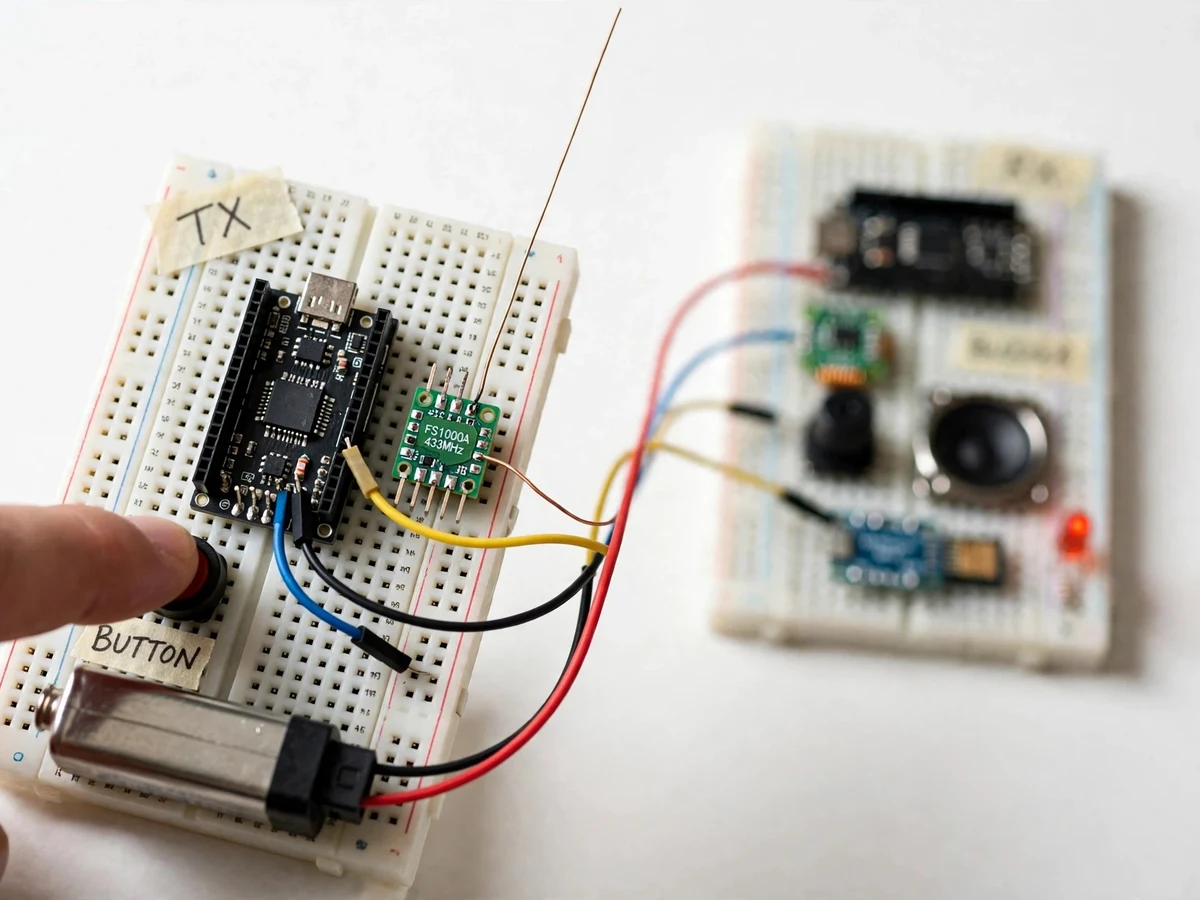
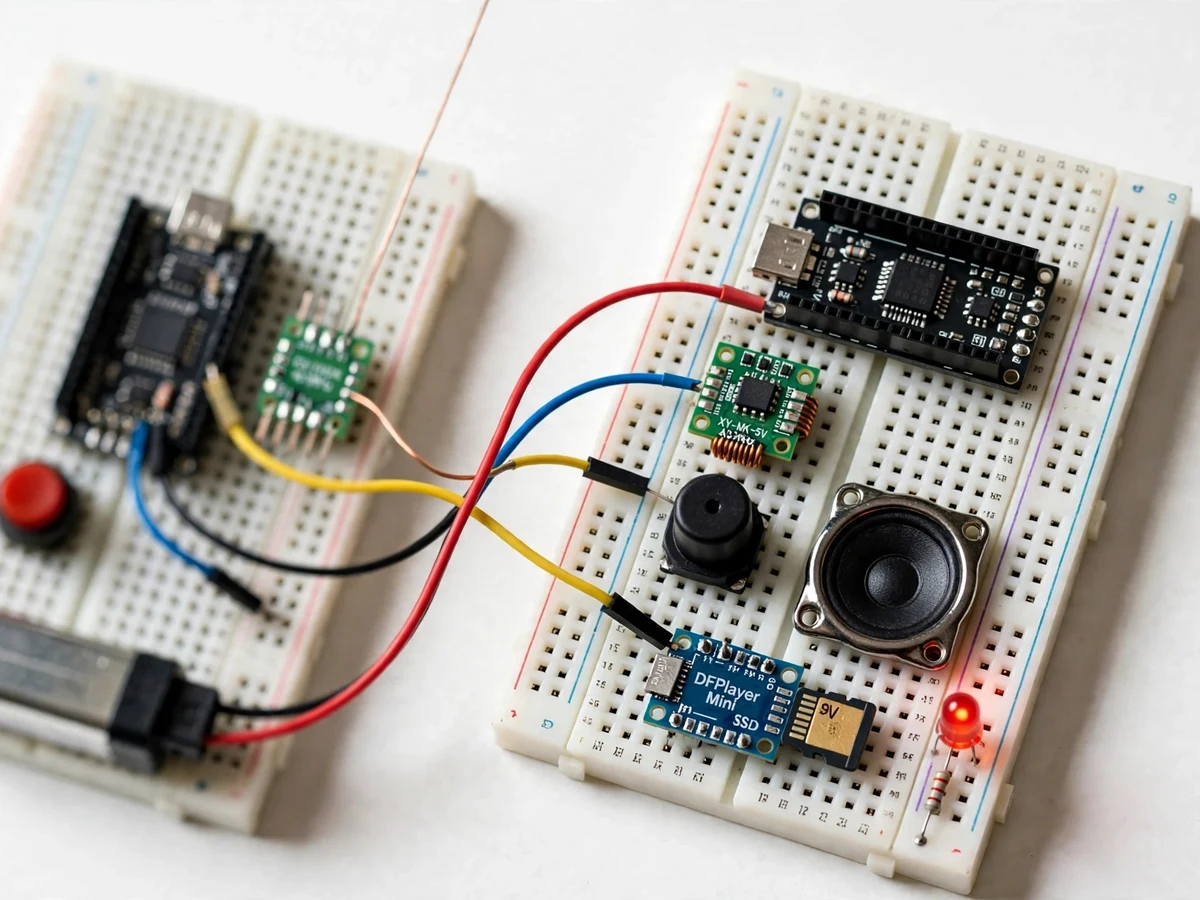
The doorbell works as a two-node radio system: a transmitter at the door and a receiver at the chime, with nothing between them but a 433 MHz radio wave. Pressing the button wakes the transmitter's Arduino Nano, which uses the RCSwitch library to send a fixed 24-bit code three times through the FS1000A transmitter module. The transmitter keys its 433.92 MHz carrier on and off — carrier on for a 1, off for a 0 — which is ASK modulation; the XY-MK-5V receiver's DATA pin simply mirrors whether it hears a carrier, so all addressing and checking happens in Arduino code, not in the modules. The receiver's Nano decodes the pulses, compares the code with the one it was taught, and if they match it tells the DFPlayer Mini to play the selected MP3 melody through the speaker, while the buzzer sounds and the LED lights. A code that does not match is ignored.
- The visitor presses the door button; the transmitter's Arduino Nano reads the press (debounced in firmware) and picks the stored 24-bit code.
- The Nano sends the code three times through the RCSwitch library to the FS1000A transmitter, which keys the 433.92 MHz carrier on and off (ASK modulation) with a 17.3 cm quarter-wave wire antenna.
- The XY-MK-5V receiver picks up the carrier and outputs the received pulse train on its DATA pin.
- The receiver's Nano decodes the pulses and compares the 24-bit code with the code it was taught; any code that does not match is ignored.
- On a match, the Nano commands the DFPlayer Mini over serial to play the selected MP3 melody from the microSD card through the 8 Ω speaker.
- The active buzzer sounds and the red LED lights together with the melody; the receiver then returns to listening for the next press.
Builder note: cutting both antennas to exactly 17.3 cm — a quarter wavelength at 433.92 MHz — was the single change that mattered most during the build; a coiled or shortened antenna left the link working only across one room, and keeping the antenna wire vertical and clear of the metal battery clip mattered as much as its length. Early testing also showed false rings from a neighbour's 433 MHz remote, which is why the receiver accepts only its own 24-bit code.
Tech stack:
- Arduino Nano (ATmega328P) × 2
- FS1000A 433 MHz RF transmitter
- XY-MK-5V 433 MHz RF receiver
- DFPlayer Mini MP3 module
- RCSwitch library · Arduino IDE
- Active buzzer · LED indicator
- 9 V battery · 5 V DC supply
- 8 Ω speaker · microSD card
| Parameter | Value |
|---|---|
| Controller | 2 × Arduino Nano (ATmega328P, datasheet value) |
| RF frequency | 433.92 MHz (datasheet value) |
| Modulation | ASK / OOK (datasheet value) |
| Transmitter supply | 3–12 V DC (datasheet value); 9 V battery in this build |
| Receiver supply | 5 V DC (datasheet value) |
| Receiver sensitivity | −105 dBm (datasheet value) |
| Antenna | 17.3 cm quarter-wave wire at each end (calculated: c ÷ 4f at 433.92 MHz) |
| Data rate | Up to 4 kbps (design target); 1 kbps typical for a reliable link |
| Range | 50–100 m open field (design target, antenna and obstacle dependent) |
| Melodies | 4 selectable MP3 tunes on microSD, DFPlayer Mini + 8 Ω speaker (design target) |
Project features
A long-range wireless doorbell with RF module and custom melodies stands on four capabilities: an encoded radio link, selectable melodies, a backup alert, and rejection of false rings. The transmitter sends a fixed 24-bit code using the RCSwitch library, so the receiver only rings for its own button and ignores every other 433 MHz remote in the neighbourhood. Four MP3 melodies stored on a microSD card are played by a DFPlayer Mini through a small speaker, and a switch selects which tune plays — the student can swap in any tune by replacing a file. A buzzer and a red LED fire with every valid ring, so the alert is heard even if the speaker is muted or unplugged. A quarter-wave wire antenna on each module, cut to 17.3 cm, is what makes the link reach across a house, and the whole system runs offline with no Wi-Fi or internet.
- [Encoded 433 MHz RF link] The transmitter sends a fixed 24-bit code using the RCSwitch library, and the receiver only responds to that code, so the doorbell is an addressed radio system rather than a raw carrier detector.
- [Custom melodies with DFPlayer Mini] A DFPlayer Mini MP3 module plays one of 4 stored melodies from a microSD card through an 8 Ω speaker (design target), so the chime is a real tune the student chooses instead of a single fixed beep.
- [Melody selection switch] A selector switch on the receiver chooses which of the stored melodies plays, without reprogramming the Arduino — the student can demonstrate all four tunes at a review.
- [Buzzer and LED backup alert] An active buzzer and a red LED fire together with every valid ring, so the alert is seen and heard even if the speaker is muted, unplugged or out of earshot.
- [Battery-powered transmitter] The door unit runs from a 9 V battery (datasheet value: transmitter supply 3–12 V DC) and transmits only when the button is pressed, so there is no mains wiring at the door and the unit can be mounted anywhere.
- [False-ring rejection] The receiver decodes every incoming pulse train and ignores any code that does not match its own, so neighbouring 433 MHz remotes and the receiver module's own idle noise never ring the bell.
- [Fully offline operation] The system needs no Wi-Fi, no internet connection and no phone app — the radio link and the MP3 player are both self-contained, so the doorbell works during a power cut to the router and in buildings with no network at all.
What is included
- Working wireless doorbell prototype: battery-powered transmitter unit (button, Arduino Nano, FS1000A) and receiver unit (Arduino Nano, XY-MK-5V, DFPlayer Mini, speaker, buzzer, LED)
- Transmitter and receiver Arduino firmware (RCSwitch 24-bit code send/receive, debounce, melody selection, DFPlayer serial control)
- Wiring diagram and antenna-cutting guide (17.3 cm quarter-wave wire)
- 4 MP3 melody files on microSD card
- Project report PDF (RF theory, ASK modulation, circuit design, antenna notes, testing procedure)
- Abstract PDF (10-section)
- PPT presentation for final review
- Viva Q&A preparation document (433 MHz band, ASK modulation, RCSwitch, DFPlayer Mini, antenna length, interference)
Timeline
- Built-to-order assembly, wiring and testing typically takes 2–3 weeks after order confirmation (expected timeline, confirmed at quotation).
- The report, PPT and viva kit ship with the prototype.
Support
- Remote guidance for setting up the transmitter and receiver and running the first range check.
- A walkthrough of the ASK radio link, the 24-bit code check and the melody-selection switch so the student can present the system confidently.
- Viva preparation support covering the 433 MHz band, ASK modulation, RCSwitch, the DFPlayer Mini and the quarter-wave antenna calculation.
Limitations & prerequisites
- The 50–100 m open-field range is a design target, stated honestly — the report documents the range achieved in the builder's own open-area check, not a guaranteed figure; walls, metal doors and concrete reduce it.
- The XY-MK-5V is a super-regenerative receiver, so its DATA pin is noisy when no signal is present; the code check is what makes the system usable, and a strong nearby 433 MHz transmitter can still swamp the receiver.
- The link is one-way with no acknowledgement, so a missed packet means a missed ring; the transmitter sends each code three times per press to reduce this, but delivery is not guaranteed.
- Melodies are pre-loaded MP3 files; changing a tune means replacing a file on the microSD card, and the module plays only the formats the DFPlayer Mini supports.
- Transmitter battery life depends on how often the button is pressed (expected); no battery-life figure is claimed, and the 9 V battery must be replaced when the link weakens.
- The 24-bit code is fixed, not encrypted, so this is a doorbell and not a security or access-control device.
- This is an academic prototype, not a certified consumer doorbell product, and it carries no weatherproofing rating — the door unit must be kept dry.
Frequently Asked Questions
Is this project suitable for a final-year project?
Yes — for Electronics & Telecommunication, Electronics and Electrical programs, because it combines RF communication, ASK modulation, code-based addressing and MP3 audio playback into one complete two-node embedded system with a working prototype the student can demonstrate live at a review. The build is compact enough for one semester, the antenna-length calculation gives the student a real design decision to explain, and the code-check mechanism makes a strong viva talking point.
How far does the wireless doorbell work?
The design target is 50–100 m in open field with a 17.3 cm quarter-wave antenna on each module, but that is a target, not a measured guarantee, and the exact figure depends on the antenna, the transmitter supply voltage and what stands between the two units. Indoors, walls, metal doors, concrete and the transmitter supply voltage all reduce the range, and the report documents the range achieved in the builder's own open-area check. A straight, vertical antenna and a fresh 9 V battery give the best result.
How do the custom melodies work?
Melodies are MP3 files stored on a microSD card and played by a DFPlayer Mini module, which the receiver's Arduino controls over a serial connection, with a selector switch choosing which of the four stored tunes plays when the bell rings. To change a tune, the student replaces an MP3 file on the card — no code change is needed.
Why does the receiver check a code instead of ringing on any signal?
Because the XY-MK-5V receiver's DATA pin is noisy when nothing is being sent, and any 433 MHz remote nearby — a car remote, a garage remote, a neighbour's bell — can put a signal on the same frequency, so the code check is what makes the system usable in a real neighbourhood. The transmitter therefore sends a fixed 24-bit code using the RCSwitch library, and the receiver rings only when the code it decodes matches its own. Early testing showed false rings from a neighbour's remote before this check was added.
What power does each unit need?
The transmitter runs from a 9 V battery, inside the FS1000A module's 3–12 V DC datasheet range, so no mains wiring is needed at the door, while the receiver runs from a 5 V DC adapter that also powers its Arduino, the DFPlayer Mini and the speaker. The system works entirely offline, with no Wi-Fi or internet connection.
Can more buttons or receivers be added?
Yes — each extra button can send a different 24-bit code, and the receiver can be programmed to play a different melody for each code, so a front door and a back door can sound different tunes, and an extra receiver in another room can listen for the same code. Both are optional customizations, not part of the base build.
Components & software requirements
- Arduino Nano (ATmega328P) × 2
- FS1000A 433 MHz RF transmitter
- XY-MK-5V 433 MHz RF receiver
- DFPlayer Mini MP3 module
- RCSwitch library · Arduino IDE
- Active buzzer · LED indicator
- 9 V battery · 5 V DC supply
- 8 Ω speaker · microSD card
Delivery information
Built-to-order project. Delivery timeline is shared after order confirmation based on current queue.
Support terms
Complete documentation, setup guide, and viva preparation included. Support for setup and explanation provided.
Download free synopsis (PDF)
Enter your name and WhatsApp number — the synopsis PDF downloads immediately. We may send occasional project updates on WhatsApp; no spam.