
More project photos (3)


The problem
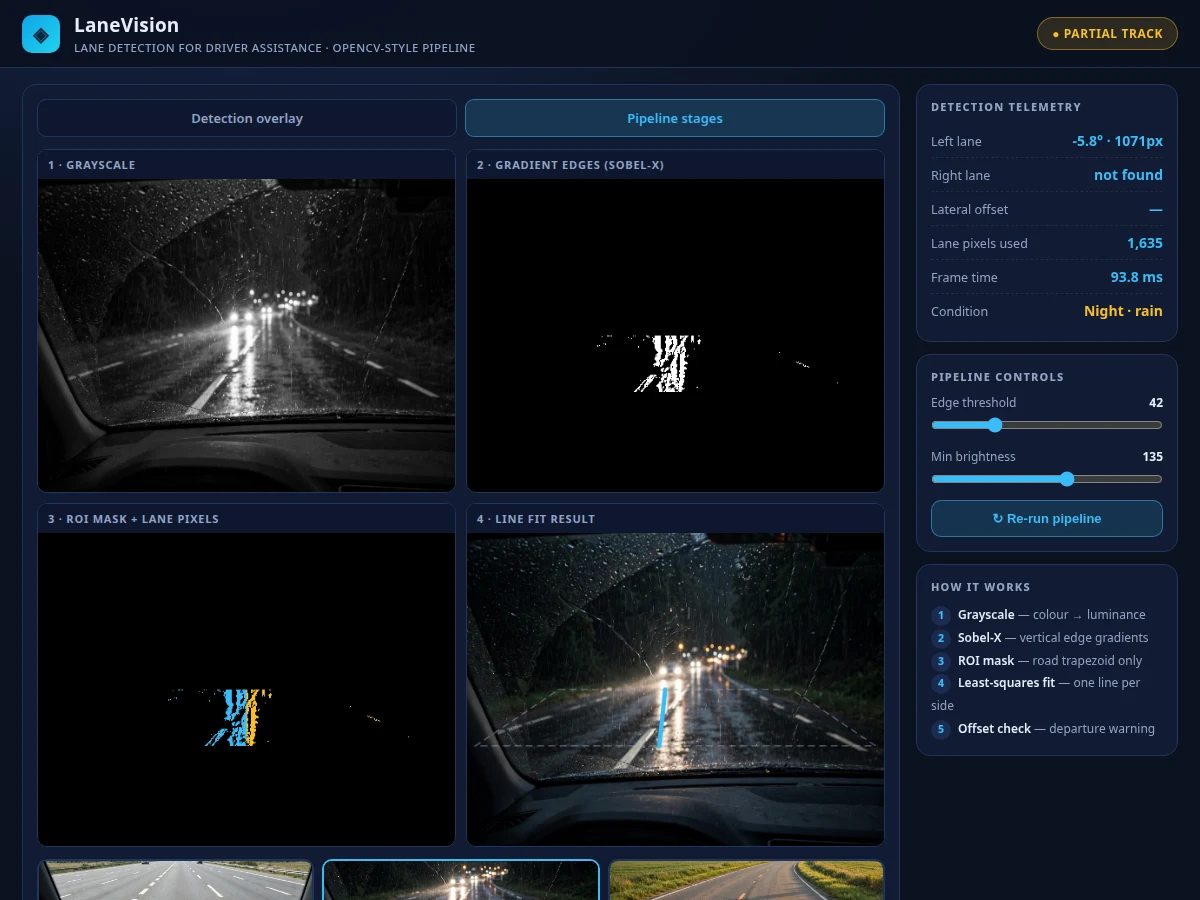
Lane keeping is one of the core functions of modern driver-assistance systems: before a car can warn about drifting or steer itself, it must reliably find the lane markings in the camera frame. That turns out to be a genuinely instructive computer-vision problem — perspective makes parallel lines converge, shadows and wet asphalt create false edges, and dashed markings appear and disappear between frames. This project implements the classic, explainable solution: a multi-stage OpenCV pipeline that converts each frame to grayscale, extracts vertical edge gradients with a Sobel-X operator, restricts processing to a road-region trapezoid, and fits one line per side through the surviving lane pixels with least squares. The lateral offset of the vehicle from the lane centre is computed from the two fitted lines, and a departure warning fires when the offset exceeds a configurable threshold. The project is honest about its approach: it uses deterministic classical vision rather than a learned model, which makes every intermediate stage inspectable — ideal for a viva where each step can be questioned and defended.
This is a built-to-order software project: the Python OpenCV pipeline, the interactive web demo, sample dashcam frames and the complete viva kit (report, PPT, Q&A) are prepared fresh for you.
Dataset & Model Details
- Dataset: TuSimple Lane Detection Benchmark (tuSimple / CVPR 2017 workshop data). Real highway driving clips with annotated lane polylines: 3,626 training and 2,782 test clips at 1280x720, the standard public benchmark for lane-line detection.
- Task: Detect the ego-lane's left and right boundary lines in each frame and estimate lateral vehicle offset.
- Model (classical, non-learned): Grayscale conversion → Gaussian blur → Sobel-X gradient magnitude → brightness/gradient thresholding → trapezoidal region-of-interest mask → weighted least-squares line fit (x = m·y + b) per lane side, with slope-sign and steepness sanity checks. No neural network is involved; every stage is inspectable.
- Metrics: Evaluated with the TuSimple official protocol — per-point accuracy, false-positive rate and false-negative rate. Reported as design targets (typically ≥90% point accuracy on clear daytime highway clips) — actual measured values depend on the student's own evaluation run and are reported honestly from it, never pre-filled.
- Demo data: The web demo ships with three sample dashcam frames (day highway, night rain, rural curve) plus upload-your-own support, so the pipeline can be exercised and its failure modes (heavy rain, sharp curves) demonstrated live.
Uploads a dashcam frame or tunes the sliders in the demo.
Follow the working sequence
How it works
- The input frame is downscaled and converted to grayscale, removing colour information that lane detection does not need.
- A Sobel-X operator computes horizontal brightness gradients, highlighting the vertical-ish edges that lane paint produces.
- Pixels must pass both the gradient threshold and a brightness floor, then survive the trapezoidal road-region mask that excludes sky, dashboard and roadside clutter.
- Surviving pixels are split into left and right halves; each side gets a gradient-weighted least-squares line fit (x = m·y + b).
- Fits are sanity-checked: minimum pixel support, plausible steepness and the correct slope sign for their side (up-to-the-right for left, up-to-the-left for right).
- The two lines are drawn over the frame, the drivable lane region is shaded, and the lateral offset is computed from the lane centre at the bottom of the region of interest.
- If the absolute offset exceeds the warning threshold (default 25% of lane width), a lane-departure warning is raised.
Tech stack:
- Python 3.10+ with OpenCV (cv2) for the reference pipeline
- NumPy for the gradient and least-squares computation
- JavaScript (ES6) + HTML5 Canvas for the interactive web demo
- TuSimple Lane Detection Benchmark for evaluation
- Matplotlib for evaluation plots and the report figures
| Parameter | Value |
|---|---|
| Approach | Classical computer vision (no neural network) |
| Pipeline stages | Grayscale → blur → Sobel-X → threshold → ROI mask → least-squares fit |
| Input | 1280×720 dashcam frames (TuSimple) or any road photo in the demo |
| Line model | Straight line per side (x = m·y + b); gentle curves approximated |
| Evaluation | TuSimple official protocol: accuracy, false-positive rate, false-negative rate |
| Expected daytime accuracy | Design target ≥90% point accuracy on clear highway clips (measured in your own run) |
| Demo frame time | Approximately 100–450 ms per frame in the browser demo (measured on sample frames) |
| Departure threshold | Default 25% of lane width, configurable |
| Platform | Python pipeline runs on any laptop; demo runs in a modern browser |
Project features
- [Multi-stage lane pipeline] Grayscale, Sobel-X edges, road-region mask and least-squares line fitting run as a real, inspectable pipeline — each stage can be viewed separately in the demo.
- [Left/right lane tracking] One weighted line fit per lane side with slope-sign and steepness validation, so spurious edges are rejected rather than drawn.
- [Lateral offset estimation] The vehicle position relative to the lane centre is computed from the two fitted lines and shown as a percentage of lane width, left or right.
- [Lane-departure warning] A configurable offset threshold triggers a visual warning when the vehicle drifts — the core driver-assistance behaviour.
- [Three built-in test frames] Day highway, night rain and rural curve dashcam photos let the pipeline be compared across easy, hard and curved conditions.
- [Live threshold tuning] Edge-strength and brightness sliders re-run the pipeline instantly, showing exactly how each parameter changes detection.
- [Upload your own frame] Any dashcam photo can be dropped in to test the pipeline on new roads.
What is included
- Complete Python source code (OpenCV lane-detection pipeline with all stages)
- Interactive web demo (3 sample dashcam frames, stage inspector, live threshold sliders, upload-your-own)
- Evaluation script for the TuSimple benchmark with the official accuracy/FP/FN protocol
- Setup guide (installing OpenCV, downloading TuSimple, running the evaluation)
- Project report PDF (background, pipeline design, stage-by-stage explanation, evaluation results, limitations)
- PPT presentation for final review
- Viva Q&A preparation document (Sobel operators, ROI design, least-squares fitting, lane-departure logic)
Limitations & prerequisites
- Straight-line model only: gentle curves are approximated by lines, but sharp bends need polynomial fits (listed as future scope) — the curved-road sample frame only partially tracks.
- Heavy rain, worn-out paint and strong shadows reduce detection quality; the night-rain frame demonstrates partial tracking honestly.
- The pipeline needs visible lane markings; unmarked rural roads and intersections are out of scope.
- Camera mounting matters: the ROI trapezoid assumes a roughly centred forward-facing dashcam view; a badly aimed camera degrades results.
- Frame time of ~100–450 ms in the browser demo is a prototype figure, not a real-time automotive guarantee.
- This is a driver-assistance prototype for study, not a certified safety system — it must never steer a real vehicle.
Frequently Asked Questions
Is this a deep-learning project?
No — deliberately. It uses classical computer vision (Sobel edges, ROI masking, least-squares fitting) so every stage is inspectable and explainable in a viva. The listing states this openly.
Which dataset is used for evaluation?
The TuSimple Lane Detection Benchmark — real highway driving clips with annotated lane polylines, evaluated with the official accuracy / false-positive / false-negative protocol.
What accuracy does it achieve?
The design target is ≥90% point accuracy on clear daytime highway clips, but the honest number is whatever your own evaluation run measures — the report template records measured values from your run, never pre-filled claims.
Can it handle curves?
Gentle curves are approximated by the straight-line fit and partially tracked; sharp bends are a stated limitation, with polynomial lane models listed as future scope.
Does it work at night or in rain?
Partially — the night-rain sample frame shows the pipeline finding one lane where paint is reflective and missing the other. Tuning thresholds live in the demo shows this trade-off directly.
Is this project suitable for a final-year project?
Yes — for Computer, AI/ML and Electronics Engineering programs. It demonstrates image processing, edge detection, geometric fitting and a real driver-assistance behaviour with honest evaluation. Suitable for B.E./B.Tech final-year projects in Computer, AI/ML and Electronics Engineering.
Components & software requirements
- Python 3.10+ with OpenCV (cv2) for the reference pipeline
- NumPy for the gradient and least-squares computation
- JavaScript (ES6) + HTML5 Canvas for the interactive web demo
- TuSimple Lane Detection Benchmark for evaluation
- Matplotlib for evaluation plots and the report figures
Delivery information
Built-to-order project. Delivery timeline is shared after order confirmation based on current queue.
Support terms
Complete documentation, setup guide, and viva preparation included. Support for setup and explanation provided.
Download free synopsis (PDF)
Enter your name and WhatsApp number — the synopsis PDF downloads immediately. We may send occasional project updates on WhatsApp; no spam.