
More project photos (2)
The problem
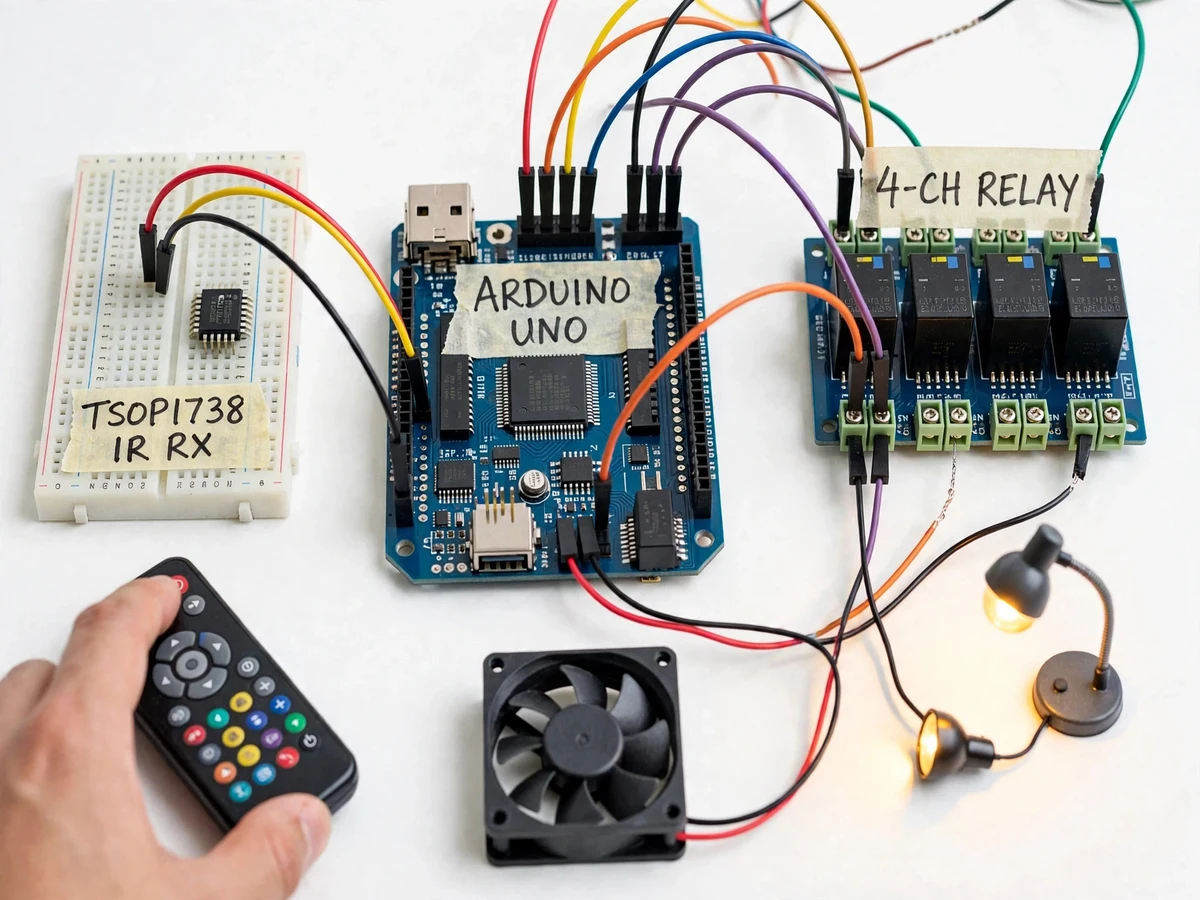
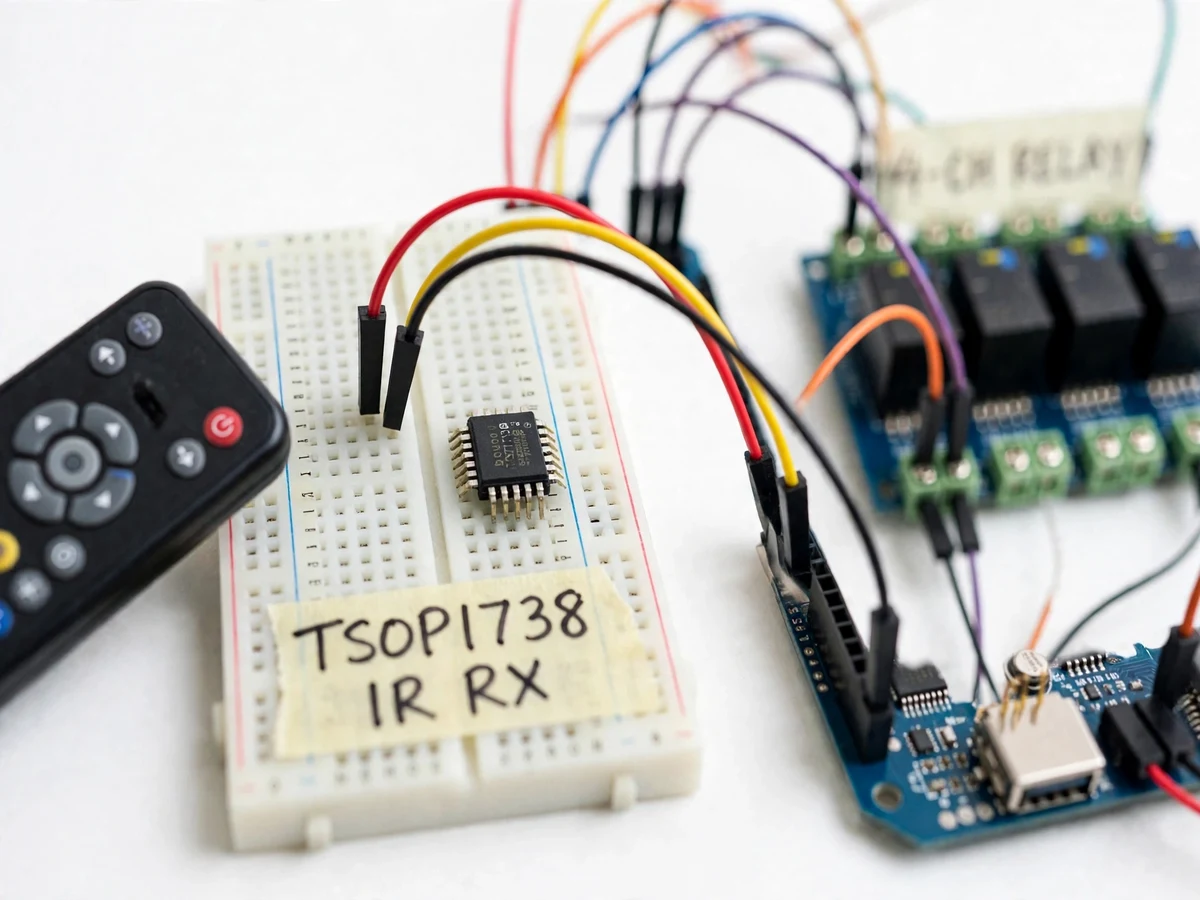
IR Remote Controlled Home Appliances using Arduino and TSOP1738 is a hardware project that switches household appliances on and off from an ordinary infrared TV remote, with no phone, app or internet needed. Many homes rely on wall switches inconvenient to reach at night or from a bed, while commercial home-automation systems are often expensive, need Wi-Fi and a smartphone, and stop working when the network drops. This project solves the problem with the simplest wireless link there is: a TSOP1738 infrared receiver listens for the 38 kHz modulated signal from a standard remote, an Arduino Uno decodes the NEC protocol frame, and a 4-channel relay module switches the connected appliances. Each remote button maps to one appliance, so a lamp, a fan or another small load toggles with a single press. The build is inexpensive, fully offline and easy to demonstrate in a viva, and teaches infrared communication, protocol decoding and safe relay switching on real hardware.
Any NEC TV remote; a button press sends a 38 kHz infrared frame.
Follow the working sequence
How it works
Pressing a button on the TV remote makes its infrared LED flash in bursts of a 38 kHz carrier, and the TSOP1738 receiver — a PIN photodiode with a preamplifier and a bandpass filter tuned to 38 kHz — turns those bursts back into a clean digital pulse train while ignoring steady infrared from room lighting. The Arduino Uno reads that pulse train on a digital pin, and the Arduino-IRremote library measures the timing: a 9 ms leading pulse followed by a 4.5 ms space marks the start of an NEC frame, then 32 bits arrive as 562.5 µs bursts with short or long spaces for logic 0 and logic 1. The firmware checks the address and its inverse, reads the command byte, looks it up in the button table, and toggles the matching relay channel, which powers the appliance. The whole chain completes in a fraction of a second, and the channel LED shows the new state immediately.
- Pressing a button on the remote makes its IR LED transmit a 38 kHz modulated NEC frame carrying the button's 32-bit address and command.
- The TSOP1738 receiver detects the 38 kHz bursts, filters out ambient infrared, and outputs an active-low digital pulse train to the Arduino.
- The Arduino Uno reads the pulse train and the Arduino-IRremote library decodes the NEC frame, starting with the 9 ms leading pulse and 4.5 ms space.
- The firmware verifies the address byte against its inverse, extracts the 8-bit command, and looks it up in the button-to-appliance table.
- The matched command toggles the corresponding digital output pin, which drives one channel of the 4-channel relay module through its optocoupler.
- The relay contacts close or open, switching the connected appliance on or off, and the channel LED updates to show the new state.
- A dedicated all-off button repeats the same chain for all four channels at once, switching every appliance off in one press.
Tech stack:
- Arduino Uno (ATmega328P)
- TSOP1738 IR receiver module
- 4-channel 5 V relay module
- NEC infrared protocol
- Arduino-IRremote library
- Embedded C · Arduino IDE
- Breadboard prototyping
- 5 V DC power supply
| Parameter | Value |
|---|---|
| Controller | Arduino Uno, ATmega328P, 16 MHz clock (datasheet value) |
| IR receiver | TSOP1738, 3-pin module (datasheet value) |
| Carrier frequency | 38 kHz (datasheet value) |
| Receiver supply voltage | 4.5 V to 5.5 V (datasheet value) |
| Receiver supply current | 0.6 mA typical (datasheet value) |
| Protocol | NEC, 32-bit frame (datasheet value) |
| NEC frame start | 9 ms leading pulse + 4.5 ms space (protocol specification) |
| NEC bit timing | 562.5 µs burst; logic 0 = 562.5 µs space, logic 1 = 1.6875 ms space (protocol specification) |
| Relay module | 4-channel, 5 V DC coil, optocoupler isolated (datasheet value) |
| Relay contact rating | 10 A at 250 V AC / 10 A at 30 V DC per channel (datasheet value) |
| Appliances controlled | 4 channels (design target) |
| Control range | Up to approximately 8 m indoors with a clear line of sight (design target) |
| Response time | Under approximately 200 ms from button press to relay click (design target) |
| Power supply | 5 V DC, 1 A adapter for controller and relays (design target) |
| Firmware | Embedded C, Arduino-IRremote library, 1 lookup table for button codes |
Project features
IR Remote Controlled Home Appliances using Arduino and TSOP1738 offers four independent relay channels, NEC protocol decoding, toggle and all-off control, and visible status indication, all running on a single Arduino Uno with no internet or phone needed. The four relay channels switch four separate appliances — a lamp, a fan and two further loads of the buyer's choice — each from its own remote button, so the whole room can be controlled from one handset. NEC protocol decoding reads the 32-bit address and command from any compatible TV remote, and the firmware maps each received code to an action in a small lookup table that is easy to edit. Toggle control switches an appliance on or off with the same button, while a dedicated all-off button shuts every channel down at once. On-board LEDs mirror each relay state, so the switching is visible even before a load is connected.
- [Four independent relay channels] A 4-channel relay module switches four separate appliances, each wired to its own relay, so a lamp, a fan and two further loads are controlled independently from one remote.
- [NEC protocol decoding] The Arduino-IRremote library decodes the 32-bit NEC frame — 8-bit address, inverted address, 8-bit command and inverted command — and the firmware matches each command code to an appliance action.
- [Toggle and all-off control] Pressing a button toggles its appliance between on and off, and a dedicated button switches all four channels off at once, which is useful when leaving the room.
- [Status LEDs] An LED on each relay channel and on the Arduino shows the live on/off state of every appliance, so the switching can be verified at a glance during a demonstration.
- [Works with any NEC TV remote] The receiver accepts the standard NEC codes sent by most TV and set-top-box remotes, so no special transmitter has to be built or bought.
- [Fully offline operation] The system needs no Wi-Fi, Bluetooth, phone or cloud service; the remote, receiver, controller and relays form a complete closed loop.
- [Simple button remapping] Remote codes are stored in one editable lookup table in the firmware, so any button can be reassigned to any appliance by changing a single line.
What is included
- Working prototype: Arduino Uno, TSOP1738 receiver, 4-channel relay module and demo loads (lamp and fan) wired on a breadboard base
- Arduino firmware source code with the editable button-to-appliance lookup table
- Circuit diagram and step-by-step wiring documentation
- Component list with part numbers and quantities
- Project report PDF (background, NEC protocol theory, circuit design, methodology, results)
- Project abstract PDF
- PPT presentation for final review
- Viva Q&A preparation document (infrared communication, NEC timing, relay isolation, line-of-sight limits)
- Setup and demonstration instructions
Limitations & prerequisites
- Infrared needs a clear line of sight: the remote must point at the TSOP1738 receiver, and walls, closed doors and furniture block the signal completely.
- Direct sunlight and some fluorescent lighting interfere with the receiver, so reliable operation needs the receiver shielded from strong light sources.
- The receiver is tuned to a 38 kHz carrier, so remotes using other carriers or protocols (RC5, Sony SIRC) need their codes re-checked and may not work.
- The system has no feedback from the appliance itself: the Arduino knows the relay state, not whether a bulb has failed or a fan is unplugged.
- Only 4 appliances are controlled in the base build; more channels need an additional relay module and extra code.
- Mains-voltage appliances must be wired with care: the prototype is an academic build, not a certified product, and mains connections should be checked by a qualified person before use.
- There is no timer, scheduling or automatic control — every action needs a button press on the remote.
Frequently Asked Questions
How does the remote switch an appliance on and off?
Pressing a remote button sends an NEC infrared frame on a 38 kHz carrier, the TSOP1738 receiver converts it to a digital pulse train, the Arduino decodes the command and toggles the matching relay channel, which closes its contacts and powers the appliance. The same button toggles the appliance back off.
Which remote can I use with this project?
Any standard TV or set-top-box remote that transmits NEC protocol codes works, because the TSOP1738 receiver is tuned to the 38 kHz carrier NEC uses. The firmware prints each received code to the serial monitor, so the buttons of a new remote can be mapped in minutes.
Does it work through walls or from another room?
No. Infrared light cannot pass through walls, doors or furniture, so the remote must have a clear line of sight to the TSOP1738 receiver. This is a genuine limit of IR control and is the main reason it differs from Bluetooth or Wi-Fi home automation.
Is it safe to switch mains appliances with this prototype?
The relay contacts are rated at 10 A at 250 V AC per channel (datasheet value), and the module's optocouplers isolate the Arduino from the mains side. Even so, the build is an academic prototype, not a certified product, so mains wiring must be checked by a qualified person and the demo loads are kept low-voltage where possible.
Can more appliances or extra features be added?
Yes. A second relay module adds 4 more channels with a few extra lines of code, and optional additions include a timer-based auto-off, a manual override switch, or a Bluetooth module for phone control alongside the remote. Each addition is quoted separately.
Is this project suitable for a final-year project?
Yes — for Electronics and Telecommunication, Electrical and Electronics Engineering programs. It demonstrates infrared communication, the NEC protocol, embedded C programming and relay-based load switching, all on hardware that can be shown live in a viva. The NEC timing, receiver behaviour and relay isolation give the team solid technical material for viva questions.
Components & software requirements
- Arduino Uno (ATmega328P)
- TSOP1738 IR receiver module
- 4-channel 5 V relay module
- NEC infrared protocol
- Arduino-IRremote library
- Embedded C · Arduino IDE
- Breadboard prototyping
- 5 V DC power supply
Delivery information
Built-to-order project. Delivery timeline is shared after order confirmation based on current queue.
Support terms
Complete documentation, setup guide, and viva preparation included. Support for setup and explanation provided.
Download free synopsis (PDF)
Enter your name and WhatsApp number — the synopsis PDF downloads immediately. We may send occasional project updates on WhatsApp; no spam.