
More project photos (3)
The problem
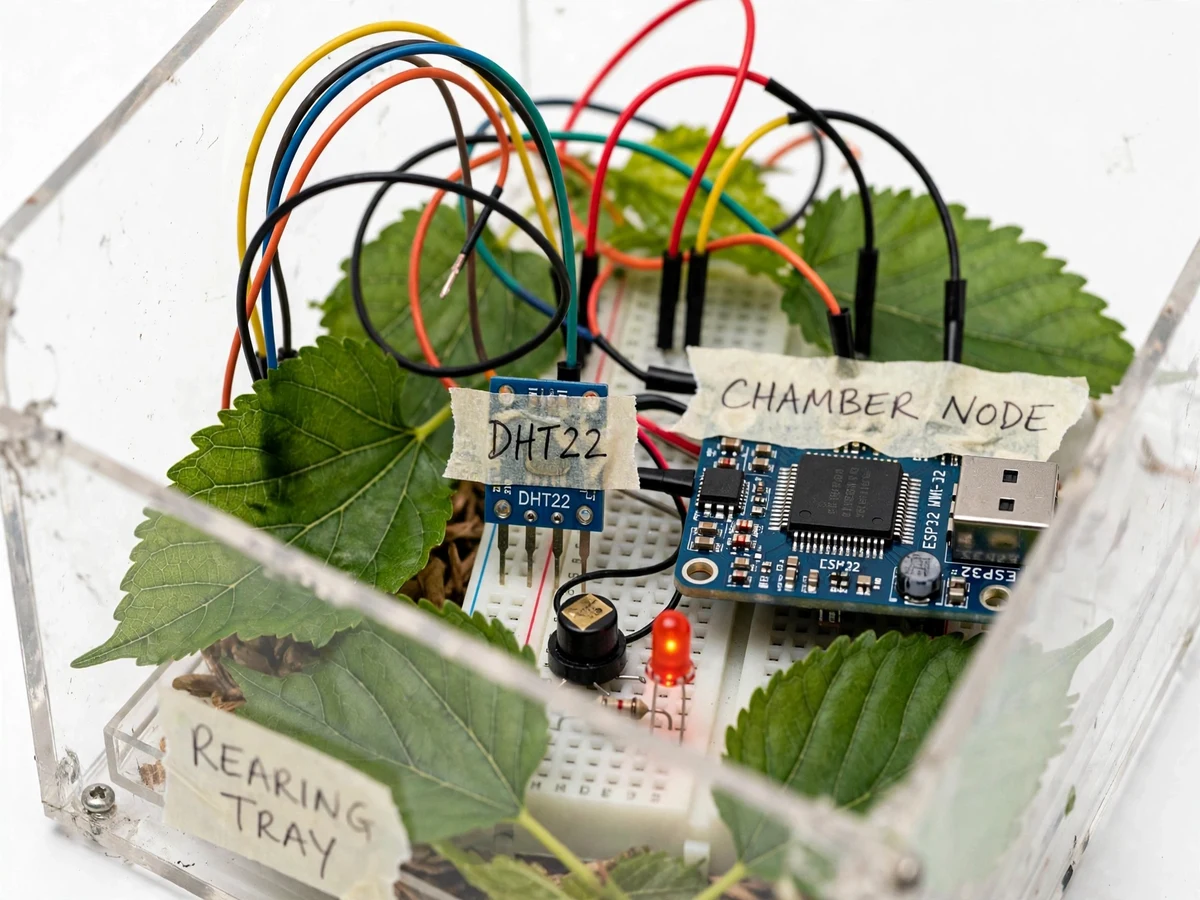
Sericulture is unforgiving of bad climate: silkworms (Bombyx mori) need rearing-chamber temperature around 24–28°C and relative humidity around 70–85%, and deviations in either direction raise mortality, slow growth, and spoil cocoon quality. Small farms and college rearing units still check these values with manual thermometers a few times a day, so a hot afternoon or a dry night can pass unnoticed until the larvae show it. This project replaces that guesswork with an ESP32 sensor node placed inside the rearing chamber: a DHT22 measures temperature and humidity every few seconds, a light sensor (LDR/BH1750-class) records rearing-room illumination, and readings stream over Wi-Fi to a web dashboard with instar-stage presets — because the ideal bands differ slightly across the 1st to 5th instars. When readings drift outside the selected band, the dashboard raises an alert and the node signals locally with a buzzer/LED. Everything — sensor node, firmware, dashboard, wiring, and a buyer-run calibration procedure — is prepared fresh for each order, and the report documents the real climate bands published in sericulture extension literature as reference ranges, not as claims about this build.
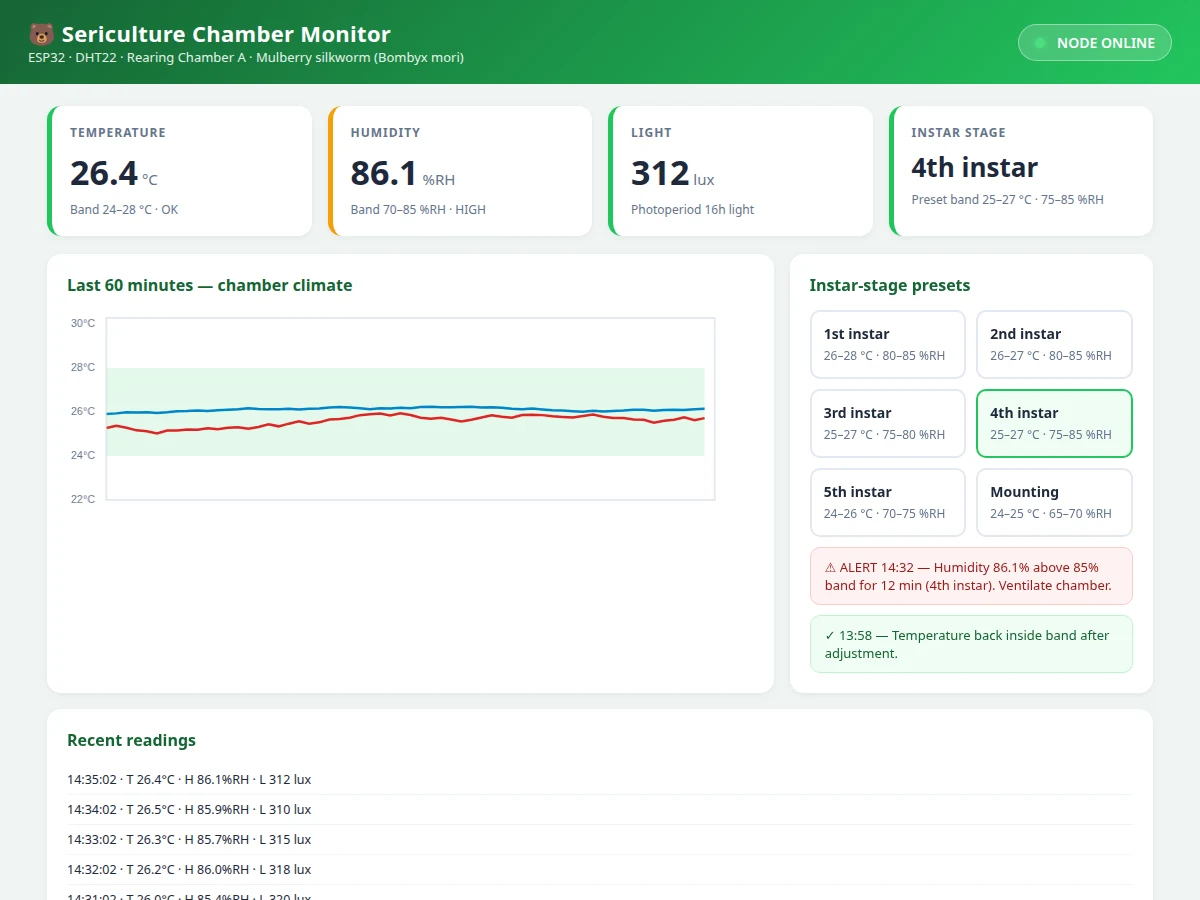
Chamber temperature and humidity, sampled every few seconds.
Follow the working sequence
How it works
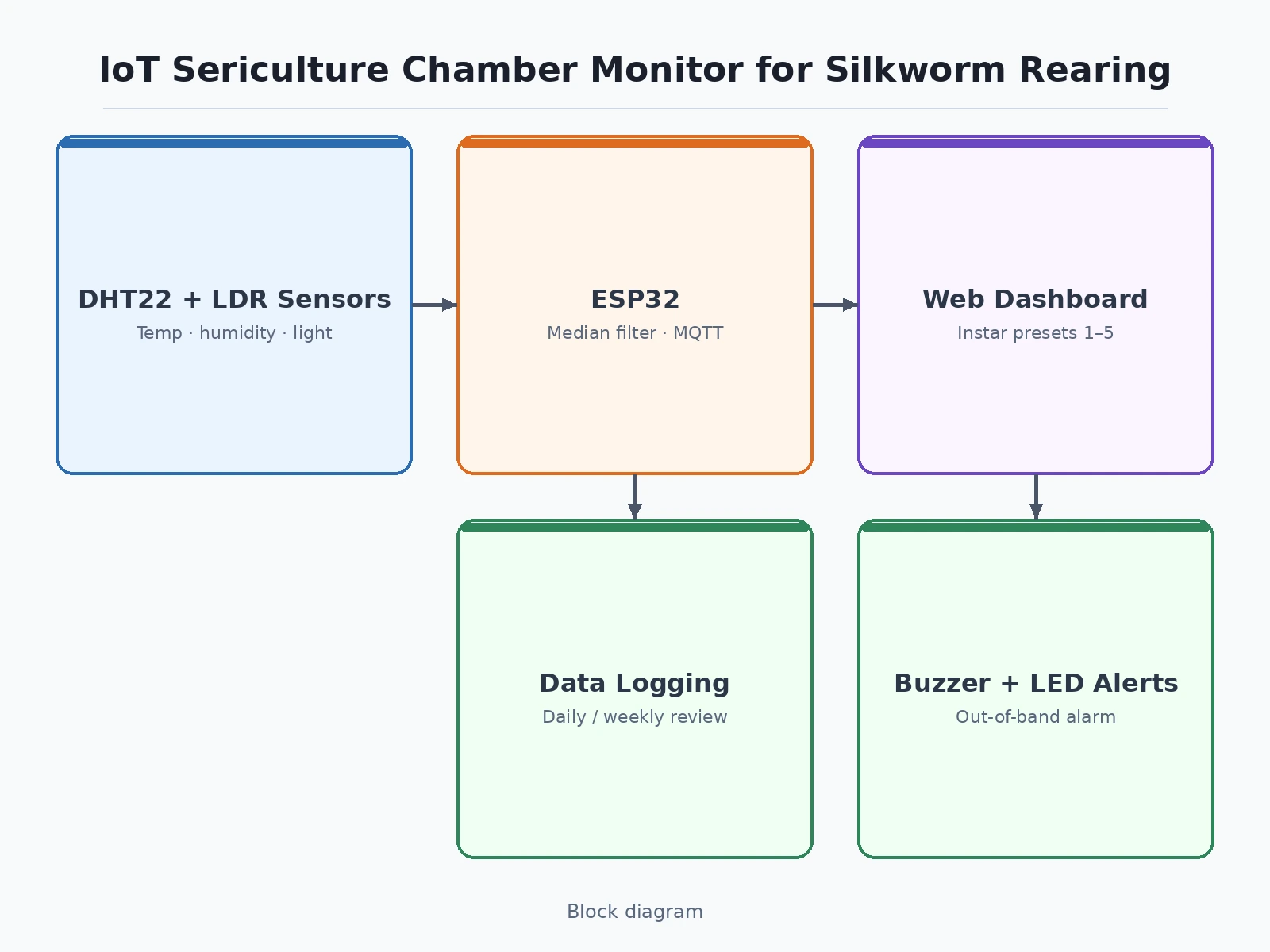
- The DHT22 inside the rearing chamber measures temperature and humidity; the light sensor records ambient illumination levels.
- The ESP32 samples the sensors every few seconds, applies median filtering to reject spikes, and compares readings against the active instar-stage band.
- Readings are published over Wi-Fi (MQTT/HTTP) to the dashboard backend and stored as timestamped time-series data.
- The dashboard plots live temperature, humidity and light curves, shows the current preset band, and logs every reading for review.
- If a reading stays outside the selected band longer than the configurable grace period, an alert is raised on the dashboard and the node's buzzer sounds locally.
- The rearer switches the instar preset as the larvae molt; bands and grace periods are adjustable from the dashboard without reflashing firmware.
- During commissioning, the buyer runs the included calibration procedure — comparing the DHT22 against a reference thermometer/hygrometer and entering the offset in firmware.
Tech stack:
- ESP32 (Wi-Fi microcontroller)
- DHT22 temperature & humidity sensor
- LDR / BH1750-class light sensor
- Arduino/C++ firmware (median filtering, MQTT/HTTP)
- Web dashboard (HTML/CSS/JS, charting)
- MQTT broker or HTTP logging backend
| Parameter | Value |
|---|---|
| Temperature band (reference) | Approximately 24–28°C (sericulture reference range, not a device claim) |
| Humidity band (reference) | Approximately 70–85% RH (sericulture reference range, not a device claim) |
| Temperature sensing | DHT22, ±0.5°C accuracy class (datasheet value) |
| Humidity sensing | DHT22, ±2% RH accuracy class (datasheet value) |
| Sampling | Every few seconds, median-filtered in firmware |
| Alerts | Dashboard warning + local buzzer/LED after grace period |
| Connectivity | Wi-Fi (802.11 b/g/n), MQTT or HTTP |
| Power | USB 5V or battery pack (expected) |
Project features
- [Instar-stage climate presets] Selectable bands for 1st–5th instar rearing (reference ranges drawn from sericulture literature), so thresholds change as the larvae grow instead of using one fixed band.
- [Live web dashboard] Real-time temperature, humidity and light graphs from the chamber, current instar preset, and alert history — viewable on a phone or laptop over the local network or cloud.
- [Out-of-band alerts] Dashboard warnings plus local buzzer/LED when temperature or humidity leaves the selected band for longer than a configurable grace period.
- [DHT22 sensing] ±0.5°C temperature and ±2% RH accuracy class sensor (datasheet values), sampled every few seconds with median filtering in firmware.
- [Light monitoring] Rearing-room illumination logged alongside climate, useful for rearers who adjust photoperiod during feeding schedules.
- [Data logging] Timestamped readings stored on the dashboard side for daily/weekly review — feeding-time patterns and night-time dips become visible in the graphs.
- [Battery/USB power options] Runs from USB for bench demos or a battery pack for placement inside the chamber without mains wiring.
What is included
- ESP32 sensor node (assembled prototype) with DHT22 and light sensor
- Firmware source (Arduino/C++) with instar presets, filtering and alerts
- Live web dashboard with graphs, presets and alert history
- Data logging backend setup notes
- Wiring diagram and enclosure/chamber-mounting guide
- Buyer-run calibration procedure (reference thermometer/hygrometer method)
- Project report PDF (background, hardware design, firmware logic, methodology)
- PPT presentation for final review
- Viva Q&A preparation document (sericulture climate bands, DHT22, MQTT, ESP32)
Limitations & prerequisites
- The 24–28°C / 70–85% figures are published sericulture reference ranges, not measured performance of this unit — the report states them as targets the alerts are set against.
- The DHT22's ±0.5°C / ±2% RH accuracy is a datasheet class, not a calibration result for the shipped unit; the buyer runs the calibration procedure at commissioning.
- The node monitors climate only — it does not control heaters, humidifiers or fans (actuation is listed as future scope in the report).
- Wi-Fi range limits apply inside metal-lined chambers or distant rearing rooms; placement and signal strength must be checked at install time.
- Light sensing indicates illumination trends only; it is not a calibrated lux meter.
- High humidity environments demand attention to sensor condensation and enclosure ventilation, covered in the mounting guide.
Frequently Asked Questions
What climate bands does it monitor?
Reference rearing bands of approximately 24–28°C temperature and 70–85% relative humidity, taken from sericulture extension literature. The dashboard lets you set instar-specific sub-bands within these ranges.
What are instar-stage presets?
Silkworms pass through five instars (larval stages between molts), each with slightly different ideal conditions. The dashboard stores a climate band per instar so thresholds update as the rearing cycle progresses.
Does it control temperature or humidity automatically?
No — as shipped it is a monitoring and alerting system. Adding relay-driven heater/humidifier control is documented as future scope.
How accurate is the sensing?
The DHT22 is specified at ±0.5°C and ±2% RH (datasheet values). The kit includes a calibration procedure so the buyer can verify and offset-correct the unit against a reference instrument.
Does it need internet?
Readings stream over Wi-Fi; the dashboard can run on the local network without internet, or use a cloud MQTT/HTTP endpoint if remote access is wanted.
Is this project suitable for a final-year project?
Yes — for Electronics, Electrical and IoT & Embedded programs. It combines sensor interfacing, embedded firmware, wireless communication and a data dashboard around a real agricultural application. Suitable for B.E./B.Tech final-year projects in Electronics, Electrical and IoT & Embedded.
Components & software requirements
- ESP32 (Wi-Fi microcontroller)
- DHT22 temperature & humidity sensor
- LDR / BH1750-class light sensor
- Arduino/C++ firmware (median filtering, MQTT/HTTP)
- Web dashboard (HTML/CSS/JS, charting)
- MQTT broker or HTTP logging backend
Delivery information
Built-to-order project. Delivery timeline is shared after order confirmation based on current queue.
Support terms
Complete documentation, setup guide, and viva preparation included. Support for setup and explanation provided.
Download free synopsis (PDF)
Enter your name and WhatsApp number — the synopsis PDF downloads immediately. We may send occasional project updates on WhatsApp; no spam.