
More project photos (3)
The problem
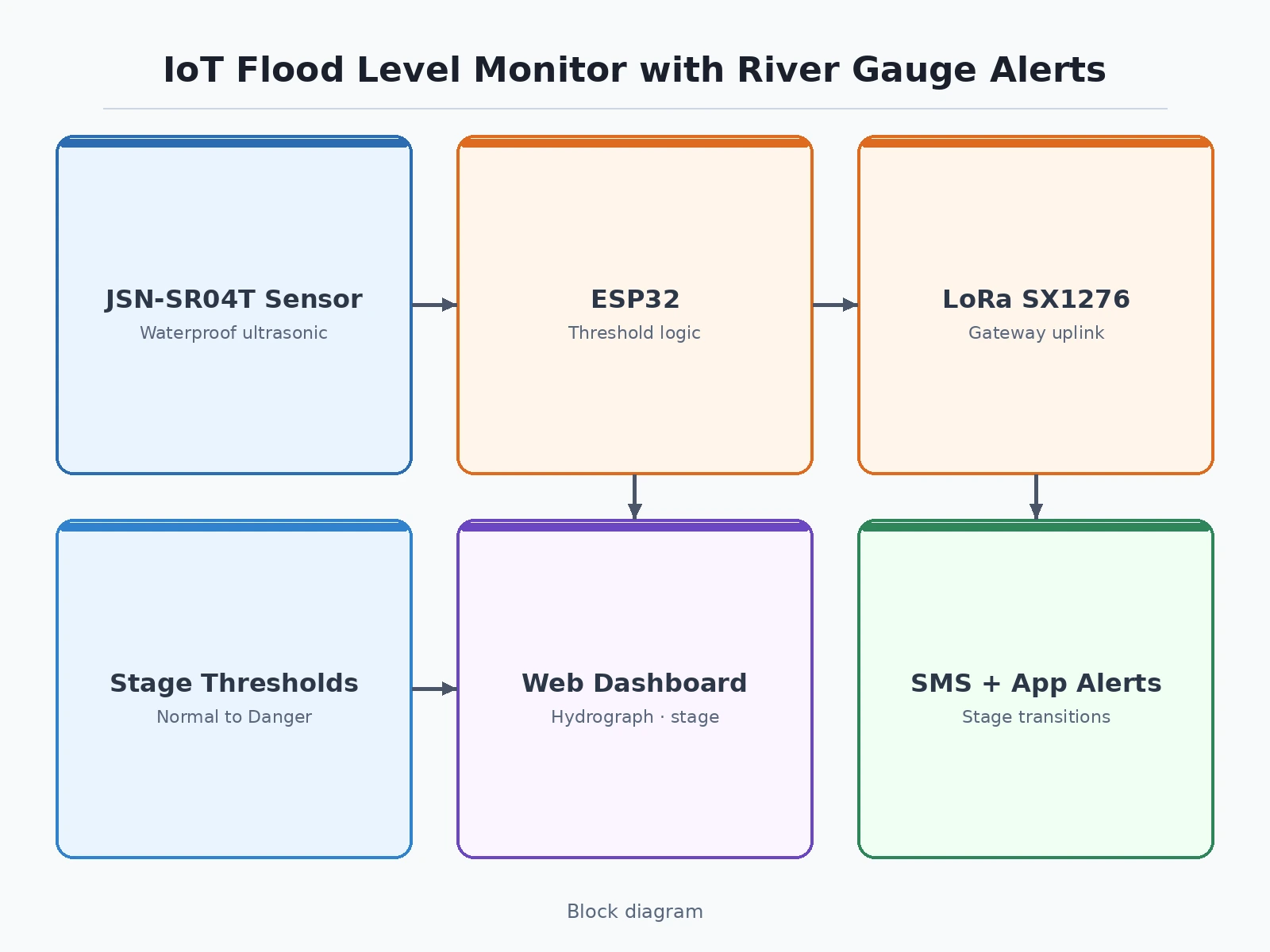
River and culvert flooding during monsoon months routinely strands villages and damages infrastructure, yet most small bridges and rural gauge stations are still read manually, if they are read at all. Gauge readers visit a staff gauge once or twice a day, so a river that rises two metres between visits gives downstream communities no warning. This project replaces that manual gap with a continuous, autonomous monitor: a waterproof JSN-SR04T ultrasonic probe mounted above a staff gauge measures the distance to the water surface every few minutes, an ESP32 converts it to a gauge level, and an SX1276 LoRa module transmits the reading kilometres to a gateway. A web dashboard plots the live level against four configurable flood stages — Normal, Watch, Warning and Danger — and an alert engine sends SMS and push notifications to a registered authority list the moment a stage transition is confirmed. Because the hardware is solar-ready and the link is long-range, the unit can sit at remote gauge sites with no mains power or mobile coverage. It is a genuine embedded-systems plus telemetry build: analog sensing, wireless communication, backend ingestion and a real-time UI in one project.
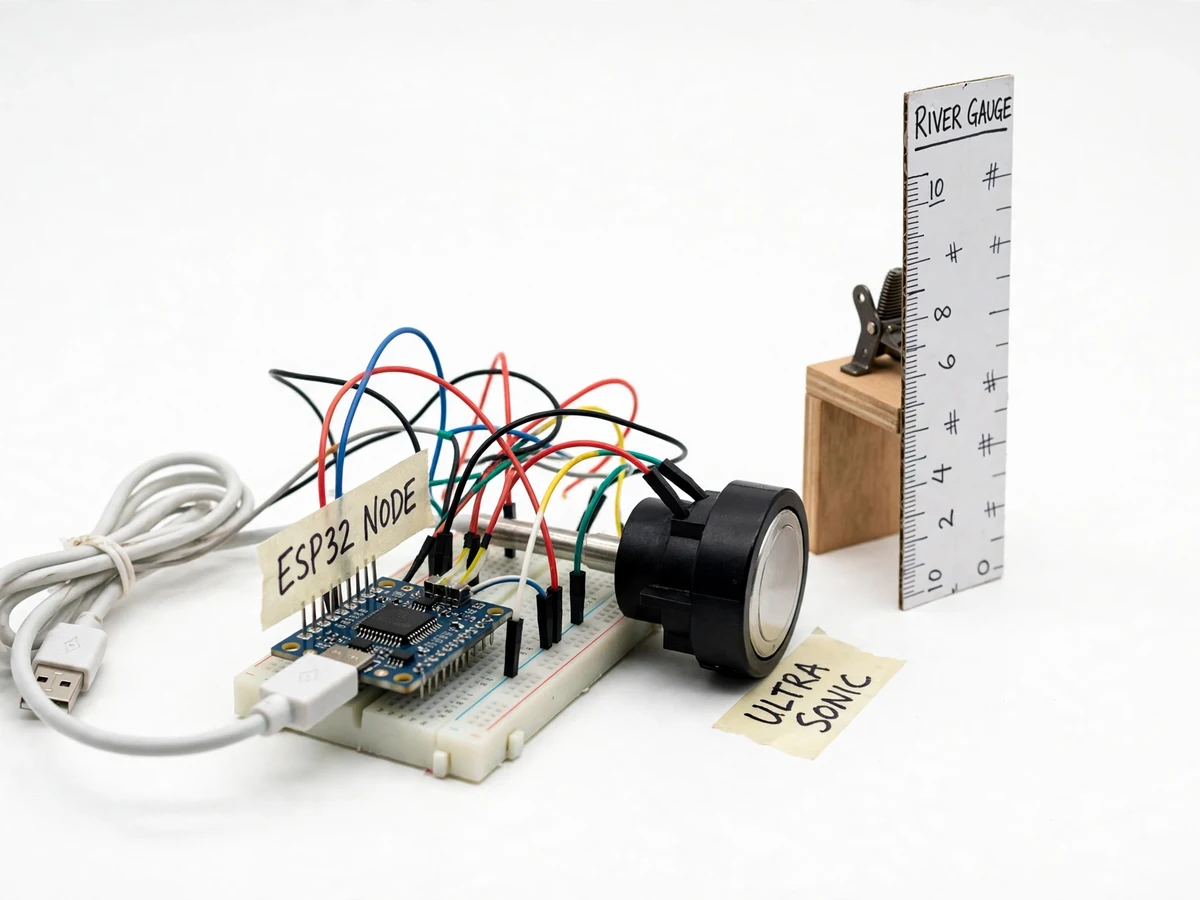
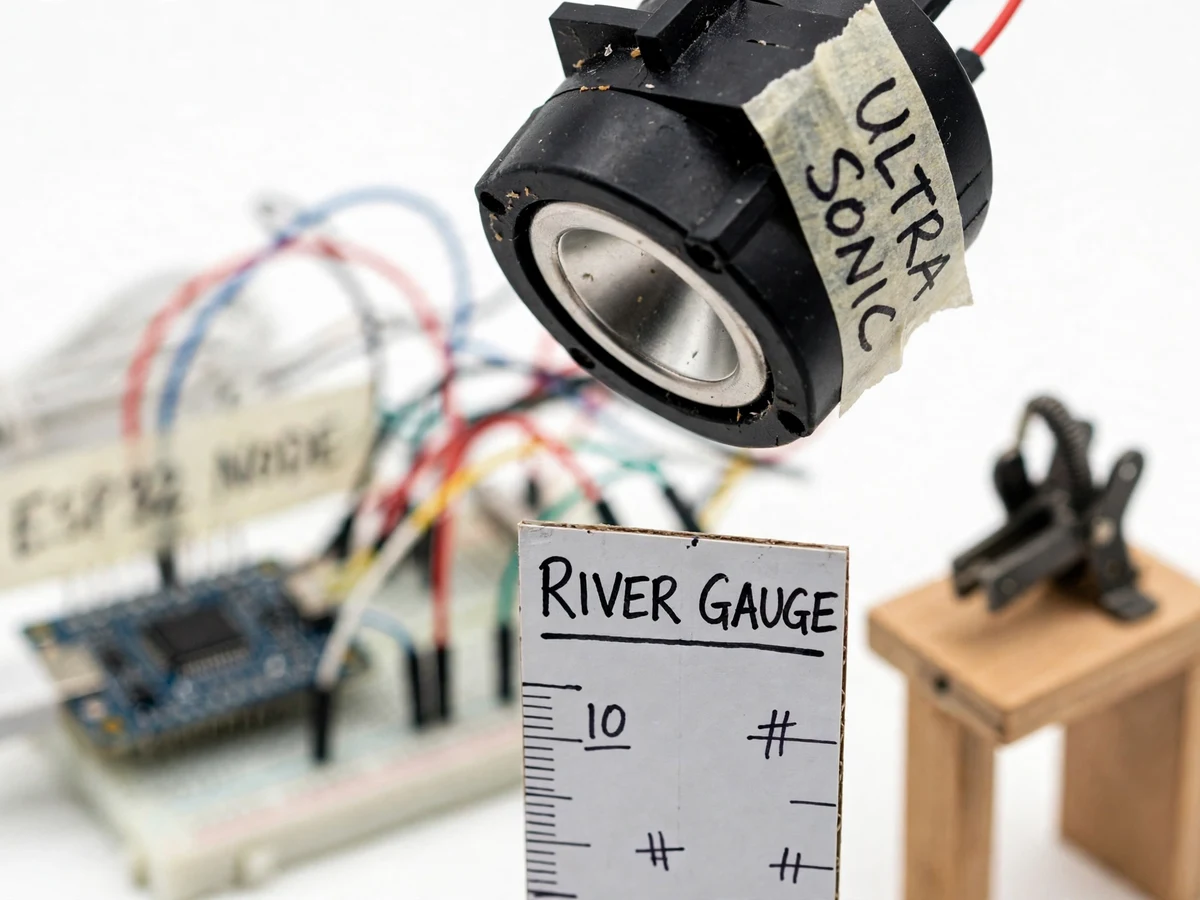
Waterproof ultrasonic probe aimed down at the water from a fixed bracket.
Follow the working sequence
How it works
- The JSN-SR04T probe is fixed on a bracket above the staff gauge at a known height; the distance-to-water reading is converted to a gauge level by subtracting it from the probe's reference height.
- The ESP32 samples the sensor five times, takes the median to reject wave spikes, and applies temperature-compensated distance calculation (ultrasound speed varies with air temperature).
- Every five minutes (configurable), the reading, battery voltage and packet counter are transmitted over LoRa to the gateway, which forwards them to the backend.
- The backend stores each reading with a timestamp, evaluates the level against the four site-configured stage thresholds, and updates the live dashboard and hydrograph.
- When the level crosses a threshold, the alert engine waits for three consecutive confirmations, then classifies the new stage and dispatches SMS plus push alerts to the registered authority list.
- Authorities open the dashboard link in the alert to see the current level, the rate of rise, and the projected time to the next stage, then follow their own flood-response protocol.
Tech stack:
- ESP32 (sensor node firmware, Arduino framework)
- JSN-SR04T waterproof ultrasonic sensor
- SX1276 LoRa module (433 MHz telemetry)
- LoRa gateway + MQTT broker
- Python backend, SQLite time-series storage
- HTML5, JavaScript, canvas-based dashboard
- Twilio-compatible SMS API + push notification service
| Parameter | Value |
|---|---|
| Sensor | JSN-SR04T waterproof ultrasonic probe (datasheet) |
| Measuring range | 20–600 cm (datasheet) |
| Blind zone | 20 cm minimum (datasheet) |
| Resolution | Approximately 1 cm |
| Ranging accuracy | Approximately ±1 cm typical (datasheet-quoted, not measured) |
| Probe rating | IP66 (datasheet) |
| Operating voltage | 3.3–5 V DC (datasheet) |
| LoRa module | SX1276, 433 MHz |
| LoRa range | Approximately 3–5 km line-of-sight (vendor typical; terrain-dependent) |
| Telemetry interval | Approximately 5 minutes (configurable in firmware) |
| Flood stages | 4 (Normal / Watch / Warning / Danger, site-configurable) |
Project features
- [Waterproof ultrasonic gauge sensing] The JSN-SR04T probe (20–600 cm range, IP66-rated head) is aimed down at the water from a fixed bracket, measuring surface distance without touching the water, so rain splashes and turbidity do not affect the reading.
- [Four configurable flood stages] Normal, Watch, Warning and Danger thresholds are set in gauge datum per installation site; the dashboard shows a color-coded stage banner and the distance-to-next-stage in centimetres.
- [LoRa telemetry link] An SX1276 module sends level packets up to several kilometres to a gateway, working where there is no Wi-Fi or mobile signal at the gauge site.
- [Live web dashboard] Current level, a 24-hour hydrograph, stage history, battery voltage, LoRa RSSI and sensor health in one real-time view.
- [SMS and app alert engine] On a confirmed stage transition, SMS plus push notifications go out to the registered authority list with the level, stage and timestamp; configurable quiet hours and re-alert throttling are included.
- [Wave-spike rejection] A five-sample median filter plus a confirmation rule (three consecutive over-threshold readings) suppresses false alarms from boat wakes, floating debris and wind chop.
- [Solar-ready low-power node] The firmware supports deep-sleep between readings and the BOM lists an optional solar panel plus 18650 backup for unattended field operation.
What is included
- Sensor node hardware: ESP32 board, JSN-SR04T probe, SX1276 LoRa module, bracket and wiring kit
- ESP32 firmware with median filtering, deep-sleep and LoRa telemetry
- LoRa gateway setup notes and MQTT ingestion backend
- Live web dashboard with flood-stage banner and 24-hour hydrograph
- SMS/app alert engine configuration with authority contact list
- Wiring diagram, mounting guide and threshold calibration worksheet
- Project report PDF (background, sensing theory, methodology, results)
- PPT presentation for final review
- Viva Q&A preparation document (ultrasound sensing, LoRa, alert logic, power budget)
Limitations & prerequisites
- This is a prototype and educational build, NOT a certified flood-warning system — official flood warnings are issued only by government disaster-management agencies, and this device must never be presented as one.
- No accuracy figure is claimed as measured; the ±1 cm figure is the sensor datasheet value, and real river conditions (wind waves, foam, floating debris) add noise the firmware can only reduce, not eliminate.
- The 3–5 km LoRa range is a vendor-typical figure for open line-of-sight; hills, buildings and vegetation reduce it substantially, and the buyer must site-survey the actual link.
- Stage thresholds must be derived from local gauge history by the buyer; the project ships with a calibration worksheet, not pre-validated flood numbers for any real river.
- SMS delivery needs an active SIM/balance and gateway subscription, which are not included in the kit.
- Outdoor mounting requires a weatherproof enclosure, lightning protection and theft-resistant installation — all the installer's responsibility.
- The node is a prototype and is not rated for submersion during extreme floods; the bracket height must keep it above the highest expected stage.
Frequently Asked Questions
How does the ultrasonic sensor measure the water level?
The JSN-SR04T probe emits an ultrasonic pulse and measures the echo return time from the water surface. With the probe fixed at a known height above the gauge, subtracting the measured distance gives the water level. The firmware applies temperature compensation because the speed of sound in air changes with temperature.
How do the four flood stages work?
The buyer enters threshold levels (in gauge datum) for Normal, Watch, Warning and Danger, taken from local river-gauge records. The backend classifies every reading into a stage; when the classification changes and is confirmed by three consecutive readings, the alert engine fires SMS and push notifications to the registered authority list.
Why LoRa instead of Wi-Fi or GSM?
River gauges are typically far from mains power, Wi-Fi and mobile towers. LoRa reaches several kilometres on milliwatts of power, so a single gateway can serve multiple gauge nodes across a catchment at a fraction of the running cost.
How are false alarms from waves and debris avoided?
Each reading is the median of five rapid samples, and a stage change requires three consecutive over-threshold readings before alerts fire. This rejects boat wakes, floating debris and wind chop while still catching genuine rises.
Can this replace the official flood-warning system?
No, and it must never be presented that way. It is a monitoring and early-alert prototype that helps local authorities notice rising water sooner; official warnings come from government agencies with calibrated models.
Is this project suitable for a final-year project?
Yes — for Electronics, Electrical and IoT/Embedded programs. It combines sensor interfacing, wireless telemetry, power budgeting, backend ingestion, a real-time dashboard and an alert system, all demonstrable in the viva. Suitable for B.E./B.Tech final-year projects in Electronics, Electrical and IoT & Embedded.
Components & software requirements
- ESP32 (sensor node firmware, Arduino framework)
- JSN-SR04T waterproof ultrasonic sensor
- SX1276 LoRa module (433 MHz telemetry)
- LoRa gateway + MQTT broker
- Python backend, SQLite time-series storage
- HTML5, JavaScript, canvas-based dashboard
- Twilio-compatible SMS API + push notification service
Delivery information
Built-to-order project. Delivery timeline is shared after order confirmation based on current queue.
Support terms
Complete documentation, setup guide, and viva preparation included. Support for setup and explanation provided.
Download free synopsis (PDF)
Enter your name and WhatsApp number — the synopsis PDF downloads immediately. We may send occasional project updates on WhatsApp; no spam.