
More project photos (3)
The problem
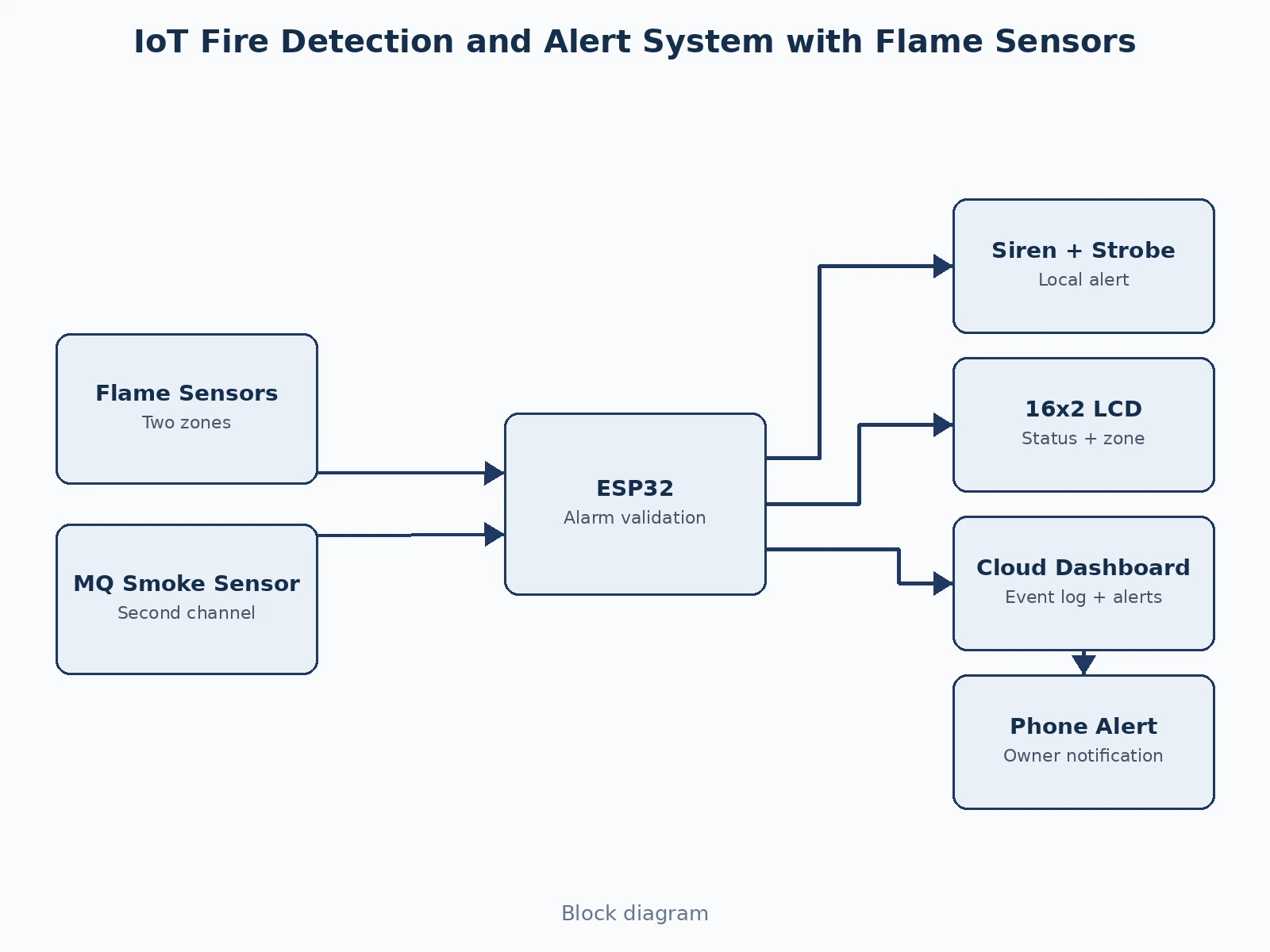
Fires are detected late because nobody is watching: a storeroom, lab or home catches fire while empty, and the loss is discovered hours later. Commercial fire panels are expensive and wired; the student-buildable answer is a wireless IoT detector that senses flame and smoke, validates the alarm locally so a matchstick doesn't cause a panic, and pushes the alert to the owner's phone within seconds. This project implements that: multiple flame sensors cover zones, a smoke sensor adds confirmation, an ESP32 runs the detection logic, and on a validated alarm it drives a siren, displays the zone on an LCD, and publishes the event to a cloud dashboard with a phone notification. The student builds the sensing-to-cloud chain end to end and documents the validation logic that separates a real alarm from a false one.
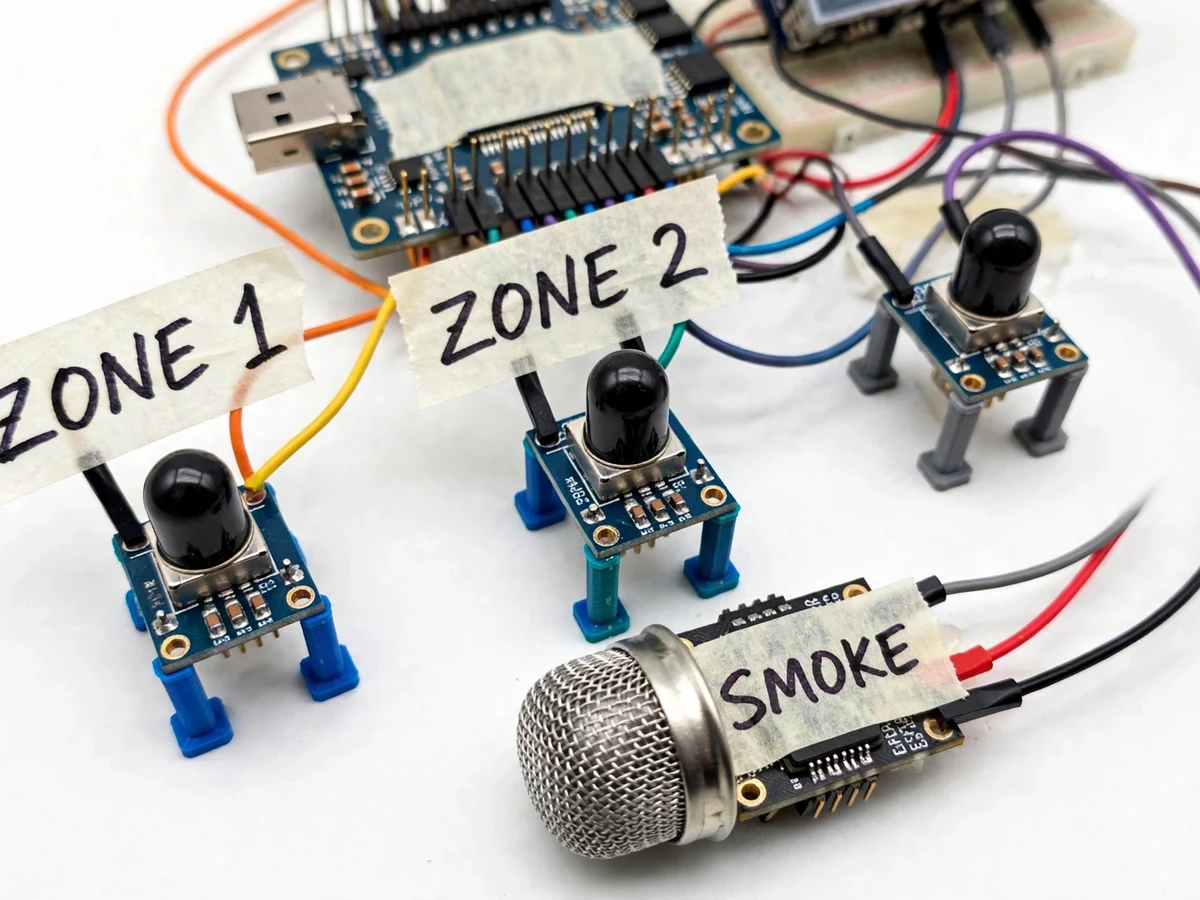
Zoned IR modules watching for flame-band infrared signatures.
Follow the working sequence
How it works
- The flame sensors continuously monitor their zones for infrared signatures in the flame band; the smoke sensor watches ambient smoke level.
- The ESP32 samples all sensors; a flame reading above threshold starts a confirmation timer rather than alarming instantly.
- If the flame persists through the confirmation window — or flame coincides with a smoke rise — the alarm is validated as a real event.
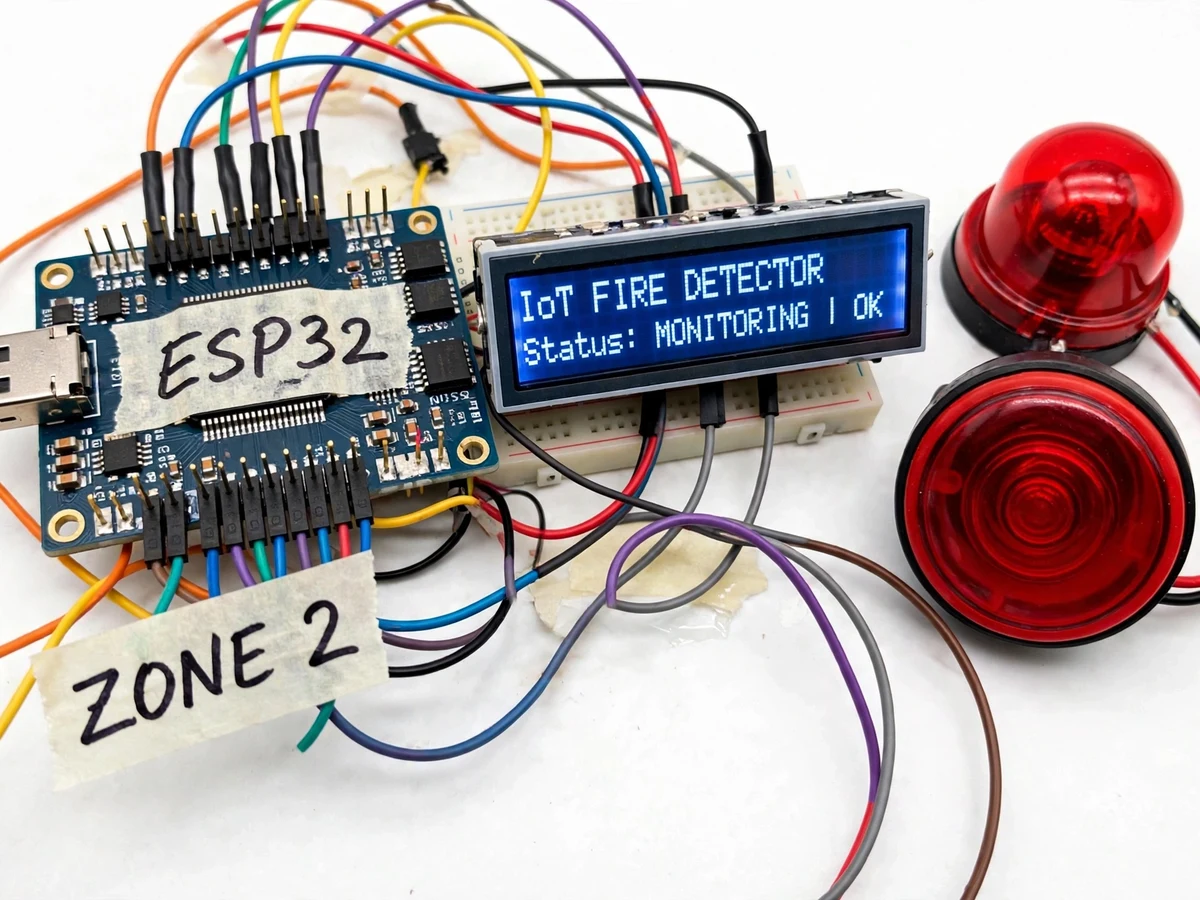
- On validation, the siren and strobe fire immediately, the LCD switches to ALARM with the zone name, and the event is published over Wi-Fi.
- The cloud dashboard logs the timestamped alarm and pushes a phone notification to the owner within seconds.
- The system latches in ALARM until the manual reset button is pressed, demonstrating proper alarm-panel behavior.
Tech stack:
- ESP32 development board (Wi-Fi)
- 3x flame sensor modules (IR, zoned)
- MQ-series smoke sensor module
- 12 V siren + strobe LED
- 16x2 LCD (zone/status display)
- Cloud dashboard + phone push alerts
- Arduino IDE (C/C++ firmware)
| Parameter | Value |
|---|---|
| Zones | 2 flame-sensor zones + 1 smoke channel (design target) |
| Flame detection | IR band, up to approximately 1 m demo range (expected, tuneable) |
| Confirmation | Flame-plus-smoke or sustained-flame validation (firmware) |
| Alert latency | Phone notification within approximately seconds of validation (expected, network dependent) |
| Local alarm | 12 V siren + strobe LED, latched until manual reset |
| Display | 16x2 LCD: ARMED/ALARM status, zone name |
| Connectivity | Wi-Fi to cloud dashboard (Blynk/ThingSpeak class) |
| Supply | 5 V logic + 12 V siren supply |
Project features
- [Multi-zone flame sensing] Two flame-sensor modules watch separate zones; the LCD and dashboard name the exact zone that triggered.
- [Smoke confirmation] An MQ-series smoke sensor adds a second sensing channel; the alarm validates on flame-plus-smoke or sustained flame, cutting false alarms.
- [Instant phone alerts] On validated alarm the ESP32 pushes a notification to the owner's phone via the cloud dashboard service within seconds.
- [Local siren and strobe] A 12 V siren and flashing LED provide on-site alerting independent of the internet connection.
- [Cloud event log] Every alarm and sensor event is timestamped on the dashboard, giving the report a real incident log to analyze.
- [Zone LCD display] 16x2 LCD shows system status (ARMED/ALARM) and the triggered zone for the on-site demo.
- [Sensitivity tuning] Per-zone flame-sensor thresholds adjustable in firmware, tuned by the buyer for their demo space with the included procedure.
What is included
- Working fire-detection prototype (sensors, ESP32, siren, LCD, strobe)
- ESP32 firmware with validation logic and cloud publishing
- Cloud dashboard setup guide with phone-alert configuration
- Wiring diagram and zone-layout guide
- Sensitivity-tuning and alarm-test procedure
- Project report PDF (fire sensing, alarm validation, IoT telemetry, test log template)
- PPT presentation for final review
- Viva Q&A preparation document
Limitations & prerequisites
- Student prototype, NOT a certified fire-alarm panel — it does not replace code-compliant fire safety equipment, stated explicitly in the report.
- Flame sensors detect line-of-sight IR; obstructions and strong sunlight can affect the demo range.
- Phone alerts depend on Wi-Fi and the cloud service; the local siren is the always-on layer.
- Smoke-sensor (MQ-series) readings are indicative, not calibrated gas measurements.
- Demo range is approximately 1 m per zone — a room-scale deployment would need more zones and proper panel hardware.
Frequently Asked Questions
How does it avoid false alarms?
A single flame blip does not alarm. The firmware requires the flame to persist through a confirmation window, or flame plus a smoke rise together — two independent conditions before the siren fires.
How fast is the phone alert?
Typically within seconds of alarm validation, depending on the Wi-Fi and cloud service. The local siren fires instantly regardless of connectivity.
Can it replace a real fire alarm?
No. It is a student IoT prototype demonstrating sensing-to-cloud alerting. Real premises need certified, code-compliant fire-alarm systems — the report states this boundary clearly.
Why two flame zones?
Zoning tells the responder WHERE the fire is. The LCD and dashboard name the triggered zone instead of just saying "fire somewhere".
What do I tune during setup?
Each flame sensor's threshold for your demo space (lighting, distances), plus the confirmation timing — the procedure walks through it and you record your values.
Is this project suitable for a final-year project?
Yes — for IoT and Embedded Systems, Electronics and Communication programs. It demonstrates multi-sensor interfacing, alarm validation logic, ESP32 Wi-Fi telemetry and cloud alerting. Suitable for B.E./B.Tech final-year projects in IoT and Embedded Systems, Electronics and Communication.
Components & software requirements
- ESP32 development board (Wi-Fi)
- 3x flame sensor modules (IR, zoned)
- MQ-series smoke sensor module
- 12 V siren + strobe LED
- 16x2 LCD (zone/status display)
- Cloud dashboard + phone push alerts
- Arduino IDE (C/C++ firmware)
Delivery information
Built-to-order project. Delivery timeline is shared after order confirmation based on current queue.
Support terms
Complete documentation, setup guide, and viva preparation included. Support for setup and explanation provided.
Download free synopsis (PDF)
Enter your name and WhatsApp number — the synopsis PDF downloads immediately. We may send occasional project updates on WhatsApp; no spam.