
More project photos (3)
The problem
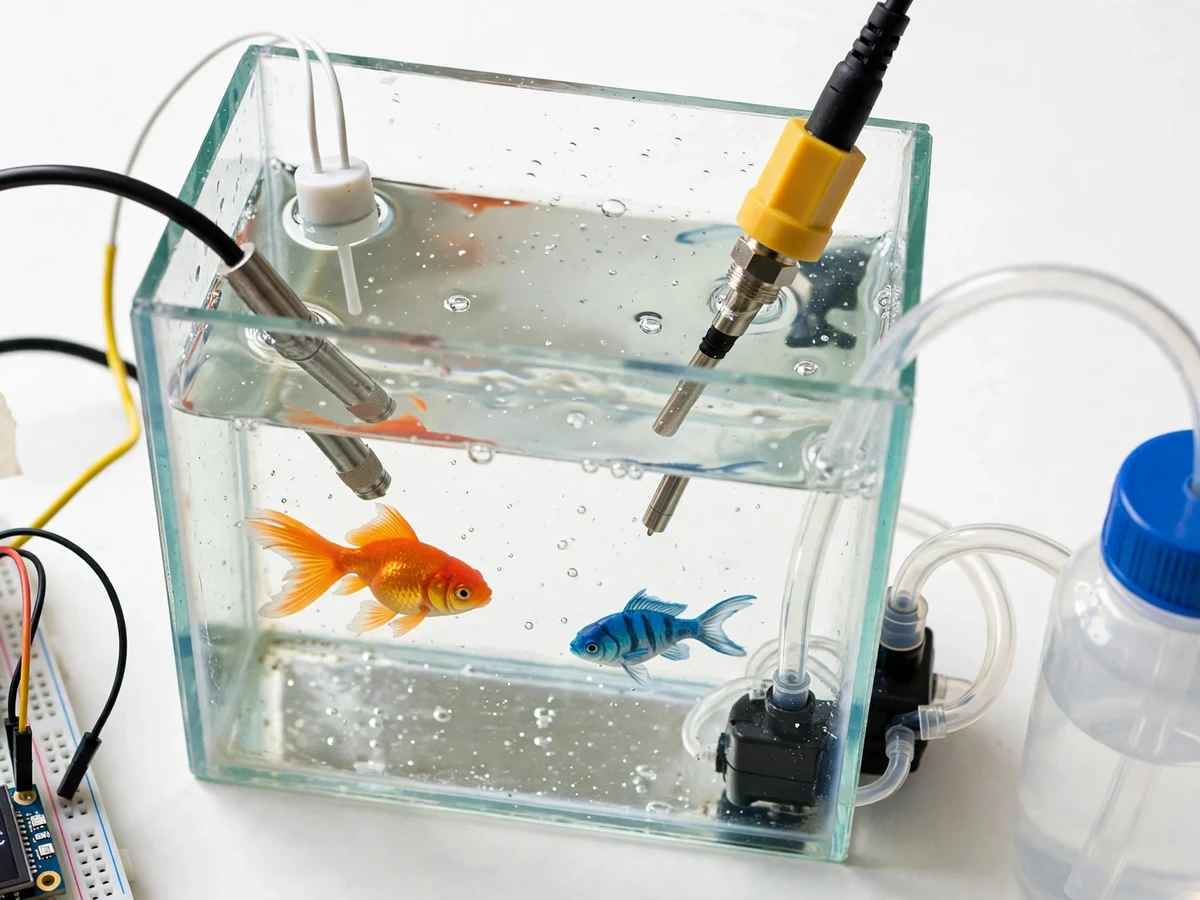
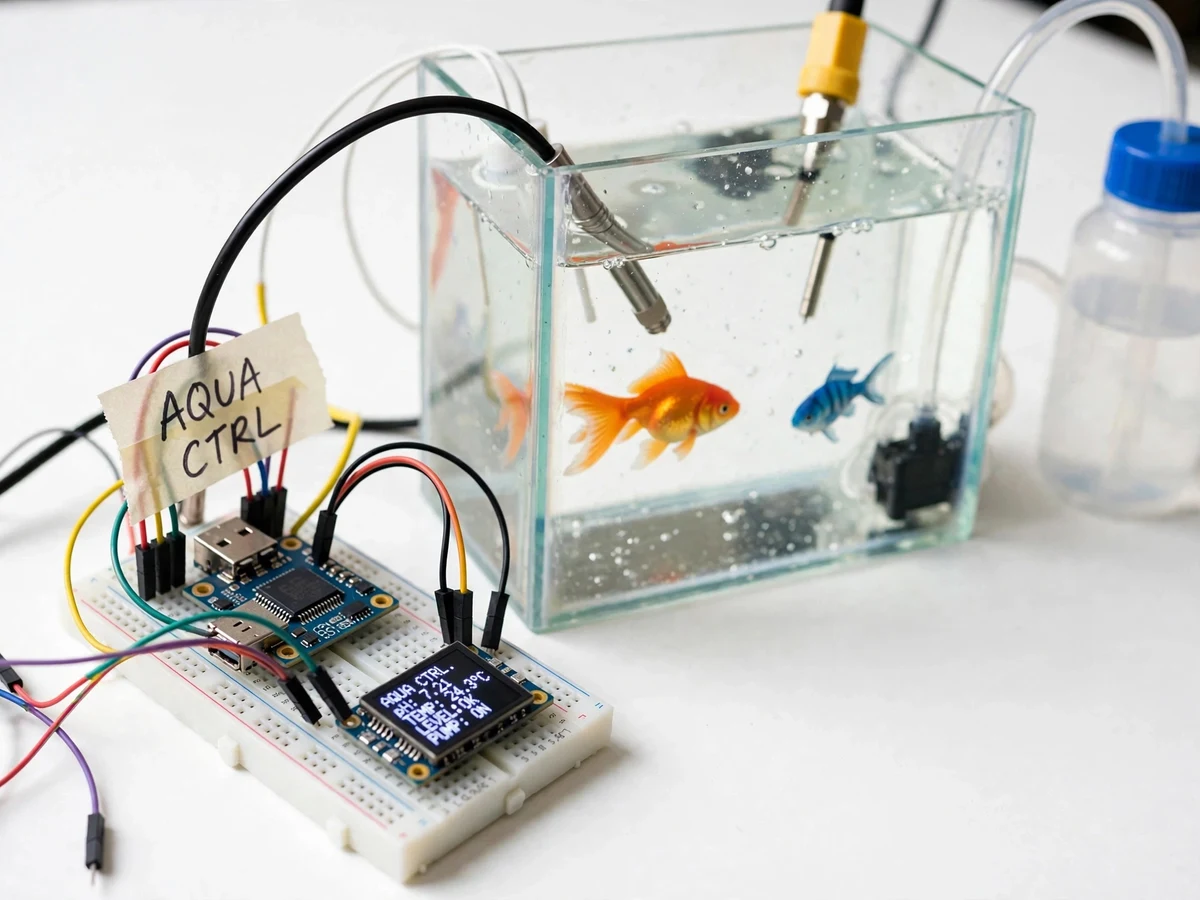
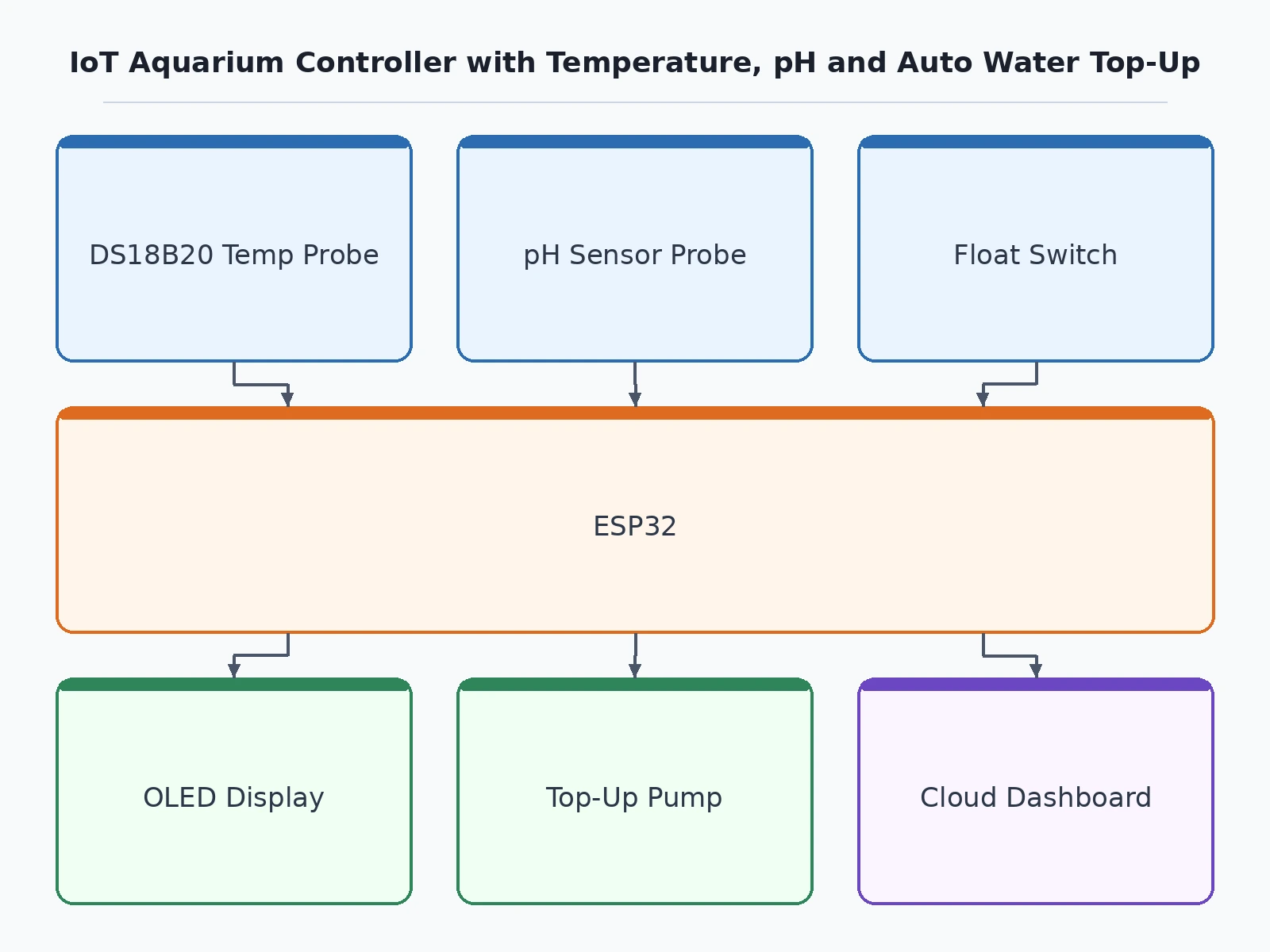
Aquarium fish die from slow, invisible changes — a heater stuck on, pH drifting after a water change, water evaporating until the filter runs dry. Hobbyists check with handheld meters when they remember. This project automates the watch: a DS18B20 waterproof temperature probe and a pH probe sit in the tank, an ESP32 samples them continuously, and an OLED shows temperature, pH and pump state live. A float switch watches the water level; when evaporation drops it, a small submersible pump tops the tank up from a reservoir bottle. Out-of-band readings trigger the buzzer and a cloud dashboard alert, and the dashboard keeps the full history so trends (like slowly climbing pH) are visible before they become emergencies.
Waterproof probe tracks tank temperature continuously against the configured safe band.
Follow the working sequence
How it works
- The DS18B20 and pH probe sample the tank water on a regular cycle; the float switch reports the water level continuously.
- Firmware applies calibration offsets and temperature compensation, then checks each value against its configured safe band.
- The OLED updates with temperature, pH, level and pump state; any out-of-band value flips its indicator and sounds the buzzer.
- When the float switch reports low level, the ESP32 runs the top-up pump until the level restores or the safety run-time elapses.
- Readings and events publish over Wi-Fi to the cloud dashboard, which plots the history and marks alert events.
- Before first use, the student calibrates the pH probe with buffer solutions and sets the safe bands for their demo species' range.
Tech stack:
- ESP32 development board (Wi-Fi)
- Arduino IDE (C/C++ firmware)
- DS18B20 waterproof temperature sensor (±0.5 °C)
- Analog pH probe with conditioning board
- Float switch level sensor
- Submersible mini pump + reservoir bottle with tubing
- 0.96-inch OLED display (I2C)
- Active buzzer for alerts
- Cloud dashboard (ThingSpeak/Blynk class) over MQTT/HTTP
| Parameter | Value |
|---|---|
| Controller | ESP32, 3.3 V logic, Wi-Fi 802.11 b/g/n |
| Temperature | DS18B20, -55 to +125 °C, ±0.5 °C (datasheet) |
| pH | 0–14; approximately ±0.2 after buyer two-point calibration |
| Level sensing | Float switch, low-level trigger |
| Top-up pump | Submersible mini pump with max run-time safety cut-off |
| Display | 0.96-inch OLED, 128x64, I2C |
| Alerts | Buzzer + cloud dashboard flag on band violation |
| Dashboard | Temperature/pH history charts with alert markers |
| Power | 5 V USB supply; pump on separate feed |
Project features
- [Temperature monitoring] A waterproof DS18B20 probe (±0.5 °C datasheet) tracks tank temperature continuously against a configurable safe band.
- [pH monitoring] An analog pH probe with conditioning board measures tank pH with buyer-run two-point calibration (approximately ±0.2 pH indicative).
- [Auto water top-up] A float switch detects low water level and the ESP32 runs a submersible pump from the reservoir bottle until the level restores, with a maximum run-time safety cut-off.
- [Threshold alerts] Temperature or pH leaving the safe band triggers the buzzer and a cloud dashboard alert with the offending value.
- [On-device OLED] A 0.96-inch OLED shows temperature, pH, level state and pump state live at the tank.
- [Cloud history] Readings publish over Wi-Fi (MQTT/HTTP); the dashboard charts temperature and pH over days so slow drift is visible.
- [Pump safety cut-off] The top-up pump stops on a maximum run time even if the float switch sticks — the report documents this fail-safe.
What is included
- Working prototype: demo tank, ESP32, temperature + pH probes, float switch, pump, reservoir bottle, OLED, buzzer
- Complete ESP32 firmware (probe reading, compensation, band checks, pump control with safety cut-off, cloud publishing)
- pH two-point calibration procedure and safe-band configuration guide
- Cloud dashboard and alert setup guide
- Wiring diagram and connection table
- Project report PDF (background, aquarium water chemistry basics, methodology, working, results)
- PPT presentation for final review
- Viva Q&A preparation document (DS18B20/pH interfacing, pump control, fail-safes, IoT alerting)
Limitations & prerequisites
- Indicative accuracy (approximately ±0.2 pH after calibration) — a monitoring aid for hobbyists, not a laboratory water-analysis instrument.
- The demo tank is desk-scale; a real aquarium needs the probes and pump sized to its volume.
- pH probes need periodic recalibration and wet storage — the maintenance guide covers this.
- The top-up pump adds fresh water but does not treat it; dechlorination/conditioning of top-up water is the keeper's job, stated in the report.
- The dashboard needs Wi-Fi; the OLED, buzzer and pump logic work locally without it.
Frequently Asked Questions
What does it monitor?
Tank temperature (DS18B20, ±0.5 °C) and pH (approximately ±0.2 after calibration) — the two parameters behind most aquarium fish losses — plus water level via a float switch.
How does the auto top-up work?
When evaporation drops the level, the float switch triggers and the ESP32 runs the submersible pump from the reservoir bottle until the level restores. A maximum run-time cut-off protects against a stuck float switch.
What happens when readings go wrong?
An out-of-band temperature or pH triggers the local buzzer, flips the OLED indicator, and raises a cloud dashboard alert with the offending value and timestamp.
Does it feed the fish?
No — feeding is a separate function (and a separate project idea). This controller handles water parameters and level only; the report states the scope plainly.
How accurate is the pH reading?
Approximately ±0.2 pH after the buyer's two-point calibration with buffer solutions — indicative monitoring accuracy, not lab grade.
Is this project suitable for a final-year project?
Yes — for IoT & Embedded programs. It combines analog and digital sensing, pump actuation with a documented fail-safe, and cloud alerting around a relatable real-world problem. Suitable for B.E./B.Tech final-year projects in IoT & Embedded.
Components & software requirements
- ESP32 development board (Wi-Fi)
- Arduino IDE (C/C++ firmware)
- DS18B20 waterproof temperature sensor (±0.5 °C)
- Analog pH probe with conditioning board
- Float switch level sensor
- Submersible mini pump + reservoir bottle with tubing
- 0.96-inch OLED display (I2C)
- Active buzzer for alerts
- Cloud dashboard (ThingSpeak/Blynk class) over MQTT/HTTP
Delivery information
Built-to-order project. Delivery timeline is shared after order confirmation based on current queue.
Support terms
Complete documentation, setup guide, and viva preparation included. Support for setup and explanation provided.
Download free synopsis (PDF)
Enter your name and WhatsApp number — the synopsis PDF downloads immediately. We may send occasional project updates on WhatsApp; no spam.