
More project photos (3)
The problem
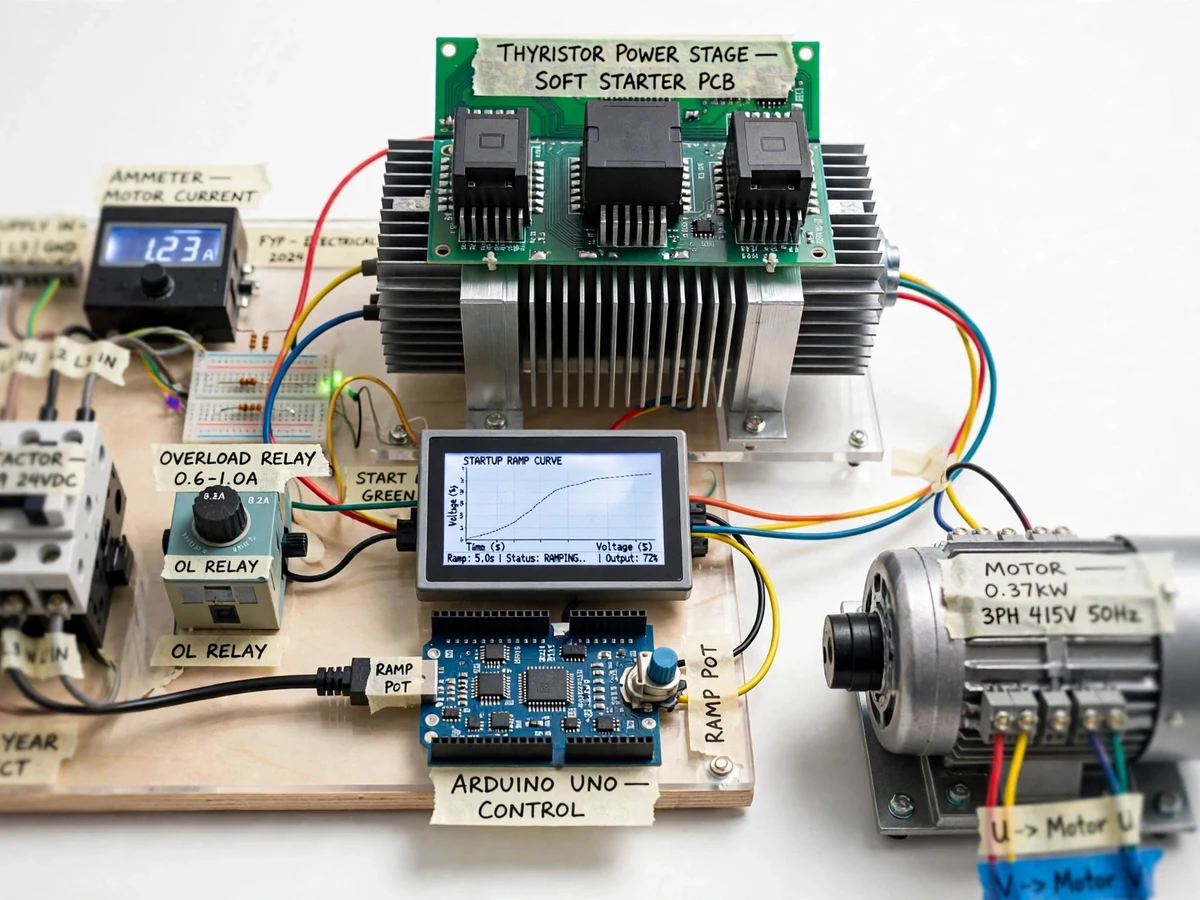
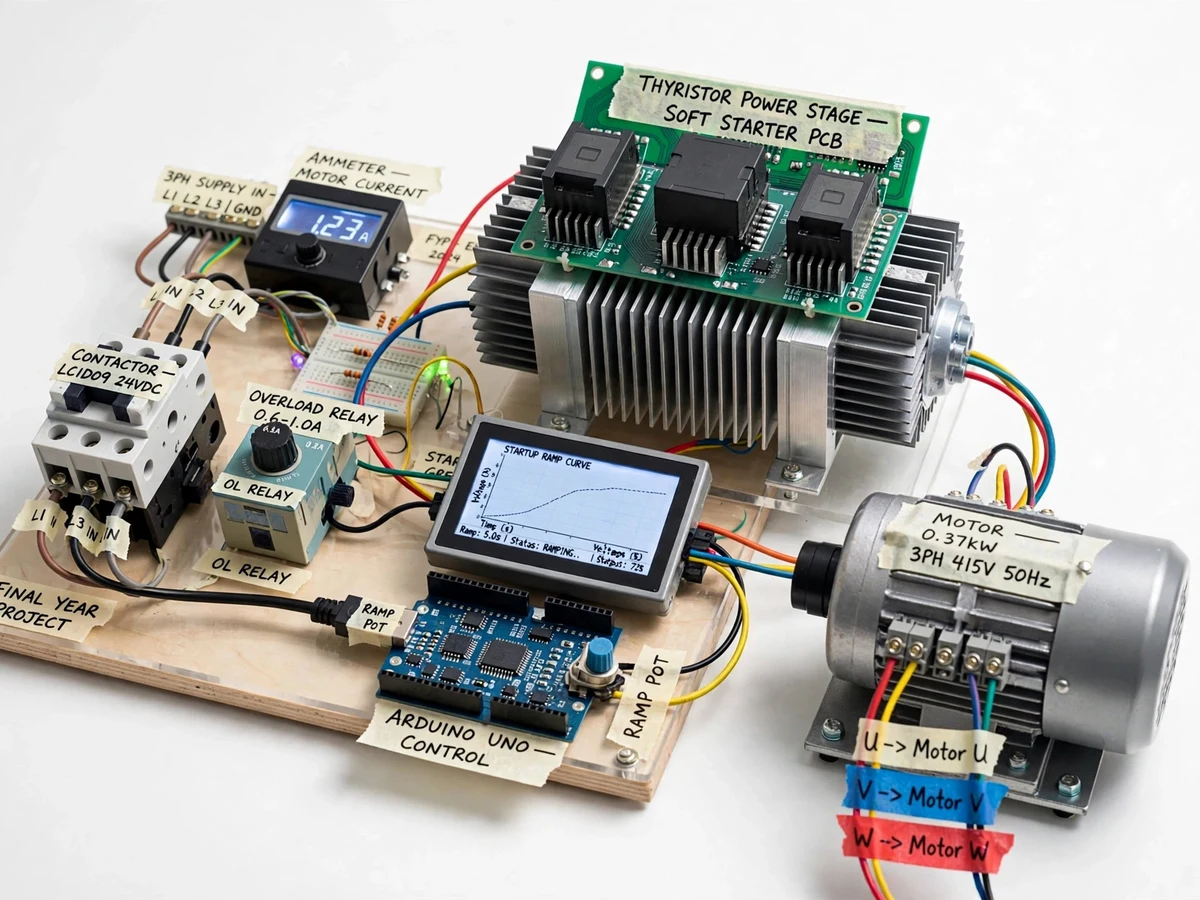
A 3-phase induction motor started direct-on-line can draw five to seven times its rated current for the first moments — tripping breakers, dimming lights and stressing windings. A soft starter solves this by raising the applied voltage gradually instead of slamming full voltage on at once. This project builds a demonstration unit around that principle: a thyristor (SCR) power stage on a heatsink chops each mains half-cycle under Arduino firing-angle control, so the motor terminal voltage ramps from a set pedestal to full over an adjustable 1–10 seconds. A small display draws the startup ramp curve in real time, a digital ammeter shows the tamed current, and a bypass contactor with overload relay completes the industrial-style control chain. The report derives the firing-angle versus voltage relationship and the expected inrush reduction — theory the student can point at on the screen.
Sets the ramp time, presses start and runs the DOL comparison.
Follow the working sequence
How it works
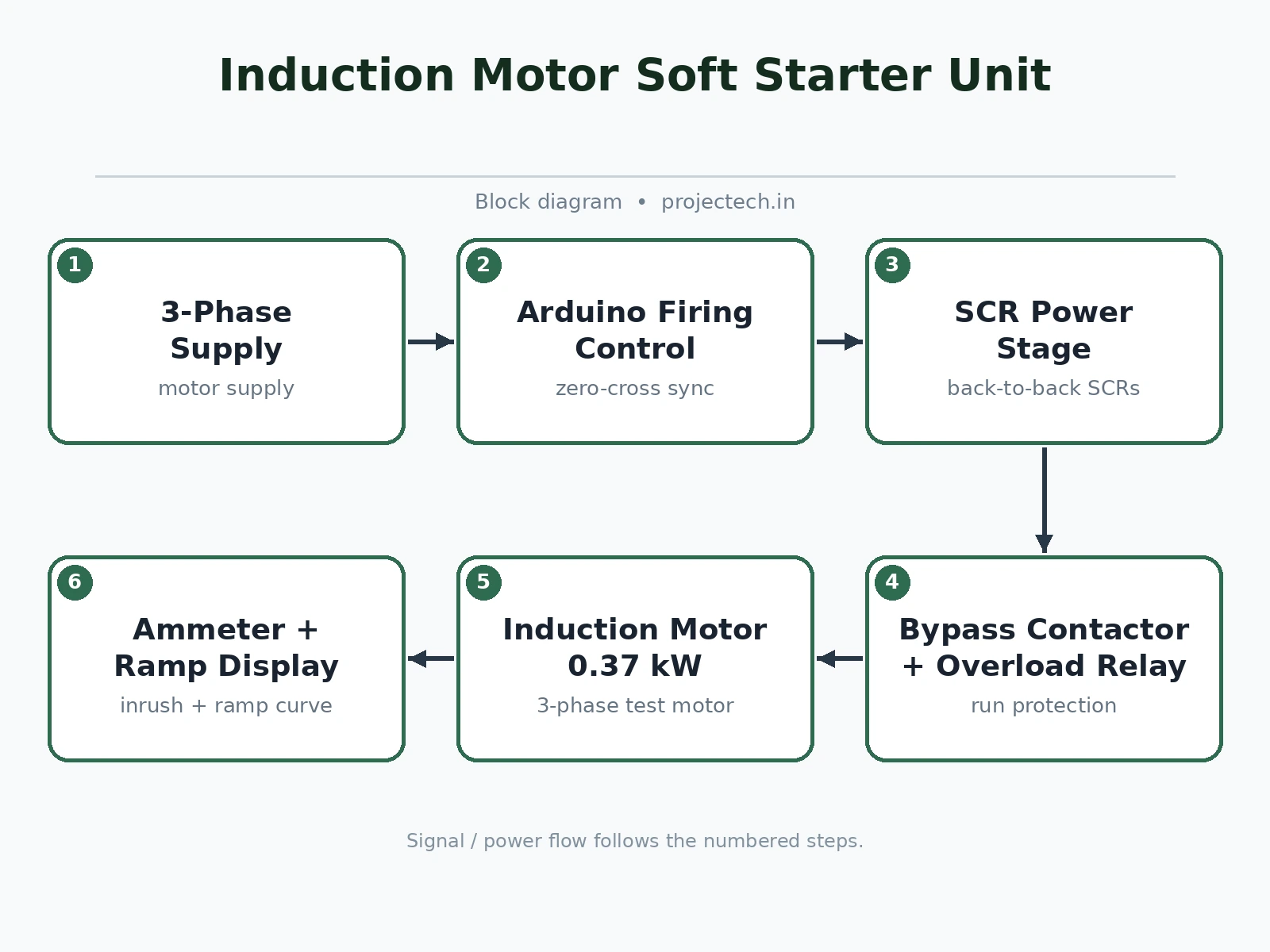
- The operator sets the desired ramp time on the panel potentiometer and presses start.
- The main contactor closes and the Arduino begins firing the thyristors at a large firing angle (low voltage).
- Over the set ramp time, the firing angle advances and the motor terminal voltage rises smoothly toward full.
- The display draws the rising voltage curve while the ammeter shows current well below DOL inrush.
- At ramp end the bypass contactor closes across the thyristor stage and the overload relay takes over running protection.
- Pressing stop drops the contactors; the unit is ready for the next start or a DOL comparison run.
Tech stack:
- Back-to-back SCR (thyristor) power stage
- Arduino Uno firing-angle control
- Zero-cross detection for gate synchronisation
- Heatsink for thyristor stage
- 3-phase contactor with overload relay
- Digital panel ammeter
- Ramp-curve display
- 0.37 kW, 3-phase, 415 V test motor
| Parameter | Value |
|---|---|
| Test motor | 0.37 kW, 3-phase, 415 V, 50 Hz (nameplate value) |
| Ramp time | Adjustable, approximately 1–10 s (design target) |
| Initial voltage | Adjustable pedestal, approximately 30–50% (design target) |
| Expected inrush | Approximately 2–3× rated current with soft start vs 5–7× DOL (expected) |
| Control | Arduino Uno, phase-angle firing with zero-cross sync |
| Protection | Overload relay 0.6–1.0 A range (nameplate value) |
| Display | Ramp curve: voltage versus time (design target) |
| Supply | 3-phase 415 V input (laboratory supply required) |
Project features
- [Thyristor power stage] Back-to-back SCR pairs per phase on a shared heatsink, the classic soft-starter topology, on a dedicated PCB.
- [Arduino firing-angle control] The Uno generates synchronised gate pulses with phase-angle control, ramping the conduction angle over the set time.
- [Adjustable ramp time] A panel potentiometer sets the voltage ramp from approximately 1 to 10 seconds.
- [Live ramp-curve display] A display plots motor voltage versus time during starting, making the soft start visible.
- [Digital ammeter] A panel ammeter shows motor current so the inrush reduction is directly readable.
- [Bypass contactor with overload relay] After ramp completion the contactor bypasses the thyristors and the overload relay provides running protection, as in industrial starters.
- [DOL comparison mode] The unit can start the motor direct-on-line for a before/after inrush comparison on the same motor.
What is included
- Fully assembled soft starter demonstration unit with test motor
- Arduino with programmed firing-angle firmware
- Power and control wiring diagrams
- Ramp-time setting and DOL-comparison test procedure
- Project report PDF (background, thyristor phase control theory, firing-angle calculations, test procedure)
- PPT presentation for final review
- Viva Q&A preparation document (soft starting vs star-delta vs VFD, SCR phase control, inrush)
Limitations & prerequisites
- This is a reduced-voltage starter: it limits starting current but provides no speed control — that distinction is explicit in the report (a VFD is a different project).
- Starting torque falls with the square of the voltage, so high-inertia or loaded starts are outside the demo's scope; the test motor starts unloaded or lightly loaded.
- The unit needs a 3-phase 415 V laboratory supply, which is not included.
- Expected inrush figures are design targets for the demonstration; actual values depend on the motor and supply impedance.
- Thyristors need the heatsink and ventilation respected; the operating procedure defines duty limits.
- The firing-angle firmware is tuned for 50 Hz mains; it is not a universal-frequency design.
Frequently Asked Questions
How does phase-angle control reduce starting current?
Delaying the thyristor firing angle within each half-cycle applies only part of the sine wave to the motor, so the effective voltage — and therefore the current — starts low and rises as the angle advances.
How is this different from a star-delta starter?
Star-delta gives one fixed voltage step (58% then 100%); the soft starter ramps continuously, so the current peak is lower and there is no switching transient. The report compares all three methods.
Why the bypass contactor?
Thyristors drop ~1.5 V and dissipate heat continuously; once the motor is up to speed the contactor shorts across them, removing losses and heat — standard industrial practice.
What does the display show?
A live plot of motor terminal voltage against time during the ramp, so the audience watches the soft start happen instead of taking it on faith.
Can the ramp time be changed?
Yes — the panel potentiometer sets approximately 1–10 s, and the firmware maps it to the firing-angle schedule.
Is this project suitable for a final-year project?
Yes — for Electrical Engineering. Power electronics, microcontroller timing and motor behaviour meet in one of the most viva-rich topics in drives. Suitable for B.E./B.Tech final-year projects in Electrical Engineering.
Components & software requirements
- Back-to-back SCR (thyristor) power stage
- Arduino Uno firing-angle control
- Zero-cross detection for gate synchronisation
- Heatsink for thyristor stage
- 3-phase contactor with overload relay
- Digital panel ammeter
- Ramp-curve display
- 0.37 kW, 3-phase, 415 V test motor
Delivery information
Built-to-order project. Delivery timeline is shared after order confirmation based on current queue.
Support terms
Complete documentation, setup guide, and viva preparation included. Support for setup and explanation provided.
Download free synopsis (PDF)
Enter your name and WhatsApp number — the synopsis PDF downloads immediately. We may send occasional project updates on WhatsApp; no spam.