
More project photos (2)
The problem
Home Tutor Discovery is an Android app for a problem parents solve badly today: finding a home tutor through word of mouth, notice boards and coaching-class flyers — channels that reveal nothing about teaching quality or true monthly cost. A tutor charging ₹500 an hour sounds cheaper than one charging ₹600, but the real difference is ₹1,200 a month at 12 one-hour classes — a comparison nobody makes. This project puts tutor search, free demo-class booking and fee comparison in one place. Students filter tutors by subject, fee range and rating; each profile shows qualifications, experience, reviews and per-subject fees; and the comparison view normalizes up to 3 tutors to a monthly cost — the cheapest hourly fee cannot hide the most expensive month. Demo bookings capture subject, day, time slot and contact details, with booking history on-device. The build covers 5 app screens, 12 seeded tutor profiles across 9 subjects, and a booking flow on a 5-day slot window.
Discovers tutors and books a free demo class.
Follow the working sequence
How it works
The app follows a simple marketplace flow: a student discovers tutors, shortlists by comparing real monthly costs, books a free demo class, and manages bookings — all inside 5 screens. Search and filters run against the local tutor data, booking writes to on-device storage, and the fee comparison computes monthly estimates from hourly fees with a fixed, documented rule: monthly = hourly fee × 12 one-hour classes. That single formula is the product's core insight — it turns a misleading unit (₹/hour) into the unit parents budget with (₹/month), and the demo applies it live in the comparison table. The demo build keeps data local so the whole flow works without a server, while the delivered project wires the same 5 screens to a REST backend with a real database and push notifications for booking confirmations.
- The student opens the app and sees the tutor list with 12 seeded profiles, each showing rating, review count, starting fee per hour and area.
- Subject chips (9 subjects), keyword search and top-rated/lowest-fee sorting narrow the list to relevant tutors.
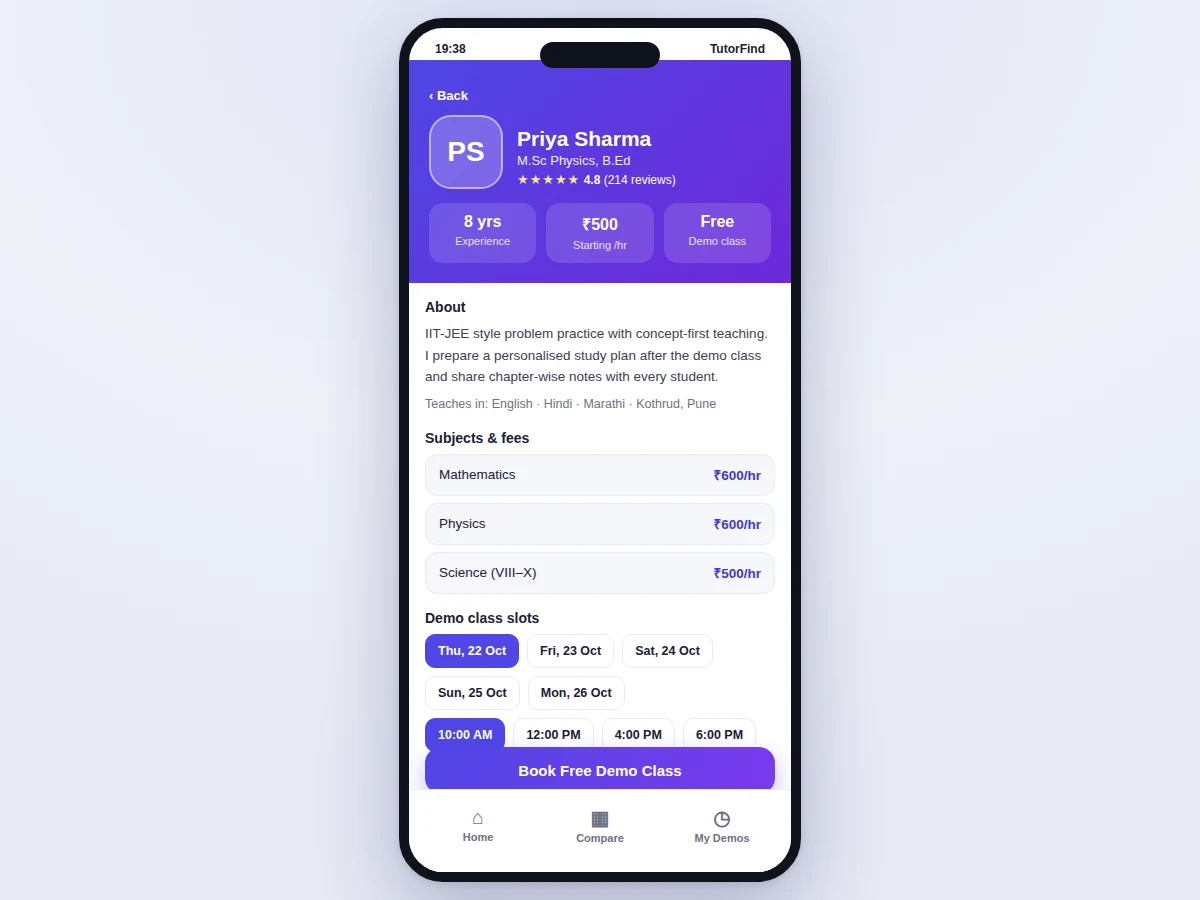
- Tapping a tutor opens the profile: qualifications, experience, per-subject fees, languages, reviews, and available demo days generated for the next 5 days.
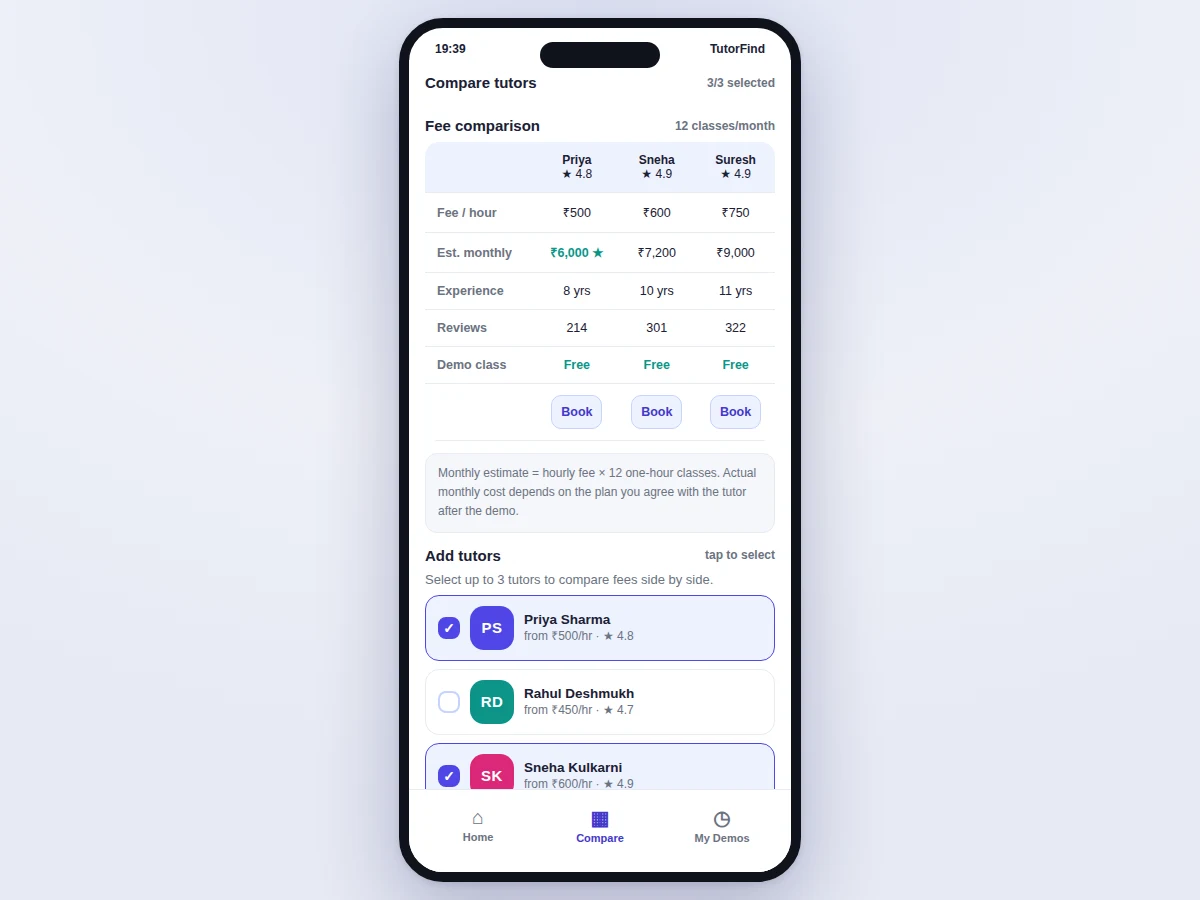
- The comparison tab lets the student select up to 3 tutors; the app renders a table of hourly fee, expected monthly cost (hourly × 12 classes), experience, reviews and demo availability.
- Tapping Book Free Demo Class starts the 4-step flow: subject, day, time slot, then name and 10-digit mobile number with validation.
- The summary screen shows the free 45-minute demo details; confirming saves the booking and shows a confirmation state.
- All confirmed bookings appear under My Demos with status, and can be referenced when the tutor calls back.
Tech stack:
- Kotlin with Jetpack Compose UI
- Android SDK (API 26+, design target)
- Retrofit for REST API calls
- Room for on-device booking storage
- Firebase Authentication (phone)
- Firebase Cloud Messaging (booking alerts)
- MySQL backend with REST endpoints
- Google Maps SDK (area search, optional module)
| Parameter | Value |
|---|---|
| Platform | Android (native) |
| Language & UI | Kotlin with Jetpack Compose |
| App screens | 5 (Home, Tutor detail, Booking, Compare, My Demos) |
| Seeded tutor profiles | 12 across 9 subjects (demo data) |
| Comparison limit | Up to 3 tutors per comparison |
| Demo class duration | 45 minutes (free) |
| Slot window | Next 5 days, generated live |
| On-device storage | Room database for bookings |
| Backend | REST API with MySQL (design target) |
| Screen load | Design target: under 2 seconds on 4G |
Project features
The app's strongest capabilities are its honest fee comparison, its complete demo-class booking flow, and its filterable tutor discovery — the three things a parent actually does when hiring a tutor, rebuilt as software. The comparison view answers the question parents really ask — "what will this cost me per month?" — by normalizing every tutor to an expected monthly figure at 12 one-hour classes, a normalization rule designed during the build because hourly fees alone hide the real decision: a ₹100/hr gap reads as a ₹1,200/month gap once normalized. Booking mirrors how a real tutoring business runs: pick a subject, a day from a live 5-day rolling window, a time slot, and enter contact details, with every booking saved to a history screen. Discovery keeps it practical with 9 subject filters, keyword search across names, subjects and areas, and top-rated/lowest-fee sorting.
- [Tutor discovery with filters] Browse 12 seeded tutor profiles across 9 subjects with keyword search over names, subjects and areas, plus subject chips and top-rated / lowest-fee sorting.
- [Tutor profile pages] Each profile shows qualifications, years of experience, star rating with review count, per-subject fees, languages taught, area, and student reviews.
- [Free demo class booking] A 4-step flow — subject, day, time slot, contact details — with Indian mobile-number validation, a booking summary screen, and a confirmation state.
- [Booking history] Every confirmed demo booking is stored on-device and listed under My Demos with tutor, subject, slot and contact details.
- [Three-tutor fee comparison] Select up to 3 tutors to compare fee per hour, expected monthly cost, experience, review count and demo availability in one table, with the lowest monthly cost highlighted.
- [Monthly cost normalization] Hourly fees are converted to an expected monthly figure at 12 one-hour classes, so a ₹100/hr gap reads as the ₹1,200/month difference parents actually pay.
- [Live 5-day slot window] Demo dates are generated fresh for the next 5 days, so the booking calendar never shows stale dates.
What is included
- Complete Android source code (Kotlin + Jetpack Compose, 5 screens)
- Backend REST API with database schema and setup guide
- Seeded tutor data (12 profiles, 9 subjects) with realistic Indian names, fees and areas
- Demo booking flow with validation and booking history
- Fee comparison module with monthly normalization logic
- Project report PDF (background, methodology, architecture, screens)
- PPT presentation for final review
- Viva Q&A preparation document (Android components, API design, booking state management)
Limitations & prerequisites
- The shipped demo data contains 12 tutor profiles — a real launch needs tutor onboarding and a verification process, which is an operational task, not a code feature.
- Tutor identity, credential and background verification is NOT part of this project; profiles are marked as self-declared in the design.
- Payments and fee collection are not implemented; the app compares fees and books free demos only. Payment gateway integration is available as an optional extension.
- Slot availability is tutor-declared in this build; live calendar sync with tutors is listed as future scope.
- Maps-based nearby search is an optional module, not in the base build.
Frequently Asked Questions
What does the fee comparison actually compare?
It compares up to 3 tutors on fee per hour, expected monthly cost, experience, review count and demo availability in one table. The key design decision is monthly normalization: every hourly fee is multiplied by 12 one-hour classes, because a ₹100/hr gap is really a ₹1,200/month gap — the number parents actually decide on. The lowest monthly cost is highlighted.
How does the free demo class booking work?
You pick a subject, then a day from a live 5-day rolling window, then a time slot, then enter the student name and a 10-digit mobile number. The app validates the number format, shows a summary of the free 45-minute demo, and on confirmation saves the booking with a CONFIRMED status. Every booking is stored on-device and listed under My Demos with full details.
Is tutor verification part of this project?
No. Verification of a tutor's identity, qualifications and background is an operational process, not something code can do — so this project honestly does not claim it. Profiles carry a self-declared marker in the design, and the report documents verification as a launch requirement. Claiming verified tutors without a real process would be dishonest.
Does the app need internet to work?
The tutor list, filters, fee comparison and booking history all work offline against the on-device data. Internet is needed for the backend-backed version: syncing bookings, receiving booking confirmation alerts via push notification, and fetching new tutor profiles. The report documents exactly which screens work offline.
What can be customized or added?
Realistic extensions include payment gateway integration for advance fees, a tutor-side app for managing slots, live calendar sync, maps-based nearby search, and in-app chat between parents and tutors. The report separates these as optional modules with effort notes, so a student can pick one as an extension without confusing it with the base build.
Is this project suitable for a final-year project?
Yes — for Computer Science, IT and MCA programs. It demonstrates native Android development with Jetpack Compose, REST API integration, local database storage, form validation, and a real multi-screen product flow, all of which map cleanly to viva questions on mobile architecture and state management.
Components & software requirements
- Kotlin with Jetpack Compose UI
- Android SDK (API 26+, design target)
- Retrofit for REST API calls
- Room for on-device booking storage
- Firebase Authentication (phone)
- Firebase Cloud Messaging (booking alerts)
- MySQL backend with REST endpoints
- Google Maps SDK (area search, optional module)
Delivery information
Built-to-order project. Delivery timeline is shared after order confirmation based on current queue.
Support terms
Complete documentation, setup guide, and viva preparation included. Support for setup and explanation provided.
Download free synopsis (PDF)
Enter your name and WhatsApp number — the synopsis PDF downloads immediately. We may send occasional project updates on WhatsApp; no spam.