
More project photos (3)
The problem
Old phones, laptops and chargers pile up in drawers because there is no trusted way to get rid of them. Much of India's e-waste still flows to informal scrap dealers who strip devices with unsafe methods, recovering only part of the metals while releasing hazardous substances into air, soil and groundwater. The formal route exists: under the E-Waste (Management) Rules, 2022 (notified November 2022, in force from 1 April 2023), e-waste must go to CPCB-authorised recyclers, and recyclers generate EPR certificates for the key metals they recover. But ordinary users cannot easily find or book these recyclers. This project builds an Android app that closes that gap: users pick e-waste categories with indicative per-kg rates, choose a recycler that displays its CPCB authorisation number, and book a pickup slot. They then receive two things informal channels never provide — a per-device data-wipe certificate issued before the pickup agent can mark the item received, and an EPR credit receipt that mirrors the recycler's filing on the CPCB portal.
How it works
- The user selects e-waste categories and quantities; the app shows an indicative estimate using per-kg reference rates, clearly marked as an estimate, not a quote.
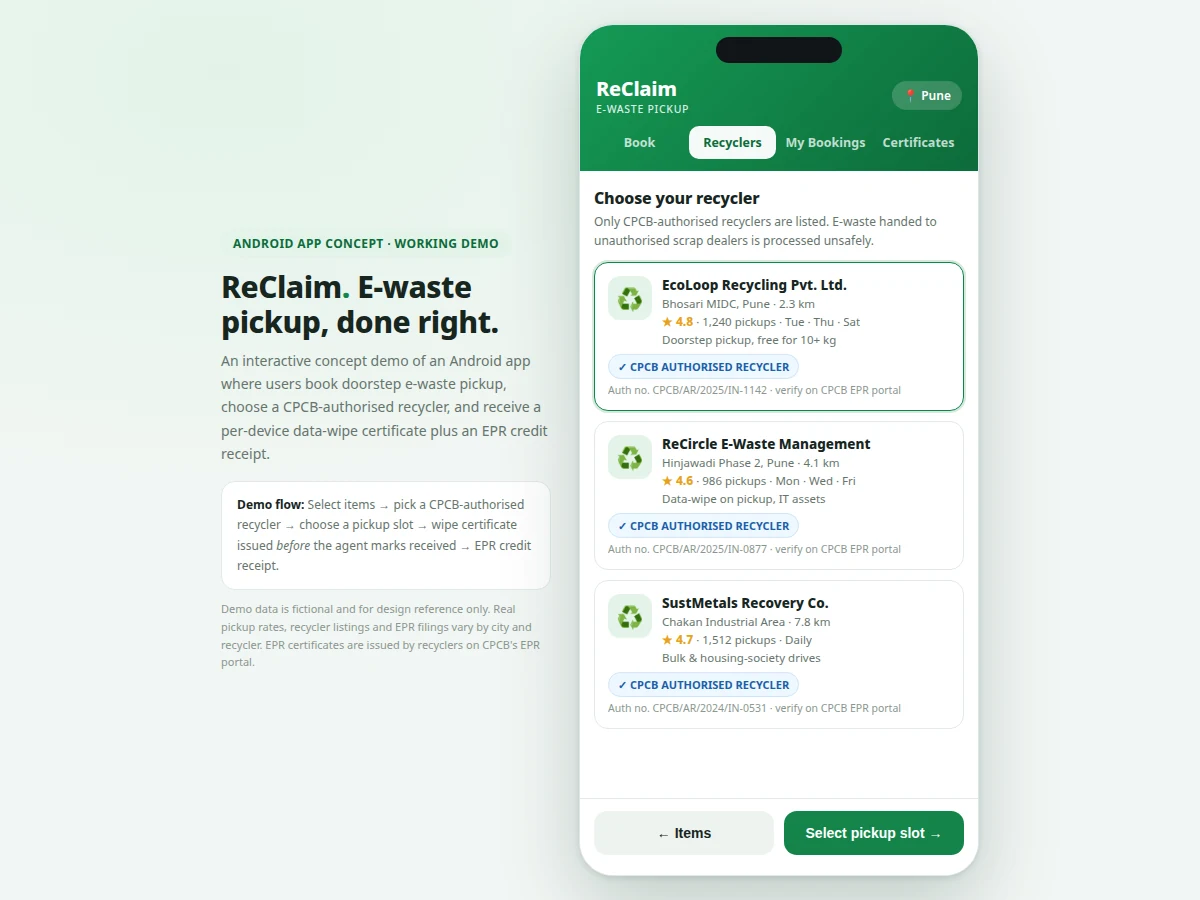
- The user picks a recycler from the directory of CPCB-authorised recyclers, each card showing its authorisation number for verification on the CPCB EPR portal.
- The user chooses a date from the 7-day strip, a 3-hour time slot and a saved address; the recycler accepts the request and a booking ID is generated.
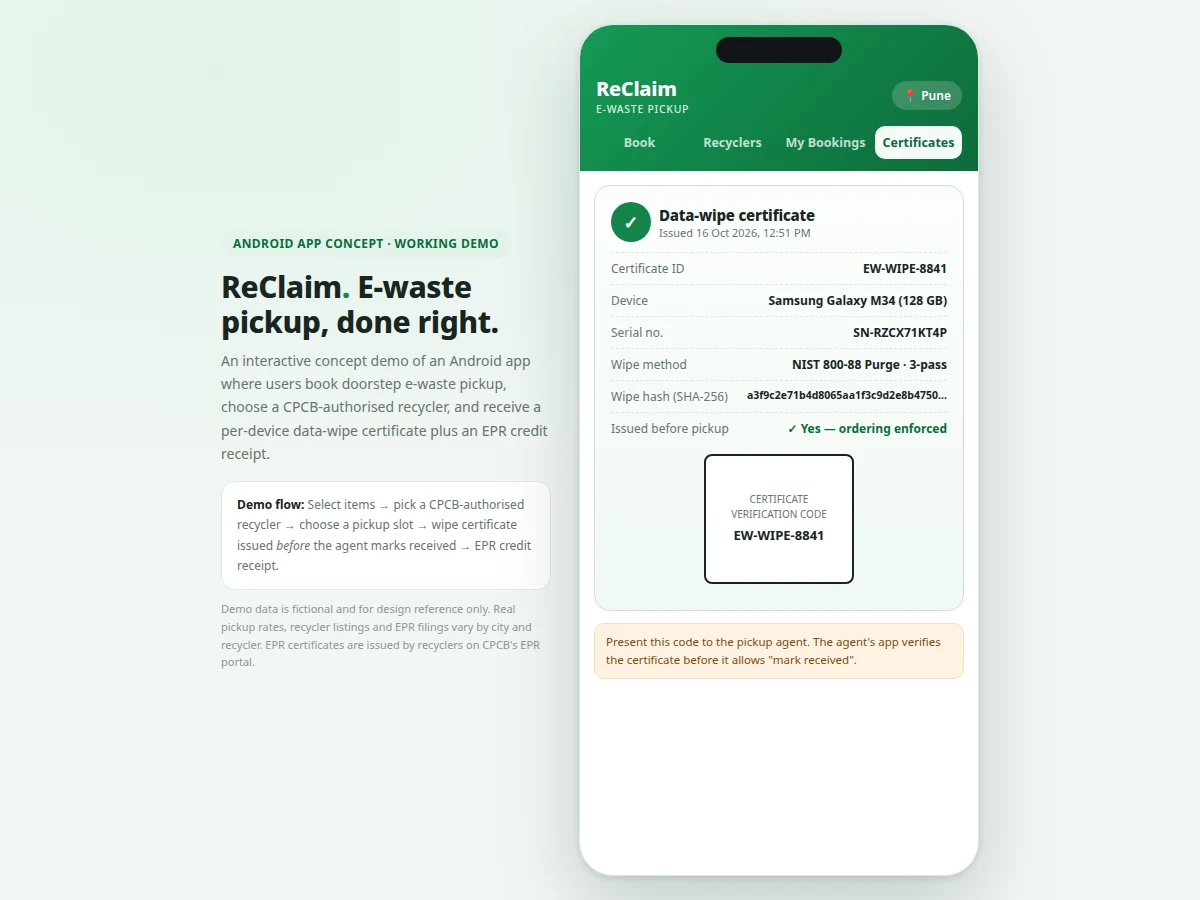
- For storage devices, the app runs a guided data wipe with the device in the user's hand (NIST SP 800-88 Purge, 3-pass, design reference) and issues a per-device certificate before the pickup agent can mark anything received.
- The agent arrives in the slot, weighs items at the door, and the user approves the recycler's final quote inside the app before loading.
- After the recycler processes the waste, the app issues an EPR credit receipt showing recovered fractions (ferrous, copper, aluminium, PCB/other) and referencing the recycler's filing on the CPCB portal.
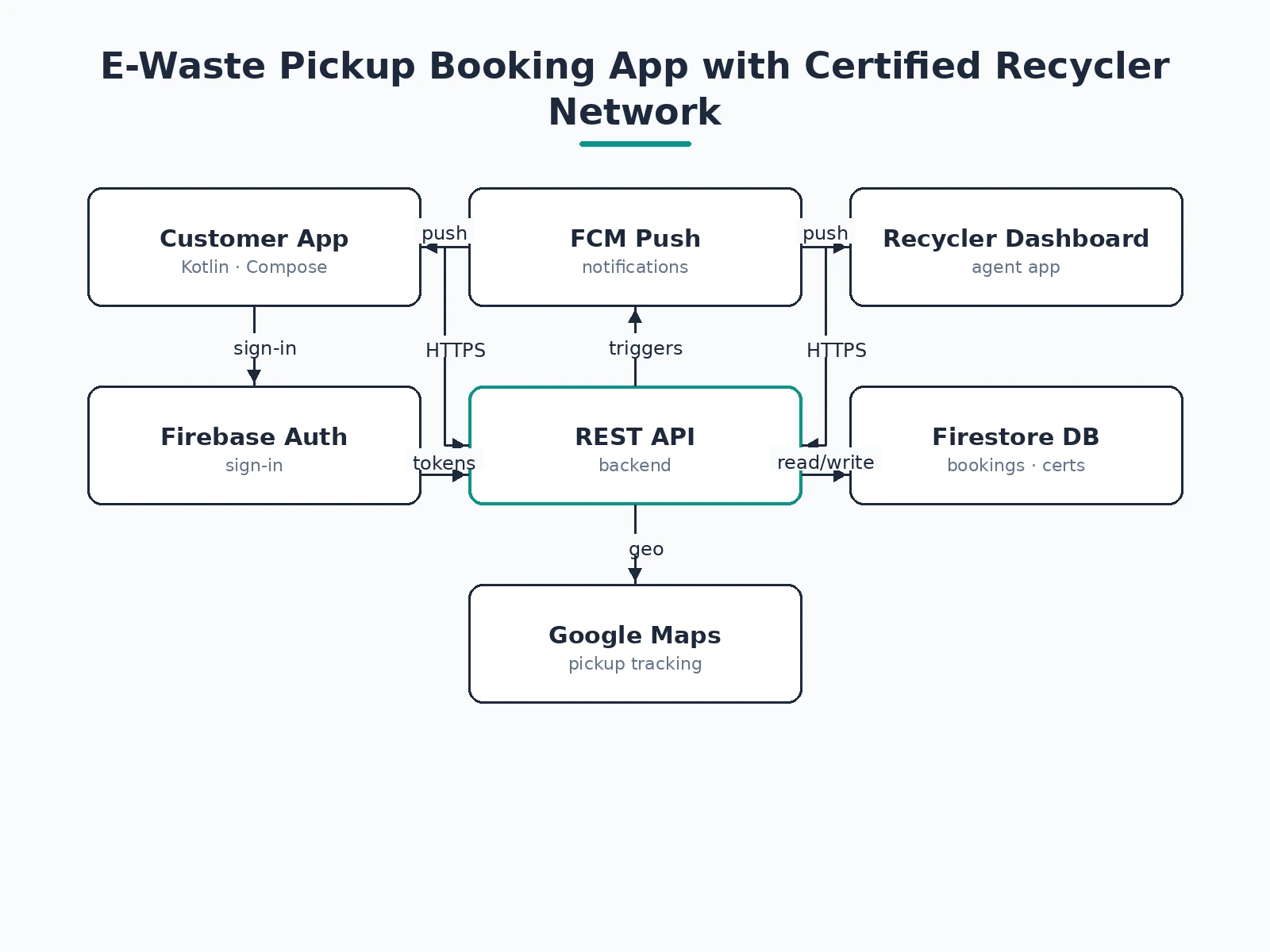
Tech stack:
- Kotlin (Android app)
- Jetpack Compose (UI)
- Firebase Authentication
- Cloud Firestore (database)
- Firebase Cloud Messaging (notifications)
- Google Maps SDK (recycler locations)
- Material 3 (design system)
- REST API backend (recycler/admin services)
| Parameter | Value |
|---|---|
| Platform | Android 8.0 (API level 26) and above (design target) |
| App screens | Approximately 9 screens: booking, recycler directory, slots, confirmation, tracking, wipe flow, certificate, EPR receipt, my bookings (design target) |
| E-waste categories | 12 categories (design reference) |
| Pickup slot window | 3-hour slots over a 7-day date strip (design target) |
| Wipe standard | NIST SP 800-88 Purge, 3-pass overwrite (design reference) |
| Certificate payload | Device, serial number, wipe method, SHA-256 wipe hash, issue timestamp |
| Recycler data | Name, area, distance, CPCB authorisation number, pickup days, rating (sample data in the demo build) |
| Notifications | Firebase Cloud Messaging push for booking status changes (design target) |
Project features
- [Category-based booking] Twelve e-waste categories (smartphones, laptops, CRT and LED monitors, printers, batteries and more) with indicative per-kg buyback rates; a quantity stepper shows an on-screen estimate before the recycler confirms the final quote at doorstep weighing.
- [CPCB-authorised recycler directory] Each recycler card shows its CPCB authorisation number, distance, pickup days and rating, and only authorised recyclers are listed — the regulatory backbone of the whole app, since e-waste given to unauthorised dealers is processed unsafely.
- [Slot-based pickup scheduling] A 7-day date strip plus 3-hour time slots and a saved pickup address; the booking generates a trackable booking ID once the recycler accepts the request.
- [Per-device data-wipe certificates] Storage devices (phones, laptops, tablets) get a guided wipe on NIST SP 800-88 Purge lines with a certificate recording the device, serial number, wipe method and SHA-256 wipe hash. Builder note from the build: the certificate is issued per device BEFORE the pickup agent's app unlocks "mark received" — that ordering is deliberate, because it removes the most common dispute in doorstep e-waste pickup: "received but never wiped".
- [EPR credit receipts] After processing, the app shows an EPR credit receipt with the recovered metal fractions and the recycler's CPCB portal filing reference, explaining the 2022 Rules' certificate chain in plain terms.
- [Live pickup tracking] A booking timeline runs from confirmation through wipe issuance, agent arrival, doorstep weighing with final-quote approval, to recycling completion.
- [Agent-side verification code] The pickup agent scans the user's wipe certificate code; the agent's app verifies it before "mark received" becomes tappable, so unwiped devices cannot enter the chain by accident.
What is included
- Complete Android app source code (Kotlin, Jetpack Compose)
- Firebase backend setup guide (Authentication, Firestore, Cloud Messaging)
- Working demo build with realistic sample screens and sample recycler data
- Recycler onboarding checklist with CPCB authorisation verification notes
- Project report PDF (background, E-Waste Rules 2022 summary, architecture, methodology)
- PPT presentation for final review
- Viva Q&A preparation document (Android concepts, Firebase, EPR and compliance flow)
Limitations & prerequisites
- Per-kg rates in the app are indicative estimates (design reference); the actual buyback or pickup fee varies by city, recycler and material, and is only confirmed at doorstep weighing.
- The demo ships with sample recycler listings; a production rollout needs a real recycler-onboarding pipeline that verifies CPCB authorisation numbers against the CPCB EPR portal.
- EPR certificates on the CPCB portal are generated by the recycler, not by the app — the app's EPR credit receipt mirrors and references the recycler's filing.
- A NIST 800-88 Purge wipe on a user's phone needs device-specific implementation; older devices and non-removable storage may need manufacturer tools instead.
- Doorstep pickup, agent fleet management and payment settlement are operational concerns outside the software itself.
- Booking and tracking need an internet connection to sync recycler availability and booking status; the wipe flow itself runs on-device.
Frequently Asked Questions
What does CPCB-authorised mean in this app?
Under the E-Waste (Management) Rules, 2022, e-waste must be processed by recyclers registered and authorised through the CPCB EPR portal. The app lists only such recyclers and shows each one's authorisation number so the user can verify it — that is the regulatory difference between this app and handing devices to an informal scrap dealer.
How does the data-wipe certificate actually work?
For storage devices, the app runs a guided wipe (NIST SP 800-88 Purge lines, 3-pass) with the device in the user's hand, then issues a certificate with the device, serial number, method and SHA-256 wipe hash. The pickup agent's app keeps "mark received" locked until that certificate verifies — so no unwiped device can enter the chain by accident.
Is the EPR credit receipt a real certificate?
The app's receipt is a user-facing record: it shows the recovered metal fractions and references the recycler's filing. The actual EPR certificates under the 2022 Rules are generated by recyclers on the CPCB EPR portal (initially for key metals such as gold, copper, aluminium and iron/steel) and used by producers to meet EPR targets.
Can the app be customised for my college or city?
Yes — categories, per-kg reference rates, supported cities, languages and the sample recycler directory are all configurable; a recycler-admin module for onboarding and verification can be added as an optional extension.
Is this project suitable for a final-year project?
Yes — for Computer Science, IT and Android-focused programs. It demonstrates mobile UI design, Firebase backend integration, a real-world booking flow and engagement with an actual Indian regulation, which gives strong viva material.
Components & software requirements
- Kotlin (Android app)
- Jetpack Compose (UI)
- Firebase Authentication
- Cloud Firestore (database)
- Firebase Cloud Messaging (notifications)
- Google Maps SDK (recycler locations)
- Material 3 (design system)
- REST API backend (recycler/admin services)
Delivery information
Built-to-order project. Delivery timeline is shared after order confirmation based on current queue.
Support terms
Complete documentation, setup guide, and viva preparation included. Support for setup and explanation provided.
Download free synopsis (PDF)
Enter your name and WhatsApp number — the synopsis PDF downloads immediately. We may send occasional project updates on WhatsApp; no spam.