
More project photos (3)

The problem
Harvested grain never arrives clean. Wheat straight from the thresher carries dust, chaff, straw bits, small stones and broken kernels, and that mixture stores badly, mills badly and sells for less. Small farmers and rural millers usually clean it by hand winnowing, which is slow, weather-dependent and tiring, while commercial cleaning plants are sized and priced for bulk lots, not for a few bags. This project fills that gap with a compact bench-top machine built from a welded steel frame, a sheet-metal hopper, an inclined perforated sieve deck and a small single-phase motor drive. It is a mechanical-design project through and through: frame loads, sieve sizing, vibration parameters, drive reduction and fabrication drawings all have to be worked out, not just assembled.
This is a built-to-order hardware project: the machine is fabricated fresh for you, and the report, drawings and presentation are prepared with it.
The Problem
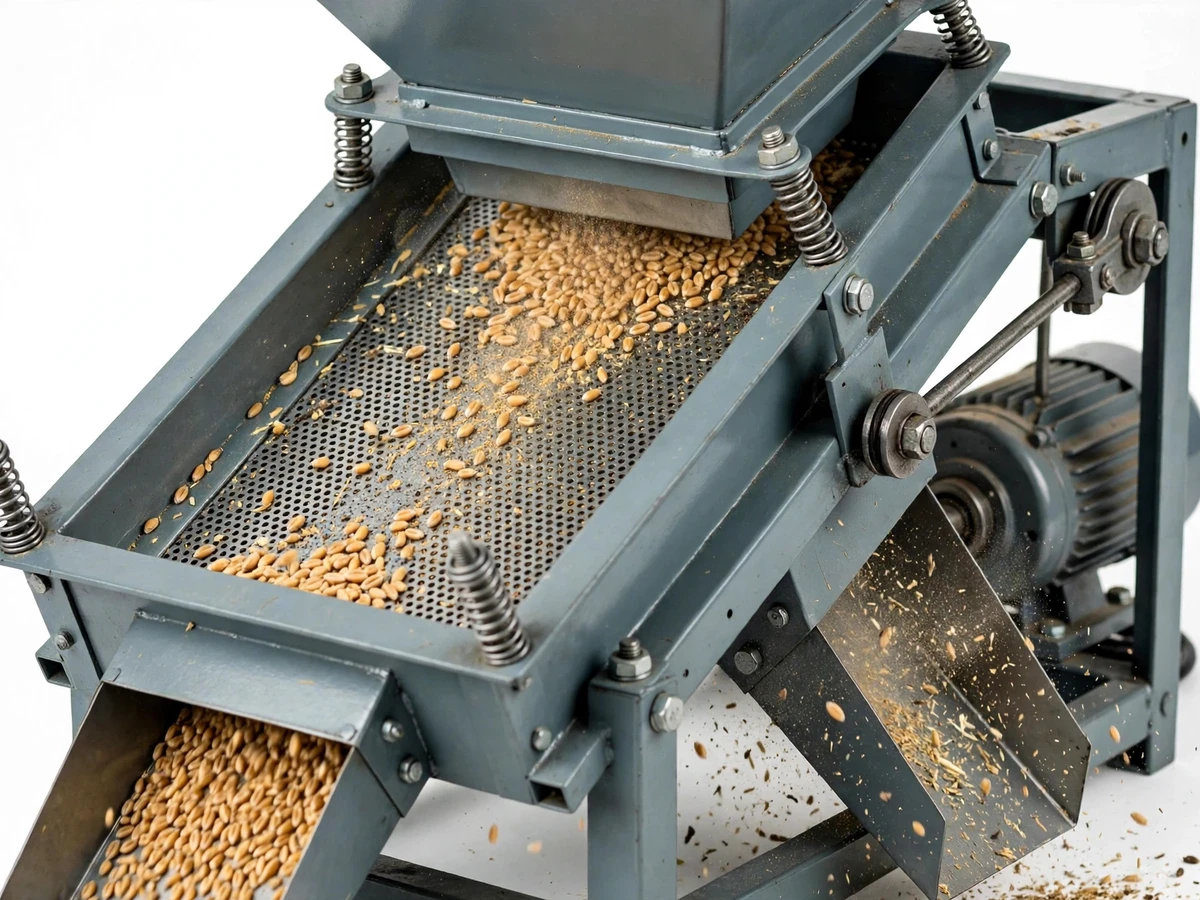
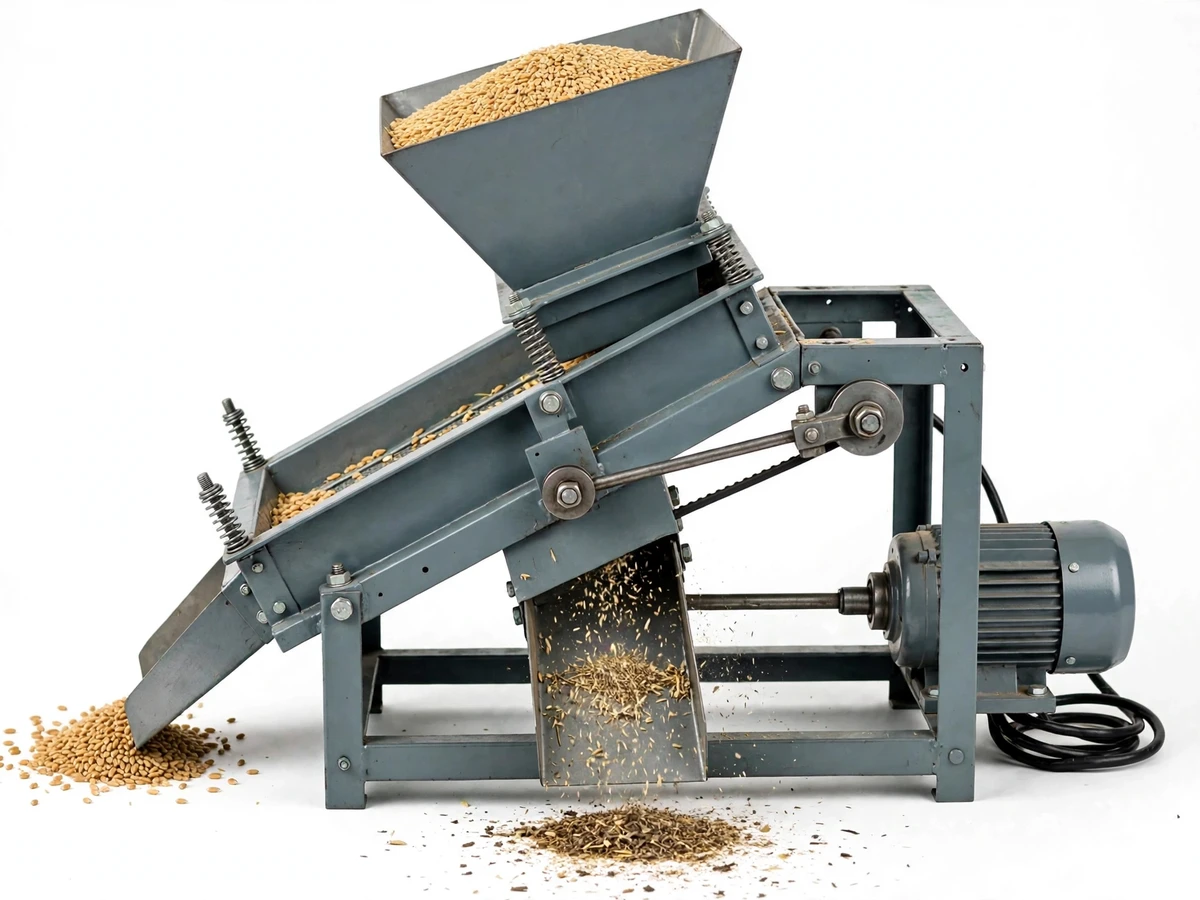
Farmers and small millers lose saleable grain quality because harvested wheat and similar grains arrive mixed with dust, chaff, straw bits, stones and broken kernels. Hand winnowing is slow and weather-dependent, and hiring a large commercial cleaner is uneconomical for a small lot. The Gravity Grain Cleaner with Vibrating Sieve Shaker answers this with a compact bench-top machine: grain poured into a top hopper flows by gravity onto an inclined sieve deck, and a motor-driven eccentric drive vibrates the deck so fine impurities fall through the mesh while cleaned grain travels down the slope to its own outlet. Oversize trash stays on the sieve and leaves through a separate chute, so one pass produces cleaned grain, fine impurities and oversize trash as three separate streams. The machine runs on a standard single-phase supply, needs no compressed air or water, and is sized for small farms, college workshops and rural service centres.
How it works
Cleaning takes one pass through four stages. Grain poured into the top hopper flows by gravity through a feed gate onto the upper end of an inclined sieve deck, and the gate opening sets how thick the grain layer on the sieve is. A motor-driven eccentric shakes the spring-mounted deck, and the vibration tosses the grain slightly with each stroke so fine dust, sand and small broken kernels fall through the mesh while whole grains stay on top. Gravity pulls the grain layer down the slope, and the cleaned grain slides off the lower end of the deck into its own outlet chute. Oversize trash such as straw and large stones rides on top of the sieve and leaves through a separate reject chute, while the fines that passed through the mesh collect in a tray below the deck. The operator controls the result with two adjustments: the feed gate and the sieve mesh size.
- Grain is poured into the top hopper, which holds one batch and feeds it steadily through the sliding feed gate.
- The feed gate opening is set so the grain forms a thin, even layer on the upper end of the inclined sieve deck.
- The motor drives the eccentric through a belt reduction, and the eccentric shakes the spring-mounted deck at its working frequency.
- Vibration tosses the grain layer slightly with each stroke, so dust, sand and small broken kernels fall through the mesh into the fines tray below.
- Whole grains stay on the mesh and travel down the slope by gravity to the cleaned-grain outlet chute at the lower end.
- Oversize trash such as straw bits and large stones rides on top of the sieve and leaves through the separate reject chute.
- The operator checks the three streams and adjusts the feed gate or swaps the mesh if too much good grain appears in the fines or too much trash stays in the cleaned grain.
Tech stack:
- MS angle-iron frame · welded
- 2.5 mm perforated sieve mesh (design target)
- 0.5 HP single-phase induction motor (design target)
- Eccentric drive · belt reduction
- Coil spring mounts
- Sheet-metal hopper · outlet chutes
- Mild steel fasteners · bearings
- Single-phase switch · overload protection
| Parameter | Value |
|---|---|
| Hopper capacity | 15 kg (design target) |
| Sieve deck size | 600 mm × 400 mm (design target) |
| Sieve mesh opening | 2.5 mm round holes (design target) |
| Deck inclination | 8 degrees (adjustable, design target) |
| Motor | 0.5 HP single-phase · 1440 RPM (design target) |
| Vibration frequency | Approximately 12–15 Hz (design target) |
| Vibration amplitude | Approximately 2–3 mm (design target) |
| Overall size | Approximately 1200 mm × 600 mm × 1400 mm (design target) |
| Throughput | Approximately 100–150 kg per hour (design target, grain and feed-rate dependent) |
| Power supply | 230 V single-phase AC |
Builder note (original data)
The 2.5 mm mesh opening is a design-target choice, not a catalogue copy: a wheat kernel is roughly 6 mm long and 3 mm wide, so a 2.5 mm round hole is small enough to retain whole kernels while passing dust, sand and small broken pieces. The vibration figures are design targets with their reasoning stated plainly: an amplitude of approximately 2–3 mm at approximately 12–15 Hz tosses the grain layer just enough to break the static friction that lets particles wedge into the mesh — the blinding effect — without throwing good grain off the deck or bouncing it over the outlet. If the amplitude were much larger, grain would jump and mix instead of stratifying; if it were much smaller, fines would sit on the mesh and blind it. No cleaning efficiency or throughput figure is claimed as measured — throughput is stated only as a design target that depends on grain type and feed rate.
Project features
The Gravity Grain Cleaner with Vibrating Sieve Shaker combines four capabilities that matter in daily use: gravity feeding with no auger or blower to damage grain, a spring-mounted vibrating sieve deck that keeps the mesh clear, an interchangeable sieve so the same frame can handle wheat and similar grains, and three separate outlets that keep cleaned grain, fine impurities and oversize trash apart without a second pass. A small single-phase motor drives the deck through an eccentric and belt reduction, so the vibration is steady and the running cost stays low. The frame is a simple welded angle-iron structure that a workshop can build and repair with basic tools, and every wearing part — the sieve mesh, the springs and the belt — can be replaced without dismantling the machine.
- [Gravity feed, no blower] Grain moves by gravity alone from hopper to outlets, so there is no auger or fan to crack kernels or blow good grain away with the dust. Implemented in the delivered machine.
- [Vibrating sieve deck] A motor-driven eccentric shakes the spring-mounted deck, tossing the grain layer slightly with each stroke so fines fall through the mesh instead of settling on it. Implemented in the delivered machine.
- [Interchangeable sieve mesh] The mesh panel bolts into the deck frame and can be swapped for a different opening size, so the same machine can be set up for wheat and similar grains. One mesh size fitted as standard; additional mesh sizes are an optional add-on.
- [Three separate outlets] Cleaned grain, fines that pass through the mesh, and oversize trash leave through three different chutes, so no hand sorting is needed after a pass. Implemented in the delivered machine.
- [Adjustable feed gate] A sliding gate at the hopper throat sets how thick the grain layer on the sieve is, which is the main control the operator uses to balance cleaning quality against speed. Implemented in the delivered machine.
- [Spring-mounted deck] Four coil springs carry the deck, isolating vibration from the frame so the machine runs quietly and does not walk across the floor. Implemented in the delivered machine.
- [Workshop-friendly frame] The structure is welded MS angle iron with bolted joints at every wearing part, so a local workshop can repair it with basic tools. Implemented in the delivered machine.
- [Future scope: second sieve deck] A second deck with a finer mesh below the first would give two size cuts in one pass; it is documented as future scope in the report and is not part of the delivered machine.
What is included
- Fabricated gravity grain cleaner machine with hopper, vibrating sieve deck, motor drive and three outlet chutes
- One interchangeable sieve mesh fitted (2.5 mm opening, design target)
- Fines collection tray
- Fabrication drawings (frame, deck, hopper, drive layout)
- Project report PDF (design calculations, sieve sizing, vibration parameters, testing procedure)
- PPT presentation for final review
- Viva Q&A preparation document (sieving theory, vibration, drive selection, fabrication)
Limitations & prerequisites
- It separates by size only: it does not sort by grain quality, colour or density, so shrivelled grains of the same size as good grain pass into the cleaned stream.
- Damp grain clogs the sieve: grain above approximately 14% moisture (approximate) sticks to the mesh and blinds it, so grain must be sun-dried before cleaning.
- Throughput of approximately 100–150 kg per hour is a design target only, not a measured result; actual throughput depends on grain type, impurity load and feed-gate setting, and no cleaning efficiency percentage is claimed.
- One sieve deck gives one size cut per pass; a second cut needs a mesh change or a second pass.
- Fine dust escapes around the open deck, so the machine should run outdoors or in a ventilated space; a dust hood is an optional add-on, not standard.
- It needs a level floor and a 230 V single-phase supply, and it cleans threshed grain only — it cannot thresh or winnow an unthreshed crop.
Frequently Asked Questions
How does the vibrating sieve separate grain from impurities?
The sieve separates purely by size, with vibration keeping the process moving. Grain flows down an inclined perforated deck while an eccentric drive shakes the deck; particles smaller than the mesh openings — dust, sand and small broken kernels — fall through into a fines tray, whole grains stay on top and slide to the cleaned-grain outlet, and oversize trash rides off the end into a reject chute. Gravity does the transport and vibration does the unblocking, so the mesh does not clog the way a static sieve does.
What grains can it clean?
Wheat and similar-sized grains such as barley and sorghum, with a mesh change for each grain size. The standard fitted mesh has a 2.5 mm opening sized for wheat; a different opening is needed for a much larger or smaller grain, which is why the mesh panel is bolted in and interchangeable rather than welded. The machine does not grade grain by quality or colour, only by size.
Why does vibration stop the sieve from clogging?
Vibration breaks the static friction that wedges particles into the mesh holes, an effect called blinding. Each stroke tosses the grain layer slightly, so a particle stuck in a hole is shaken loose and the hole is free for the next particle; without vibration, fines settle into the holes and the open area shrinks until almost nothing passes through. The design-target amplitude of approximately 2–3 mm is chosen to unblock the mesh without throwing good grain off the deck.
What throughput can it handle?
Approximately 100–150 kg per hour is the design target, not a measured result. Real throughput depends on the grain type, how dirty the input is, and how wide the feed gate is set: a thick grain layer cleans more slowly because fines must work through more material, while a thin layer runs faster but moves less grain. The report states this honestly and gives a test procedure so the actual figure can be measured for the delivered machine.
Is this project suitable for a final-year project?
Yes — for Mechanical Engineering and Agricultural Engineering programs, where it fits machine design and manufacturing coursework. It covers sieve sizing, vibration analysis, drive selection, fabrication drawings and testing, which gives the student genuine design calculations to defend and a working machine to demonstrate. The report documents every calculation, so the review discussion can stay on the student's own design decisions.
Components & software requirements
- MS angle-iron frame · welded
- 2.5 mm perforated sieve mesh (design target)
- 0.5 HP single-phase induction motor (design target)
- Eccentric drive · belt reduction
- Coil spring mounts
- Sheet-metal hopper · outlet chutes
- Mild steel fasteners · bearings
- Single-phase switch · overload protection
Delivery information
Built-to-order project. Delivery timeline is shared after order confirmation based on current queue.
Support terms
Complete documentation, setup guide, and viva preparation included. Support for setup and explanation provided.
Download free synopsis (PDF)
Enter your name and WhatsApp number — the synopsis PDF downloads immediately. We may send occasional project updates on WhatsApp; no spam.