
More project photos (3)
The problem
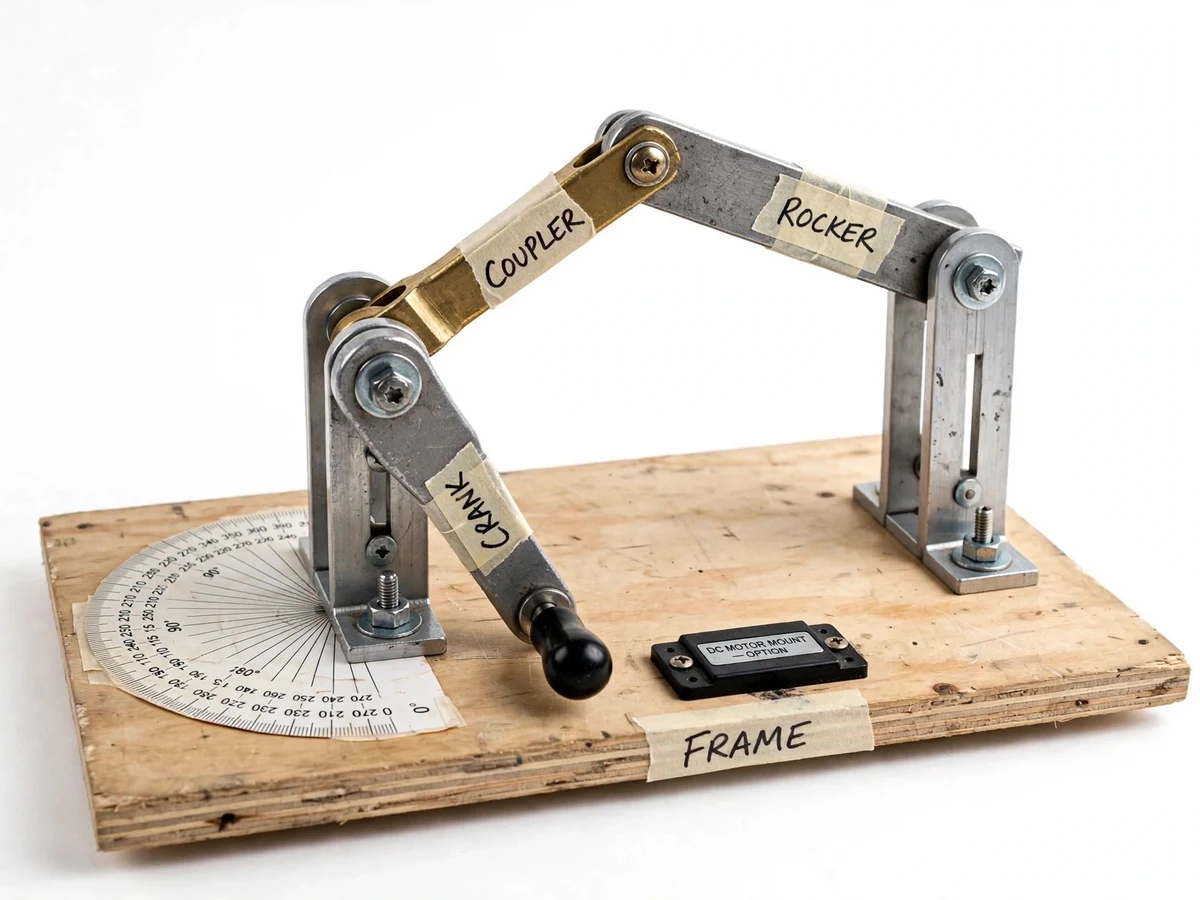
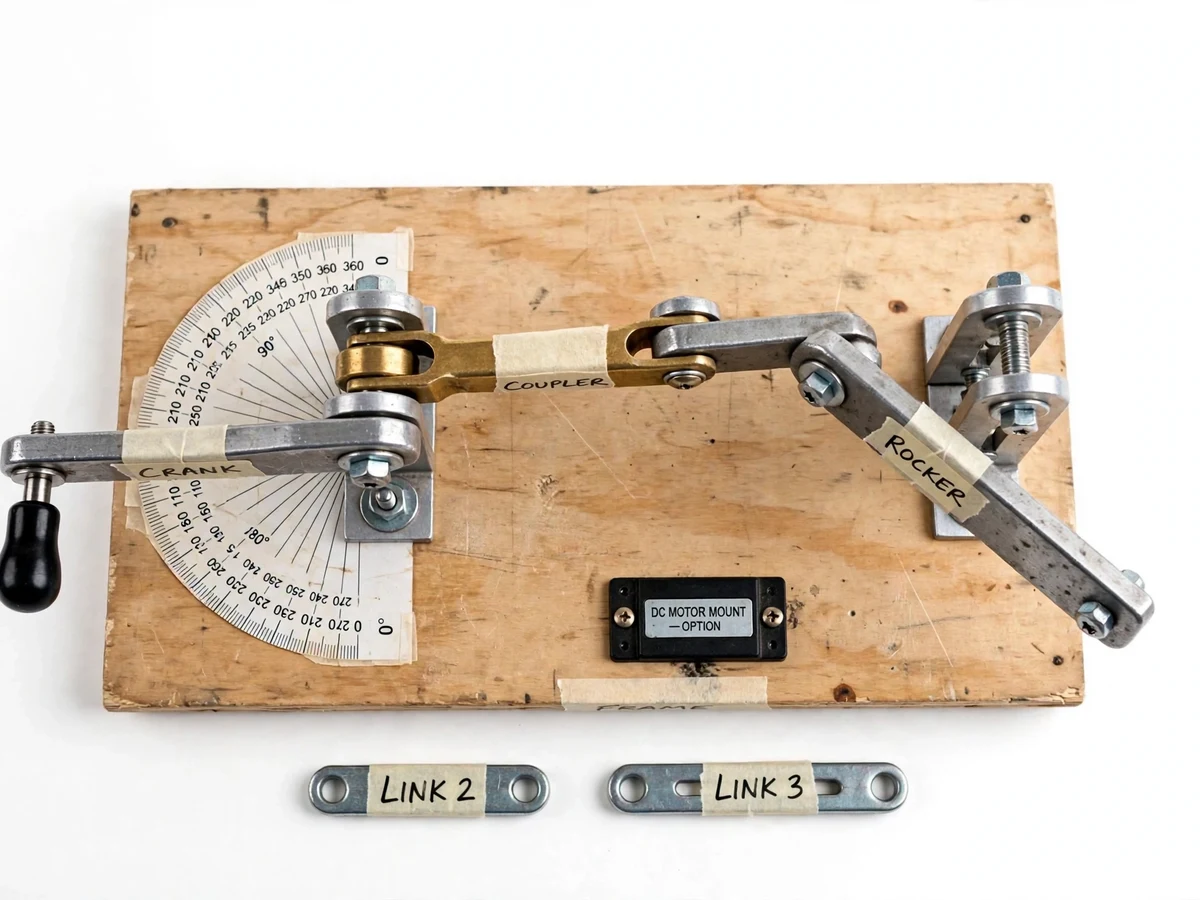
Kinematics of machines is where most Mechanical students first meet mechanisms they cannot actually see: textbooks draw the four-bar linkage as clean line diagrams, but a line diagram never shows why the same four links can behave as a crank-rocker in one arrangement and a double-rocker in another. This project answers that gap with a bench-top four-bar mechanism demonstrator: a hand-cranked rig of interchangeable links on a rigid plywood base that physically runs all three Grashof inversions — crank-rocker, double-crank (drag-link) and double-rocker. A printed 0–360° protractor scale under the crank pivot lets the student measure input and output angles and plot the motion-transmission relationship from real readings. Because the links are bolted, not welded, link lengths change in minutes, turning Grashof's criterion (s+l ≤ p+q) from an abstract inequality into something the student verifies by swapping one link. The honest deliverable is a teaching rig for kinematics-of-machines labs: it makes the four-bar's motion classification tangible, measurable and viva-ready.
How it works
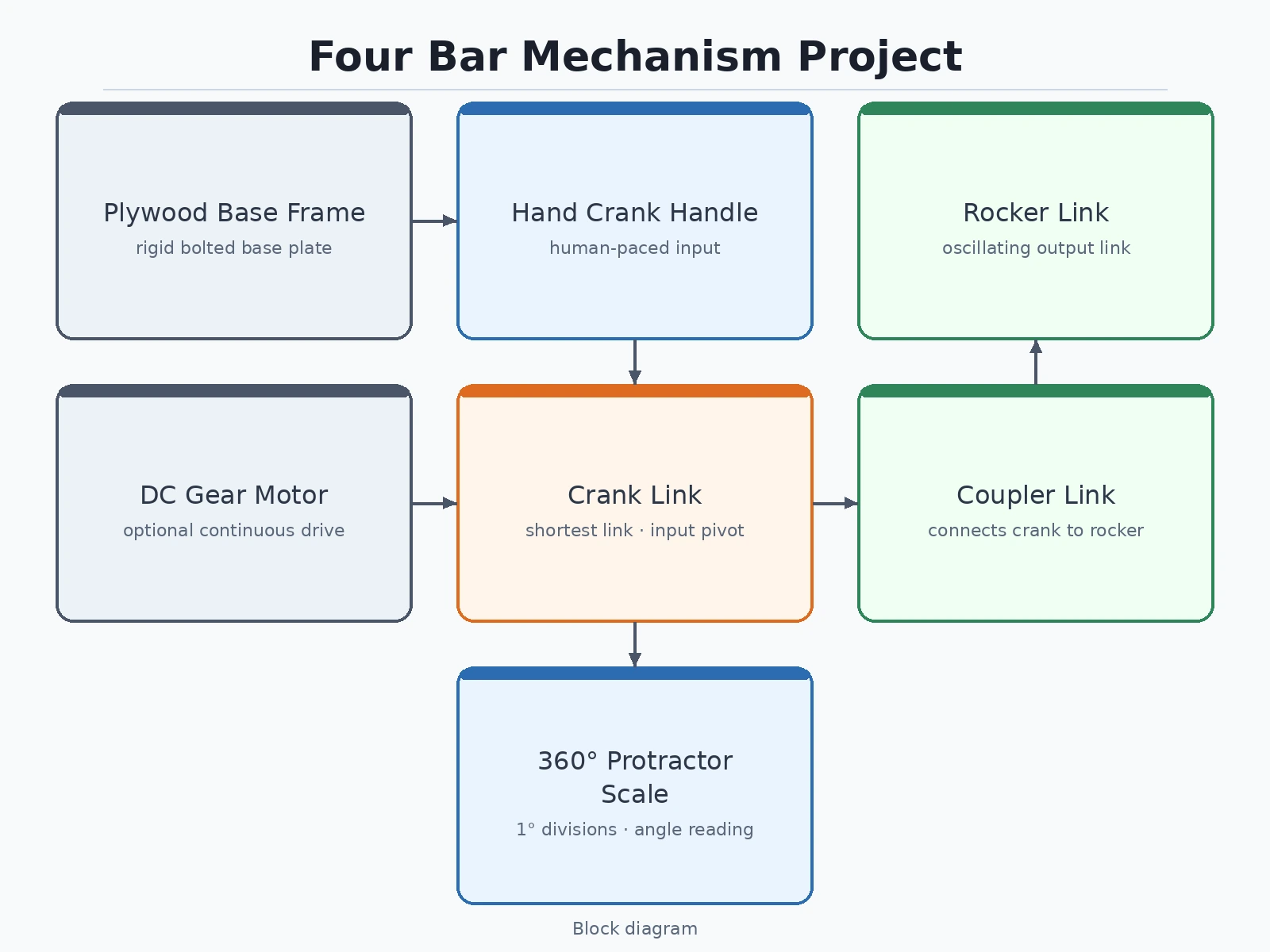
The four-bar mechanism model converts continuous rotation into a family of controlled motions: the operator turns the hand crank, the crank drags the coupler through a complex planar path, and the coupler drives the rocker into an oscillating sweep — every input revolution producing one full back-and-forth cycle of the output. Inside a crank-rocker, the shortest link completes full revolutions while the rocker merely oscillates, because Grashof's criterion (s+l ≤ p+q) locks the shortest link to continuous rotation when it sits adjacent to the frame. Swap the links so the shortest link becomes the frame itself, and both side links rotate fully in a double-crank (drag-link) drive; make the shortest link the coupler, and neither side link can complete a revolution — the double-rocker. A drop of machine oil at each revolute joint is the single most common fix for a crank that stalls mid-cycle.
- The frame link (base between the two fixed pivots) is fixed; the two side links pivot only about their fixed axes.
- The operator turns the hand crank, the shortest link in the crank-rocker setup, through full 360° revolutions.
- The coupler transmits the crank's motion, its body tracing a complex planar coupler curve.
- The rocker, unable to complete a full revolution under Grashof's criterion, swings between two extreme positions (dead-center positions).
- The student reads input angle on the printed protractor and notes the crank positions where the rocker reverses — the dead centers.
- To change inversion, links are unbolted and a different-length set fitted: shortest-as-frame gives double-crank, shortest-as-coupler gives double-rocker.
- With the marker mount fitted, a pen traces the coupler curve on paper for a full crank revolution.
- Optionally, the DC gear motor replaces the hand crank on the motor mount for continuous runs.
Tech stack:
- Aluminium flat-bar links
- Steel pivots · bolts · washers
- Plywood base plate
- Printed protractor angle scale
- Hand crank handle
- DC gear motor (optional drive)
- Masking tape · machine oil
- Vernier caliper · protractor · stopwatch
| Parameter | Value |
|---|---|
| Mechanism | Four-bar chain with 4 revolute joints (design) |
| Degrees of freedom | 1 (Grübler criterion, design) |
| Inversion family | Crank-rocker · double-crank · double-rocker (design) |
| Link set 1 (crank-rocker) | Frame 200 mm · crank 60 mm · coupler 180 mm · rocker 160 mm (design targets); Grashof check s+l = 260 mm ≤ p+q = 340 mm |
| Link set 2 (double-crank) | Frame 60 mm · crank 120 mm · coupler 180 mm · rocker 200 mm (design targets) |
| Link set 3 (double-rocker) | Frame 200 mm · crank 120 mm · coupler 60 mm · rocker 180 mm (design targets) |
| Base plate | Approximately 300 × 200 mm plywood (design target) |
| Angle scale | 0–360° printed protractor, 1° divisions (design) |
| Input drive | Hand crank (included); optional DC gear motor drive |
| Coupler curve | Traced physically on paper via marker mount (design target) |
| Total mass | Approximately 1.5–2 kg (expected) |
Project features
The four-bar mechanism model gives the student three genuinely different machines on one base plate: a crank-rocker for studying rotation-to-oscillation conversion, a double-crank (drag-link) for full-rotation coupling of two shafts, and a double-rocker for bounded oscillating output — each achieved by unbolting and swapping links, not by rebuilding the rig. A printed 360° angle scale turns the demonstrator into a measurement instrument: students log input versus output angles at each rocker extreme and verify Grashof's predictions from their own readings. The hand crank keeps every demonstration human-paced and classroom-friendly, while an optional DC motor mount supports continuous unattended running. Masking-tape labels on the crank, coupler, rocker and frame keep the four links unambiguous during viva demonstrations and lab sessions, and a coupler-point marker mount traces real coupler curves on paper.
- [All three Grashof inversions on one rig] Interchangeable bolted links let the student assemble a crank-rocker (shortest link = crank, adjacent to frame), a double-crank (shortest link = frame itself) and a double-rocker (shortest link = coupler) — the complete inversion family in one build.
- [Hand crank plus optional motor drive] A hand-crank handle on the input pivot gives slow, stoppable classroom demonstrations; a bolt-on motor mount plate accepts a small DC gear motor for continuous unattended running of long experiments.
- [Printed 360° angle scale] A protractor print glued under the crank pivot gives 1°-division input/output angle readings, so students measure rocker swing angles and map the input-output relationship instead of guessing it.
- [Coupler-curve tracer mount] A marker holder clamped at a coupler point traces the actual coupler curve on paper as the crank turns, converting abstract coupler-point theory into a physical drawing the student keeps.
- [Masking-tape link labels] Each link carries a handwritten masking-tape label (CRANK, COUPLER, ROCKER, FRAME), so the inversion being demonstrated is readable at a glance during vivas and lab sessions.
- [Rigid bolted construction] A plywood base with steel pivot stands, bolted link joints and washers keeps the mechanism running true through repeated demonstrations without loosening.
- [Student-friendly assembly and maintenance] The rig assembles with basic hand tools; a drop of machine oil at each revolute joint is the single most common fix for a crank that stalls mid-cycle — a builder note every demonstrator carries.
What is included
- Working four-bar mechanism demonstrator model (hand-cranked)
- Three interchangeable link sets for crank-rocker, double-crank and double-rocker configurations
- Printed 360° protractor angle scale fitted under the crank pivot
- Coupler-curve marker mount for paper tracing
- Masking-tape labels on crank, coupler, rocker and frame
- Assembly drawings with link-length schedule and Grashof checks
- Measurement procedure: input-output angle logging and inversion verification steps
- Project report PDF (background, Grashof theory, methodology, readings template)
- PPT presentation for final review
- Viva Q&A preparation document (inversions, Grübler, dead centers, transmission angle)
Limitations & prerequisites
- A teaching demonstrator, not a precision instrument: angle readings from the printed scale are good to about ±1° (expected), not metrology grade.
- The hand-cranked drive gives steady demonstrations, but crank speed varies with the operator — the optional motor drive steadies long runs.
- Link-length sets are design targets; the fabricated rig demonstrates the three inversion types, not exact textbook dimensions.
- The model carries no load beyond its own links — it is a kinematics demonstrator, not a power-transmission device.
- Wear at the bolted revolute joints accumulates over heavy use; joints are re-tightenable and links replaceable.
- The coupler-curve tracer needs a flat paper surface and a freely moving marker; thick or dragging markers distort the traced curve.
- Grashof's criterion predicts motion type; exact swing angles depend on the fabricated link lengths and must be measured on the student's own build.
Frequently Asked Questions
Which mechanisms does this project demonstrate?
It demonstrates all three Grashof inversions of the four-bar chain: the crank-rocker (continuous input rotation to oscillating output), the double-crank or drag-link (both side links rotating fully), and the double-rocker (bounded oscillation on both sides). Each is assembled on the same base by swapping the bolted link sets — no rebuild needed.
Is this project suitable for a final-year project?
Yes — for Mechanical Engineering programs. It demonstrates kinematics of machines fundamentals: the four-bar chain, Grashof's criterion, Grübler's mobility rule, inversion analysis, dead-center positions and coupler curves. Every claim in the report is backed by measurements the student takes on their own rig.
Can the link lengths be changed?
Yes. The links are bolted, not welded, and the project ships with three link sets covering all three inversions. Swapping a set takes minutes with basic hand tools, so the student can verify Grashof's criterion (s+l ≤ p+q) experimentally by changing which link is shortest, instead of just quoting the inequality from a textbook.
What measurements can I take with the angle scale?
The printed 360° protractor lets you log the crank angle at each rocker dead center, measure the rocker's total angular sweep, and plot the input-output angle relationship for the full cycle. These student-taken readings feed directly into the report's theory-vs-experiment comparison and give the viva concrete numbers to discuss.
Can it run on a motor instead of the hand crank?
The rig ships hand-cranked for paced, stoppable classroom demonstrations, and a bolt-on motor mount plate is included so a small DC gear motor can drive the crank continuously for long experiments. The hand crank stays the default because controlled speed makes dead centers and inversions easier to show; motor, controller and power supply are optional extras.
What will I receive with the project?
The working mechanism model with three inversion link sets, angle scale, coupler-curve tracer mount, masking-tape link labels, assembly drawings with the link-length schedule, the measurement procedure, report PDF, PPT and viva Q&A. It is a complete demonstration plus documentation package built to order, not just loose hardware.
Components & software requirements
- Aluminium flat-bar links
- Steel pivots · bolts · washers
- Plywood base plate
- Printed protractor angle scale
- Hand crank handle
- DC gear motor (optional drive)
- Masking tape · machine oil
- Vernier caliper · protractor · stopwatch
Delivery information
Built-to-order project. Delivery timeline is shared after order confirmation based on current queue.
Support terms
Complete documentation, setup guide, and viva preparation included. Support for setup and explanation provided.
Download free synopsis (PDF)
Enter your name and WhatsApp number — the synopsis PDF downloads immediately. We may send occasional project updates on WhatsApp; no spam.