
More project photos (2)
The problem
Small and marginal farmers rarely own the full set of machines their cropping calendar needs — a combine harvester is used a few weeks a year, a laser leveller even less — yet hiring one still runs on phone calls, middlemen and word of mouth. The result is familiar: machines sit idle in one village while a farmer ten kilometres away misses a sowing window, with no written record of the rate, dates or handover condition. This project builds the missing marketplace: a web platform where equipment owners list machines with per-day rates, photos and availability, and renting farmers search by machine type and location, check a live calendar, book, and pay online. Owners approve requests and track earnings from a dashboard; an admin verifies owner documents, approves listings and resolves disputes. The scope is deliberately bounded to what one student team can build and defend: relational data modelling, role-based access, a booking state machine, calendar logic and a real payment-gateway integration — the core of any marketplace product, applied to an agricultural problem the examiners will recognise instantly.
How it works
- The renter opens the portal, signs up with a phone number and OTP, and searches equipment by machine type, location and date range; the frontend queries the backend's listing API with availability computed from existing bookings.
- The backend (Node.js + Express) checks the requested dates against the bookings table — any overlap with a confirmed booking marks the machine unavailable — and returns only rentable machines with live per-day pricing.
- The renter picks start and end dates on the availability calendar; the frontend totals rental days × rate + delivery fee + 5% platform commission and shows the bill before payment.
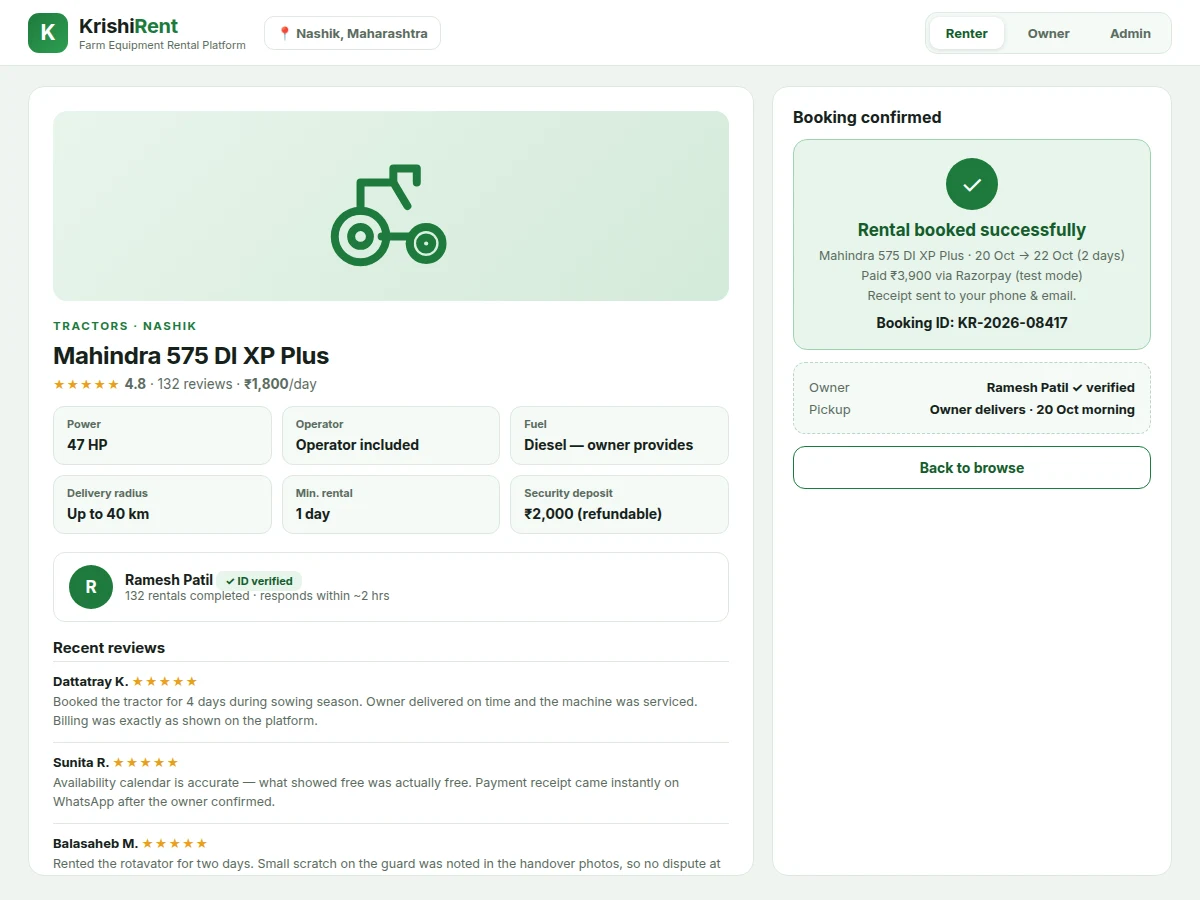
- On "Pay", the backend creates a Razorpay order, the renter completes UPI/card payment in the checkout widget, and a webhook verifies the payment before the booking row flips from pending to confirmed.
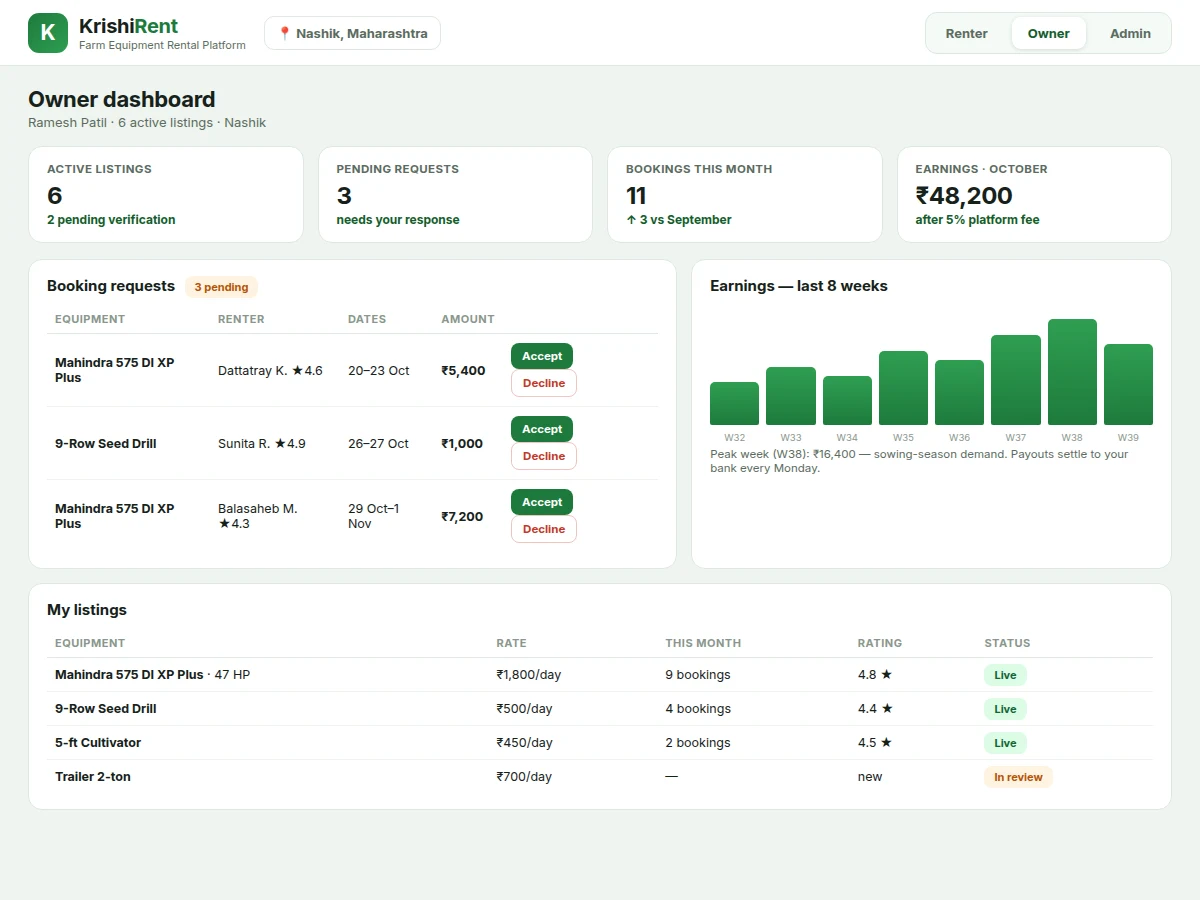
- The owner sees the request in their dashboard with renter details and rating, accepts it, and the dates are locked on the calendar so no second renter can book the same machine.
- At handover both parties confirm machine condition with notes/photos in the app; on return the renter marks completion, the security deposit hold is released, and both sides leave ratings.
- The admin monitors everything: new listings wait in the verification queue until owner ID and machine documents are approved, disputes are resolved against the handover evidence, and weekly payouts settle owner earnings minus commission.
Tech stack:
- React + Vite (responsive frontend)
- Node.js + Express (REST backend API)
- MySQL (relational database)
- JWT + OTP (phone-based authentication)
- Razorpay (payment gateway, test mode)
- Prisma ORM (schema & migrations)
- Redis (session & availability caching)
- Nginx + VPS deployment
| Parameter | Value |
|---|---|
| User roles | 3: renter, equipment owner, admin |
| Database tables | Approximately 14 (users, listings, bookings, payments, reviews, disputes, payouts) |
| Booking conflict check | Date-overlap query per listing (design target: <200 ms at 1,000 concurrent listings) |
| Availability calendar window | 90 days forward (configurable) |
| Payment methods | UPI, cards, netbanking via Razorpay (test mode in demo) |
| Platform commission | 5% per booking (configurable in admin panel) |
| Page load | Expected <2.5 s on 4G for listing grid (design target) |
| Supported browsers | Chrome, Edge, Firefox, Safari — latest 2 versions (expected) |
| Seed data | 40+ listings, 120+ bookings across 12 districts (included) |
| Hosting requirement | Any Node.js-capable VPS or shared host with MySQL (deployment guide included) |
Project features
- [Equipment listings with availability calendar] Owners create listings with machine type, power rating, per-day rate, photos, delivery radius and terms; a month-view calendar marks each date available, booked or blocked, so renters never request a machine that is already out.
- [Search and filters] Renters search by keyword, machine category (tractors, harvesters, tillage, sowing, sprayers, threshing) and location, with distance, price and rating sort — results update live without page reloads.
- [Booking flow with online payment] Date selection computes the rental total with delivery fee and platform commission; checkout runs through Razorpay (UPI, cards, netbanking) in test mode, and each confirmed booking gets an ID, receipt and cancellation window.
- [Owner dashboard] Pending booking requests with accept/decline, a listings table with live/paused status, booking history, an earnings chart and weekly payout summary after the platform fee.
- [Admin panel] Platform stats (users, listings, bookings, GMV), a verification queue where owner ID and machine documents are approved before a listing goes live, dispute tickets, and commission settings.
- [Ratings and reviews] Both sides rate each other after return; handover condition notes and photos are attached to the booking record to settle damage disputes with evidence.
- [Notifications and receipts] Booking confirmation, owner acceptance and payment receipts are generated for every transaction, with SMS/WhatsApp hooks kept as a documented extension point.
- Optional customization: UPI-intent or manual cash/UPI payment recording instead of Razorpay, multi-language (Marathi/Hindi) UI, per-hour pricing for harvesters.
- Future scope: native mobile app, GPS tracking of delivered machines, automated deposit release, crop-calendar demand forecasting.
What is included
- Complete full-stack source code (frontend + backend API)
- MySQL schema with migrations and realistic seed data
- Razorpay payment flow implemented in test mode with webhook verification
- Owner dashboard and admin panel as specified above
- Project report PDF (background, ER design, API documentation, booking state machine, testing)
- PPT presentation for final review
- Viva Q&A preparation document (auth, payments, concurrency, schema design)
- Deployment guide for VPS hosting
Limitations & prerequisites
- The payment flow runs in Razorpay test mode; going live needs the buyer's own Razorpay business account and KYC — the code path is identical, only keys change.
- Real-time GPS tracking of machines is not included; location is owner-declared per listing.
- OTP delivery needs the buyer's own SMS provider account (test bypass documented for the demo).
- The availability calendar assumes owners keep it updated; no automatic sync with any external system.
- Built for district-scale usage (design target: ~1,000 listings); multi-region sharding is out of scope.
- Machine verification is document-based; the platform does not physically inspect equipment.
Frequently Asked Questions
Is the database included?
Yes. The complete MySQL schema ships with migrations plus seed data — 40+ realistic listings and 120+ bookings across 12 districts — so every screen, the calendar and both dashboards work from the first run without manual data entry.
Is there an admin panel?
Yes, a full admin panel is part of the build: platform statistics, a listing-verification queue (owner ID and machine documents approved before going live), dispute tickets, and configurable commission and deposit settings.
Is the payment gateway genuinely integrated or optional?
Genuinely integrated: the Razorpay flow — order creation, checkout, and webhook signature verification — is implemented and demonstrated in test mode. Switching to live needs only the buyer's Razorpay keys, or it can be replaced with manual UPI recording as a customization.
Where will the project be hosted?
Any Node.js-capable VPS or shared host with MySQL works; a step-by-step deployment guide is included. Hosting itself is arranged by the buyer — the demo and handover run on a provided staging link during development.
Can owners and renters use it on phones?
Yes. The frontend is fully responsive and tested at mobile widths; the primary usage — searching, booking, accepting requests — is designed mobile-first since farmers and owners mostly use phones.
Is this project suitable for a final-year project?
Yes — for Computer Science, IT and Web Development programs. It demonstrates full-stack development, relational schema design, role-based access control, a booking state machine with concurrency handling, and a real payment integration.
Components & software requirements
- React + Vite (responsive frontend)
- Node.js + Express (REST backend API)
- MySQL (relational database)
- JWT + OTP (phone-based authentication)
- Razorpay (payment gateway, test mode)
- Prisma ORM (schema & migrations)
- Redis (session & availability caching)
- Nginx + VPS deployment
Delivery information
Built-to-order project. Delivery timeline is shared after order confirmation based on current queue.
Support terms
Complete documentation, setup guide, and viva preparation included. Support for setup and explanation provided.
Download free synopsis (PDF)
Enter your name and WhatsApp number — the synopsis PDF downloads immediately. We may send occasional project updates on WhatsApp; no spam.