
More project photos (2)
The problem
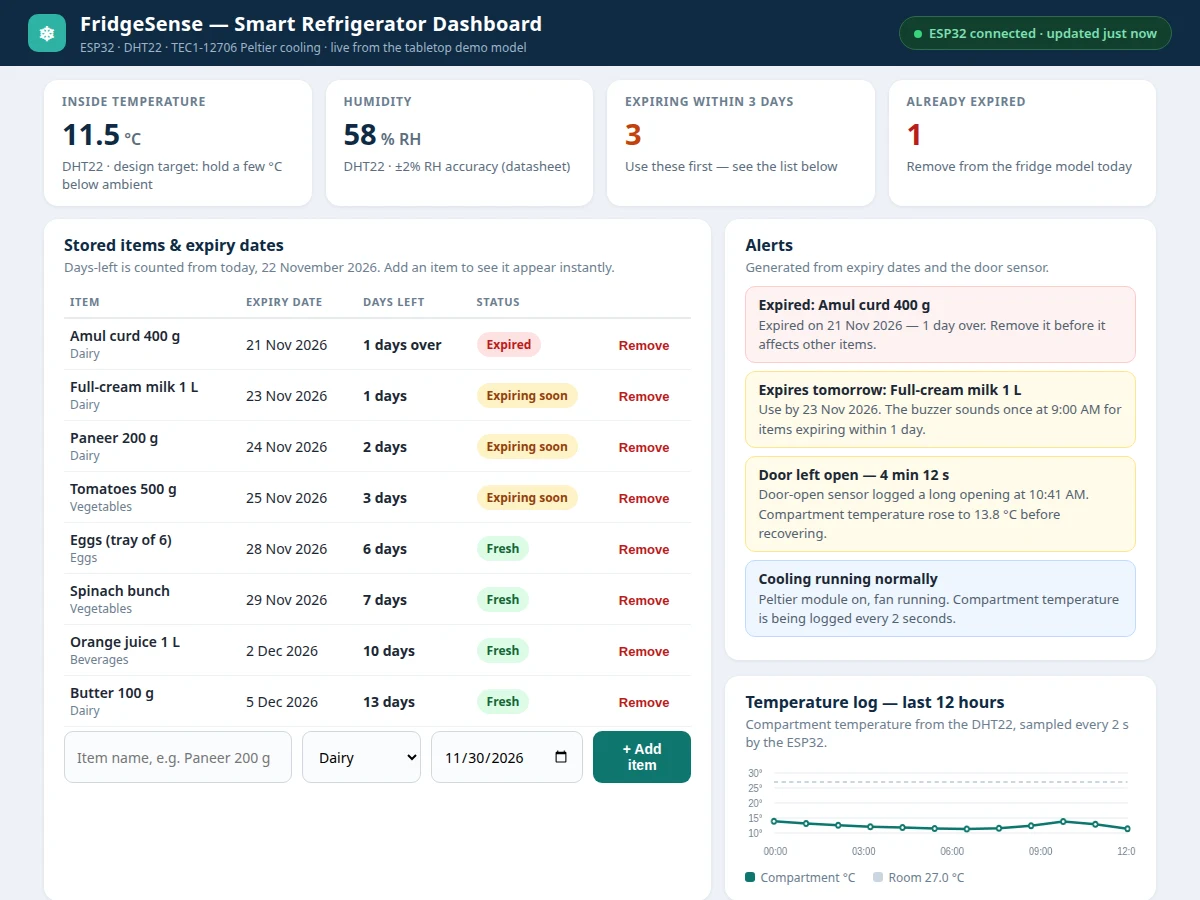
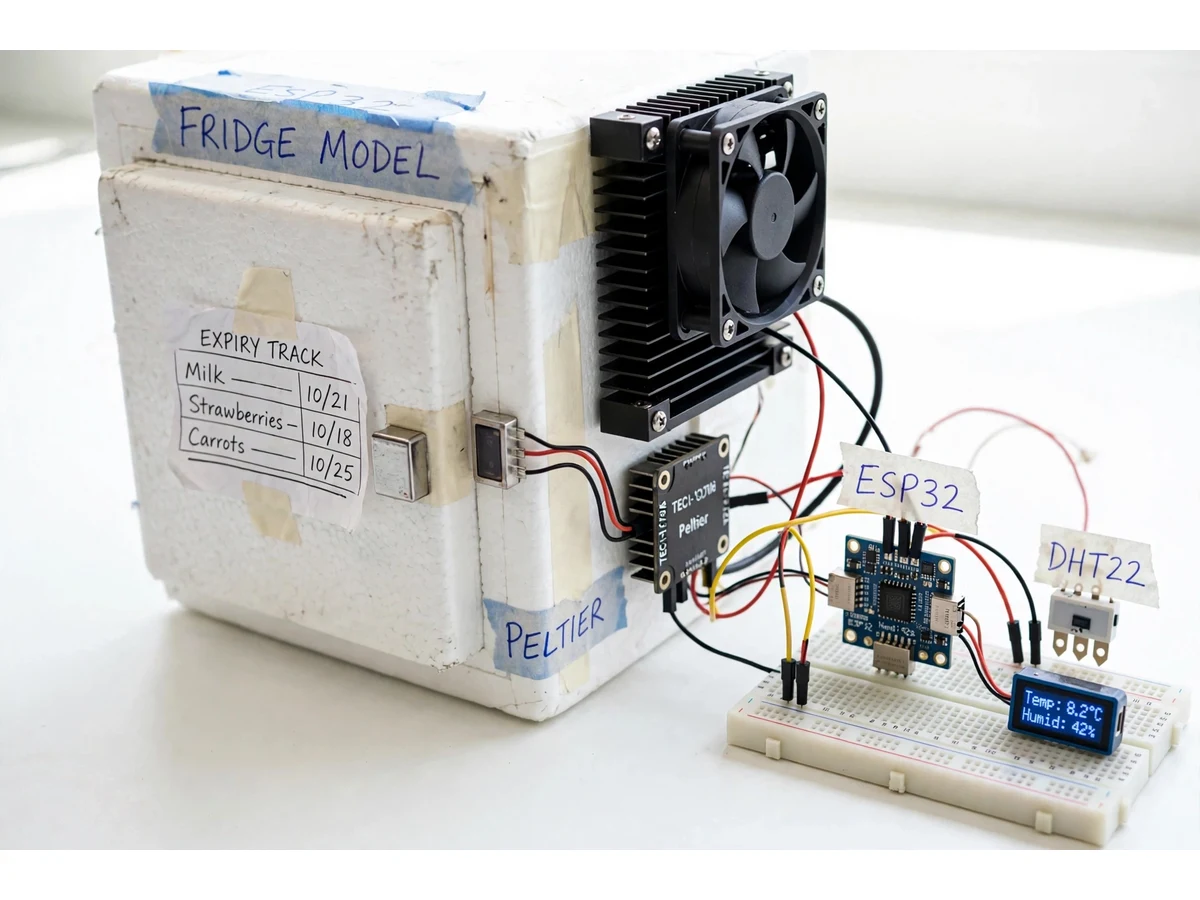
An ESP32-based smart refrigerator with expiry tracking tackles a small, everyday failure of memory: food pushed to the back of a fridge is forgotten until it spoils, and an ordinary fridge gives no warning before that happens. This project builds a tabletop demonstration model of the fix. A small insulated compartment is cooled by a TEC1-12706 Peltier module with a heatsink and fan, while an ESP32 reads compartment temperature and humidity from a DHT22 sensor, watches the door with a magnetic reed switch, and shows live readings on a small OLED display. Every item placed inside is entered in a companion dashboard with its expiry date, and the dashboard counts down the days left for each item and raises an alert as the date approaches. The result is a working demonstration of closed-loop sensing, low-power cooling and a genuinely useful household reminder, built from parts a student can wire on a breadboard in a day.
Enters each stored item and its expiry date in the dashboard.
Follow the working sequence
How it works
The ESP32-based smart refrigerator works as one loop with two halves: a physical cooling loop in the model fridge and a data loop in the companion dashboard. The ESP32 switches the TEC1-12706 Peltier module through a MOSFET driver, and the module pumps heat from the cold face inside the compartment to the hot face outside, where a heatsink and fan dump it into the room. Every 2 seconds the ESP32 reads the DHT22 sensor for compartment temperature and humidity, checks the magnetic reed switch to see whether the door is open, and updates the OLED display. The same readings are served over Wi-Fi to the dashboard, which pairs them with the expiry dates the user entered for each stored item. The dashboard subtracts today's date from each expiry date to show days left, flags items expiring within 3 days, marks expired items in red, and sounds the buzzer once each morning for anything expiring within 1 day.
- The user enters each stored item and its expiry date in the dashboard; the ESP32 stores the list and serves it over Wi-Fi.
- The ESP32 drives the TEC1-12706 Peltier module through a MOSFET driver, pumping heat out of the insulated compartment to the heatsink and fan.
- The DHT22 measures compartment temperature and humidity every 2 seconds (datasheet minimum interval) and the ESP32 updates the OLED display with the latest readings.
- The magnetic reed switch detects each door opening; the ESP32 logs the event and flags openings left open longer than a configured duration.
- The dashboard computes days-left for every item from the current date, sorts the list by nearest expiry, and colour-codes expired, expiring-soon and fresh items.
- Once each morning the buzzer sounds for items expiring within 1 day, and the dashboard keeps a near-expiry alert visible until the item is used or removed.
Tech stack:
- ESP32 DevKit (dual-core, Wi-Fi + Bluetooth)
- TEC1-12706 Peltier module with heatsink and fan
- DHT22 temperature and humidity sensor
- 0.96-inch OLED display (I2C)
- Magnetic reed switch (door-open sensing)
- Arduino IDE with ESP32 core
- HTML, CSS and JavaScript dashboard
- MOSFET driver for the Peltier stage
| Parameter | Value |
|---|---|
| Controller | ESP32 DevKit, dual-core Xtensa LX6 up to 240 MHz (datasheet value) |
| Cooling module | TEC1-12706 Peltier, 40 × 40 × 3.8 mm (datasheet value) |
| Peltier ratings | Vmax 15.4 V, Imax approximately 6 A, Qmax approximately 50–60 W (datasheet values) |
| Temperature/humidity sensor | DHT22: −40 to 80 °C at ±0.5 °C; 0–100% RH at ±2% RH (datasheet values) |
| Sensor read interval | 2 s minimum between DHT22 reads (datasheet value) |
| Display | 0.96-inch OLED, I2C interface |
| Door sensing | Magnetic reed switch on the door frame |
| Compartment | Insulated tabletop model, approximately 5 L internal volume (design target) |
| Cooling performance | Design target: hold the compartment a few degrees below room temperature; no measured cooling figure is claimed |
| Power supply | 12 V DC, 6 A supply for the Peltier stage; 5 V USB for the ESP32 logic |
| Connectivity | Wi-Fi 802.11 b/g/n (ESP32 datasheet value) |
| Dashboard | Single-page web dashboard with item list, days-left countdown and 12-hour temperature log |
| Buzzer | Active buzzer, one morning reminder for items expiring within 1 day |
Project features
The strongest capabilities of this ESP32 smart refrigerator are its live expiry countdown, its Peltier cooling loop, its door-open awareness and its honest, readable instrumentation. The expiry dashboard is the centrepiece: every item carries a date, a days-left count and a colour-coded status, so the nearest expiry is visible at a glance and nothing silently ages out of sight. The cooling loop pairs the TEC1-12706 Peltier module with a heatsink, fan and MOSFET driver under ESP32 control, with the DHT22 reporting temperature and humidity every 2 seconds. A magnetic reed switch logs every door opening and flags openings left too long, because a door left ajar is the fastest way a small cooled compartment warms up. A 0.96-inch OLED display keeps the current temperature and humidity visible on the model itself, even when Wi-Fi is down.
- [Expiry countdown dashboard] Every stored item carries an expiry date; the dashboard shows days-left, sorts items by nearest expiry, and colour-codes expired, expiring-soon and fresh items.
- [Peltier cooling loop] A TEC1-12706 module with heatsink and fan, switched by the ESP32 through a MOSFET driver, cools the insulated compartment. Builder note: the hot-side heatsink and fan are not optional — without them the module's own waste heat flows straight back into the compartment.
- [Live temperature and humidity logging] The DHT22 reports compartment temperature and humidity every 2 seconds, and the dashboard plots the last 12 hours so a warming trend is visible before food is affected.
- [Door-open sensing and alerts] A magnetic reed switch detects each opening; the ESP32 logs the event and the dashboard flags openings left too long.
- [OLED status display] A 0.96-inch OLED on the model shows the current temperature and humidity at a glance, with no phone or Wi-Fi needed.
- [Morning buzzer reminders] A buzzer sounds once each morning for items expiring within 1 day, so the reminder arrives before the day's cooking, not after it.
- [Add and remove items] Items are added with a name, category and expiry date from the dashboard, and removed with one tap when they are used or thrown away.
What is included
- Working tabletop fridge model with Peltier cooling, heatsink, fan and insulated compartment
- ESP32 firmware (cooling control, DHT22 reads, door sensing, OLED display, web dashboard)
- Expiry-tracking dashboard with add/remove items, days-left countdown and alerts
- Circuit and wiring documentation with component list
- Project report PDF (background, Peltier theory, methodology, results, limitations)
- PPT presentation for final review
- Viva Q&A preparation document (Peltier effect, ESP32, sensors, IoT dashboard)
Limitations & prerequisites
- This is a tabletop demonstration model, not a certified food-storage appliance — it must not be used to store real food for consumption decisions.
- Peltier cooling is far weaker than compressor cooling: the design target is a compartment a few degrees below room temperature, and household-fridge temperatures of approximately 3–5 °C are not claimed or expected.
- The DHT22 reads at ±0.5 °C accuracy (datasheet value), so readings are indicative and the sensor is not calibrated against a reference thermometer.
- Expiry dates are typed in by the user; the system counts down to a date but cannot detect spoilage, smell or contamination.
- The dashboard needs Wi-Fi; without a network only the OLED display and buzzer keep working.
- The Peltier stage draws up to approximately 6 A at 12 V and needs a proper 12 V supply — it cannot run from USB power, and the 12 V wiring carries real current.
- Cooling performance depends on room temperature and on the door staying shut; long door openings warm the small compartment quickly.
Frequently Asked Questions
Is this a real refrigerator or a demonstration model?
It is a tabletop demonstration model, not a converted household fridge. A small insulated compartment is cooled by a TEC1-12706 Peltier module, which is strong enough to demonstrate thermoelectric cooling and hold the compartment a few degrees below room temperature, but it cannot match a compressor fridge. The model is built for a college demonstration and viva, not for storing real food.
How does the expiry tracking work?
You type each item's name, category and expiry date into the dashboard, and the ESP32 counts down the days left from the current date. Items are sorted by nearest expiry and colour-coded as fresh, expiring soon (within 3 days) or expired, and a buzzer sounds once each morning for anything expiring within 1 day. The system tracks dates you enter; it cannot detect spoilage on its own.
Which controller and sensors are used?
An ESP32 DevKit is the controller, chosen for its built-in Wi-Fi and dual-core 240 MHz processor. A DHT22 measures compartment temperature (from −40 to 80 °C at ±0.5 °C) and humidity (0–100% RH at ±2% RH), a magnetic reed switch detects door openings, and a 0.96-inch OLED shows live readings on the model itself.
Does it work without Wi-Fi?
Partly. The cooling loop, DHT22 readings, OLED display and buzzer all run on the ESP32 itself and keep working without a network. The dashboard — the item list, days-left countdown and temperature log — is served over Wi-Fi, so it is only reachable while the ESP32 is connected to a network.
Can it keep food cold like a household fridge?
No, and that is stated plainly on this page. The design target is a compartment a few degrees below room temperature, while a household fridge holds approximately 3–5 °C. The Peltier module's datasheet cooling power is approximately 50–60 W at zero temperature difference, far below a compressor, so this model demonstrates the principle rather than replacing a fridge.
Is this project suitable for a final-year project?
Yes — for Electronics, IoT and Embedded Systems programs. It combines thermoelectric cooling, sensor interfacing, ESP32 firmware, a Wi-Fi dashboard and a genuinely useful application, giving the student hardware, embedded code and a web interface to explain in the viva.
Components & software requirements
- ESP32 DevKit (dual-core, Wi-Fi + Bluetooth)
- TEC1-12706 Peltier module with heatsink and fan
- DHT22 temperature and humidity sensor
- 0.96-inch OLED display (I2C)
- Magnetic reed switch (door-open sensing)
- Arduino IDE with ESP32 core
- HTML, CSS and JavaScript dashboard
- MOSFET driver for the Peltier stage
Delivery information
Built-to-order project. Delivery timeline is shared after order confirmation based on current queue.
Support terms
Complete documentation, setup guide, and viva preparation included. Support for setup and explanation provided.
Download free synopsis (PDF)
Enter your name and WhatsApp number — the synopsis PDF downloads immediately. We may send occasional project updates on WhatsApp; no spam.