
More project photos (3)
The problem
People who exercise alone have no coach watching their form: a squat done with knees collapsing inward or a lunge with the torso leaning forward trains the wrong pattern, and the mistake only surfaces as knee pain or a stalled lift later. Fitness trackers count steps and heart rate but say nothing about how a rep was performed, while camera-based form checkers need a phone propped up and good light — and they film the room. Cornell's EchoMotion showed a different route in November 2026: a smartwatch that tracks full-body pose with inaudible ultrasound and no camera at all. This project turns that idea into a student prototype: a wrist-worn ESP32-S3 band that emits 40 kHz chirps, reads the returning echoes and runs a TinyML classifier for six defined exercises, counting reps and flagging form errors. It does not reconstruct full-body pose like EchoMotion — it classifies a fixed set — but it proves the same principle on affordable hardware.
| This student build | EchoMotion (reported figures) | Yoga Pose Estimation and Correction using MediaPipe | |
|---|---|---|---|
| Sensing | Wrist-worn 40 kHz ultrasonic chirps plus echo envelope and MPU6050 IMU · no camera | Smartwatch speaker plus microphone ultrasonic sonar · no camera | Webcam plus MediaPipe BlazePose · 33 body landmarks from video · camera required |
| Pose output | Classifies 6 defined exercises · counts reps · form cues per exercise | Predicts 12 joints · full-body pose vs camera ground truth | Computes joint angles (elbow, knee, hip, shoulder) · compares to reference targets for 3 asanas |
| Accuracy | No accuracy claimed · confusion matrix from the student's own collected data (development target, not measured) | Average error per joint under 4 in (10 cm) · about 2.4 in (6.1 cm) after a one-time 12-minute calibration (reported) | Approximate 2D angles · ±12° acceptance tolerance (design target) · no accuracy claimed |
| Hardware | ESP32-S3 band · 40 kHz transducer pair · INMP441 mic · MPU6050 IMU · 3.7 V LiPo | 3D-printed watch replica with a mic and speaker pair on each side · later an unmodified Samsung Galaxy Watch 6 (reported) | Any laptop webcam · runs in the browser · no wearable hardware |
| Privacy | No camera · no video leaves the wrist · echo data only | No camera · acoustic sensing · about 12 mW sensing power, roughly 40x less than a wearable camera (reported) | Films the user · needs camera permission and a clear view |
| Power / session | 3.7 V 500 mAh LiPo · session length depends on chirp duty cycle and BLE use (expected, not measured) | A 30-minute session on Galaxy Watch 6 used 5–6% of battery (reported) | Laptop or phone battery · webcam mode needs a one-time CDN model download |
| Exercises | 6 defined: squat, lunge, arm raise, jumping jack, push-up, walking | 18 exercises in training · 10 volunteers · tested on 15 new volunteers (reported) | 3 asanas: Vrikshasana, Virabhadrasana II, Adho Mukha Svanasana |
| Cost | Built-to-order · quotation | Research prototype · not a product | Built-to-order · quotation |
How it works
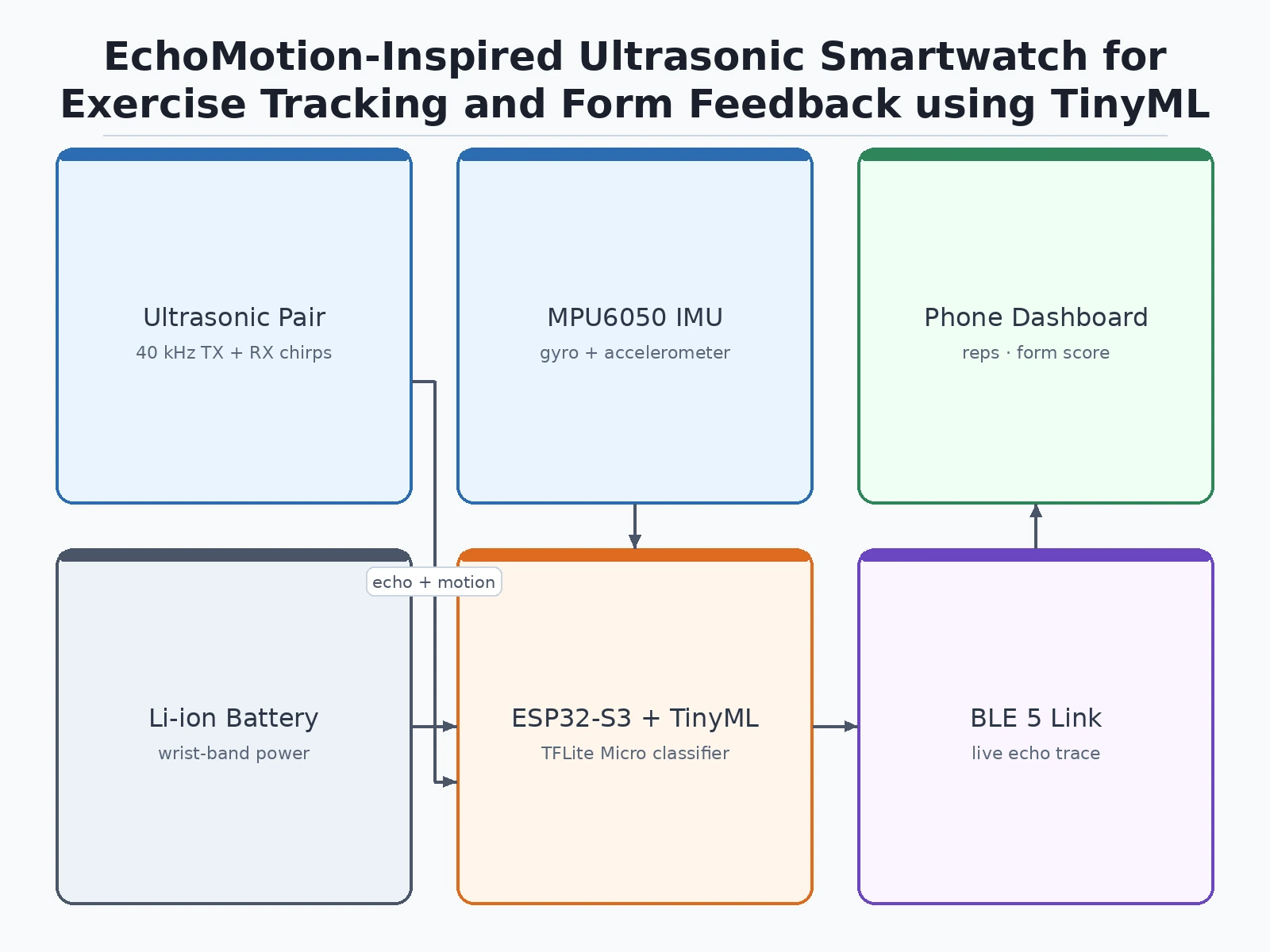
The session starts when the user straps on the band and picks an exercise. The ESP32-S3 fires a short 40 kHz chirp burst from the transmit transducer 25 times a second while the receive transducer and the INMP441 microphone listen for the returning echoes, while the MPU6050 records wrist acceleration and rotation. Sound travels at roughly 343 metres per second, so an echo returning 1 millisecond after the chirp has bounced off a surface about 17 centimetres away — as the arm swings through a squat, the echo peaks shift in time and strength; that shifting pattern is the exercise's acoustic signature. Every second the firmware bundles the echo envelope and motion features into a window, the TinyML model votes for one of the six exercises, and a rep is counted when the sequence completes a full movement cycle. The result travels over BLE to the dashboard, which shows the live rep count, form score and correction cue.
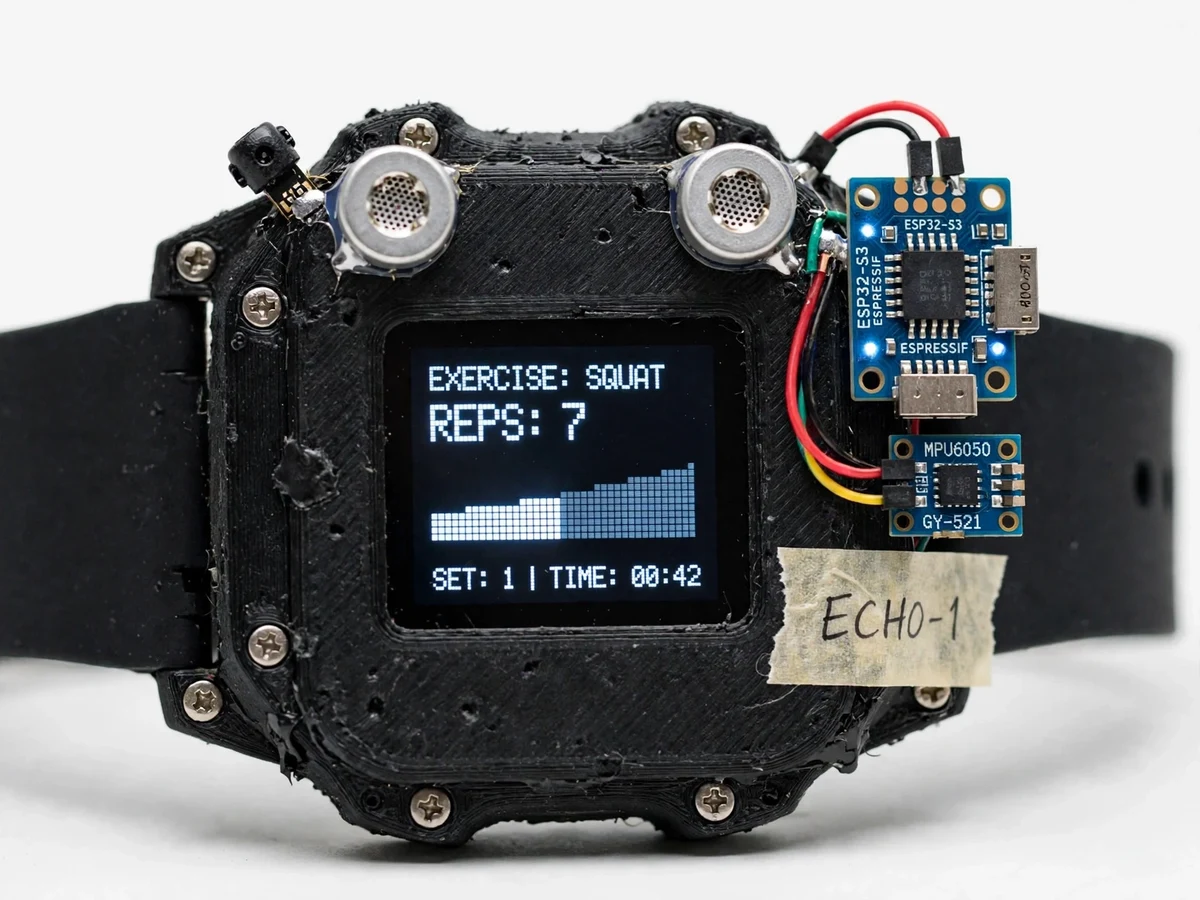
- The builder assembles the band: a 3D-printed watch case holding the ESP32-S3 board, the 40 kHz transmit and receive transducers on opposite edges of the case, the INMP441 microphone module, the MPU6050 IMU, a small OLED display and a 3.7 V LiPo cell, on a plain watch strap.
- The builder wires the sensors: the transducers to the ESP32-S3 with a short twisted pair, the INMP441 over I2S, the MPU6050 over I2C, and the OLED over I2C, then checks each sensor on the bench before the case is closed.
- The builder collects training data: wearing the band, they perform each of the 6 exercises in short recorded sessions, saving the echo-envelope windows and IMU streams with the exercise label, so the dataset is their own recorded movement.
- The builder trains the classifier in Python: echo-envelope and motion features are extracted per one-second window, a compact 1D convolutional model is trained on the labelled windows, and the trained model is converted to TensorFlow Lite Micro and quantised for the ESP32-S3.
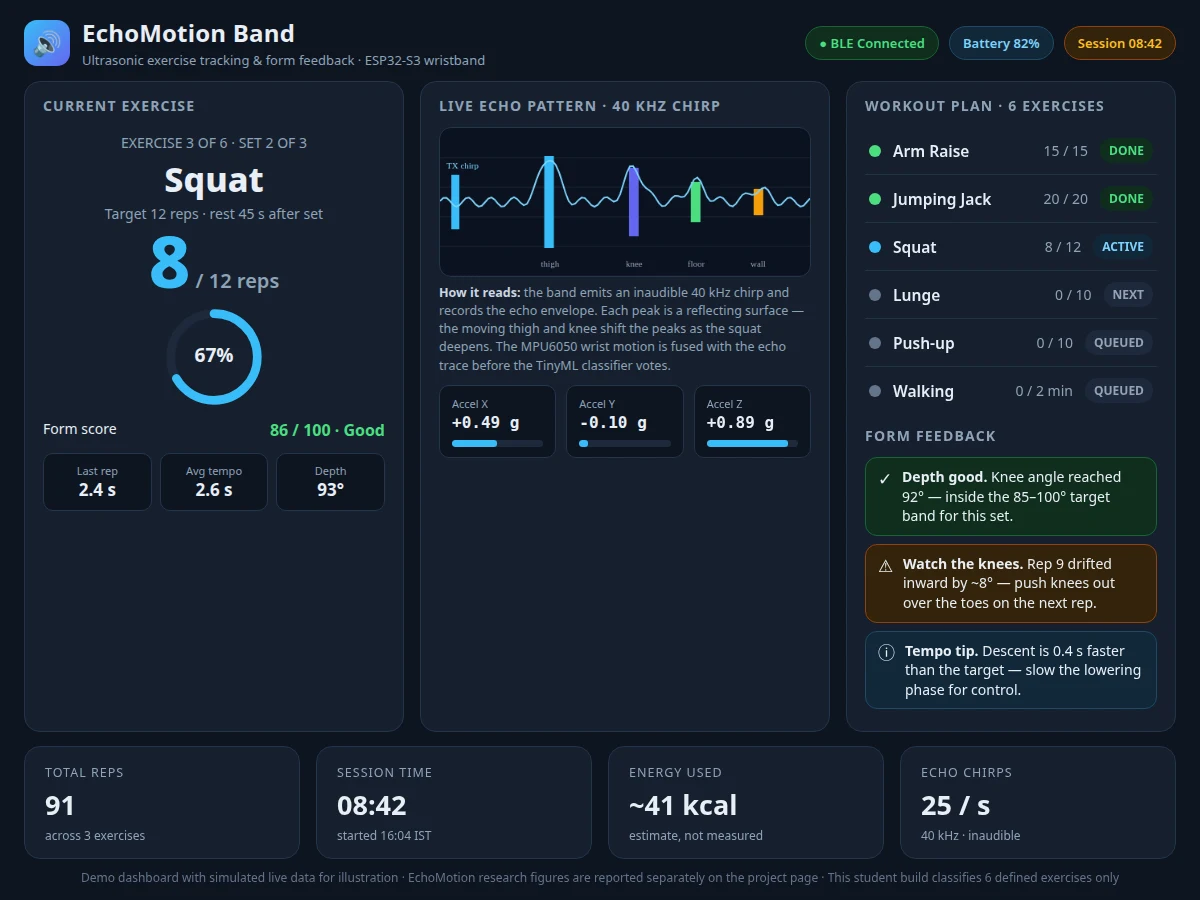
- The builder flashes the firmware and pairs the dashboard: the model runs on the band, the BLE link is opened to the phone, and the dashboard shows the live echo trace, the current exercise prediction and the rep counter.
- The builder runs the per-user calibration: each exercise is performed once in a guided pass so the classifier adapts to the wearer's arm length and movement style, and the calibration is saved on the band.
- The builder runs a test session and records the results honestly: reps counted against reps actually performed for each exercise, which exercises confused the classifier, and where the form cues were right or wrong, reported in the project report with the confusion matrix.
Tech stack:
- ESP32-S3 · dual-core TinyML inference and BLE
- 40 kHz ultrasonic transducer pair · echo sensing
- INMP441 MEMS microphone · I2S echo capture
- MPU6050 IMU · gyro and accelerometer motion
- TensorFlow Lite Micro · on-device exercise classifier
- BLE 5 · phone dashboard link
- HTML · CSS · JavaScript phone dashboard
- Arduino IDE · ESP-IDF firmware tooling
Dataset & model details
- Dataset: Custom collected by the student — echo-envelope windows and IMU streams recorded while wearing the band for the 6 exercises (squat, lunge, arm raise, jumping jack, push-up, walking). No public dataset is used. EchoMotion's training data (10 volunteers, 18 exercises) is the research reference only and is not part of this build.
- Task: 6-class time-series classification; input = one-second window of echo-envelope features plus IMU features; output = exercise label plus rep-phase estimate.
- Model: Compact 1D convolutional classifier converted to TensorFlow Lite Micro and quantised to int8 for the ESP32-S3 (design target). Inference runs on the wrist; no data is sent to a server.
- Metrics: Confusion matrix and per-class precision/recall from the student's own held-out recordings. No accuracy figure is claimed in advance — the report documents the measured figures from the build's own test sessions, and the development target is stated separately in the report.
| Parameter | Value |
|---|---|
| Build type | Hybrid wristband plus phone dashboard (design target) |
| Controller | ESP32-S3 · dual-core Xtensa LX7 up to 240 MHz · 512 KB SRAM · Wi-Fi 802.11 b/g/n · Bluetooth 5 LE (Datasheet value) |
| Sonar | 40 kHz ultrasonic transducer pair · transmit plus receive · chirp burst approximately 25 times per second (design target) |
| Echo microphone | INMP441 · I2S 24-bit · SNR 61 dBA · sensitivity −26 dBFS · flat response 60 Hz–15 kHz (Datasheet value) |
| Motion sensor | MPU6050 · gyro up to ±2000 degrees per second · accelerometer up to ±16 g · I2C up to 400 kHz (Datasheet value) |
| Model | TensorFlow Lite Micro · 6-class 1D convolutional classifier · int8 quantised (design target) |
| Exercises | 6 defined — squat, lunge, arm raise, jumping jack, push-up, walking |
| Link | BLE 5 · phone dashboard within approximately 10 m (design target) |
| Display | On-band OLED · exercise name and rep count · phone dashboard for detail (design target) |
| Battery | 3.7 V 500 mAh LiPo · session length depends on chirp duty cycle and BLE use (expected, not measured) |
| Trend reference | EchoMotion reported figures only: Cornell SciFi Lab · paper "EchoMotion: Towards Full-Body Pose Tracking with a Single Smartwatch Using Active Acoustic Sensing" · Proc. ACM IMWUT · DOI 10.1145/3832001 · presented at UbiComp/ISWC Oct 13 in Shanghai · 10 volunteers doing 18 exercises · 12 joints predicted vs camera ground truth · average error per joint under 4 in (10 cm) on an unmodified Samsung Galaxy Watch 6 with 15 new volunteers · about 2.4 in (6.1 cm) after a one-time 12-minute calibration · same model worked on Galaxy Watch 7 and Pixel Watch 3 without retraining · sensing about 12 mW, roughly 40x less than a wearable camera · a 30-minute session used 5–6% of battery · performance suffered slightly in hallways from echoes off other people · fitness use is rep counting and form correction (e.g. Bulgarian split squat) · never claimed for this build |
| Builder note | Sound travels at roughly 343 m per second at room temperature, so a 1 ms echo delay means the reflecting surface is about 17 cm away — that time-to-distance rule is how the echo envelope becomes a movement signal. The 40 kHz echo is received by the dedicated piezo receive transducer, not the MEMS microphone: the INMP441 datasheet flat response ends at 15 kHz, so the INMP441 serves as the audible-band second channel while the piezo pair carries the sonar. The two transducers sit on opposite edges of the case about 12 mm apart, so the direct transmit-to-receive leak arrives first and is blanked in firmware before the echo window opens. The I2S lines to the INMP441 run as a twisted pair with a 100 nF decoupling capacitor at the microphone supply, keeping the echo capture clean when the chirp driver switches. |
Project features
This band earns its place on a review table because four ideas work together in one build. First, acoustic exercise sensing: the 40 kHz transducer pair sends inaudible chirps and the returning echo envelope changes as the arm and torso move, so the exercise leaves a signature in sound rather than in video. Second, on-device TinyML: a TensorFlow Lite Micro classifier runs on the ESP32-S3 itself, voting on a one-second window of echo and motion features, so no audio or motion data needs to leave the wrist. Third, rep counting with form feedback: the phone dashboard counts completed reps, shows a form score and flags specific errors such as knees drifting inward on a squat, turning raw sensing into coaching a student can demonstrate. Fourth, honest scope: the classifier knows exactly six exercises and says so — it never pretends to reconstruct full-body pose the way Cornell's research system does, and the report documents that boundary plainly.
- [40 kHz ultrasonic echo sensing] The transmit transducer emits short inaudible chirp bursts and the receive transducer records the returning echo envelope, so arm and torso movement shows up as shifting echo peaks without any camera — implemented in the base build.
- [TinyML exercise classification] A TensorFlow Lite Micro model on the ESP32-S3 votes on each one-second window of echo and motion features and names one of 6 defined exercises — squat, lunge, arm raise, jumping jack, push-up, walking — entirely on the wrist — implemented in the base build.
- [Rep counting with set tracking] A rep is counted when the classified window sequence completes a full movement cycle, and the dashboard tracks reps per set and sets per exercise, so a workout has numbers a reviewer can check — implemented in the base build.
- [Form feedback on the phone dashboard] Each rep earns a form score and a plain-language cue — for example, knees drifting inward on a squat or a rushed descent — drawn from the echo and motion features of that rep — implemented in the base build.
- [Wrist IMU motion fusion] The MPU6050 gyro and accelerometer stream wrist motion alongside the echo data, so the classifier sees both the acoustic signature and the physical swing of the arm before it votes — implemented in the base build.
- [BLE phone dashboard with live echo visualisation] The band streams rep counts, form scores and the live echo trace to the phone over Bluetooth Low Energy, so the dashboard shows the sensing working in real time during a demonstration — implemented in the base build.
- [Per-user calibration routine] A short guided pass where the user performs each exercise once lets the classifier adapt to that person's arm length and movement style, the student-scale version of EchoMotion's one-time calibration — implemented in the base build.
- [Privacy by design — no camera] Nothing is filmed and no video leaves the wrist: the only data the band records is an echo envelope and motion numbers, so the project can be demonstrated in a hostel room or a lab without filming anyone — implemented in the base build.
What is included
- Complete wristband (3D-printed watch case, ESP32-S3 board, 40 kHz transducer pair, INMP441 microphone module, MPU6050 IMU, OLED display, 3.7 V 500 mAh LiPo cell, watch strap)
- Firmware (chirp driver, echo capture, IMU fusion, TensorFlow Lite Micro inference, rep counting, BLE link, per-user calibration)
- TinyML training notebook (feature extraction, 1D CNN training, TFLite Micro conversion and quantisation, confusion-matrix evaluation)
- Phone dashboard (single-file HTML/CSS/JS: live echo trace, rep counter, form score, form-feedback panel, 6-exercise plan)
- Setup and calibration guide (sensor checks, data-collection procedure, calibration pass, BLE pairing, quiet-room checklist)
- Project report PDF (EchoMotion background with reported figures labelled as reported, acoustic-sensing design, model design, test-session results, honest measurement limits)
- PPT presentation for final review
- Viva Q&A preparation document (how ultrasonic echo sensing works, why the build classifies 6 exercises instead of reconstructing pose, how TinyML runs on the ESP32-S3, calibration and privacy limits)
Limitations & prerequisites
- Not EchoMotion: this build does not reconstruct arbitrary full-body pose and does not predict 12 joint positions — it classifies 6 defined exercises only, and must never be presented as Cornell's system.
- Needs a reasonably quiet room: echoes off nearby people and walls interfere with the echo envelope — EchoMotion's own paper notes performance suffered slightly in hallways from echoes off other people, and the same applies here.
- Single-wrist sensing: exercises that differ mainly in the legs or the other arm are harder to separate, so the classifier can confuse similar motions, and the confusion matrix in the report shows exactly where.
- Calibration per user: a short guided calibration pass is needed for each new wearer; without it the rep counting and form cues are less reliable, because arm length and movement style change the echo pattern.
- No camera, no video ground truth: form feedback is an acoustic and motion estimate, not a measured joint angle — it must never be presented as clinical biomechanics or a medical assessment.
- Battery and BLE: session length depends on the chirp rate and BLE use and is not a measured figure, and the dashboard needs the phone within BLE range of the band.
- Academic prototype only: the band is a student build, not a certified fitness or medical device, and no health or injury-prevention claim is made for it.
Frequently Asked Questions
Is this project suitable for a final-year project?
Yes, for IoT, Electronics and AI & Machine Learning programmes, because it combines ultrasonic sensing, embedded TinyML, BLE communication and a working dashboard into one testable build, with a clear review thread around how a wristband can recognise exercises without a camera. The report documents the build, the training-data collection, the test sessions and the honest limits, so the project reads as engineering work rather than a copy of a headline.
Is this the EchoMotion smartwatch?
No, this is a student wristband inspired by Cornell's EchoMotion research, not the research system: it classifies 6 defined exercises with a TinyML model on an ESP32-S3, while EchoMotion predicts 12 joints and full-body pose from a smartwatch's speaker and microphone, reporting an average error per joint under 4 inches (10 cm), about 2.4 inches (6.1 cm) after a one-time 12-minute calibration. This build shares no parts, software or performance with the research system.
How does ultrasonic sensing track exercise without a camera?
The band emits inaudible 40 kHz chirps and records the echoes bouncing off the arm and torso: as the body moves through a rep, the echo peaks shift in time and strength, and that shifting pattern is the exercise's acoustic signature. Sound travels at roughly 343 metres per second, so a 1 millisecond echo delay means a surface about 17 centimetres away. The TinyML model reads one-second windows of that echo pattern together with the wrist IMU motion and votes for one of the six exercises.
Why does it only recognise 6 exercises?
Because full-body pose reconstruction needs the research system's trained model, its multi-speaker watch hardware and its 10-volunteer dataset, none of which a student build has. Six defined exercises is the honest scope: each one is recorded by the student, labelled, and tested, so the classifier's confusion matrix is real and the review can discuss exactly which exercises it confuses. Adding a seventh exercise means collecting its data and retraining, which the guide covers.
What accuracy does the model achieve?
No accuracy figure is claimed in advance: the model is trained on the student's own recorded sessions, and the report documents the measured confusion matrix and per-class precision and recall from held-out recordings. EchoMotion's reported figures — under 4 inches per joint, about 2.4 inches after calibration — belong to the research system and are never quoted as this build's results.
What will I receive with the project?
You receive the wristband with the ESP32-S3, ultrasonic transducers, MEMS microphone, IMU, OLED and battery, the firmware with the TinyML classifier and BLE link, the training notebook, the phone dashboard, the setup and calibration guide, the project report, the presentation and the viva Q&A document. A phone with Bluetooth and a reasonably quiet room for the demo are needed, both covered in the setup guide.
Components & software requirements
- ESP32-S3 · dual-core TinyML inference and BLE
- 40 kHz ultrasonic transducer pair · echo sensing
- INMP441 MEMS microphone · I2S echo capture
- MPU6050 IMU · gyro and accelerometer motion
- TensorFlow Lite Micro · on-device exercise classifier
- BLE 5 · phone dashboard link
- HTML · CSS · JavaScript phone dashboard
- Arduino IDE · ESP-IDF firmware tooling
Dataset & model details
- Dataset: Custom collected by the student — echo-envelope windows and IMU streams recorded while wearing the band for the 6 exercises (squat, lunge, arm raise, jumping jack, push-up, walking). No public dataset is used. EchoMotion's training data (10 volunteers, 18 exercises) is the research reference only and is not part of this build.
- Task: 6-class time-series classification; input = one-second window of echo-envelope features plus IMU features; output = exercise label plus rep-phase estimate.
- Model: Compact 1D convolutional classifier converted to TensorFlow Lite Micro and quantised to int8 for the ESP32-S3 (design target). Inference runs on the wrist; no data is sent to a server.
- Metrics: Confusion matrix and per-class precision/recall from the student's own held-out recordings. No accuracy figure is claimed in advance — the report documents the measured figures from the build's own test sessions, and the development target is stated separately in the report.
Delivery information
Built-to-order project. Delivery timeline is shared after order confirmation based on current queue.
Support terms
Complete documentation, setup guide, and viva preparation included. Support for setup and explanation provided.
Download free synopsis (PDF)
Enter your name and WhatsApp number — the synopsis PDF downloads immediately. We may send occasional project updates on WhatsApp; no spam.