
More project photos (2)
The problem
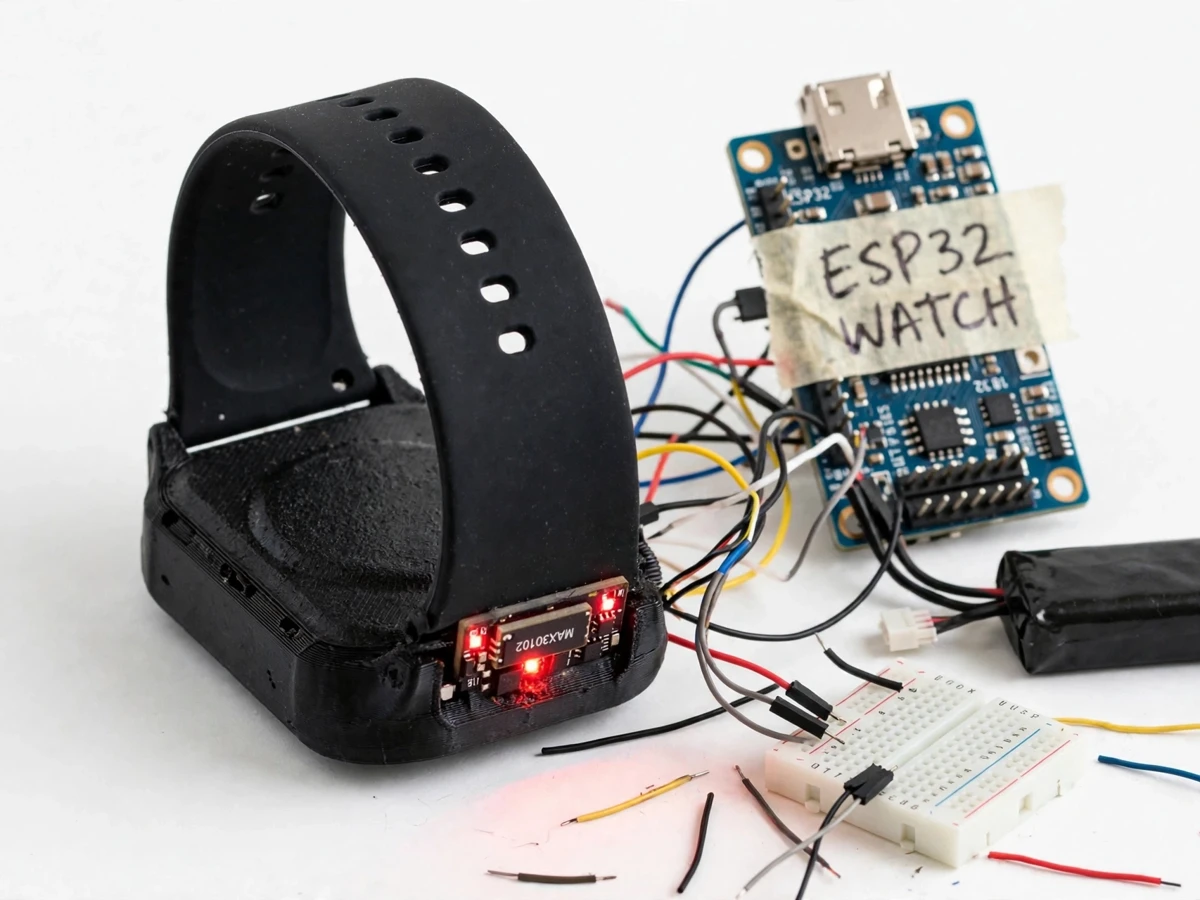
A DIY smartwatch with ESP32, OLED display and heart-rate monitoring is a wrist-worn wearable that tells the time, counts steps, measures heart rate and shows phone notifications on the wearer's wrist, instead of sitting on a desk. Students who want to learn wearable electronics have only two options: buy a finished commercial smartwatch whose internals are sealed and unexplainable, or build a bench-top heart-rate monitor that never leaves the table and teaches nothing about miniaturisation, battery power or wearing a device all day. This project closes that gap by packing an ESP32, a 0.96-inch OLED display, a MAX30102 optical heart-rate sensor and an MPU6050 motion sensor into a 3D-printed watch case with a strap and a rechargeable battery. The result is a working watch the student actually wears: it shows time and date, tracks steps, samples heart rate every two seconds, vibrates for notifications and syncs history to a companion app over Bluetooth Low Energy.
Shines red and infrared light into the wrist and reads the reflection.
Follow the working sequence
How it works
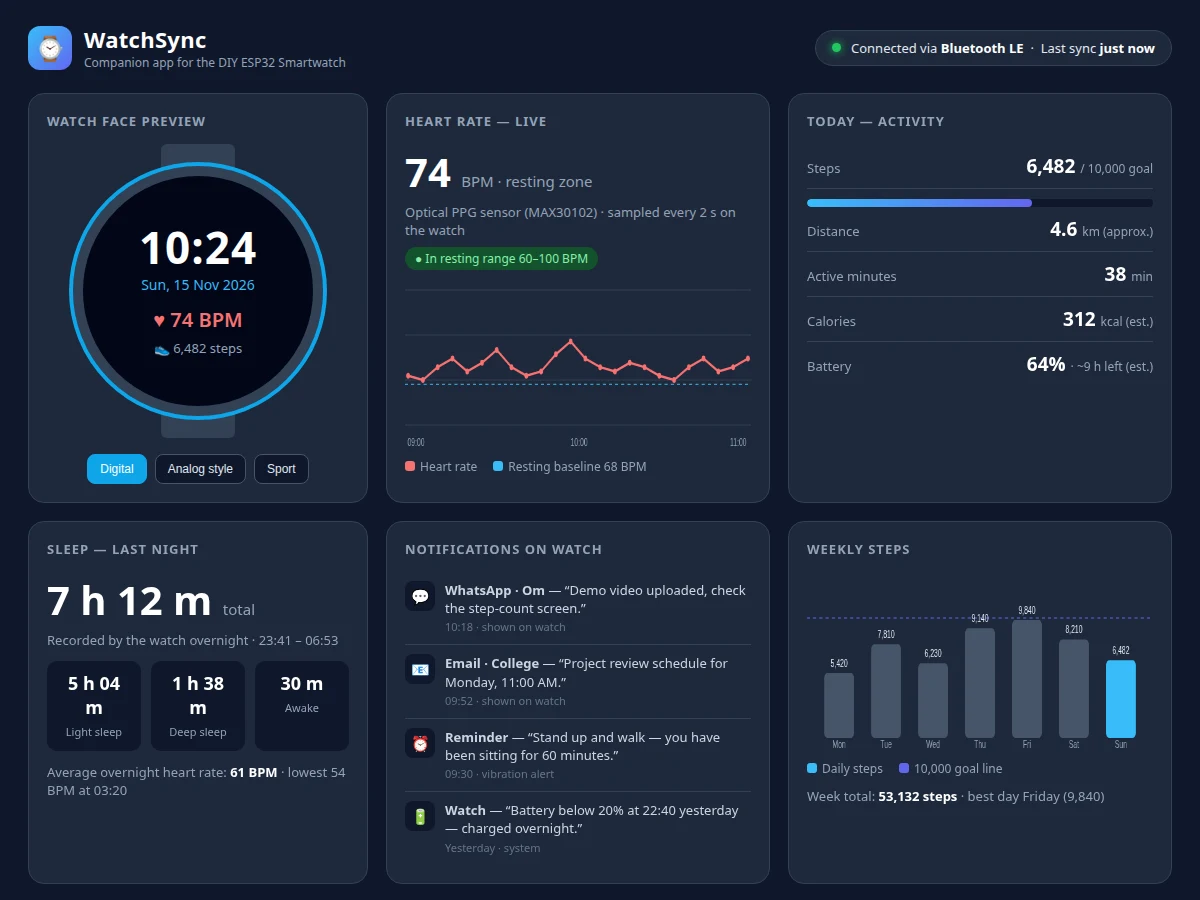
From wrist to phone, the smartwatch works as a continuous loop: sense, process, display, sync. The MAX30102 sensor on the underside of the case shines red (660 nm) and infrared (880 nm) light into the skin of the wrist; with every heartbeat, blood volume in the capillaries rises and falls, changing how much light reflects back to the sensor's photodetector, and the time between successive peaks in that signal is the beat-to-beat interval. The ESP32 reads the sensor over I2C, filters the signal, converts the interval into beats per minute, and updates the OLED watch face every two seconds, while the MPU6050 accelerometer counts steps from wrist movement. When the phone is nearby, the ESP32 sends the stored readings over Bluetooth Low Energy to the companion app, which draws the heart-rate chart, the weekly step bars and the sleep summary, and forwards phone notifications back to the watch for a vibration alert.
- The MAX30102 sensor, pressed against the wrist by the strap, shines red and infrared light into the skin and the photodetector records the reflected signal.
- The ESP32 reads the sensor over I2C, filters the photoplethysmography signal and detects the peak of each heartbeat to compute beats per minute.
- The MPU6050 accelerometer measures wrist movement and the firmware counts steps, accumulating distance and active minutes for the day.
- The ESP32 updates the 0.96-inch OLED watch face every 2 seconds with the current time, date, heart rate and step count.
- Readings are stored in the ESP32's memory through the day, including overnight heart rate and movement for the sleep summary.
- When the phone is in range, the watch syncs over Bluetooth Low Energy and the companion app draws the heart-rate chart, weekly step bars and sleep summary.
- Phone notifications are forwarded to the watch over the same link and shown on the display with a short vibration alert.
Tech stack:
- ESP32 dual-core microcontroller with Wi-Fi and Bluetooth Low Energy
- Arduino IDE with ESP32 core
- MAX30102 optical heart-rate sensor (red 660 nm · IR 880 nm)
- SSD1306 OLED display, 0.96-inch, 128 × 64 pixels
- MPU6050 accelerometer and gyroscope
- Bluetooth Low Energy (BLE) sync
- HTML · CSS · JavaScript companion-app dashboard
- 3.7 V LiPo battery with TP4056 charging module
| Parameter | Value |
|---|---|
| Controller | ESP32 dual-core Xtensa LX6, 240 MHz (datasheet) |
| Display | 0.96-inch SSD1306 OLED, 128 × 64 pixels (datasheet) |
| Heart-rate sensor | MAX30102, red 660 nm + IR 880 nm, I2C address 0x57 (datasheet) |
| Motion sensor | MPU6050, 3-axis accelerometer + 3-axis gyroscope (datasheet) |
| Sensor current | 600 µA typical operating, 0.7 µA standby (datasheet) |
| Sensor LED current | Up to 50 mA per LED, programmable (datasheet) |
| Battery | 3.7 V LiPo, 500 mAh (design target) |
| Runtime | Approximately 12–16 hours per charge (design target, display-on use) |
| Sync range | Approximately 10 m over Bluetooth Low Energy (design target, open space) |
| Watch case | 3D-printed PLA, approximately 45 × 38 × 14 mm (design target) |
| Weight | Approximately 55 g including strap and battery (design target) |
| Heart-rate sampling | Every 2 seconds (implemented) |
| Step goal | 10,000 steps per day (configurable) |
Project features
The smartwatch's strongest capabilities are its always-on wrist display, its optical heart-rate sensing, its step counting and its companion-app sync. The OLED watch face shows time, date, heart rate and steps at a glance, with three switchable face styles, and it stays readable in daylight because the display is emissive rather than backlit. The MAX30102 sensor on the underside of the case shines red and infrared light into the wrist and reads the returning signal to detect each heartbeat, sampling every two seconds while the watch is worn. The MPU6050 accelerometer counts steps and detects movement, and the ESP32 sends the day's heart-rate, step and sleep data to the companion app over Bluetooth Low Energy, where it appears as charts and a weekly summary. Notifications from the phone arrive on the watch with a short vibration, so the wearer can glance at a message without taking the phone out.
- [Wrist-worn OLED watch face] The 0.96-inch OLED shows time, date, heart rate and step count on the wrist, with three switchable face styles (digital, analogue-style, sport) selected from a push button. Implemented.
- [Optical heart-rate monitoring] The MAX30102 sensor on the underside of the case measures heart rate by photoplethysmography, sampling every 2 seconds and updating the watch face and the companion app. Implemented.
- [Step counting and activity tracking] The MPU6050 accelerometer counts steps from wrist movement, with a configurable daily goal (10,000 steps as shipped) and distance estimated from step count. Implemented.
- [Notification display with vibration alert] Phone notifications are forwarded over Bluetooth Low Energy and shown on the watch with a short vibration, so messages can be glanced at without taking the phone out. Implemented.
- [Bluetooth LE sync to companion app] Heart-rate, step and sleep data sync to the companion dashboard, which shows a live heart-rate chart, a weekly step chart, a sleep summary and a watch-face preview. Implemented.
- [Sleep summary] Overnight heart rate and movement are recorded while the watch is worn to bed and summarised in the app as total sleep time with light, deep and awake splits. Implemented.
- [Low-power modes] The display dims after a configurable idle period and the ESP32 drops into light sleep between sensor reads, extending battery life. Configurable.
- [SpO2 display] The MAX30102 also captures the red/infrared ratio used for blood-oxygen estimation; an SpO2 readout on the watch face can be added on request. Optional customisation, not in the base build.
What is included
- Working wrist-worn smartwatch prototype: 3D-printed case, strap, ESP32, OLED display, MAX30102 sensor, MPU6050, vibration motor, battery and charging circuit
- Complete ESP32 firmware source code (Arduino IDE)
- Companion-app dashboard (HTML/CSS/JavaScript) with heart-rate chart, weekly steps, sleep summary and watch-face preview
- Circuit diagram and wiring documentation
- Component list with part numbers
- Setup and charging instructions
- Project abstract PDF
- Demonstration guidance and viva Q&A notes
Limitations & prerequisites
- This is an academic prototype, not a certified medical device: readings are prototype-grade and must not be used for diagnosis, treatment or clinical decisions.
- Heart-rate accuracy depends on a snug strap fit and a still wrist; in the demo build, the sensor only produced a stable trace when the strap held it firmly against the wrist and the wearer stayed still for about 10 seconds.
- Motion artefacts affect readings during walking, running or arm movement; the watch reports a smoothed value, not a clinical measurement.
- Battery runtime of approximately 12–16 hours is a design target, not a measured figure; actual runtime varies with display brightness, sampling rate and Bluetooth use.
- The watch is not water resistant; the 3D-printed case is not sealed against rain or sweat ingress.
- Bluetooth sync needs the phone within approximately 10 m; notifications stop when the phone is out of range or Bluetooth is off.
- Step counting estimates distance from step count and an assumed stride length, so distance is approximate.
Frequently Asked Questions
How is this different from a bench-top heart-rate monitor?
It is a different device in form and use: this is a wrist-worn smartwatch with a strap, a 3D-printed case, a battery and a watch face that shows time, date, steps and heart rate all day, while a bench-top monitor sits on a desk and is used for a few minutes at a time. The smartwatch adds miniaturisation, battery power, step counting, notifications and a companion app for history — none of which a bench monitor teaches.
How accurate is the heart-rate reading?
It is prototype-grade optical sensing, not a medical measurement: the MAX30102 reads the pulse optically from the wrist, and the figure is a smoothed beats-per-minute value updated every 2 seconds, so fit and movement matter — a loose strap or a moving arm degrades the trace. The watch is an academic prototype, not a certified medical device, so readings must never be used for diagnosis or treatment.
Which controller and sensors are used?
An ESP32 runs the watch, chosen because it combines a dual-core 240 MHz processor with built-in Bluetooth Low Energy in one chip, which is what the phone sync needs, while the MAX30102 optical sensor measures heart rate and the MPU6050 accelerometer counts steps. The sensor uses red 660 nm and infrared 880 nm LEDs over I2C address 0x57, and a 0.96-inch SSD1306 OLED shows the watch face.
Does the watch work without the phone?
Yes, the core watch functions work standalone: time, date, heart rate, step counting and the watch face all run on the ESP32 with no phone nearby, and readings are stored on the watch until the phone comes back in range. The phone is only needed for the companion-app history charts, the sleep summary view and receiving notifications, which sync over Bluetooth Low Energy when the phone is in range.
How long does the battery last, and how is it charged?
The design target is approximately 12–16 hours per charge from the 500 mAh 3.7 V LiPo battery, which covers a full day of wear, and the watch charges over USB through the TP4056 charging module, so it can be topped up from any USB port or power bank. That runtime is a design target, not a measured figure — it varies with display brightness, heart-rate sampling rate and how often Bluetooth syncs — and the actual figure for the built unit is measured during the build and recorded in the handover notes.
Is this project suitable for a final-year project?
Yes, for Electronics, IoT & Embedded and Computer Science programs: it demonstrates embedded firmware, I2C sensor interfacing, optical heart-rate sensing, step-counting algorithms, Bluetooth Low Energy communication, battery-powered design and a companion-app dashboard, giving the student a wearable device to demonstrate live during the review. The viva can cover sensor interfacing, power budgeting, wireless sync and the trade-offs of miniaturising a bench design into a wearable.
Components & software requirements
- ESP32 dual-core microcontroller with Wi-Fi and Bluetooth Low Energy
- Arduino IDE with ESP32 core
- MAX30102 optical heart-rate sensor (red 660 nm · IR 880 nm)
- SSD1306 OLED display, 0.96-inch, 128 × 64 pixels
- MPU6050 accelerometer and gyroscope
- Bluetooth Low Energy (BLE) sync
- HTML · CSS · JavaScript companion-app dashboard
- 3.7 V LiPo battery with TP4056 charging module
Delivery information
Built-to-order project. Delivery timeline is shared after order confirmation based on current queue.
Support terms
Complete documentation, setup guide, and viva preparation included. Support for setup and explanation provided.
Download free synopsis (PDF)
Enter your name and WhatsApp number — the synopsis PDF downloads immediately. We may send occasional project updates on WhatsApp; no spam.