
More project photos (2)

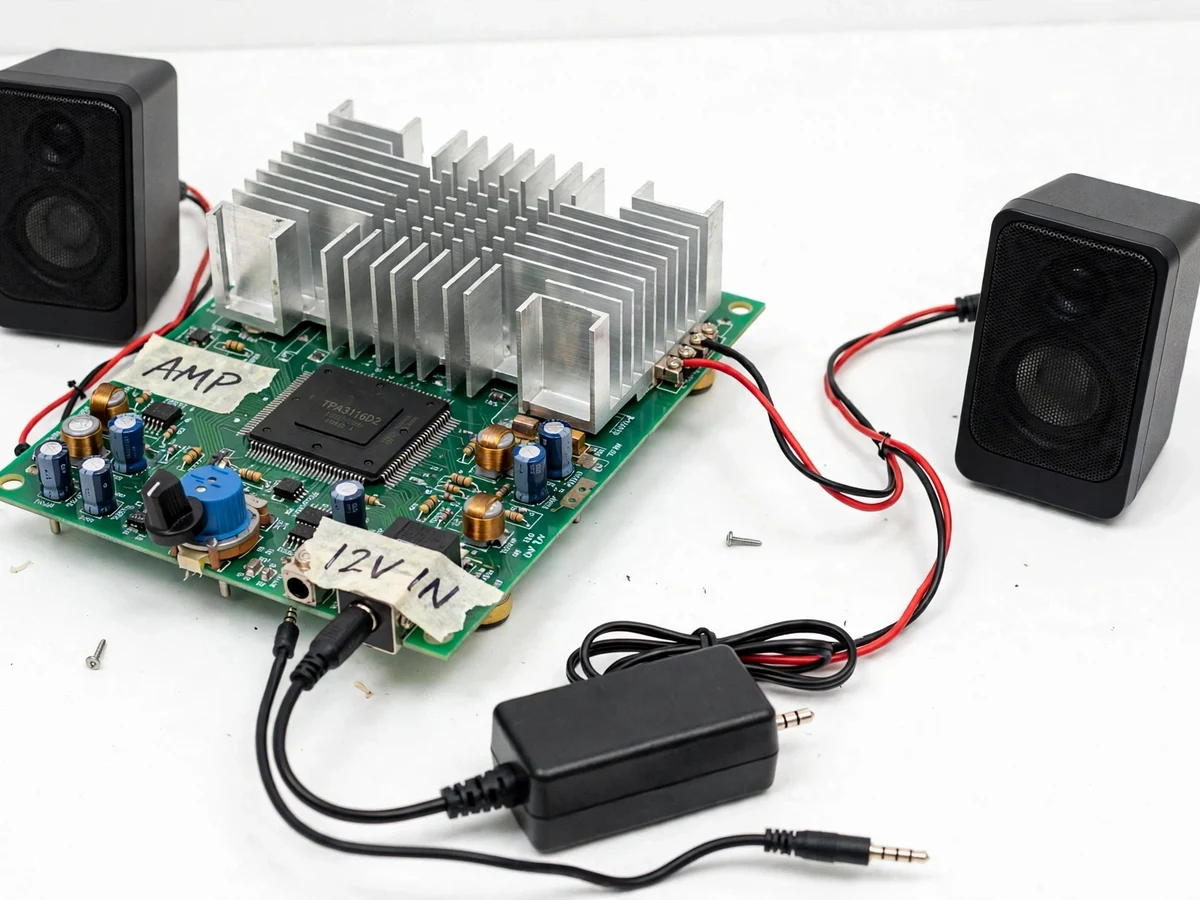
The problem
A phone or laptop can play music, but its headphone output cannot drive a pair of bookshelf speakers to room-filling volume. That gap is where amplifier design lives: a small signal must be raised to tens of watts without wasting most of the power as heat or distorting the sound beyond recognition. This build answers that gap with a single-chip stereo Class-D amplifier that students can assemble, wire, and test on a bench. The TPA3116D2 board accepts a standard line input, provides a volume control, and drives two speakers from a DC supply. Because every stage — input, switching, filtering, output, and thermal path — is visible on the board, the build doubles as a teaching rig: each measurement, from supply current to output waveform, maps directly to a concept in analog electronics and power electronics.
This is a built-to-order hardware project: the amplifier board, heatsink, wiring, speakers, and documentation are assembled fresh for you.
Small phone and laptop speakers sound thin because their built-in amplifiers deliver only a few watts and their tiny drivers cannot move enough air for a room. A DIY Class-D audio amplifier using TPA3116D2 answers that gap by taking the same ordinary line-level audio signal and boosting it to tens of watts per channel, enough to drive bookshelf speakers loudly and clearly on a bench. The TPA3116D2 chip does the heavy lifting as a stereo Class-D amplifier: it switches its output transistors fully on and off at high frequency instead of holding them partly on, so very little power is wasted as heat. An LC filter on each output smooths the switching waveform back into audio, a heatsink carries away the remaining heat, and a volume control sets the listening level. The result is a compact, efficient amplifier that students can build, measure, and explain stage by stage, rather than a sealed commercial unit whose working stays hidden inside.
Students who buy a ready-made speaker system never see why Class-D amplifiers run cooler than older linear designs, why an output filter is needed at all, or why supply voltage and speaker impedance set the maximum output power. This build makes each of those questions answerable with a probe, a meter, and a listening test. It also gives a realistic bench project: wiring a power stage correctly, keeping high-current paths short, and checking for hum, hiss, and overheating before calling the build finished.
Phone or laptop sends a low-level stereo signal.
Follow the working sequence
How it works
Audio enters the DIY Class-D audio amplifier using TPA3116D2 as a low-level stereo signal from a phone, laptop, or other player through a 3.5 mm jack, passes through a volume control, and reaches the TPA3116D2 chip. Inside the chip, the audio waveform is converted into a high-frequency pulse-width-modulated signal whose pulse widths follow the shape of the original sound. Output transistors switch fully on and off in step with that signal, producing a powerful switching waveform that carries the audio information at much higher power. An inductor-capacitor filter on each channel removes the high switching frequency and reconstructs a smooth audio waveform. That amplified waveform then drives the left and right speakers, whose cones move in step with the music and produce audible sound in the room. The volume control stays in the signal path throughout, so level changes never disturb the switching or filtering stages.
- The player sends a low-level stereo audio signal through a 3.5 mm cable into the amplifier board input jack.
- The volume potentiometer attenuates the signal to the desired listening level before it reaches the amplifier chip.
- The TPA3116D2 converts each channel's audio into a pulse-width-modulated switching signal at a high switching frequency.
- Output transistors switch fully on and off in step with the modulated signal, delivering power efficiently with little wasted heat.
- An LC filter on each channel removes the switching frequency and reconstructs the amplified audio waveform.
- The filtered waveform drives the left and right speakers through screw terminals and colour-coded wiring.
- The heatsink carries away heat from the chip during playback, and the built-in protection features shut the outputs down on over-temperature or over-current faults.
Tech stack:
- TPA3116D2 Class-D amplifier
- LC output filter
- 12 V DC power supply
- 3.5 mm stereo audio input
- 50 kΩ volume potentiometer
- Aluminium heatsink
- Bookshelf speakers
- Screw-terminal wiring
| Parameter | Value |
|---|---|
| Amplifier chip | TPA3116D2 stereo Class-D amplifier |
| Channels | 2 channels (stereo left and right) |
| Output power | Up to 50 W per channel into a 4 Ω load at 10% THD with a 21 V supply (datasheet value) |
| Mono output | Up to 100 W into a 2 Ω load in mono mode (datasheet value) |
| Supply voltage range | 4.5 V to 26 V DC (datasheet range) |
| Recommended supply | 12 V DC to 24 V DC adapter (design choice) |
| Speaker impedance | 4 Ω to 8 Ω loads |
| Efficiency | Approximately 90% at typical listening levels (datasheet value) |
| Switching frequency | Approximately 400 kHz (datasheet value) |
| Input connector | 3.5 mm stereo jack |
| Volume control | 1 × 50 kΩ logarithmic potentiometer |
| Output filter | LC filter on each channel |
| Protection | Over-temperature, over-current, and under-voltage protection (datasheet features) |
| Heatsink | Finned aluminium heatsink on the amplifier chip |
Project features
The DIY Class-D audio amplifier using TPA3116D2 offers stereo Class-D amplification, a hands-on volume and input stage, effective thermal management, and a power supply sized for real listening levels. Stereo amplification delivers up to 50 W per channel into a 4 Ω load at 10% THD with a 21 V supply according to the datasheet, so ordinary bookshelf speakers play loudly without strain. The volume control and 3.5 mm input accept any standard player, making demonstrations simple and repeatable. A large aluminium heatsink bolted to the amplifier board keeps the chip within safe temperature limits during extended listening, while the LC output filters on both channels recover clean audio from the switching waveform. Together, these capabilities give a complete, demonstrable amplifier: a real input, real power, real heat to manage, and real sound to judge.
- [Stereo Class-D amplification] The TPA3116D2 drives left and right speakers from one chip, with a datasheet output of up to 50 W per channel into a 4 Ω load at 10% THD with a 21 V supply.
- [High-efficiency switching] Output transistors switch fully on and off rather than dissipating power as heat, so the amplifier stays efficient (datasheet efficiency approximately 90% at typical listening levels) and the heatsink stays manageable.
- [Volume and line input] A 50 kΩ logarithmic potentiometer sets the listening level, and a 3.5 mm stereo jack accepts any phone, laptop, or player as the source.
- [LC output filtering] An inductor-capacitor filter on each channel removes the high-frequency switching component and reconstructs smooth audio for the speakers.
- [Thermal management] A finned aluminium heatsink mounted on the amplifier chip spreads heat during extended playback, with ventilation space kept clear around the fins.
- [Clear bench wiring] Colour-coded speaker wiring, labelled power input, and screw terminals keep the high-current paths short, visible, and easy to trace during a demonstration.
- [Built-in protection] The TPA3116D2 includes datasheet over-temperature, over-current, and under-voltage protection features that shut the outputs down rather than letting a fault destroy the chip.
Optional customization (not part of the base build): a Bluetooth receiver module, a tone-control stage, or a wooden enclosure can be added on request. Future scope (not implemented): a subwoofer output, a digital volume display, or battery-powered operation.
What is included
- Assembled TPA3116D2 amplifier board with heatsink fitted
- Pair of bookshelf speakers with speaker wiring
- 12 V DC power adapter with input lead
- Volume control and 3.5 mm input cable
- Circuit diagram and wiring documentation
- Component list with part values
- Setup and testing instructions, including a buyer-run listening and heat check
- Project report PDF (working, measurements procedure, limitations)
- PPT presentation for final review
- Viva Q&A preparation document (Class-D switching, PWM, LC filtering, thermal design)
Limitations & prerequisites
- Output power depends on supply voltage and speaker impedance: a 12 V supply into 8 Ω speakers delivers far less than the 50 W per channel datasheet figure quoted at 24 V into 4 Ω.
- No output power, distortion, or efficiency figure is claimed as measured for this build — datasheet values are labelled as datasheet values, and the buyer-run test procedure documents what the assembled unit actually delivers.
- The amplifier is an academic bench prototype, not a certified commercial audio product; it carries no audio-quality certification.
- Long unshielded input cables can pick up hum and hiss; the input lead supplied is kept short for this reason.
- The heatsink needs free airflow: running the amplifier at high volume inside a closed box without ventilation can trigger thermal protection shutdown.
- The base build has no Bluetooth, tone controls, or remote control; those are optional additions, not included features.
- Very low-impedance loads below 4 Ω per channel in stereo mode can trigger over-current protection and are not recommended.
Frequently Asked Questions
What does the TPA3116D2 amplifier actually do?
The TPA3116D2 amplifier takes a low-level stereo audio signal from a phone or laptop and boosts it to enough power to drive bookshelf speakers loudly in a room. It does this by switching its outputs at high frequency and filtering the result back into smooth audio, which keeps efficiency high and heat low compared with older linear amplifier designs.
How much power does it deliver?
The datasheet output is up to 50 W per channel into a 4 Ω load at 10% THD with a 21 V supply, and lower with a 12 V supply or 8 Ω speakers. No figure is claimed as measured for this build; the documentation includes a buyer-run procedure for checking output level, supply current, and heatsink temperature on the assembled unit.
What power supply and speakers are needed?
A 12 V DC to 24 V DC adapter powers the board, and a pair of 4 Ω to 8 Ω bookshelf speakers connects through the screw terminals. The base build ships with a 12 V DC adapter and a speaker pair, so it plays out of the box; a 24 V supply can be fitted on request for higher output.
Why does a Class-D amplifier need an output filter?
A Class-D amplifier needs an output filter because its output is a high-frequency switching waveform, not audio, and the filter removes that switching frequency. Each channel uses an inductor-capacitor filter that reconstructs the smooth audio waveform, so the speaker receives music rather than switching noise and high-frequency energy.
Can Bluetooth or tone controls be added?
Yes, a Bluetooth receiver module or a tone-control stage can be added as optional customization, priced separately from the base build. The base amplifier as shipped has a wired 3.5 mm input and a single volume control only, so any wireless or tone feature must be requested before assembly.
Is this project suitable for a final-year project?
Yes, this amplifier suits Electronics and Telecommunication programs because it demonstrates Class-D switching, pulse-width modulation, LC filtering, power-supply sizing, and thermal design in one working prototype. It also gives measurable bench work — supply current, output waveform, and temperature checks — that supports a strong technical discussion.
Builder note: during the build, the amplifier hummed until the input cable was shortened and routed away from the power lead, and the heatsink ran noticeably cooler once ventilation space was left clear around its fins. The lesson carried into the documentation: keep signal leads short, keep power leads separate from audio leads, and never test at full volume with the heatsink pressed against a surface.
Components & software requirements
- TPA3116D2 Class-D amplifier
- LC output filter
- 12 V DC power supply
- 3.5 mm stereo audio input
- 50 kΩ volume potentiometer
- Aluminium heatsink
- Bookshelf speakers
- Screw-terminal wiring
Delivery information
Built-to-order project. Delivery timeline is shared after order confirmation based on current queue.
Support terms
Complete documentation, setup guide, and viva preparation included. Support for setup and explanation provided.
Download free synopsis (PDF)
Enter your name and WhatsApp number — the synopsis PDF downloads immediately. We may send occasional project updates on WhatsApp; no spam.