
More project photos (3)
The problem
Voice cloning tools can now synthesize anyone's speech from seconds of audio, and replayed recordings can fool voice authentication — the "is this voice real?" question has become a genuine security problem. Detecting spoofed audio is a well-defined machine-learning task with a respected benchmark: ASVspoof 2019, which packages text-to-speech, voice-conversion and replay attacks into logical-access and physical-access partitions. This project trains a light CNN (LCNN) on LFCC acoustic features to classify utterances as bonafide or spoof, evaluates with the challenge's equal error rate (EER) and tandem detection cost metrics, and delivers an audio-forensics web demo: select a clip, inspect its waveform and mel spectrogram, and get a verdict with the contributing artifact signals explained. The full methodology is documented for the viva.
ASVspoof 2019 utterances spanning neural TTS, voice conversion and replay attacks in train, dev and eval splits.
Follow the working sequence
How it works
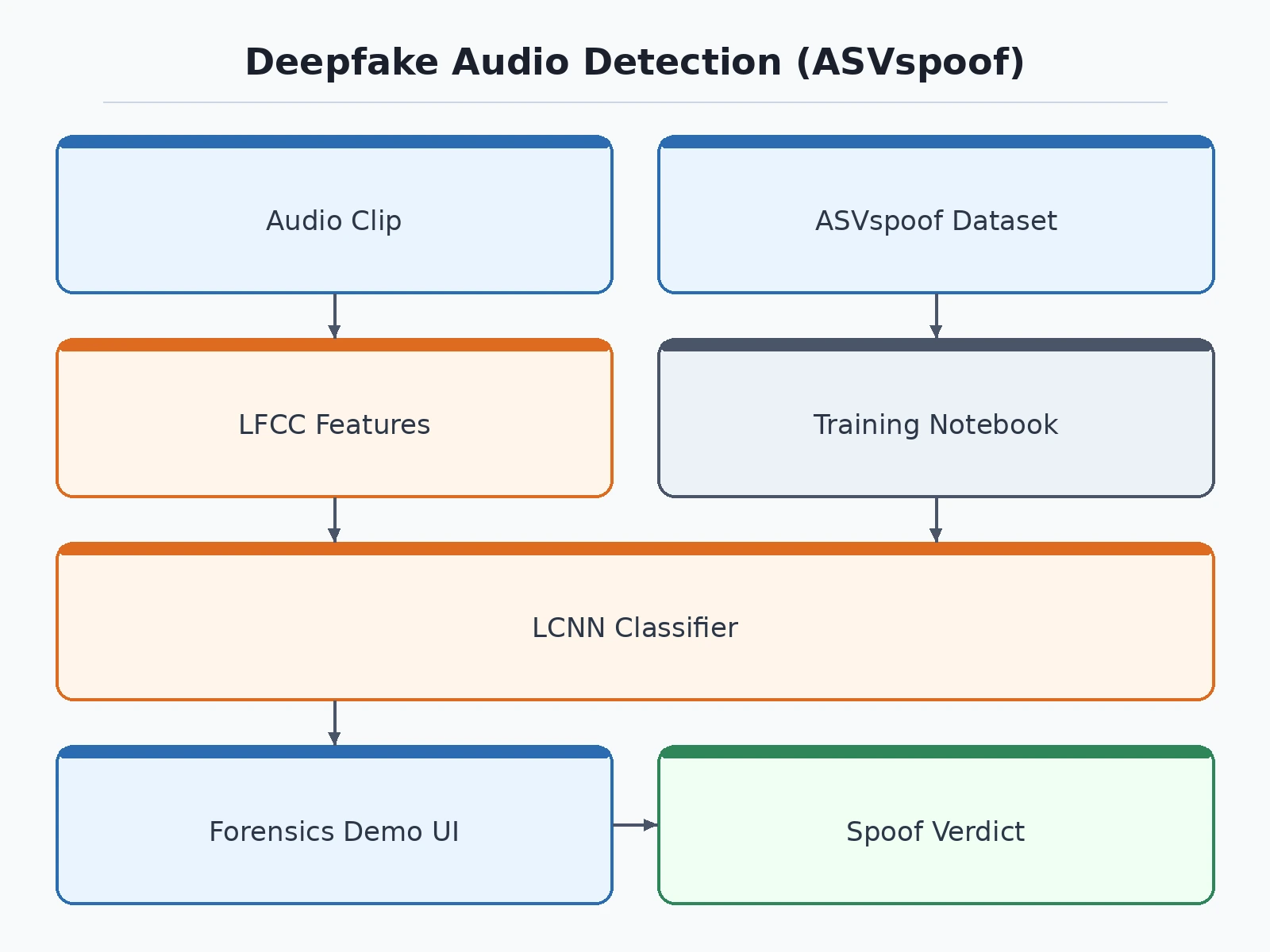
- ASVspoof 2019 utterances (16 kHz) are loaded from the logical-access and physical-access partitions with train/dev/eval splits as defined by the challenge.
- 60-dimensional LFCC features (with delta and double-delta) are extracted per utterance and truncated/padded to a fixed 400-frame window.
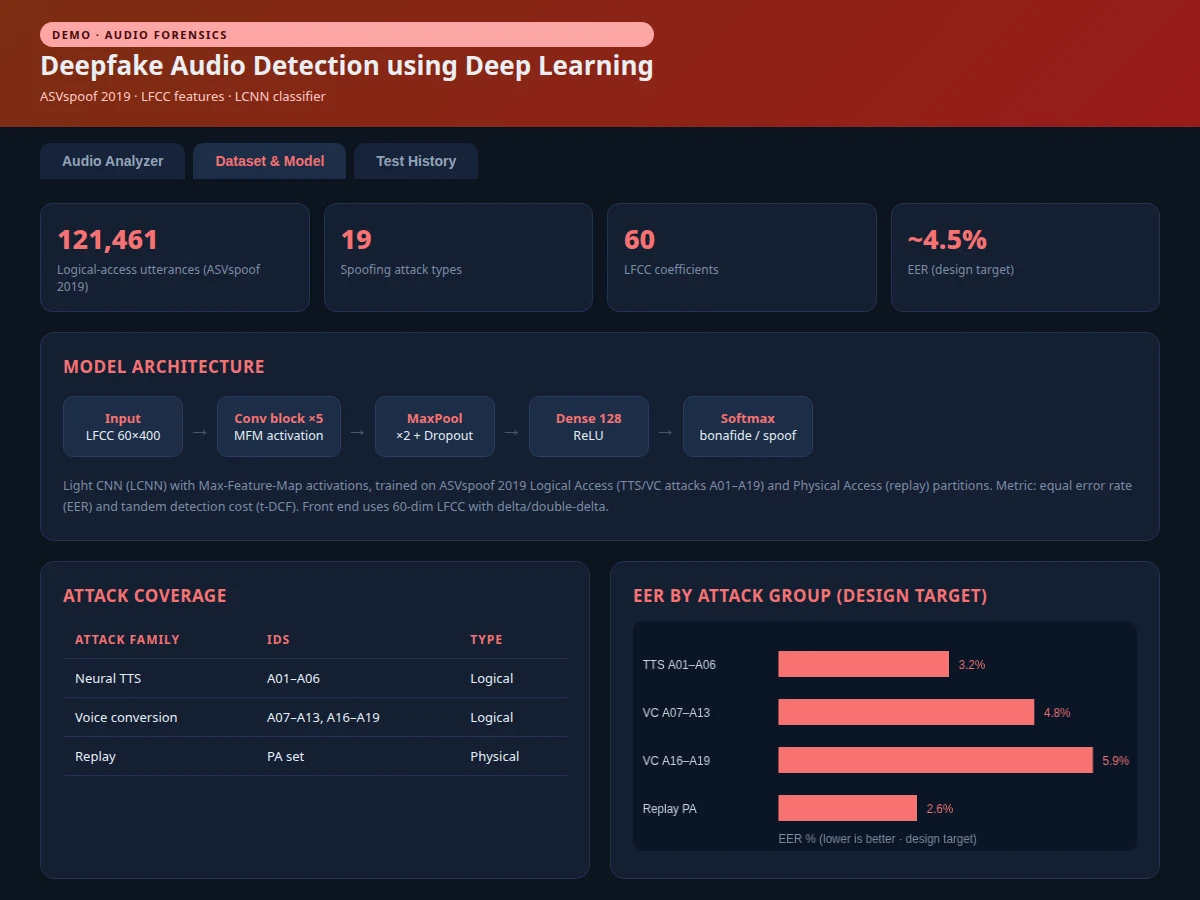
- An LCNN — five conv blocks with Max-Feature-Map activation, max-pooling, dropout, a dense layer and a 2-way softmax — is trained with cross-entropy.
- Development-set scores pick the EER operating threshold; evaluation-set scores are computed once and scored with the official EER and t-DCF routines.
- Per-attack EER is broken down by attack ID (A01–A19, replay) to show which spoof families are hardest.
- In the web demo, a clip's waveform and mel spectrogram are rendered, the feature pipeline runs, and the model returns P(spoof) with the top contributing artifact signals.
Tech stack:
- Python 3, PyTorch
- librosa (LFCC / mel features)
- ASVspoof 2019 dataset
- NumPy, Matplotlib, scikit-learn
- Jupyter Notebook (training & evaluation)
- HTML5 canvas + JavaScript (forensics demo)
Dataset & model details
- Dataset: ASVspoof 2019 — logical access: 121,461 utterances (TTS/VC attacks A01–A19, plus bonafide); physical access: replay attacks. 16 kHz, defined train/dev/eval splits. From the ASVspoof consortium challenge.
- Task: Binary utterance classification; input = 60×400 LFCC feature matrix, output = P(spoof) vs P(bonafide).
- Model: Light CNN (LCNN): 5 conv blocks with Max-Feature-Map activation → max-pool ×2 → dropout → Dense(128, ReLU) → Dense(2, softmax). Approximately 0.5M parameters.
- Metrics: Equal error rate ~4.5% on eval (design target for the built-to-order training run), t-DCF, per-attack EER breakdown. No EER is claimed as measured until the training run is executed for the order.
| Parameter | Value |
|---|---|
| Input format | 16 kHz mono utterance, 60×400 LFCC |
| Classes | 2 (bonafide, spoof) |
| Attack coverage | 19 spoof attack types + replay |
| Model parameters | Approximately 0.5M (design target) |
| Eval EER | ~4.5% (design target, not a measured claim) |
| Feature extraction | Approximately 0.3 s per utterance (expected) |
| Inference | Approximately 15 ms per utterance on CPU (expected) |
| Demo | Web app with waveform + spectrogram canvas rendering |
Project features
- [LCNN spoof classifier] Light CNN with Max-Feature-Map activations on 60-dim LFCC features — the architecture family that performed strongly in the ASVspoof 2019 challenge.
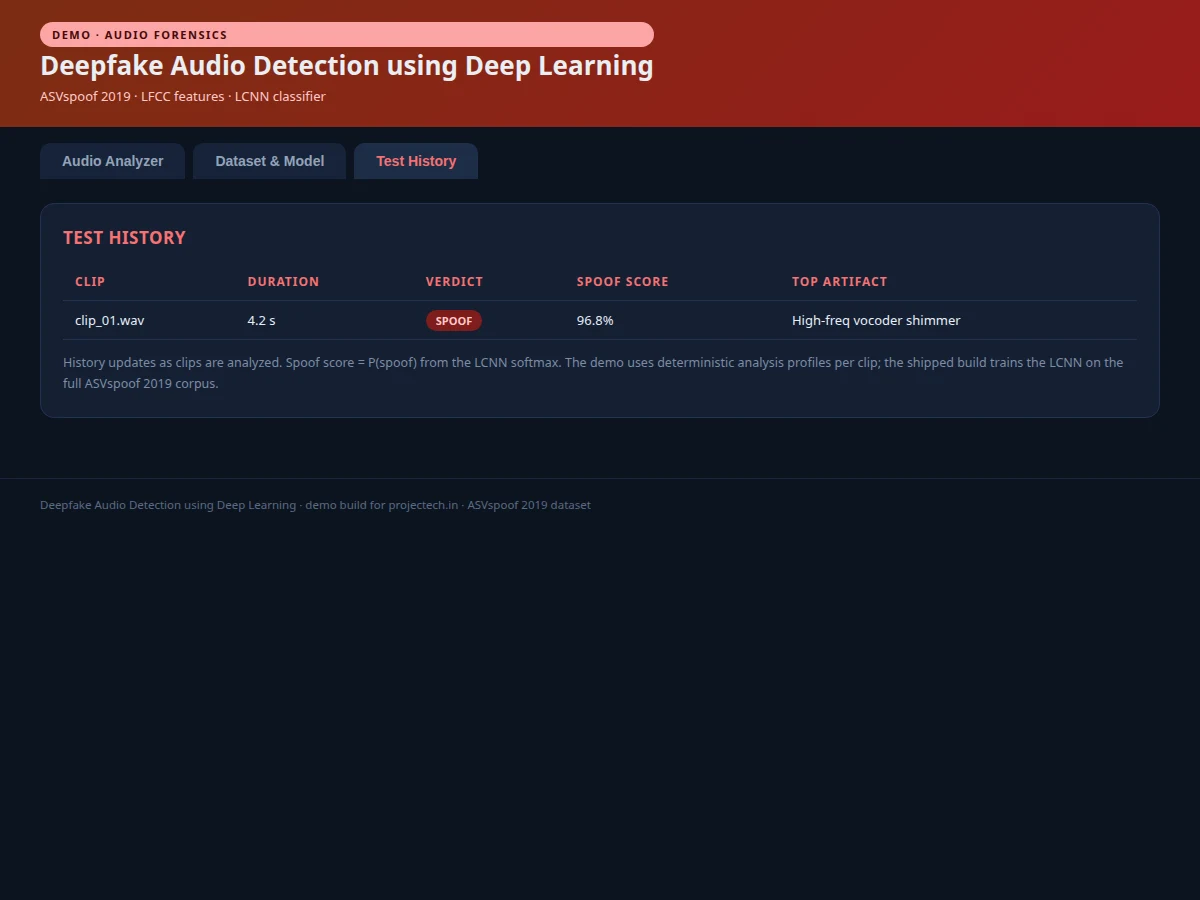
- [Audio forensics demo] Waveform and mel-spectrogram visualization per clip, with a bonafide/spoof verdict and an artifact breakdown (vocoder shimmer, F0 anomalies, replay echo).
- [19 attack types covered] Training spans neural TTS (A01–A06), voice conversion (A07–A13, A16–A19) and replay attacks from both challenge partitions.
- [Challenge-standard evaluation] Equal error rate (EER) and t-DCF computed per the ASVspoof 2019 protocol, not ad-hoc accuracy.
- [Full training notebook] Feature extraction, model definition, training, and EER/t-DCF scoring in one reproducible notebook.
- [Test history log] The demo keeps a scored history of analyzed clips with verdicts and top artifacts.
- [Threshold analysis] Score distributions for bonafide vs spoof with the EER operating point marked.
What is included
- Complete training & evaluation Jupyter notebook
- Trained LCNN model file with LFCC extraction code
- Audio forensics web demo (verdict, artifacts, history)
- EER/t-DCF scoring scripts and per-attack breakdown plots
- Project report PDF (background, spoofing taxonomy, methodology, results)
- PPT presentation for final review
- Viva Q&A preparation document (LFCC, MFM, EER, t-DCF, attack families)
Limitations & prerequisites
- ~4.5% EER is a design target for the training run, stated honestly — the report documents the actual achieved figure.
- Unseen attack families (newer vocoders than 2019) are the hardest case; generalization to them is measured and reported, not assumed.
- Very short utterances (<1 s) carry less discriminative information and score less reliably.
- Heavy compression or noise outside the training distribution degrades performance.
- The system detects spoofing; it does not identify which tool or speaker produced the audio.
Frequently Asked Questions
Which dataset is used and why?
ASVspoof 2019 — the standard benchmark for spoofed-speech detection, with 121,461 logical-access utterances covering 19 TTS/voice-conversion attack types plus a replay partition. Using the challenge's fixed splits makes every result comparable.
What is EER and why not accuracy?
Equal error rate is the operating point where false accepts equal false rejects — the standard spoofing metric, because accuracy hides the security-relevant tradeoff. The project also reports t-DCF, which folds in the cost to a downstream speaker-verification system.
What are LFCC features?
Linear-frequency cepstral coefficients — a spectral representation like MFCCs but with linear (not mel) filter spacing, which the ASVspoof literature found more sensitive to the high-frequency artifacts vocoders leave behind.
How does the demo explain its verdict?
Alongside P(spoof) it lists the top contributing artifact signals — e.g. high-frequency vocoder shimmer or replay echo tails — computed from the feature analysis, so the verdict is inspectable, not a black box.
Can it catch the newest voice-cloning tools?
That is exactly the generalization experiment in the report: attacks held out of training are scored separately, and the numbers are reported honestly, including where they degrade.
Is this project suitable for a final-year project?
Yes — for Computer Science, IT and AI/ML programs. It covers audio signal processing, CNN design, security evaluation methodology and a forensics demo with real-world relevance. Suitable for B.E./B.Tech final-year projects in Computer Science, IT and AI & Machine Learning.
Components & software requirements
- Python 3, PyTorch
- librosa (LFCC / mel features)
- ASVspoof 2019 dataset
- NumPy, Matplotlib, scikit-learn
- Jupyter Notebook (training & evaluation)
- HTML5 canvas + JavaScript (forensics demo)
Dataset & model details
- Dataset: ASVspoof 2019 — logical access: 121,461 utterances (TTS/VC attacks A01–A19, plus bonafide); physical access: replay attacks. 16 kHz, defined train/dev/eval splits. From the ASVspoof consortium challenge.
- Task: Binary utterance classification; input = 60×400 LFCC feature matrix, output = P(spoof) vs P(bonafide).
- Model: Light CNN (LCNN): 5 conv blocks with Max-Feature-Map activation → max-pool ×2 → dropout → Dense(128, ReLU) → Dense(2, softmax). Approximately 0.5M parameters.
- Metrics: Equal error rate ~4.5% on eval (design target for the built-to-order training run), t-DCF, per-attack EER breakdown. No EER is claimed as measured until the training run is executed for the order.
Delivery information
Built-to-order project. Delivery timeline is shared after order confirmation based on current queue.
Support terms
Complete documentation, setup guide, and viva preparation included. Support for setup and explanation provided.
Download free synopsis (PDF)
Enter your name and WhatsApp number — the synopsis PDF downloads immediately. We may send occasional project updates on WhatsApp; no spam.