
More project photos (3)
The problem
Concrete is the world's most used construction material, and its 28-day compressive strength decides whether a structure stands — but testing means casting cubes and waiting weeks. The relationship between mix proportions and strength is non-linear and interactive: more cement helps until it doesn't, water hurts past the workability minimum, and age matters logarithmically. The UCI concrete dataset (1,030 real mixes, I-Cheng Yeh 1998) captures exactly this, and it is the standard regression benchmark in civil-informatics. This project trains an XGBoost regressor on those 8 components with a log-age transform, evaluated by 5-fold CV plus holdout. The mix-designer demo turns the model into a tool: drag the cement slider and watch strength climb, then saturate — the water–cement ratio law, learned from data. Built with standard tools (Python, XGBoost, scikit-learn).
1,030 concrete mixes with eight mix proportions and measured strength in MPa that the regressor learns from.
Follow the working sequence
How it works
- The UCI concrete dataset (1,030 instances; 8 inputs: cement, blast-furnace slag, fly ash, water, superplasticizer, coarse/fine aggregate, age; output MPa) is loaded and checked.
- Age is log-transformed (strength gain is logarithmic); all components are kept in engineering units (kg/m³, days).
- 5-fold cross-validation tunes the XGBoost regressor; a final held-out test set is evaluated once.
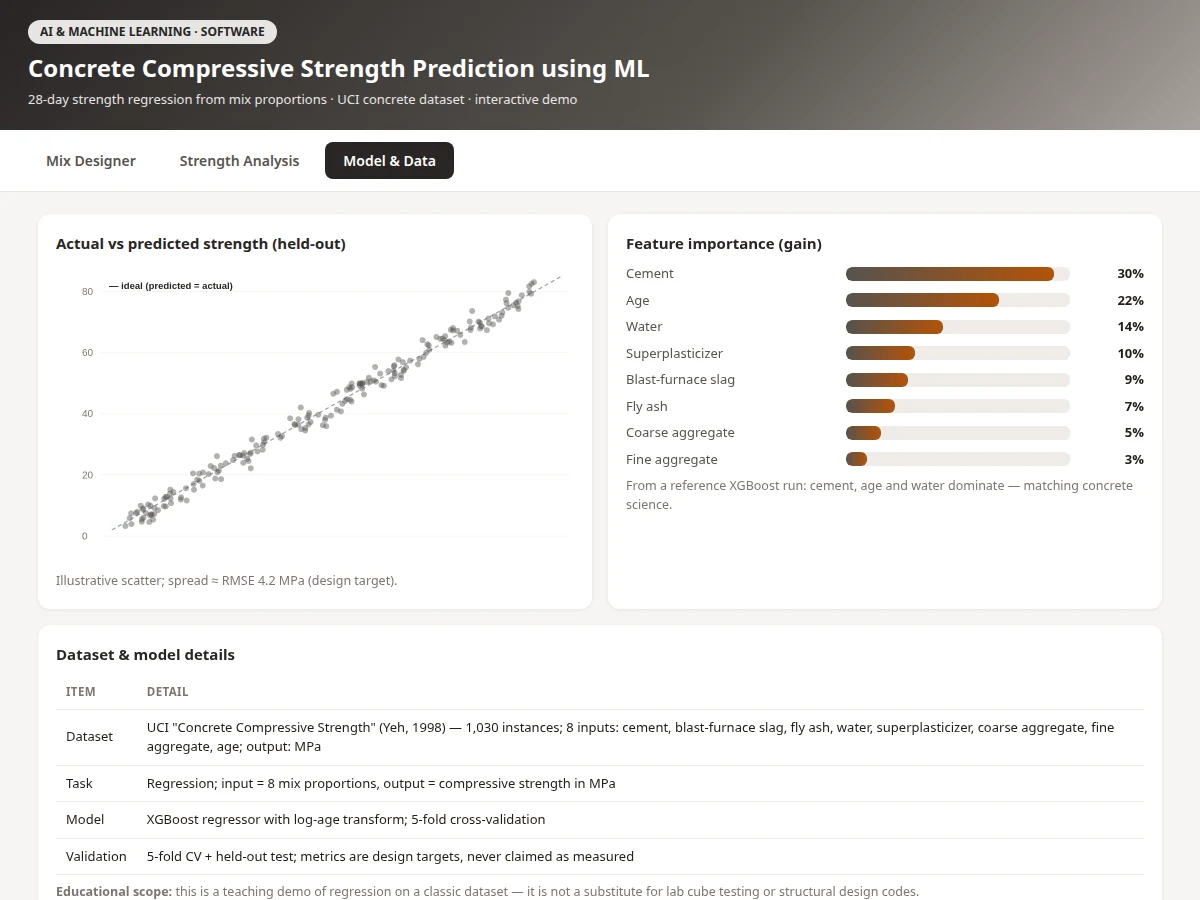
- RMSE 4.2 MPa / R² 0.92 are the design targets; residuals are analyzed against cement content and age.
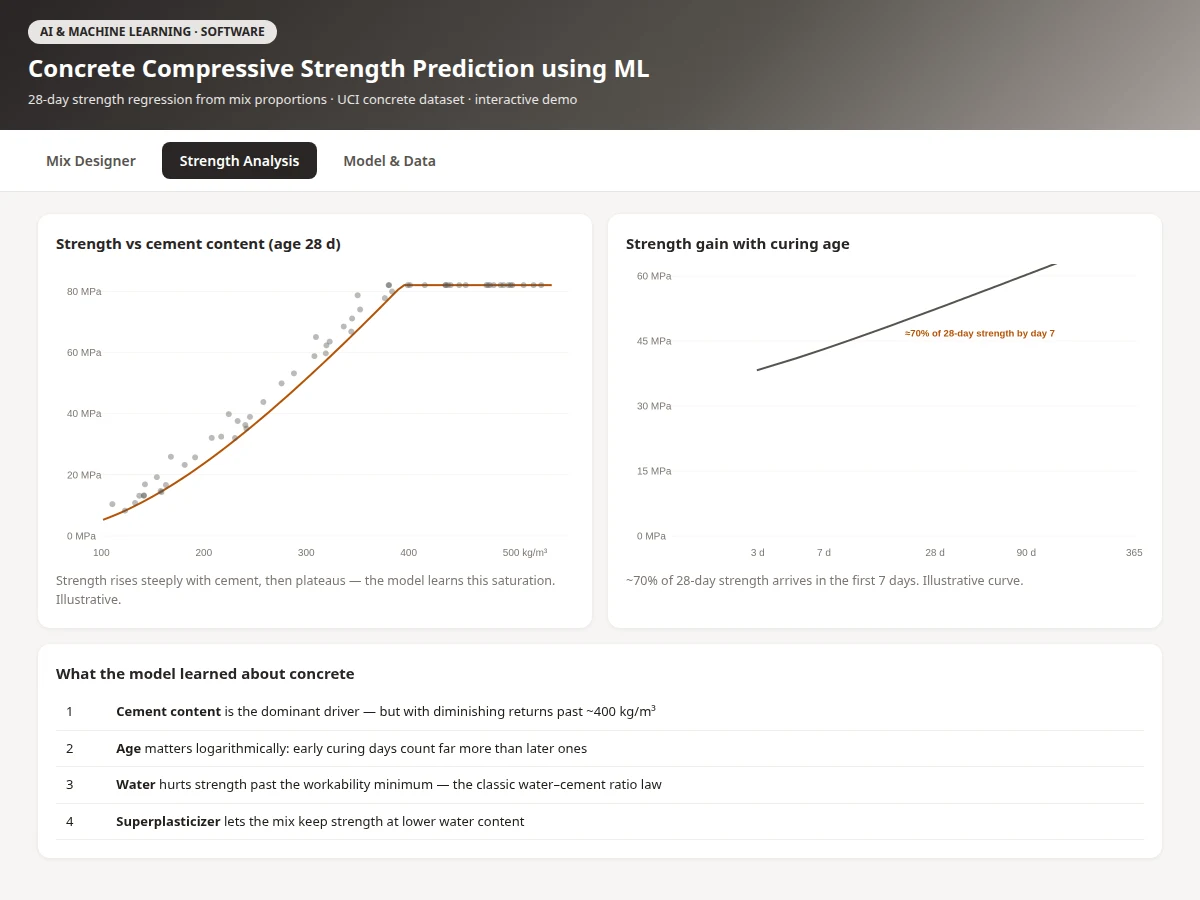
- Partial-dependence style curves (strength vs cement, strength vs age) are generated for the report.
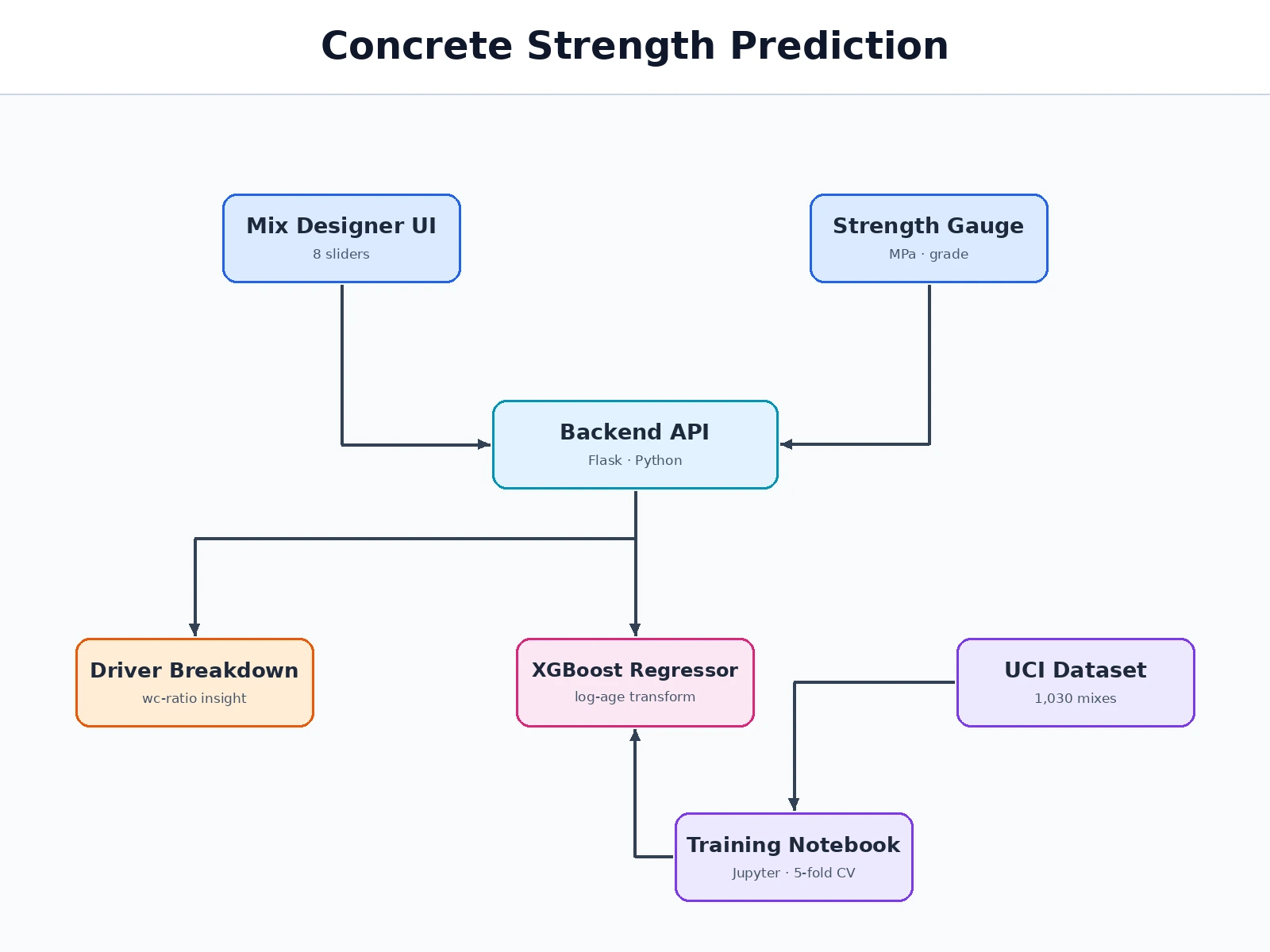
- The web demo loads the saved model behind the mix-designer sliders with live strength, gauge and grade readouts.
Tech stack:
- Python 3, XGBoost
- scikit-learn (CV, metrics)
- NumPy, pandas, Matplotlib
- Jupyter Notebook (training & evaluation)
- HTML/CSS/JavaScript (mix-designer demo)
- UCI concrete compressive strength dataset
Dataset & model details
- Dataset: UCI "Concrete Compressive Strength" (I-Cheng Yeh, 1998) — 1,030 instances; 8 quantitative inputs (cement, blast-furnace slag, fly ash, water, superplasticizer, coarse aggregate, fine aggregate, age in days); output: compressive strength in MPa (range 2.8–82.6).
- Task: Regression; input = 8 mix proportions, output = compressive strength in MPa.
- Model: XGBoost regressor with log-age transform; hyperparameters tuned by 5-fold cross-validation.
- Metrics: RMSE, MAE, R² on 5-fold CV and the held-out test — RMSE 4.2 MPa / R² 0.92 are the design targets for the built-to-order training run, stated honestly and never claimed as measured.
| Parameter | Value |
|---|---|
| Mix records | 1,030 |
| Input features | 8 (kg/m³ components + age in days) |
| RMSE | 4.2 MPa (design target, not a measured claim) |
| R² | 0.92 (design target, not a measured claim) |
| Strength range | 2.8–82.6 MPa |
| Inference | Under 20 ms per mix on CPU (expected) |
| Demo | Single-file web app, runs offline after download |
Project features
- [Mix-designer demo] Eight sliders (cement → age); predicted MPa, gauge and indicative grade update live with driver bars.
- [XGBoost strength regressor] Trained on 1,030 mixes with log-age transform; 5-fold CV + held-out test evaluation.
- [Learned materials science] The demo's curves show cement saturation past ~400 kg/m³ and the logarithmic age effect — textbook behavior, learned from data.
- [Water–cement insight] The driver breakdown surfaces the classic wc-ratio law behind every prediction.
- [Actual-vs-predicted diagnostics] Holdout scatter with RMSE bands, documented in the notebook and report.
- [Feature importance study] Cement, age and water ranked by gain — matching concrete science, a strong viva talking point.
- [Educational-scope framing] The report is explicit: a teaching demo of regression, not a substitute for lab cube testing or design codes.
What is included
- Data pipeline & exploratory mix analyses
- Complete training & evaluation Jupyter notebook (5-fold CV)
- Tuned XGBoost strength regressor with inference code
- Interactive mix-designer web demo with live grade readout
- Strength-vs-cement and strength-vs-age curve analyses
- Project report PDF (materials background, methodology, honest evaluation)
- PPT presentation for final review
- Viva Q&A preparation document (regression, CV, log transforms, feature importance)
Limitations & prerequisites
- RMSE 4.2 MPa / R² 0.92 are design targets for the training run, stated honestly — the report documents the actual achieved figures after training.
- This is an educational regression demo: it does not replace laboratory cube testing, mix certification or structural design codes — the report states this explicitly.
- The dataset covers conventional mixes; ultra-high-performance or geopolymer concretes are outside its range.
- Indicative grades (M25, M45…) in the demo are approximations, not certification.
- Curing conditions (temperature, humidity) are not in the dataset and are not modeled.
Frequently Asked Questions
Which dataset is used?
The UCI concrete compressive strength dataset by I-Cheng Yeh (1998) — 1,030 real concrete mixes with 8 component quantities and measured MPa. The classic benchmark for this task.
What did the model actually learn?
Real materials science: strength rises with cement then saturates, follows the water–cement ratio law, and grows logarithmically with curing age (~70% of 28-day strength by day 7). The feature importances match the textbooks.
Why log-transform the age?
Because strength gain is logarithmic — the difference between day 3 and day 7 dwarfs the difference between day 90 and day 180. The transform lets a linear-ish learner capture that.
Can I use it to design a real building's mix?
No — and the report is explicit. It is a teaching demo of regression. Real structural concrete needs lab testing and code compliance (IS 456 and friends).
How is it evaluated?
5-fold cross-validation for tuning plus one held-out test set for the final numbers — so the reported RMSE reflects genuinely unseen mixes.
Is this project suitable for a final-year project?
Yes — for AI/ML, Computer Science and IT programs (and civil students wanting an AI/ML-angle project). It shows ML learning real engineering laws from data. Suitable for B.E./B.Tech final-year projects in Computer Science, IT and AI & Machine Learning.
Components & software requirements
- Python 3, XGBoost
- scikit-learn (CV, metrics)
- NumPy, pandas, Matplotlib
- Jupyter Notebook (training & evaluation)
- HTML/CSS/JavaScript (mix-designer demo)
- UCI concrete compressive strength dataset
Dataset & model details
- Dataset: UCI "Concrete Compressive Strength" (I-Cheng Yeh, 1998) — 1,030 instances; 8 quantitative inputs (cement, blast-furnace slag, fly ash, water, superplasticizer, coarse aggregate, fine aggregate, age in days); output: compressive strength in MPa (range 2.8–82.6).
- Task: Regression; input = 8 mix proportions, output = compressive strength in MPa.
- Model: XGBoost regressor with log-age transform; hyperparameters tuned by 5-fold cross-validation.
- Metrics: RMSE, MAE, R² on 5-fold CV and the held-out test — RMSE 4.2 MPa / R² 0.92 are the design targets for the built-to-order training run, stated honestly and never claimed as measured.
Delivery information
Built-to-order project. Delivery timeline is shared after order confirmation based on current queue.
Support terms
Complete documentation, setup guide, and viva preparation included. Support for setup and explanation provided.
Download free synopsis (PDF)
Enter your name and WhatsApp number — the synopsis PDF downloads immediately. We may send occasional project updates on WhatsApp; no spam.