
More project photos (1)
The problem
Hydroponic crops depend heavily on maintaining suitable nutrient concentration and pH. Manual testing and chemical dosing can be repetitive, inconsistent and may allow nutrient conditions to move outside the desired range.
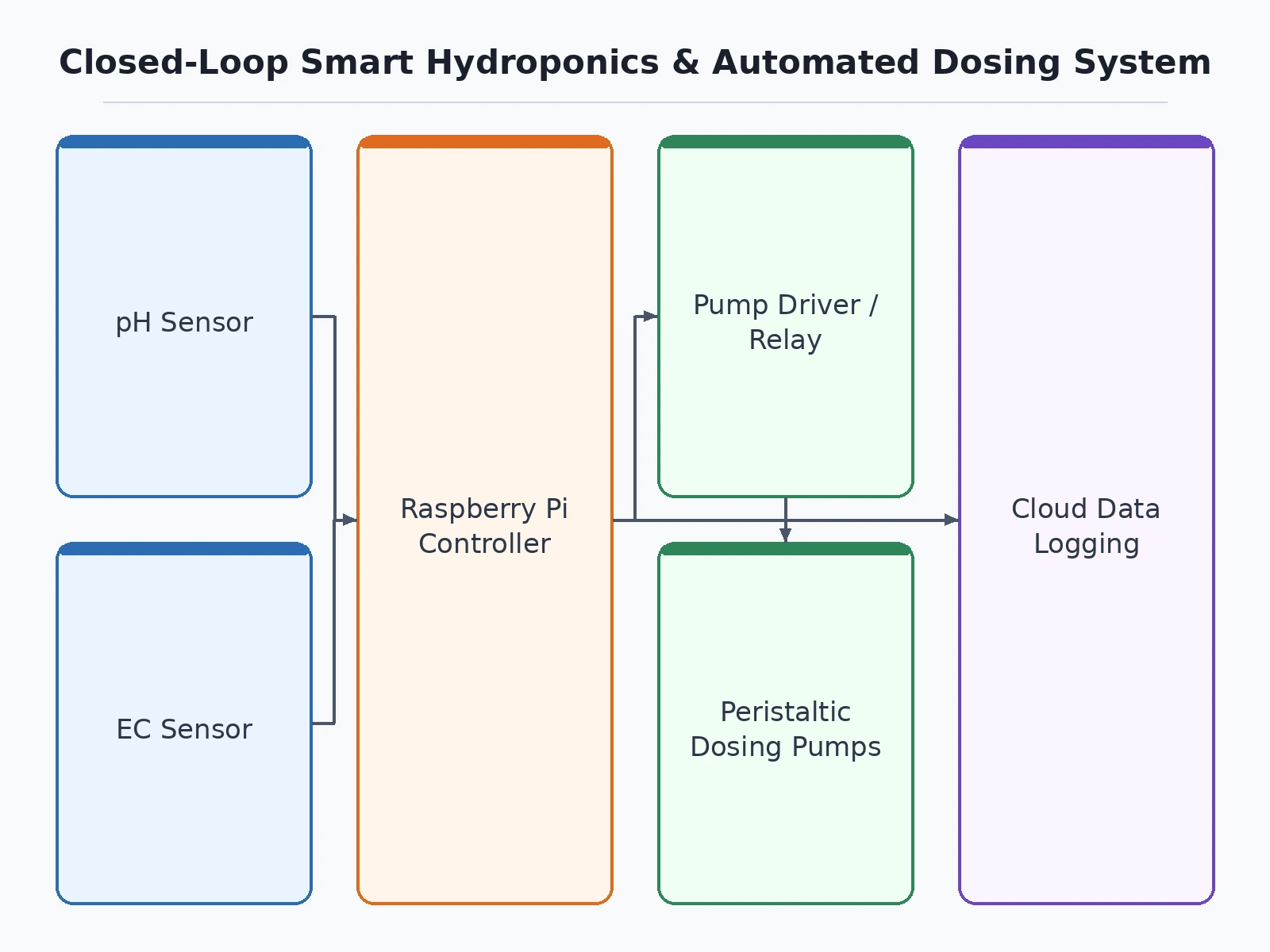
This project demonstrates automatic monitoring and correction of hydroponic nutrient solution using pH and EC sensors with controlled chemical and nutrient dosing.
sensorpH Probe
Continuously measures the acidity or alkalinity of the nutrient solution.
Follow the working sequence
How it works
- The pH probe continuously measures the acidity or alkalinity of the nutrient solution.
- The EC probe measures electrical conductivity, which provides an indication of dissolved nutrient concentration.
- The Raspberry Pi reads both sensor values and compares them with configured target ranges.
- If pH becomes too high, the pH Down pump is activated for a controlled dosing period. If pH becomes too low, the pH Up pump is activated.
- When EC falls below the configured nutrient threshold, the nutrient dosing pump adds a measured quantity of nutrient solution.
- After dosing, the system waits for mixing and takes another reading before deciding whether further correction is necessary.
- This feedback process creates a closed-loop control system that continuously attempts to maintain the configured hydroponic conditions.
Project features
- Real-time pH monitoring of hydroponic nutrient solution
- EC-based nutrient concentration monitoring
- Automatic pH Up and pH Down dosing
- Automated nutrient dosing using peristaltic pumps
- Closed-loop control based on configurable pH and EC setpoints
- Raspberry Pi-based monitoring and dosing control
- Independent control of multiple dosing pumps
- Expandable data logging and remote monitoring capability
What is included
- Source code
- Circuit diagram
- Component list
- Project report
- Abstract PDF
- PPT / presentation
- Installation guide
- Setup support
- Demonstration video
- Sensor calibration and dosing-control documentation
Advantages
- Continuous real-time pH monitoring of the hydroponic nutrient solution.
- EC-based nutrient concentration monitoring.
- Closed-loop automatic dosing — pH Up, pH Down and nutrients — based on configurable setpoints.
- Independent control of multiple dosing pumps using peristaltic pumps.
- Raspberry Pi-based monitoring and dosing control with expandable data logging and remote monitoring.
Disadvantages
- Academic prototype — not a certified commercial agricultural dosing controller.
- pH and EC accuracy depends on probe quality, calibration, temperature and proper sensor placement.
- Incorrectly configured dosing quantities can cause overshoot, so pump flow rates must be calibrated.
- EC alone does not identify individual nutrient concentrations such as nitrogen, phosphorus or potassium.
- Sufficient mixing time is required after each dosing operation before reliable measurements are taken; pumps, tubing and probes need periodic cleaning and maintenance.
Limitations & prerequisites
- This is an academic hydroponics prototype and not a certified commercial agricultural dosing controller.
- pH and EC accuracy depends on probe quality, calibration, temperature and proper sensor placement.
- Incorrectly configured dosing quantities can cause overshoot, so pump flow rates must be calibrated.
- The prototype does not independently identify individual nutrient concentrations such as nitrogen, phosphorus or potassium from EC alone.
- Sufficient mixing time is required after each dosing operation before reliable measurements are taken.
- Pumps, tubing and probes require periodic cleaning and maintenance.
- Hardware components may vary depending on availability.
- Cloud dashboards, mobile applications, additional sensors and advanced automation require separate customisation.
Components & software requirements
- Raspberry Pi
- pH probe with interface module
- EC conductivity probe with interface module
- Three miniature peristaltic dosing pumps
- Pump driver / relay interface
- Dosing bottles, silicone tubing and nutrient reservoir
- Regulated power supply
- Python and Raspberry Pi OS
Download free synopsis (PDF)
Enter your name and WhatsApp number — the synopsis PDF downloads immediately. We may send occasional project updates on WhatsApp; no spam.