
More project photos (2)

The problem
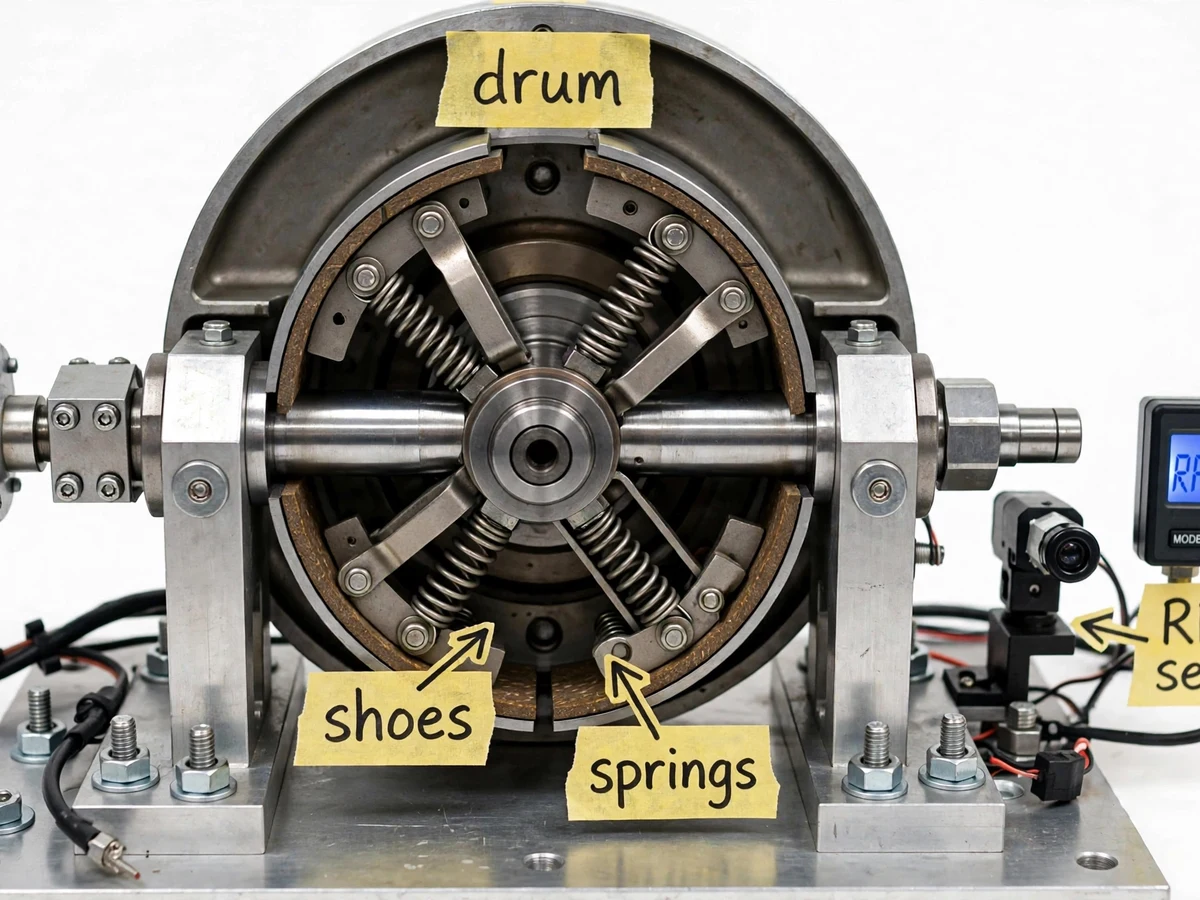
Centrifugal clutches engage automatically with speed — no lever, no pedal — which makes them elegant and, for students, mysterious. The engagement happens inside a closed drum, so the standard textbook diagram of shoes, springs and drum is never seen working; the relationship between spring stiffness and engagement speed stays a formula rather than an observation. This project opens the drum up: the rig exposes the shoe-and-spring assembly on a driven shaft, spins it with a variable-speed DC motor, and displays RPM on a digital tachometer. The student ramps the speed up slowly and notes the RPM where the shoes first kiss the drum (engagement begins) and where drive becomes positive — then repeats the test with different spring sets to see engagement speed move. The measurement is direct, the mechanism is visible, and the spring-force-versus-centrifugal-force balance becomes something the student has watched happen.
How it works
- The speed-controlled DC motor spins the clutch hub carrying the spring-loaded shoes, starting from rest.
- The IR tachometer displays live shaft RPM as the student raises the speed gradually with the controller.
- Centrifugal force on the shoes grows with the square of RPM; at the engagement speed it overcomes spring preload and the shoes move outward to contact the drum.
- The student records the RPM where contact first occurs (shoes kiss the drum) and where the drum begins turning with the hub (positive engagement).
- Speed is then reduced slowly to record the disengagement RPM, showing the hysteresis between engage and release.
- The spring set is swapped for a stiffer/softer set and the ramp test is repeated, demonstrating the spring-rate effect on engagement speed.
- Results are tabulated per spring set and compared with the theoretical force-balance estimate in the report.
Tech stack:
- Exposed centrifugal clutch (shoes, springs, open drum)
- DC motor with speed controller
- Digital tachometer with IR RPM sensor
- Interchangeable coil-spring sets
- Pillow-block ball bearings, steel shaft
- Fabricated steel base frame
- 12 V DC supply, wiring and terminal block
| Parameter | Value |
|---|---|
| Clutch type | Centrifugal, exposed drum (design) |
| Shoes | Multiple spring-loaded friction shoes (design) |
| Spring sets | 2–3 stiffness options for comparison (design) |
| Drive | DC motor with speed controller (design) |
| RPM readout | Digital tachometer, IR sensor, up to 9999 RPM (design) |
| Shaft support | Pillow-block ball bearings (design) |
| Engagement speed | Measured by the student per spring set (not pre-claimed) |
| Supply | 12 V DC |
Project features
- [Exposed clutch drum] The drum is cut open so the friction shoes, pivot links and coil springs are visible during operation — the mechanism students normally only see as a diagram.
- [Live RPM readout] A digital tachometer with IR sensor displays shaft speed continuously (design range up to 9999 RPM) for precise engagement-point detection.
- [Variable-speed drive] A speed-controlled DC motor lets the student ramp RPM gradually up and down to find engagement and disengagement points.
- [Interchangeable spring sets] Multiple coil-spring stiffness options let the student measure how spring rate shifts the engagement speed — the core experiment.
- [Labeled assembly] Handwritten masking-tape labels mark the drum, shoes, springs and RPM sensor for clear demonstration and photography.
- [Engagement test procedure] A student-run worksheet with speed-ramp steps and columns for engagement-begin, full-engagement and disengagement RPM per spring set.
- [Bearing-supported shaft] Pillow-block bearings carry the clutch shaft so the RPM reading reflects clutch behaviour, not shaft wobble.
What is included
- Fabricated centrifugal-clutch test rig (exposed drum, hub, shoes, springs, shaft, bearings, base)
- DC motor with speed controller
- Digital tachometer with IR sensor, wired and mounted
- Interchangeable spring sets
- Engagement-speed test worksheet with blank observation table
- Project report PDF (clutch theory, force balance, spring-rate effect, methodology)
- PPT presentation for final review
- Viva Q&A preparation document (engagement speed, spring preload, hysteresis, applications)
Limitations & prerequisites
- Engagement RPM values are measured by the student on their own build — no engagement speeds are claimed in advance.
- The open drum is for demonstration; the rig is not a sealed, guarded production clutch and must be run with the procedure's safety steps (eye protection, no loose clothing near the shaft).
- Spring sets give comparative, not absolute-calibrated, stiffness steps — rates are identified by the supplier's marking, not lab-calibrated.
- The tachometer reads hub RPM; drum RPM after engagement is inferred, not separately instrumented.
- Prolonged slipping at partial engagement heats the shoes; test ramps are kept short per the procedure.
Frequently Asked Questions
What is engagement speed?
The shaft RPM at which centrifugal force on the shoes overcomes spring preload and the shoes contact the drum. It is the single most important characteristic of a centrifugal clutch, and this rig measures it directly.
Why do engagement and disengagement RPMs differ?
Friction and spring hysteresis: once engaged, the shoes stay out until speed drops below the engagement point. The procedure measures both and the report explains why.
How do the springs change the result?
Stiffer springs need more centrifugal force — hence higher RPM — to engage. Swapping spring sets and re-measuring makes the force-balance equation concrete.
Is it safe with the drum open?
The procedure includes safety steps (eye protection, guards during runs, no loose items near the shaft). The open drum is the point of the rig — the mechanism must be visible.
What will the student actually report?
Engagement-begin, full-engagement and disengagement RPM for each spring set, tabulated and compared with the theoretical estimate — all measured on their own build.
Is this project suitable for a final-year project?
Yes — for Mechanical Engineering programs. It turns clutch theory into a visible, measurable experiment with a genuine variable (spring rate) to investigate. Suitable for B.E./B.Tech final-year projects in Mechanical Engineering.
Components & software requirements
- Exposed centrifugal clutch (shoes, springs, open drum)
- DC motor with speed controller
- Digital tachometer with IR RPM sensor
- Interchangeable coil-spring sets
- Pillow-block ball bearings, steel shaft
- Fabricated steel base frame
- 12 V DC supply, wiring and terminal block
Delivery information
Built-to-order project. Delivery timeline is shared after order confirmation based on current queue.
Support terms
Complete documentation, setup guide, and viva preparation included. Support for setup and explanation provided.