
More project photos (2)
The problem
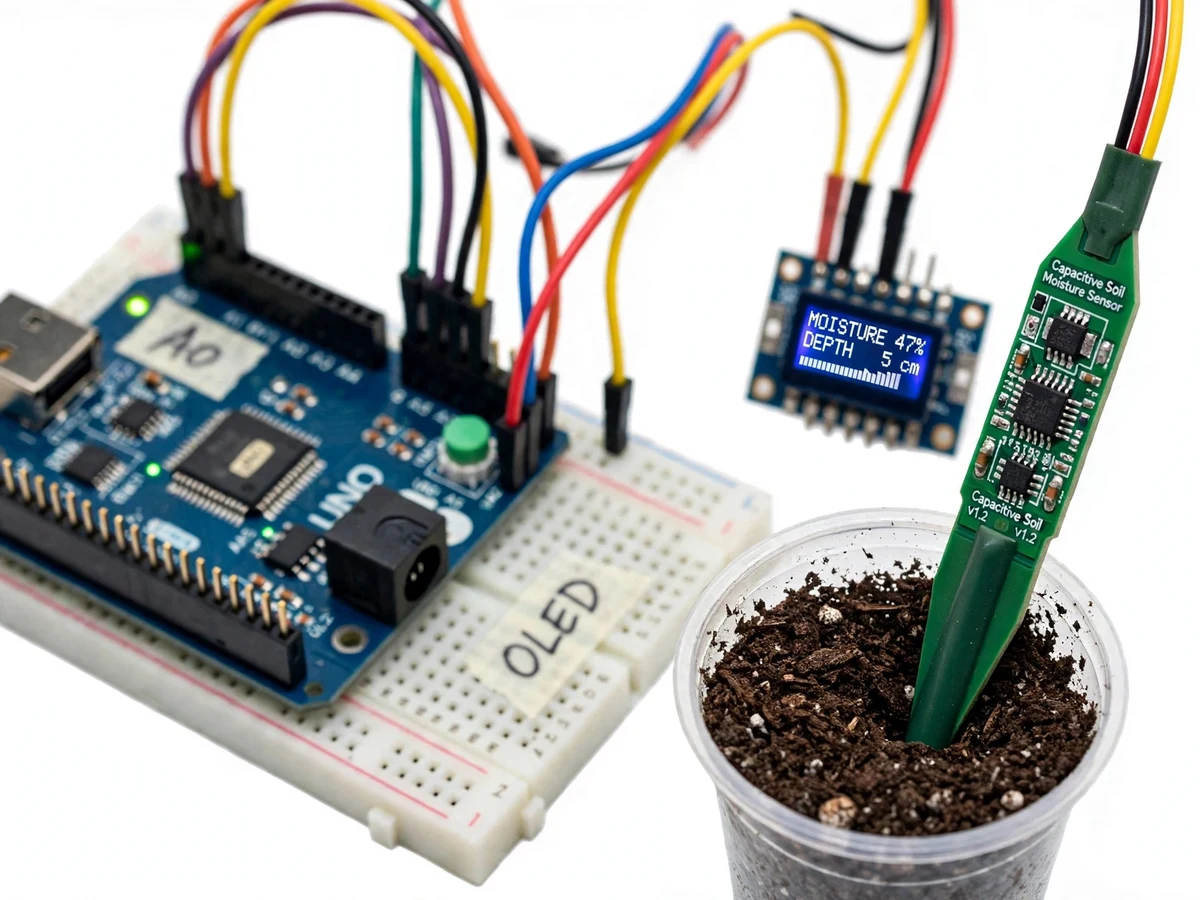
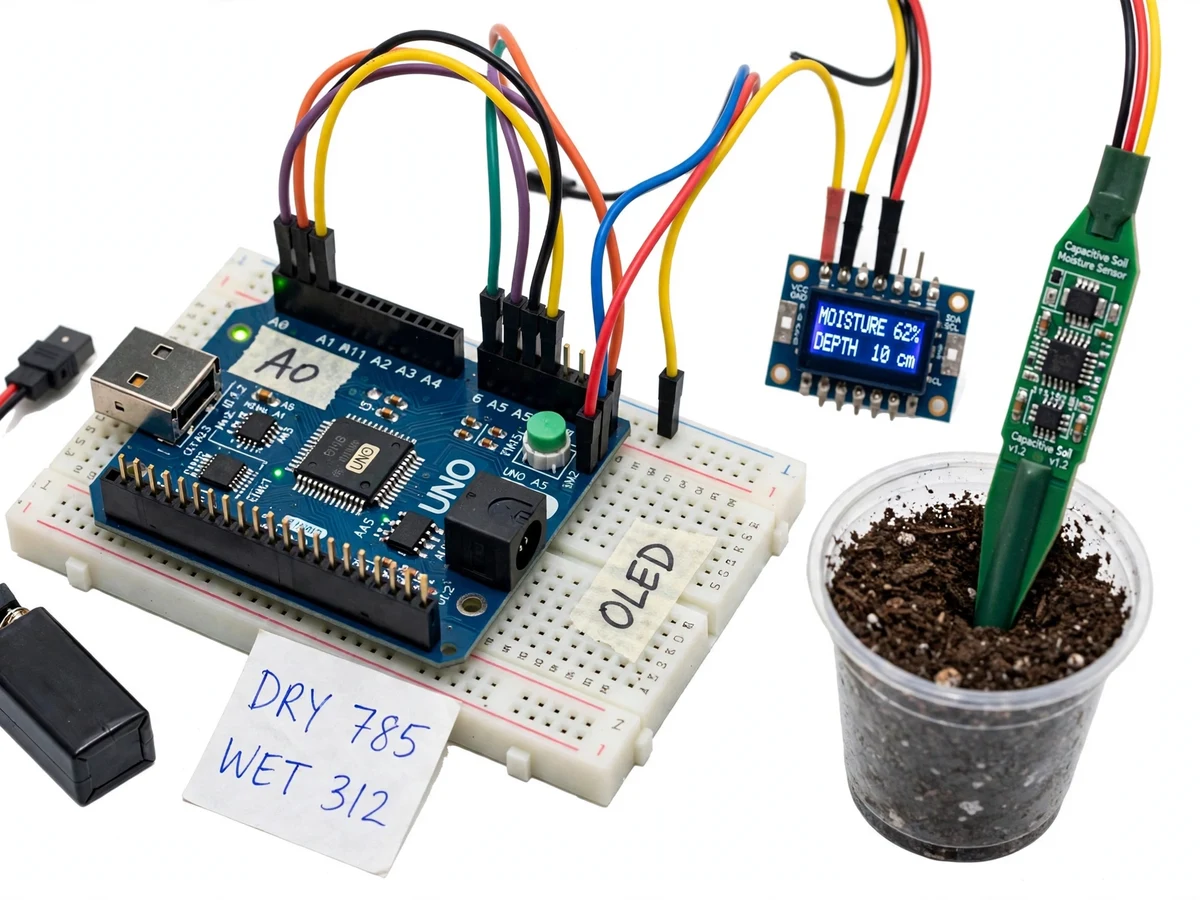
A Capacitive Soil Moisture Tester using Arduino and OLED Display is a handheld instrument that tells the user how wet the soil is at a chosen depth, as a percentage on its OLED screen. It measures only: with no pump, relay or valve, it cannot switch anything on or off and never waters anything — the user reads the number and decides what to do. It exists because judging wetness from the surface is unreliable: the top centimetre can be dry while the root zone is damp, or wet on top while the roots below are dry. Two or three depths show where the water is, using a corrosion-free probe, a microcontroller turning voltage into a percentage, and a daylight-readable display in a battery-powered unit. Builder note: after insertion the reading drifts for a few seconds until the coated probe surface makes full contact with the soil grains, so the firmware averages samples until the reading settles.
| Tester type | What it measures | Actuation | Probe life | Typical use |
|---|---|---|---|---|
| This capacitive tester (this build) | Soil moisture in percent, at a chosen depth, on an OLED | None — measurement only | Long: sealed probe, no exposed metal | Checking moisture before deciding to water |
| Resistive-probe tester | Soil moisture via resistance between two metal prongs | None — measurement only | Short: exposed prongs corrode in damp soil | Quick low-cost spot checks |
| Automatic watering controller (different device, not this build) | Soil moisture as a switching threshold | Relay plus pump switches water on and off | Depends on probe type | Unattended watering of plants |
Capacitive probe v1.2 sealed under a coating; soil acts as the dielectric.
Follow the working sequence
How it works
The Capacitive Soil Moisture Tester works end to end as a measurement chain: probe, voltage, number, percentage, display. The probe is a small circuit board whose copper pattern forms a capacitor plate, sealed under a coating; the soil acts as the dielectric, and wetter soil has a higher dielectric constant, so capacitance rises with moisture. An on-board TLC555 oscillator turns that capacitance into an analog voltage that falls as soil gets wetter, and the Arduino Uno reads it on pin A0 with its 10-bit ADC, converting 0–5 V into counts from 0 to 1023. Firmware waits for the reading to settle, averages several samples, and maps the count to a percentage using the two calibration endpoints the buyer measured in dry and wet soil. Finally the OLED shows the percentage, the raw ADC count, the selected depth and a dry/moist/wet band — and the user moves the probe to the next depth, presses the depth button, and repeats the measurement.
- The probe is pushed into the soil to the marked depth and the depth-select push-button is pressed to label the reading 5 cm, 10 cm or 15 cm (design target).
- The probe's TLC555 oscillator converts soil capacitance into an analog voltage on its AOUT pin — the voltage is high in dry soil and falls as moisture rises.
- The Arduino Uno reads AOUT on analog pin A0, and its 10-bit ADC converts the 0–5 V input into a count from 0 to 1023.
- The firmware waits a short settling interval after insertion, then averages several ADC samples so the displayed value is stable.
- The averaged count is mapped to a moisture percentage between the buyer's dry and wet calibration endpoints, which are stored in the firmware.
- The OLED displays the percentage in large digits, plus the raw ADC count, the selected depth and the dry/moist/wet status band.
- The user pulls the probe out, wipes it, inserts it at the next depth, presses the button, and records the new reading — building a depth profile in a notebook or the supplied table.
Tech stack:
- Arduino Uno (ATmega328P)
- Capacitive soil moisture probe v1.2
- 0.96-inch SSD1306 OLED display (128×64)
- Arduino IDE with C/C++ firmware
- I2C display interface
- 9 V battery and USB power
- Solderless breadboard and jumper wiring
- Push-button depth select
| Parameter | Value |
|---|---|
| Controller | Arduino Uno, ATmega328P microcontroller (datasheet value) |
| ADC resolution | 10-bit, counts 0–1023 over 0–5 V input (datasheet value) |
| Moisture probe | Capacitive soil moisture sensor v1.2, 98 mm × 23 mm (datasheet value) |
| Probe supply | 3.3–5.5 V DC (datasheet value) |
| Probe output | Analog 0–3 V on AOUT, high in dry soil and low in wet soil (datasheet value) |
| Probe current | Less than 20 mA (datasheet value) |
| Display | 0.96-inch OLED, SSD1306 driver, 128×64 pixels, I2C interface (datasheet value) |
| Depth settings | 5 cm, 10 cm and 15 cm, push-button select (design target) |
| Display update | Approximately 1 reading per second (design target) |
| Power | 9 V battery via barrel jack, or USB 5 V (design target) |
| Probe operating temperature | −40 °C to +85 °C (datasheet value) |
| Connectivity | None — fully offline handheld instrument (design target) |
Project features
The Capacitive Soil Moisture Tester combines four capabilities that make it a complete instrument rather than a sensor demo: a corrosion-free capacitive probe that senses moisture through its sealed coating, an Arduino Uno that converts the probe's analog voltage into a percentage, a push-button depth-select that records readings at several marked depths, and a buyer-run dry/wet calibration table that turns raw ADC counts into percentages meaningful for the user's own soil. Together they give the student a device that can be picked up, pushed into a pot, read at a glance, and defended in a viva with real numbers from its own calibration. The remaining features support that core: the OLED shows percentage, raw ADC value and selected depth together; the firmware waits for the reading to settle and averages samples; the unit runs from a 9 V battery or USB away from a bench; and the display marks each reading dry, moist or wet against the user's calibration bands.
- [Corrosion-free capacitive probe] The v1.2 capacitive probe senses moisture through its sealed coating, with no bare metal touching the soil, so unlike resistive prongs it does not corrode or electrolyse in damp soil and keeps giving comparable readings over repeated use.
- [OLED live readout] The 0.96-inch SSD1306 OLED (128×64 pixels) shows the moisture percentage in large digits together with the raw ADC count, the selected probe depth and a dry/moist/wet status band, readable outdoors without a laptop.
- [Multi-depth probe readings] A push-button selects the probe depth — 5 cm, 10 cm or 15 cm (design target) — and the OLED labels each reading with its depth, so one instrument maps a moisture profile instead of a single surface value.
- [Buyer-run dry/wet calibration] The student records the ADC value in dry air and in water-saturated soil, enters the two endpoints in the firmware, and the tester maps every later reading between them — so the percentage means something for their own soil, not a generic scale.
- [Settled, averaged readings] The firmware waits a short settling interval after insertion and averages several ADC samples before displaying, because the reading drifts for the first seconds until probe-to-soil contact stabilises — a real build behaviour documented in the report.
- [Battery or USB power] The unit runs from a 9 V battery through the Arduino barrel jack for field use, or from USB power on the bench, with no mains connection and no Wi-Fi or cloud dependency.
- [Dry/moist/wet status bands] The display classifies each reading against bands derived from the user's calibration endpoints, so a reading is immediately meaningful without mental arithmetic.
What is included
- Working handheld prototype: Arduino Uno, capacitive probe v1.2, OLED display, breadboard wiring, depth-select push-button and 9 V battery connector
- Complete Arduino firmware (C/C++) with settling delay, sample averaging and dry/wet calibration mapping
- Circuit and wiring documentation with pin table (probe AOUT to A0, OLED SDA/SCL to A4/A5)
- Dry/wet calibration procedure and blank calibration table for the student's own soil
- Project report PDF (background, capacitive sensing theory, methodology, calibration results)
- PPT presentation for final review
- Viva Q&A preparation document (capacitance, dielectric constant, ADC, calibration, OLED interfacing)
Limitations & prerequisites
- The percentage is relative to the buyer's own dry/wet calibration — it is not an absolute volumetric water content without laboratory gravimetric reference measurements.
- Readings depend on soil type: the same moisture level gives different ADC counts in sandy, loamy and clay soils, so the calibration must be repeated for each soil.
- The probe measures moisture only around its sensing area; a single reading does not represent a whole field or a large bed.
- The reading drifts for the first few seconds after insertion until probe-to-soil contact settles; readings taken immediately are not reliable.
- The probe must not be pushed past its marked line into water, and the electronics are not waterproof — the unit is for pot and garden-bed use, not submersion.
- The tester has no pump, relay or valve: it measures and displays only, and cannot water plants or control any equipment.
- Battery runtime varies with use and battery condition; no runtime figure is claimed without a measured test.
- The prototype is an academic instrument, not a certified agronomy or laboratory measurement device.
Frequently Asked Questions
Is this project suitable for a final-year project?
Yes — this project suits Electronics, E&TC and Electrical Engineering final-year projects because it demonstrates capacitive sensing, analog-to-digital conversion, sensor calibration, embedded C firmware and OLED interfacing in one compact handheld instrument, and the buyer-run dry/wet calibration gives the student real measured numbers of their own to present and defend in the viva. The calibration table is the student's own experiment, not a copied figure.
How is this different from an automatic plant watering system?
This tester is a handheld measurement instrument, while an automatic watering system is a controller: this build has no pump, no relay and no valve, so it only measures soil moisture and shows the percentage on an OLED while the user decides what to do next. An automatic watering system instead uses a moisture reading as a switch threshold to turn a pump on and off, which is a different project with different hardware and different viva questions.
How does the capacitive probe measure moisture?
The probe's copper pattern forms a capacitor sealed under a coating, the surrounding soil acts as its dielectric, and wetter soil has a higher dielectric constant, so the capacitance rises with moisture and the probe's on-board oscillator converts that capacitance into an analog voltage. That voltage falls as the soil gets wetter, and the Arduino reads it and converts it to a percentage using the buyer's dry and wet calibration endpoints.
What power supply does it need?
A 9 V battery through the Arduino barrel jack powers the tester for portable field use, or USB 5 V power runs it on the bench, and the probe itself draws less than 20 mA from the Arduino board at 3.3–5.5 V. The whole instrument is fully offline, with no Wi-Fi, cloud or mains connection needed.
Can this project be customized?
Yes — realistic options include adding SD-card logging of depth-profile readings, a second probe for comparing two pots side by side, a larger OLED or a buzzer for dry-soil alerts, and a soil-type calibration study across sandy, loamy and clay soils. Adding a pump or relay would turn it into a different project and is quoted separately.
What will I receive with the project?
You receive the working handheld prototype with Arduino Uno, capacitive probe, OLED display, push-button and battery connector, plus the complete Arduino firmware, wiring documentation, project report, and the dry/wet calibration procedure with its blank table for the student's own soil. The project report, PPT and viva Q&A documents are included, and the abstract PDF comes with the report.
Components & software requirements
- Arduino Uno (ATmega328P)
- Capacitive soil moisture probe v1.2
- 0.96-inch SSD1306 OLED display (128×64)
- Arduino IDE with C/C++ firmware
- I2C display interface
- 9 V battery and USB power
- Solderless breadboard and jumper wiring
- Push-button depth select
Delivery information
Built-to-order project. Delivery timeline is shared after order confirmation based on current queue.
Support terms
Complete documentation, setup guide, and viva preparation included. Support for setup and explanation provided.
Download free synopsis (PDF)
Enter your name and WhatsApp number — the synopsis PDF downloads immediately. We may send occasional project updates on WhatsApp; no spam.