
More project photos (3)
The problem
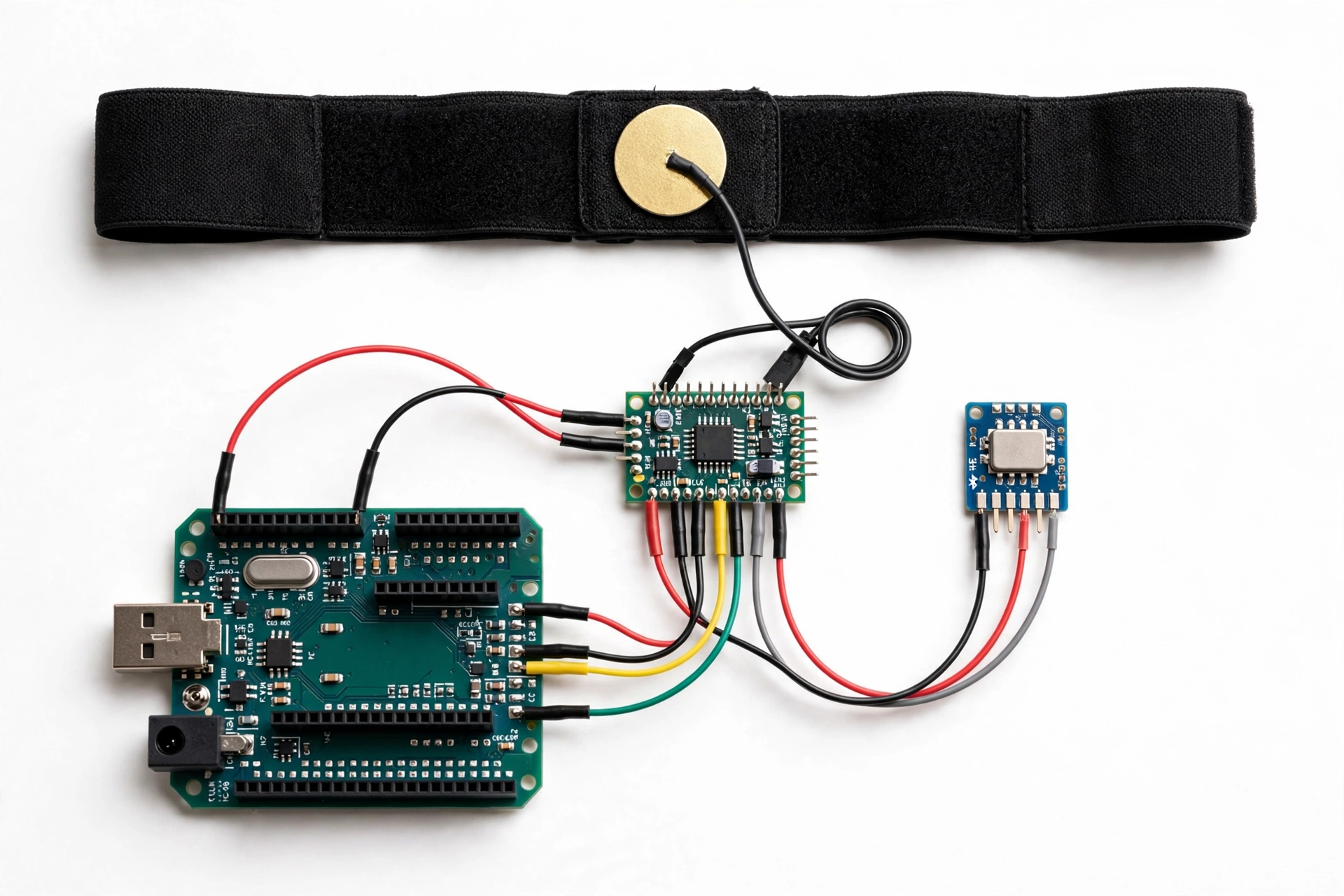
Steering a car without touching it sounds like science fiction, but the prototype version is a careful signal chain, not mind reading. The Brain-Controlled Car using EEG Sensor Module starts with the small electrical signals the brain produces, picked up by a dry electrode held against the forehead by a simple headband, with a reference electrode clipped to the ear. A single-channel EEG sensor module filters that noisy microvolt signal and outputs two scores that students can actually work with: attention, how focused the wearer is, and meditation, how relaxed they are. Those scores travel wirelessly to the car, where an Arduino turns them into motor commands. The result is a car that moves when the driver concentrates, slows and stops when they relax, and halts immediately on a hard blink. Because it uses one forehead channel only, the control vocabulary is deliberately small: forward, stop, and turn by holding a relaxed or focused state, with thresholds the student calibrates for each driver. That honesty is the point of the build. It teaches biosignal acquisition, filtering, wireless control, and threshold logic, and it teaches, just as clearly, what a single EEG channel cannot do.
How it works
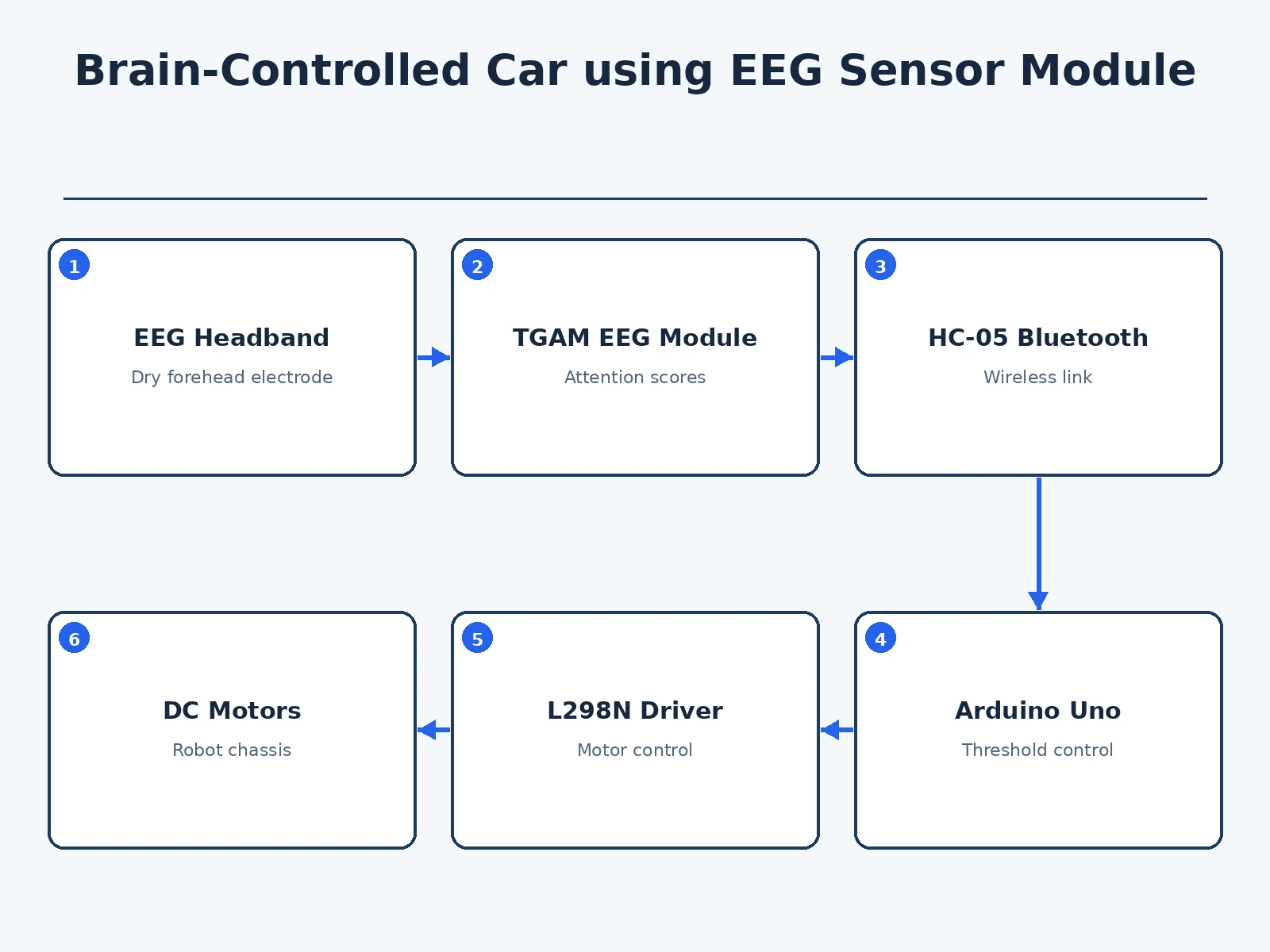
The Brain-Controlled Car using EEG Sensor Module works by turning a noisy physiological signal into three safe commands. Brain activity produces tiny electrical potentials at the scalp, measured in microvolts. The dry forehead electrode picks up a mixture of that brain signal, muscle activity, eye blinks, and mains interference. The EEG module amplifies the mixture, filters it, and runs its on-board algorithm to produce attention and meditation scores, plus a blink flag for strong eye blinks. A small transmitter board sends those values over Bluetooth to the Arduino on the car. The Arduino smooths the scores, compares attention with the driver's calibrated threshold, and drives the motor driver: high attention forward, low attention stop, sustained relaxation turn, hard blink immediate stop. Nothing in that chain decodes a thought. It measures only how focused or relaxed the wearer is, in broad bands, and the report states that limit plainly.
- The driver puts on the headband so the dry electrode sits firmly on the forehead, with the reference clip on the ear, and sits still for a few seconds while the signal settles.
- The EEG module filters the forehead signal and starts outputting attention and meditation scores on a 0 to 100 scale, plus blink events.
- A calibration session records the driver's resting scores and focused scores, and the firmware sets forward and stop thresholds between them.
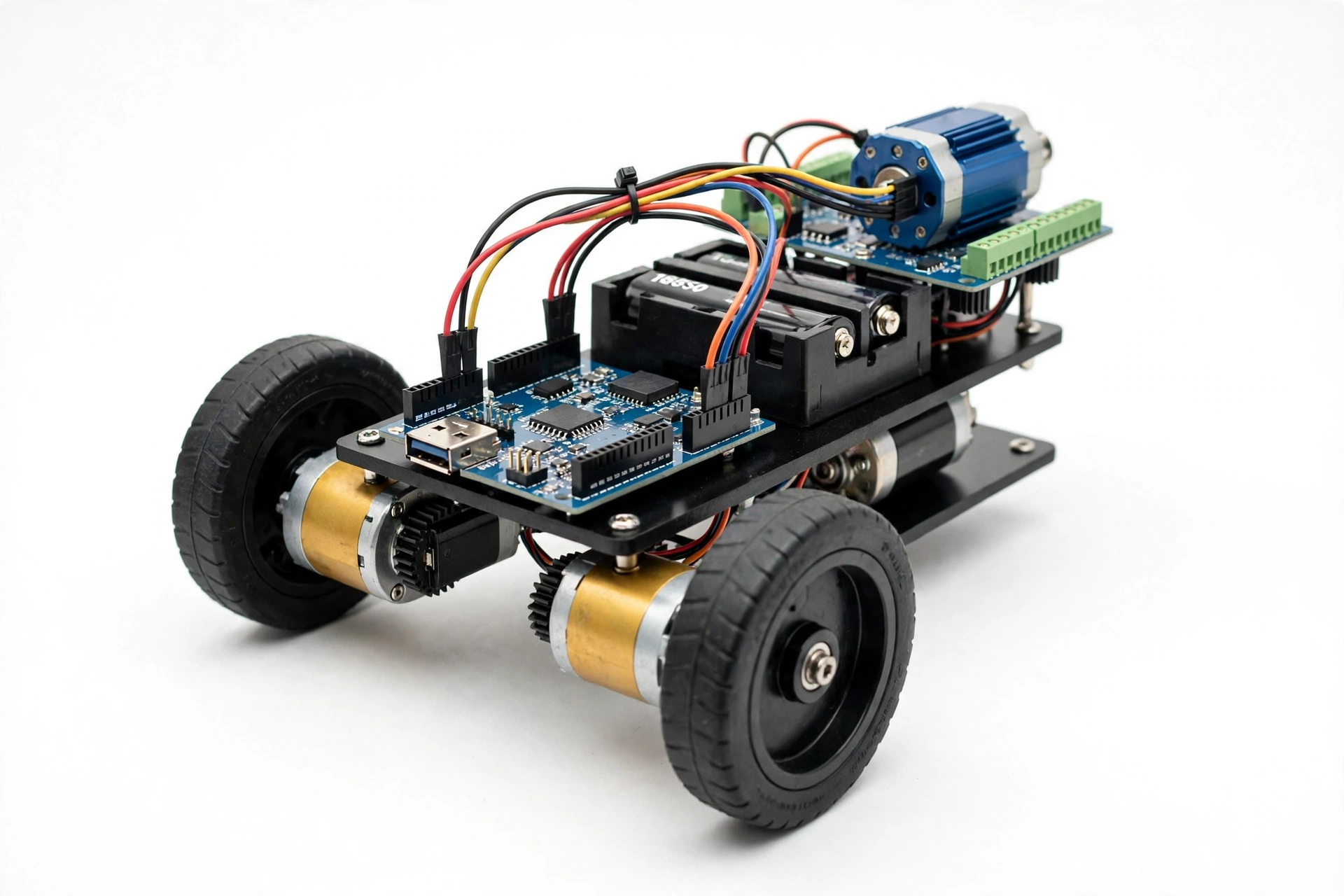
- Scores travel over Bluetooth to the Arduino mounted on the robot car chassis.
- The Arduino smooths each new score, compares attention with the calibrated threshold, and selects forward, turn, or stop.
- The motor driver powers the DC geared motors accordingly, and a hard blink overrides everything and halts the car at once.
- If the Bluetooth link drops or scores go stale, the firmware cuts the motors and waits, so the car never runs away on an old command.
- After the run, the serial log is plotted to show attention rising, the car starting, relaxation stopping it, and the blink stop, giving the report a real measured result.
Tech stack:
- TGAM single-channel EEG sensor module
- Arduino Uno
- Bluetooth HC-05 module
- L298N motor driver
- DC geared motors
- Robot car chassis kit
- Arduino IDE · C++
- Rechargeable battery pack
| Parameter | Value |
|---|---|
| Controller | Arduino Uno with ATmega328P microcontroller (datasheet value) |
| EEG input | Single dry forehead electrode plus ear reference (design target) |
| EEG module | Single-channel module with on-board filtering and attention and meditation scoring 0 to 100 (datasheet value) |
| Wireless link | Bluetooth serial link between headset unit and car (design target) |
| Motor driver | L298N dual H-bridge driving two DC geared motors (datasheet value) |
| Drive | Four-wheel robot car chassis with DC geared motors (design target) |
| Commands | Forward on high attention · stop on relaxation · turn on sustained relaxation · immediate stop on hard blink (design target) |
| Safety | Signal-loss and stale-score timeout cuts motors automatically (implemented feature) |
| Logging | Serial monitor output of scores · thresholds · motor commands (implemented feature) |
| Power | Rechargeable battery pack for the car · separate small battery for the headset unit (design target) |
| Build form | Wired prototype on a robot chassis · no soldering required for the base build (design target) |
Project features
The Brain-Controlled Car using EEG Sensor Module is built around five capabilities a student can demonstrate live: single-channel EEG acquisition from a dry forehead electrode, attention and meditation scoring from the sensor module, wireless command transfer over Bluetooth, threshold-based motor control with a blink stop, and a calibration routine that adapts the thresholds to each driver. Around those core capabilities, the firmware smooths noisy scores so the car does not jerk on every sample, logs scores to the serial monitor for plotting, and falls back to a safe stop whenever the signal is lost or the scores go stale, so a viva demonstration stays safe even when the signal does not cooperate. Every feature below is part of the base prototype unless it is marked configurable, and nothing in the list claims the car reads thoughts, intentions, or words.
- [Single-channel EEG acquisition] A dry forehead electrode on a headband, with an ear reference, feeds a single-channel EEG sensor module that filters the raw brain signal on board. Implemented in the base prototype.
- [Attention and meditation scoring] The module outputs attention and meditation scores on a 0 to 100 scale, updated continuously, which the firmware reads as its control inputs. Implemented in the base prototype.
- [Bluetooth command link] Scores and blink events travel from the headset unit to the car over a Bluetooth serial link, so the driver is untethered from the car. Implemented in the base prototype.
- [Threshold motor control] The Arduino compares the live attention score with a calibrated threshold: above it the car drives forward, below it the car slows and stops, and a sustained relaxed state triggers a turn. Implemented in the base prototype.
- [Hard-blink emergency stop] A strong blink, detected as a sharp signal artefact by the module, halts the motors immediately, independent of the attention threshold. Implemented in the base prototype.
- [Per-driver calibration] A short calibration session records the driver's resting and focused scores and sets the forward and stop thresholds from those values, rather than from fixed universal numbers. Implemented in the base prototype.
- [Signal-loss safe stop] If Bluetooth packets stop arriving or scores go stale for more than a short timeout, the firmware cuts the motors and waits for a fresh signal. Implemented in the base prototype.
- [Serial score logging] Every score, threshold decision, and motor command is sent to the serial monitor, where it can be captured and plotted to show focus rising, the car starting, and relaxation stopping it. Implemented in the base prototype.
What is included
- Working prototype: robot car with Arduino, motor driver, motors, battery pack, plus EEG headband unit with sensor module and Bluetooth transmitter, wired and tested
- Complete Arduino firmware for the headset transmitter and the car receiver, with calibration, smoothing, threshold logic, blink stop, and signal-loss safe stop
- Circuit and wiring documentation with labelled connections for every wire
- Component list with the exact parts used in the build
- Calibration and demonstration procedure, including the electrode-contact fix described below
- Project report PDF (background, EEG and brain-computer interface theory, methodology, results format, limitations)
- PPT presentation for final review
- Viva Q&A preparation document (EEG signal basics, filtering, Bluetooth serial communication, threshold logic, why one channel cannot read thoughts)
- Builder note: if the attention score jumps wildly while the driver sits still, re-seat the forehead electrode and tighten the headband before re-running calibration — loose electrode contact, not the module, is the most common cause of a wandering score in this build
Limitations & prerequisites
- One forehead channel reads focus and relaxation bands only: it cannot decode thoughts, intentions, words, or directions, and left versus right thinking is not a command in this build.
- Scores vary with electrode contact, head movement, eye blinks, muscle tension, and tiredness, so the same driver can need different thresholds on different days.
- The prototype is an educational demonstration only: it must not be used as a mobility aid, a medical device, or a safety-critical controller.
- A distracted driver cannot steer precisely, and a relaxed driver cannot hold a turn reliably, so the car is slow and the course must be clear and flat.
- Bluetooth range is short and the link can drop in a crowded radio environment; the safe-stop timeout exists for exactly that case.
- The dry electrode needs firm, steady skin contact: hair, sweat, or a loose headband degrades the signal quickly.
- Attention and meditation scores are module outputs, not direct brain measurements, and their exact algorithm is the module maker's, not a published medical standard.
Frequently Asked Questions
Does this car read my thoughts?
No, this car does not read thoughts: it reads only broad attention and meditation scores from a single forehead channel, so it can tell roughly how focused or relaxed the wearer is, not what they are thinking, intending, or saying, and the report states that limit plainly. High attention drives forward, relaxation stops the car, and a hard blink halts it, which is a small command vocabulary built from signal bands, not decoded language.
Is this project suitable for a final-year project?
Yes, for Electronics and Telecommunication students, because it demonstrates biosignal acquisition, on-board filtering, wireless serial control, threshold logic, calibration, and safe failure behaviour in a live hardware demonstration, with a strong discussion section on what one EEG channel can and cannot prove. Explaining the limits is as important as showing the car move.
What does the EEG sensor actually measure?
The EEG sensor measures tiny electrical potentials at the scalp, in microvolts, picked up by a dry forehead electrode, and the module filters that signal and converts it into attention and meditation scores on a 0 to 100 scale, plus blink events. Those scores track broad mental state bands, not specific thoughts, and they are affected by muscle activity, blinks, and electrode contact, which is why calibration and smoothing matter.
Does the project need internet or a computer during the demonstration?
No internet is needed at any point, and the core demonstration runs standalone once powered, with Bluetooth carrying scores from the headset unit to the car, and a laptop used only for uploading firmware and optionally capturing the serial log for plotting. The demonstration can therefore run in any classroom with a flat, clear floor area.
Can the project be customized?
Yes, within realistic limits: a second command such as a double-blink turn can be added, the thresholds and smoothing can be retuned, and an LCD or LED score display can be added to the car, while thought decoding, precise steering, and medical or assistive use can never be added honestly, since one forehead channel does not carry that information. The report keeps that boundary explicit.
Components & software requirements
- TGAM single-channel EEG sensor module
- Arduino Uno
- Bluetooth HC-05 module
- L298N motor driver
- DC geared motors
- Robot car chassis kit
- Arduino IDE · C++
- Rechargeable battery pack
Delivery information
Built-to-order project. Delivery timeline is shared after order confirmation based on current queue.
Support terms
Complete documentation, setup guide, and viva preparation included. Support for setup and explanation provided.
Download free synopsis (PDF)
Enter your name and WhatsApp number — the synopsis PDF downloads immediately. We may send occasional project updates on WhatsApp; no spam.