
More project photos (3)
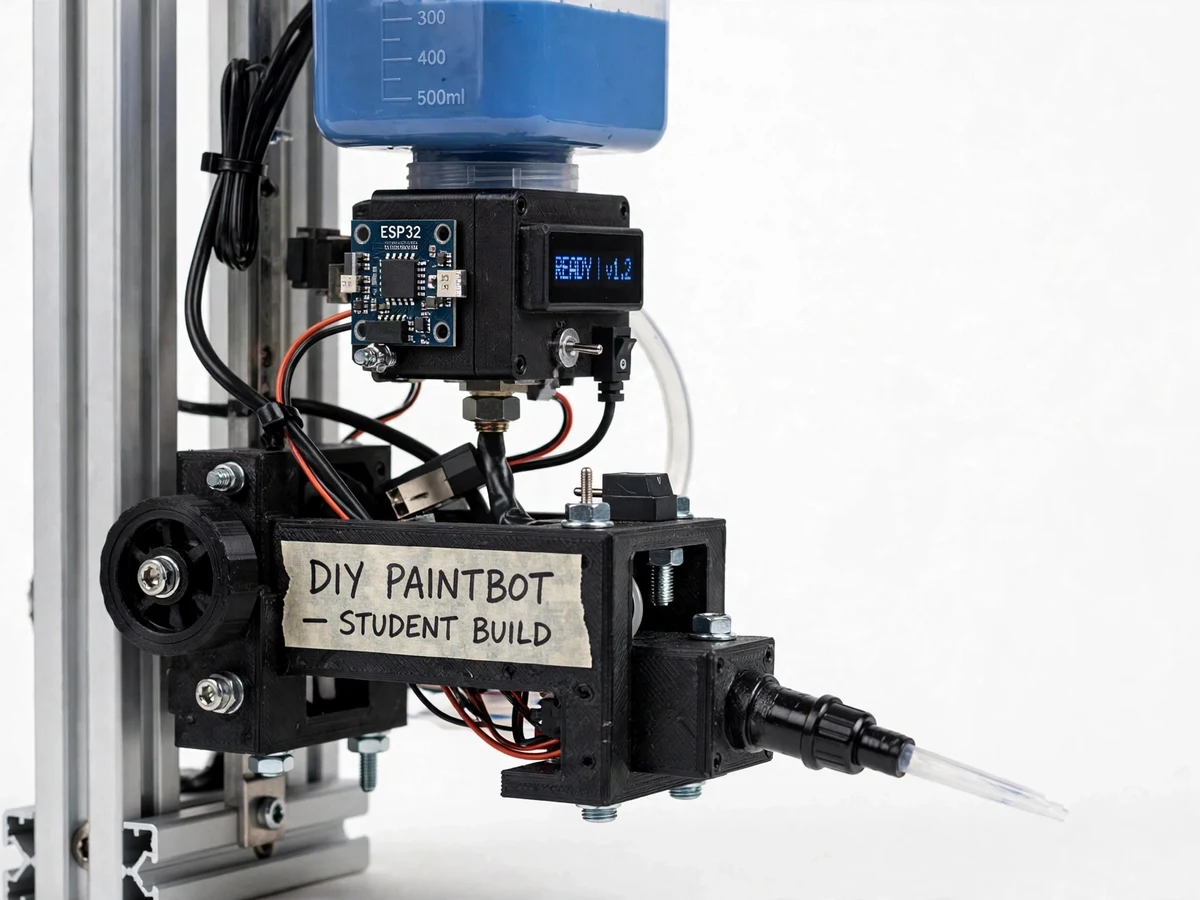
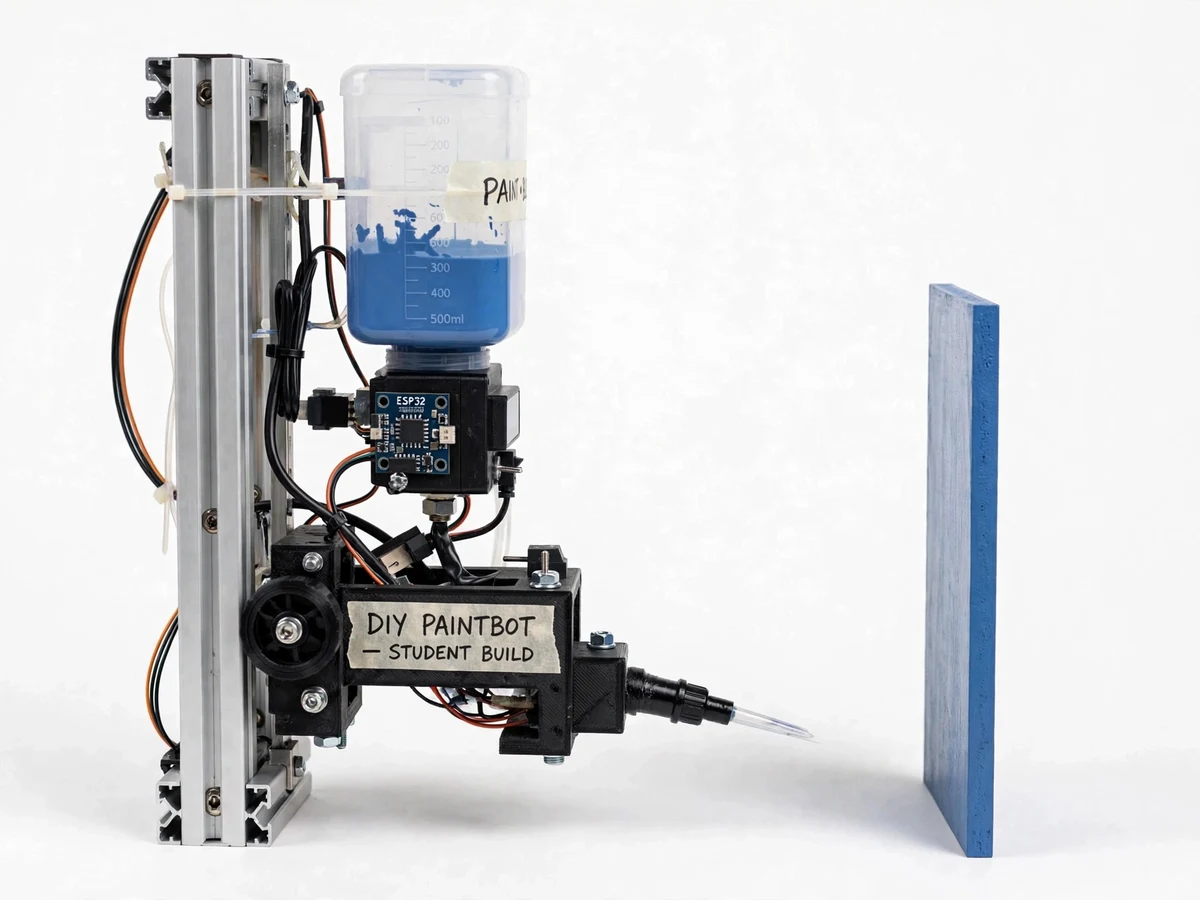
The problem
Painting is one of the most labour-intensive and hazardous jobs in construction: workers spend long hours on scaffolding breathing paint fumes, coverage quality varies from person to person, and large flat surfaces eat time that could be automated. The industry has mechanized cutting, mixing, and lifting — but the paint roller is still largely manual. A wall-painting robot attacks the most repetitive slice of the job: moving a sprayer across a flat panel at constant speed with even overlap. Building one forces students to combine motion sequencing, fluid delivery, and coverage planning in a single machine, and the result is unusually legible — anyone can judge the before-and-after panel. Construction robotics is a growing field, and a robot that visibly paints a wall gives students a concrete entry point into it.
Positions the frame, fills the reservoir and starts auto mode or jogs manually.
Follow the working sequence
How it works
The vertical rail frame is positioned against the wall panel and the paint reservoir is filled.
In auto mode, the Arduino starts the sprayer pump to pressurize the nozzle.
A motor drives the carriage upward along the rails while the nozzle sprays a vertical strip.
At the top limit switch, spraying pauses and the carriage steps horizontally to the next strip position.
The carriage descends, spraying the next strip with slight overlap for uniform coverage.
The cycle repeats until the full panel width is covered, then motion and spraying stop.
Manual mode lets the operator jog the carriage and trigger the sprayer independently.
Project features
Rail-mounted robot carriage with controlled vertical and horizontal motion
Motorized sprayer pump + nozzle for even, consistent paint coating
Arduino-controlled motion sequencing: pass, shift, next pass
Adjustable spray timing and carriage speed for coverage control
Paint reservoir with level indication and easy refill
Limit switches for safe carriage travel at rail ends
Manual/auto mode selection for demonstration flexibility
Emergency stop button for instant halt of motion and spraying
Even-coverage demo on a wall panel — visible before/after result
Modular rail frame: assembles and disassembles for transport to the review
What is included
Working wall-painting robot with rail frame and carriage
Sprayer pump, nozzle, reservoir and tubing assembly
Arduino firmware (auto sequence + manual jog mode)
Mechanical assembly diagrams + electrical wiring diagram
Project report PDF (construction-automation survey, design, coverage-test procedure, conclusion)
PPT presentation
Viva Q&A preparation document (spray dynamics, motion control, coverage planning, safety)
FAQs
- How even is the paint coverage? Successive vertical strips overlap at a constant, tuned carriage speed, producing visibly uniform coating on flat panels. The report documents the procedure for comparing robot-coated and manually coated sections.
- What kind of paint can it use? Water-based paints within the diaphragm pump's viscosity range. Thick paints risk clogging the nozzle — the report specifies the recommended paint and thinning ratio.
- How does it avoid drips and runs? Constant carriage speed and controlled spray timing keep the paint film thin; nozzle distance from the wall is fixed by the carriage geometry, and dwell time at strip ends is minimized by the motion sequence.
- Is it safe to operate? The emergency stop halts both motion and spraying instantly, limit switches prevent over-travel, and the low-voltage DC system is safe to handle during a demo.
- Why paint in overlapping vertical strips? Overlap compensates for the spray pattern's tapered edges — each pass's thin edge is covered by the next pass's full coat — which is the standard technique for uniform coverage in spray applications.
Advantages
- Automatic pass/shift/next-pass motion sequencing with adjustable spray timing and carriage speed for even coverage.
- Motorized diaphragm sprayer pump and nozzle give a consistent paint coating with visible before/after results on the panel.
- Limit switches at rail ends plus an emergency stop button for safe demonstration.
- Manual/auto mode selection for flexible demos; paint reservoir with level indication and easy refill.
- Modular rail frame assembles and disassembles for transport to reviews and viva halls.
Disadvantages
- Model-scale demo — full building walls need a scaled-up frame and industrial sprayer.
- Overspray and paint wastage at strip edges; masking is needed for clean lines.
- Thick paints can clog the nozzle — viscosity must stay within the pump's range.
- Uneven or textured walls reduce coating uniformity compared to flat panels.
Limitations & prerequisites
Demonstrated on a model-scale wall panel; full building walls need a scaled-up frame and industrial sprayer.
Overspray and paint wastage occur at strip edges — masking is needed for clean lines.
Nozzle clogging is possible with thick paints; paint viscosity must be within the pump's range.
Uneven or textured wall surfaces reduce coating uniformity compared to flat panels.
Components & software requirements
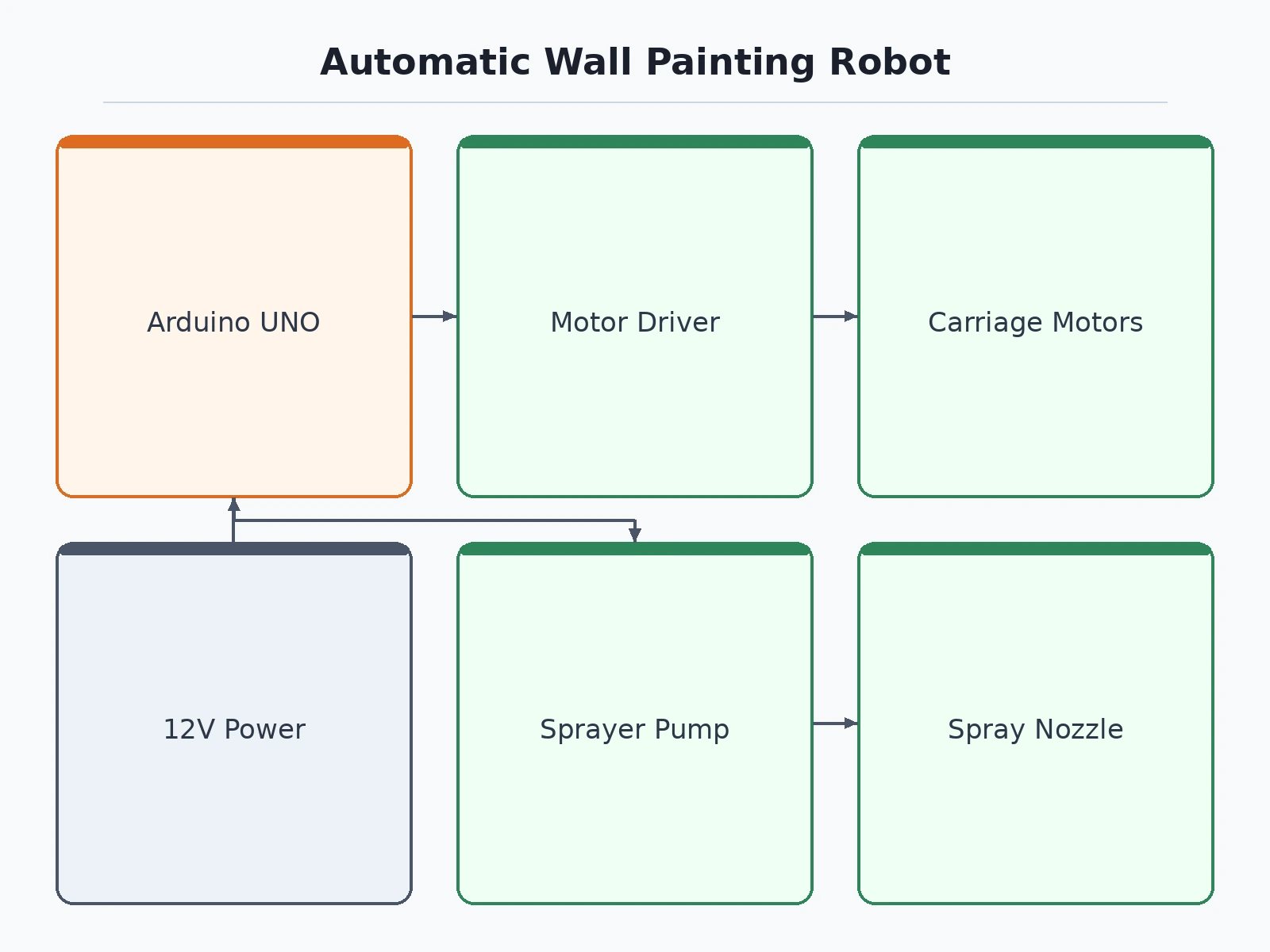
Arduino UNO (motion sequencing, spray timing, limit-switch handling)
DC / stepper motors with driver (carriage vertical + horizontal motion)
Diaphragm sprayer pump + adjustable spray nozzle
Paint reservoir with tubing and level indicator
Limit switches (travel ends), emergency stop button
Aluminium/steel rail frame with carriage rollers
12 V battery pack or mains adapter
Specifications
| Parameter | Value |
|---|---|
| Motion | Vertical carriage travel + horizontal strip stepping |
| Sprayer | Diaphragm pump with adjustable nozzle (fan/cone pattern) |
| Control | Arduino: auto sequence + manual jog mode |
| Coverage | Vertical strips with overlap for uniform coating |
| Travel safety | Limit switches at rail ends; emergency stop |
| Paint capacity | Onboard reservoir with level indicator |
| Speed | Adjustable carriage speed and spray timing |
| Frame | Modular rail frame, disassembles for transport |
| Power | 12 V DC (battery or adapter) |
| Demo target | Wall panel section with visible painted result |
Download free synopsis (PDF)
Enter your name and WhatsApp number — the synopsis PDF downloads immediately. We may send occasional project updates on WhatsApp; no spam.