
More project photos (2)
The problem
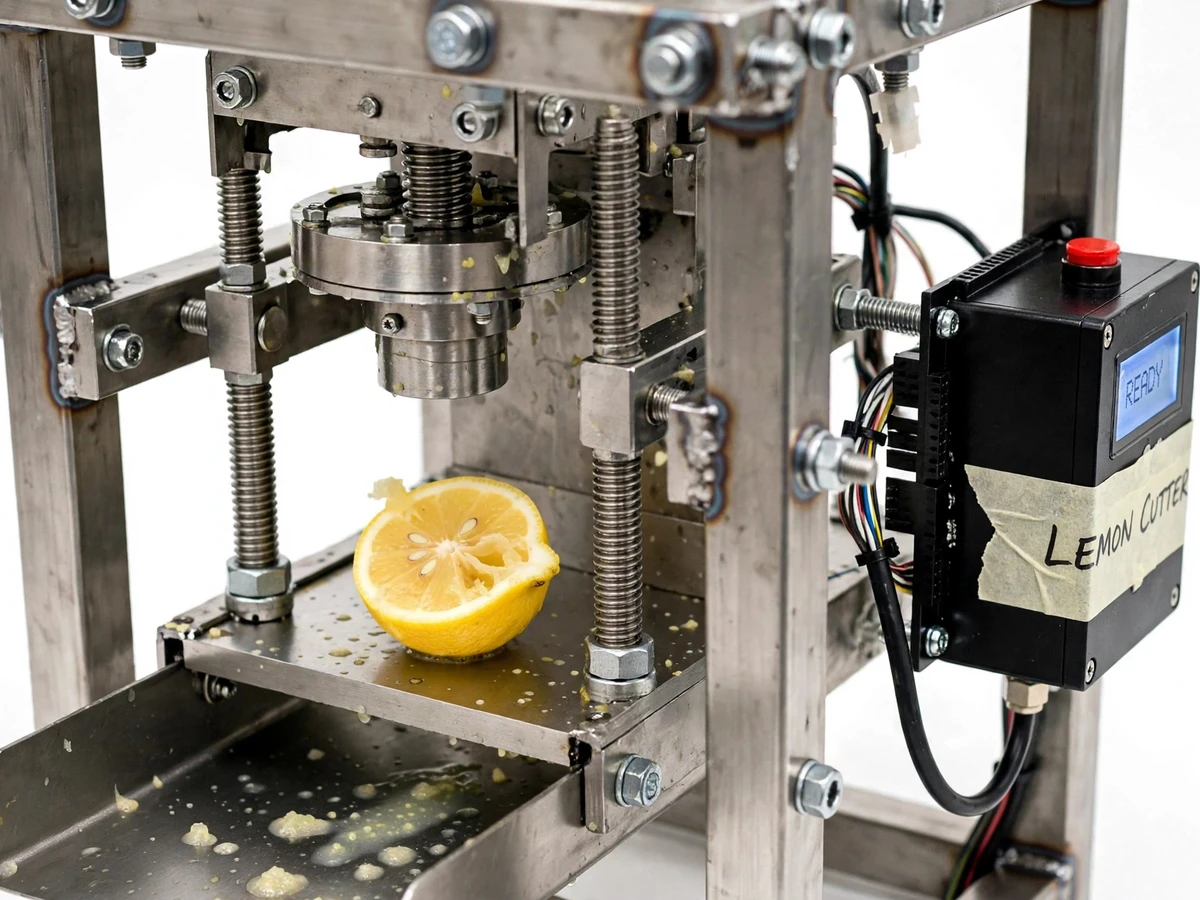
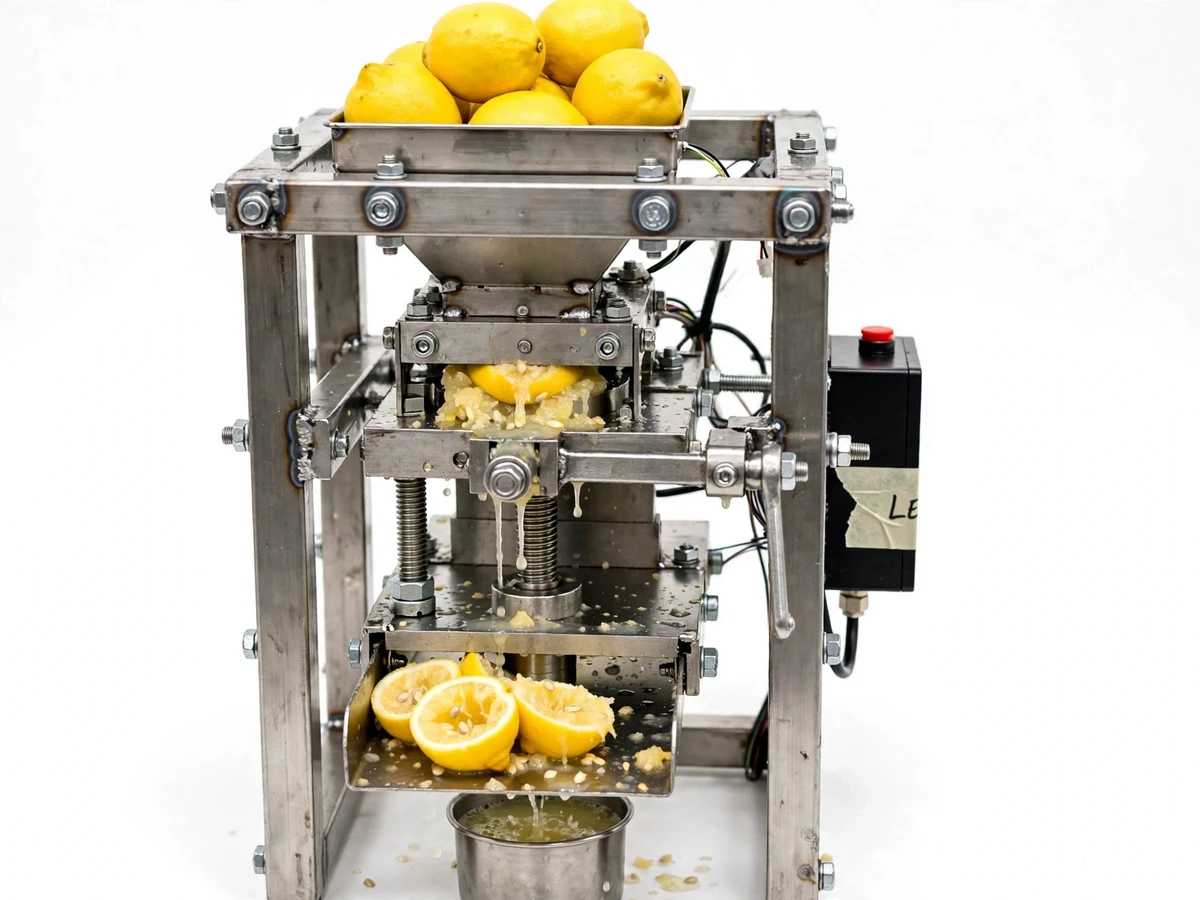
An automatic lemon cutting and squeezing machine for juice shops is a bench-top machine that takes lemons from a hopper, cuts each lemon in half with a food-grade stainless-steel blade, and presses the halves with a screw-press mechanism so the juice flows through a strainer into a cup. The spent halves drop into a separate tray, and an Arduino-based controller runs the cut-and-press cycle from a single push button, with a small LCD showing the machine state. A small juice shop otherwise cuts and squeezes every lemon by hand, which is slow in rush hours, tiring across a full day, and inconsistent — some glasses get more juice than others. This machine replaces that hand work with one repeatable cycle, so the operator loads lemons, presses a button, and serves, while the build gives a mechanical engineering student a complete design problem: a cutting edge, a pressing force, a food-contact material choice and a control sequence.
| Feature | Manual cutting and squeezing | This automatic lemon machine |
|---|---|---|
| Cutting | Knife and chopping board, one lemon at a time | Stainless-steel blade cuts each lemon in half inside the machine |
| Squeezing | Hand pressure, varies with the operator | Screw-press applies the same pressing force every cycle |
| Output per cycle | One glass at a time, pace set by the operator | One lemon per cycle, design target of approximately 20–30 seconds per lemon |
| Juice collection | Juice and seeds on the counter, poured by hand | Juice flows through a strainer into a collection cup below the spout |
| Spent halves | Mixed with the juice or set aside by hand | Drop into a separate tray, clear of the juice path |
| Hygiene | Hands touch the cut fruit and the juice | Only food-grade SS304 parts touch the fruit and the juice |
| Demonstration | Hard to show as a system | One button runs a visible cut-and-press cycle |
Builder note: the cutting blade is set at a 30-degree bevel (design target) and mounted to cut across the equator of the lemon, not along its length, because an equatorial cut exposes the most juice sacs to the press. During the demo build, a blade set to cut along the length of the lemon left a thick strip of pith unpressed and the juice yield per lemon dropped noticeably, while the equatorial cut gave a clean halving and the most juice from the same press stroke. The other practical detail from the build is the strainer: a perforated SS304 plate with 2 mm diameter holes (design target) sits between the press and the collection cup, and it keeps seeds and most pulp out of the juice while still letting the juice through without clogging during a short run.
Loads lemons in the hopper and presses start.
Follow the working sequence
How it works
The machine works in one continuous cycle. A whole lemon drops from the hopper onto the cutting station, where the SS304 blade halves it across its equator as the press plate descends. The two halves land cut-side down on the strainer plate, and the screw-press continues down, pressing the pulp against the strainer so the juice is forced out through the 2 mm holes (design target) and runs through the spout into the cup below. The Arduino controller runs the sequence: it drives the geared DC motor down for the cut and press, holds the press briefly so the juice drains, then reverses the motor to lift the plate, and the spent halves drop into the tray. A limit switch at each end of the screw travel tells the controller when the plate has reached the bottom and the top, so the motor stops at the same points every cycle.
- The operator loads whole lemons into the top hopper and places a steel cup under the juice spout.
- One push of the start button tells the Arduino to begin the cycle, and the LCD changes from ready to cutting.
- A lemon drops from the hopper onto the cutting station, and the geared DC motor drives the press plate down so the SS304 blade halves the lemon across its equator.
- The two halves land cut-side down on the strainer plate, and the screw-press continues down, forcing the juice through the perforated plate while the seeds and pulp stay above it.
- The press holds at the bottom for a short dwell (design target: approximately 3–5 seconds) so the juice drains through the spout into the cup.
- The motor reverses, the press plate lifts to the top limit switch, and the spent halves drop into the separate tray.
- The LCD shows cycle complete, and the machine is ready for the next lemon from the hopper.
Tech stack:
- Arduino Uno · ATmega328P
- Geared DC motor · lead screw press
- SS304 stainless steel · food-contact parts
- 16x2 LCD · status display
- Limit switches · press travel sensing
- Push button · cycle start
- 12 V DC power supply
- Arduino IDE · C++ firmware
| Parameter | Value |
|---|---|
| Overall size | Approximately 45 cm × 30 cm × 55 cm (design target) |
| Frame material | Mild steel angle frame with SS304 contact parts |
| Blade | SS304 stainless steel · 30-degree bevel (design target) |
| Cutting | Equatorial halving · one lemon per cycle |
| Press mechanism | Lead screw · geared DC motor |
| Juice yield | Approximately 30–40 ml per lemon (design target · varies with lemon size and freshness) |
| Cycle time | Approximately 20–30 seconds per lemon (design target) |
| Hopper capacity | Approximately 8–10 lemons (design target) |
| Strainer | Perforated SS304 plate · 2 mm diameter holes (design target) |
| Controller | Arduino Uno · ATmega328P |
| Display | 16x2 LCD · ready / cutting / pressing / complete |
| Travel sensing | Two limit switches · top and bottom of press travel |
| Power supply | 12 V DC |
| Builder note | Equatorial cut exposes the most juice sacs; a lengthwise cut left unpressed pith and lower yield in the demo build |
Project features
This lemon cutting and squeezing machine is built around four capabilities: automatic halving with a food-grade stainless-steel blade, screw-press squeezing with a repeatable pressing force, a strained juice collection path that keeps seeds out of the glass, and a single-button Arduino cycle controller with a status display. The blade is the first capability: a sharpened SS304 blade cuts each lemon across its equator as the press plate descends, so one stroke both cuts and starts the squeeze. The screw-press is the second: a lead screw driven by a geared DC motor converts rotation into a steady downward force, so every lemon gets the same squeeze regardless of the operator. The third capability is the juice path: a perforated strainer plate separates seeds and pulp, and the juice runs through a spout into a cup. The fourth is the controller: an Arduino runs the cut-and-press sequence from one push button and shows the state on a small LCD.
- [Automatic lemon halving] A food-grade SS304 blade cuts each lemon across its equator as the press plate descends, so one stroke both halves the fruit and begins the squeeze.
- [Screw-press squeezing] A lead screw driven by a geared DC motor converts rotation into a steady downward force, so every lemon is pressed with the same force regardless of the operator.
- [Strained juice collection] Juice passes through a perforated SS304 strainer plate into a collection cup, keeping seeds and most pulp out of the served juice.
- [Separate spent-half tray] The pressed halves drop into a tray clear of the juice path, so the juice stays clean and the tray can be emptied between runs.
- [Single-button cycle control] One push button starts the full cut-and-press cycle, and the Arduino controller runs the blade and press in the correct order without further input.
- [LCD status display] A small LCD shows the machine state — ready, cutting, pressing, or cycle complete — so the operator always knows what the machine is doing.
- [Hopper feed] A top hopper holds approximately 8–10 lemons (design target) so the operator can load a small batch and run several cycles without reloading.
- [Food-grade contact parts] Every part that touches the fruit or the juice is SS304 stainless steel, which is washable, rust-resistant and suitable for food contact.
What is included
- Working automatic lemon cutting and squeezing machine prototype
- Complete Arduino firmware source code with comments (cycle control, limit-switch logic, LCD display)
- Mechanical drawings and fabrication notes (frame, blade mount, screw press, hopper, strainer)
- Component list with part names and food-grade material notes
- Project report PDF (background, working, specifications, limitations)
- Project abstract PDF
- PPT presentation for final review
- Viva Q&A preparation document (cutting mechanics, screw-press force, SS304 food contact, Arduino control sequence)
- Demonstration guidance for showing the cut, the press and the juice collection
Limitations & prerequisites
- This is a tabletop demonstration prototype for a small juice shop, not a certified commercial food-processing machine, and it is not certified for continuous commercial food service.
- Juice yield is a design target only — approximately 30–40 ml per lemon — and varies with lemon size, ripeness and freshness; no yield figure is claimed as measured.
- The machine handles lemons of a similar size; very small or very large fruit may not sit correctly on the cutting station and may need the guide adjusted.
- The strainer keeps seeds and most pulp out of the juice, but fine pulp still passes through, so the juice is not filtered to a clear liquid.
- All food-contact parts must be washed and dried after each day of use; the machine must not be left with juice residue, or the SS304 parts can stain and the juice can spoil.
- The cycle time of approximately 20–30 seconds per lemon is a design target, so a large rush order still takes several minutes to process one lemon at a time.
- The base build is single-fruit only, with no automatic sorting of fruit size and no pulp-ejection mechanism beyond the spent-half tray.
Timeline
- Week 1: mechanical design, component sourcing, and frame fabrication.
- Week 2: blade mount, screw-press assembly, hopper and strainer fitting.
- Week 3: Arduino wiring, cycle-control firmware, limit-switch tuning, and cutting and pressing tests.
- Week 4: juice-yield trials, cleaning procedure, report, abstract, PPT, and demonstration preparation.
Support
- Build guidance, mechanical explanation, and firmware help are included with the order.
- Customization such as a larger hopper, a second press station, a foot-pedal start, or a different fruit size guide can be developed on request.
Get this project
- Get this project on WhatsApp: message Projectech for a quotation with the scope, starting price and delivery timeline for this machine, and the build is prepared fresh for your order.
Frequently Asked Questions
How does the machine cut and squeeze a lemon in one cycle?
The machine halves each lemon and presses it in a single stroke, so one button press runs the whole cycle from whole fruit to collected juice. A lemon drops from the hopper onto the cutting station, and the geared DC motor drives the press plate down so the SS304 blade cuts the lemon across its equator. The halves land cut-side down on the strainer plate, the screw-press continues down to force the juice out, the press holds briefly so the juice drains into the cup, and the spent halves drop into a separate tray.
Is the juice safe to drink — what touches the fruit?
Yes, for a demonstration prototype: every part that touches the fruit or the juice is food-grade SS304 stainless steel, which is washable and rust-resistant. SS304 contains approximately 18% chromium and 8% nickel (datasheet composition), which is the standard food-contact grade. The frame is mild steel and never touches the juice. The machine must still be washed and dried after each day of use, and never left with juice residue.
How much juice does one lemon give?
Approximately 30–40 ml per lemon is the design target, and the actual amount varies with the size, ripeness and freshness of the lemon. This is not a measured guarantee: the figure is a target for the build, and the report documents the yield measured during the builder's own trials. Larger, fresher lemons give more juice, while small or dry lemons give noticeably less from the same press stroke.
How fast is the machine?
One lemon takes approximately 20–30 seconds per cycle as a design target, from button press to the spent halves dropping into the tray. That is far quicker and more consistent than cutting and squeezing by hand across a full day, but it is still one lemon at a time, so a large rush order takes several minutes. A second press station can be added as customization for higher throughput.
What does the Arduino actually control?
The Arduino runs the whole cycle from one push button, with no further input needed once the cycle starts. It drives the geared DC motor down for the cut and press, holds the press for a short dwell of approximately 3–5 seconds so the juice drains, reverses the motor to lift the plate, and stops at the top and bottom limit switches. The 16x2 LCD shows the machine state — ready, cutting, pressing, or cycle complete.
Is this project suitable for a final-year project?
Yes — for Mechanical Engineering programs, because it combines cutting-tool design, screw-press force transmission, food-contact material selection and embedded control in one working prototype. The student can explain the blade angle, the lead-screw force, the strainer design and the Arduino sequence from the build, and demonstrate the full cycle in a review room, which makes the work easy to defend before a guide.
Components & software requirements
- Arduino Uno · ATmega328P
- Geared DC motor · lead screw press
- SS304 stainless steel · food-contact parts
- 16x2 LCD · status display
- Limit switches · press travel sensing
- Push button · cycle start
- 12 V DC power supply
- Arduino IDE · C++ firmware
Delivery information
Built-to-order project. Delivery timeline is shared after order confirmation based on current queue.
Support terms
Complete documentation, setup guide, and viva preparation included. Support for setup and explanation provided.
Download free synopsis (PDF)
Enter your name and WhatsApp number — the synopsis PDF downloads immediately. We may send occasional project updates on WhatsApp; no spam.