
More project photos (3)
The problem
Android App for Local Service Booking with Plumber, Electrician and Cleaner on Demand is an Android application that lets a household book a tradesperson — a plumber, an electrician or a cleaner — from a phone, with the price shown before booking. A user picks a trade, chooses one of nine fixed-price job cards such as tap leak repair at ₹349, sees an itemised quote that adds a visit fee to the job price, picks a time slot, and follows the provider through five steps with an ETA. The problem it addresses is the usual way of hiring tradespeople: phone numbers passed by word of mouth, prices negotiated at the door, and no record of who is coming or when. That wastes time, invites inflated charges, and leaves no accountability when the work is poor. This project replaces it with fixed job prices, a quote before booking, and provider ratings — real booking logic, not a static catalogue.
Picks a trade and a fixed-price job card
Follow the working sequence
How it works
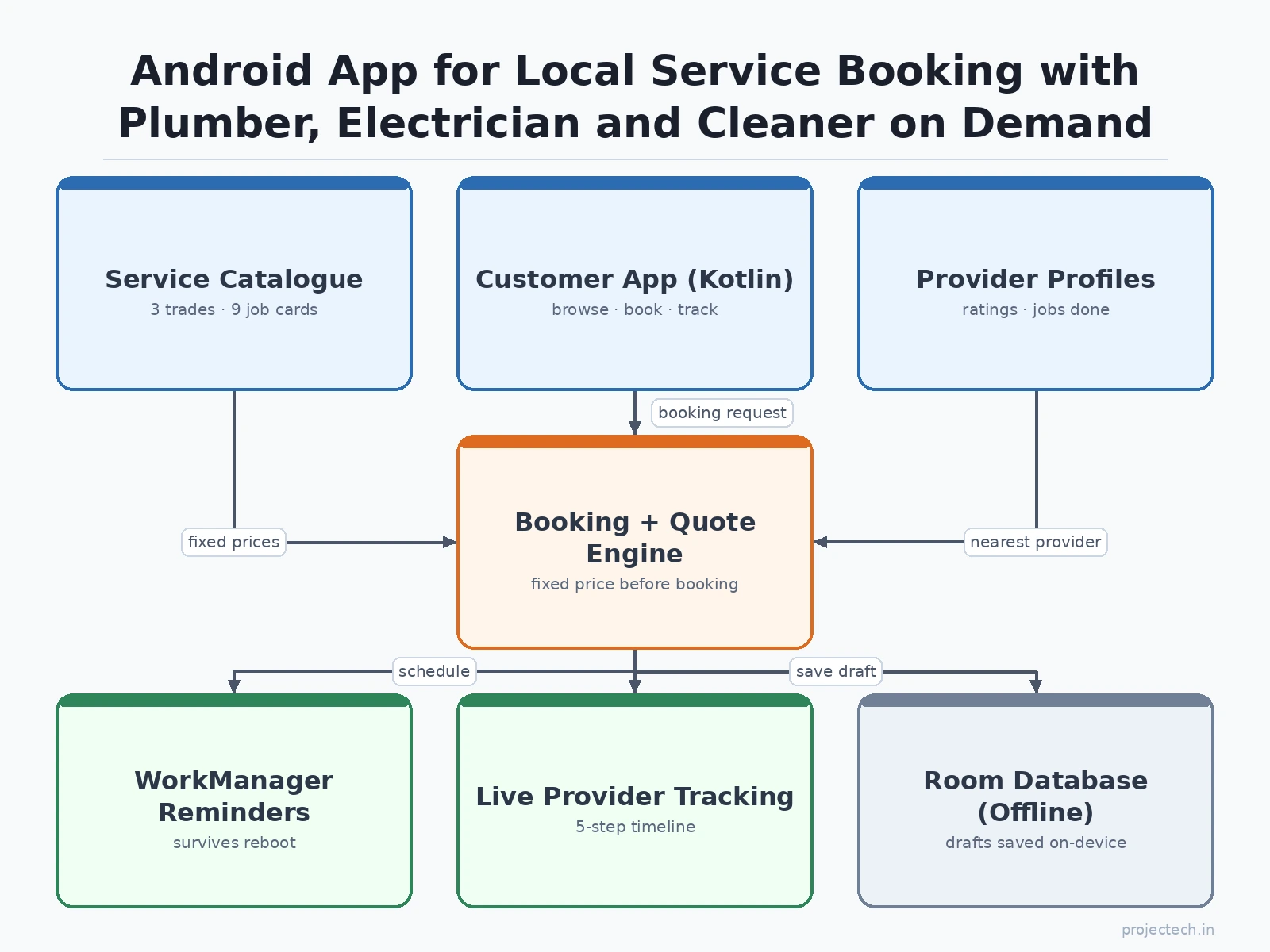
The booking travels a short, visible chain from the user's tap to the provider's arrival. The user picks a trade and a job card; the app reads the fixed job price and the trade's visit fee from the local Room database and adds them into an itemised quote, so the total is known before booking. Choosing a slot creates the booking, saved locally and sent to the server; WorkManager schedules the reminder at the same moment, so it survives the app being closed or the phone restarting. The server offers the job to the nearest available provider; when one accepts, the app switches to the five-step tracking view — confirmed, assigned, on the way, arrived, done — with an ETA from the provider's distance and live status. The provider checks in at the door with an OTP, the job is completed against the quoted price, and the user rates the work, updating the provider's record for the next customer.
- The user sets a location and browses the trade catalogue, which loads from the Room database and works offline for browsing.
- The user picks a trade — plumber, electrician or cleaner — and a fixed-price job card such as tap leak repair at ₹349.
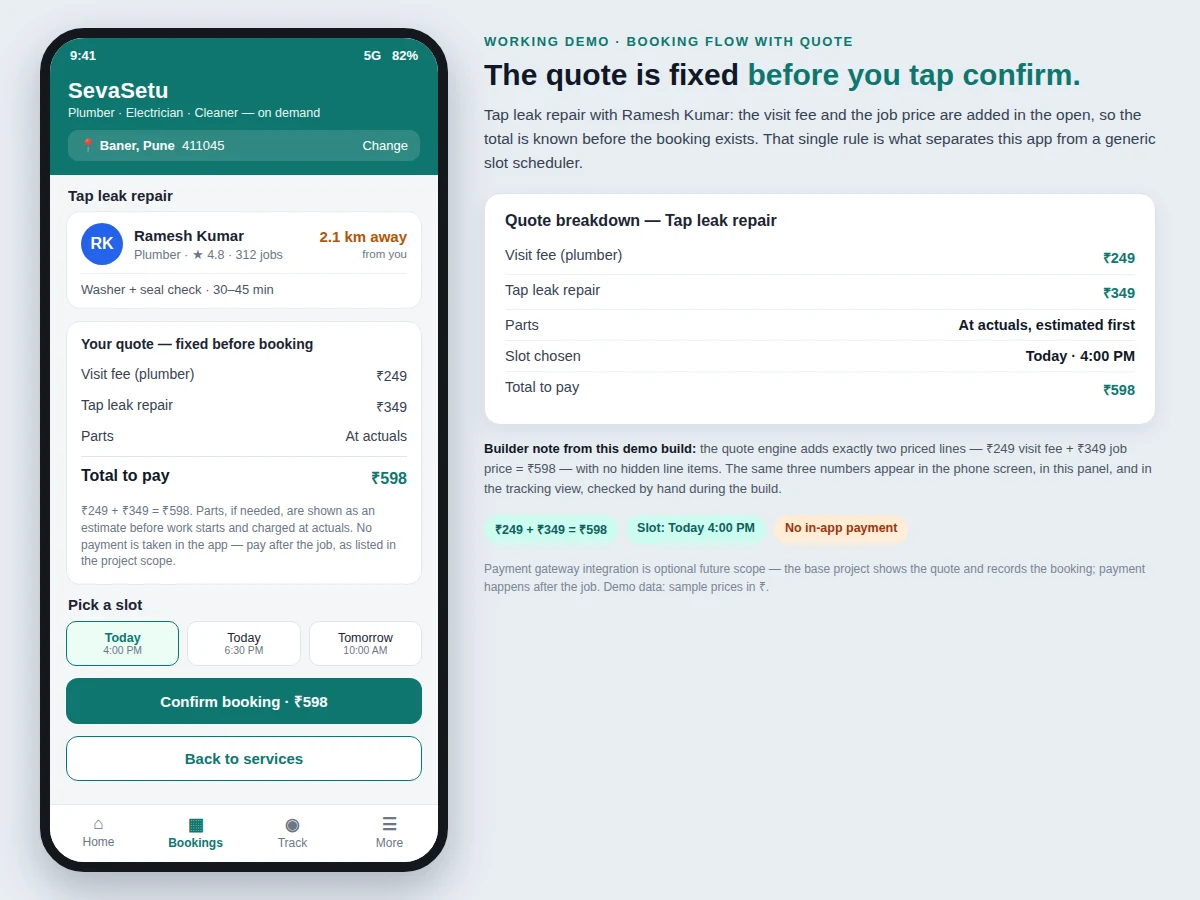
- The app builds the itemised quote: visit fee (₹249 for plumber/electrician, ₹199 for cleaner) plus the job price; parts are shown as an estimate before work starts.
- The user picks a time slot; the booking is saved in Room and sent to the server, and WorkManager schedules the reminder.
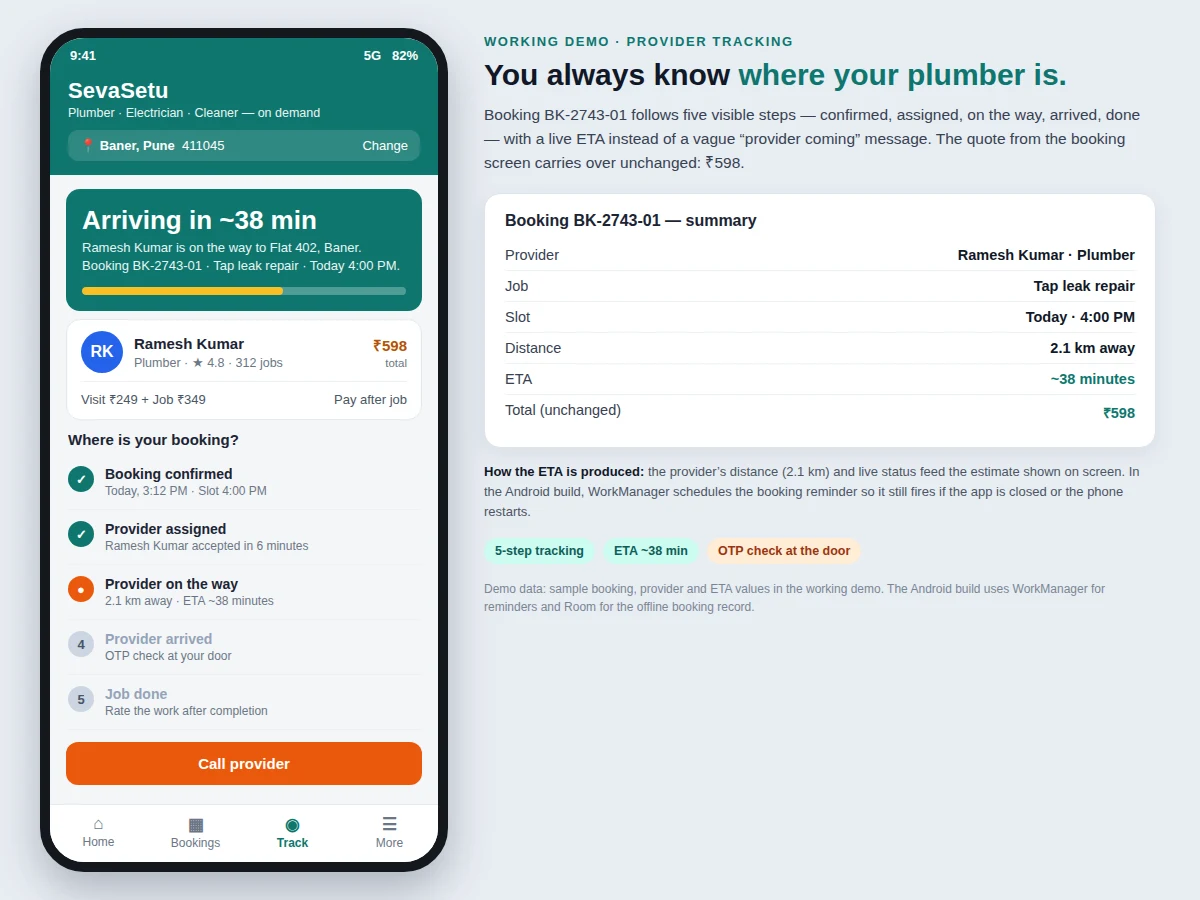
- The nearest available provider in that trade accepts; the app shows the five-step tracking view with an ETA from the provider's distance and live status.
- The provider checks in at the door with an OTP, completes the job against the quoted price, and the user rates the work.
Tech stack:
- Kotlin
- Android Jetpack · Room
- WorkManager
- Retrofit · REST API
- Material Design 3
- Android Studio
- Git
| Parameter | Value |
|---|---|
| Platform | Android 8.0 (API 26) and above (design target) |
| Language | Kotlin |
| Local database | Room over SQLite (behaviour confirmed against developer.android.com) |
| Reminders | WorkManager deferrable work, persists across reboots (behaviour confirmed against developer.android.com) |
| Trades | 3 (plumber, electrician, cleaner) |
| Job cards | 9 fixed-price cards (measured from the demo build) |
| Providers in demo | 5 sample providers (demo data) |
| Visit fee | ₹249 plumber/electrician, ₹199 cleaner (demo data) |
| Job prices | ₹299–₹1,499 across the 9 cards (demo data) |
| Example quote | ₹598 total for tap leak repair: ₹249 visit fee + ₹349 job price (measured from the demo build) |
| Emergency dispatch | Provider assigned within 60 minutes (design target) |
| Tracking | 5 steps: confirmed, assigned, on the way, arrived, done |
| Booking record | Stored locally in Room; syncs when online (design) |
| Payment | Not included in the base build; payment gateway is optional future scope |
Project features
Four capabilities carry this project. First, the quote comes before the booking: every job card carries a fixed price, the app adds the trade's visit fee — ₹249 for a plumber or electrician, ₹199 for a cleaner — and the total is shown before the user confirms anything, so the price can never change at the door. Second, emergency dispatch: a booking flagged as an emergency is assigned to a provider within 60 minutes as a design target, covering leaks, short circuits and blocked drains that cannot wait for a slot. Third, slot booking with reminders: the user picks a time slot and WorkManager schedules a reminder that still fires if the app is closed or the phone restarts. Fourth, live provider tracking with a five-step timeline and ETA, so the user always knows who is coming and when. Builder note: booking the tap-leak job end to end gives ₹249 + ₹349 = ₹598, with no hidden line items.
- [Trade-wise service catalogue] Three trades — plumber, electrician, cleaner — with nine fixed-price job cards, each showing its price and typical duration, stored in Room so the catalogue can be browsed offline.
- [Quote before you book] The app adds the trade's visit fee to the fixed job price and shows the itemised total before confirmation; the tap-leak example totals ₹598 (₹249 visit fee + ₹349 job price), checked in the demo build.
- [Emergency 60-minute dispatch] A booking flagged as an emergency is assigned to the nearest available provider within 60 minutes as a design target, for leaks, short circuits and blocked drains.
- [Slot booking with reminders] The user picks a time slot and WorkManager schedules a reminder that persists across app restarts and device reboots, confirmed against developer.android.com.
- [Live provider tracking] A five-step timeline — confirmed, assigned, on the way, arrived, done — with an ETA from the provider's distance and live status; the demo shows arrival in approximately 38 minutes for a provider 2.1 km away.
- [Provider profiles with ratings] Each provider shows a rating and completed-job count, so the user chooses on record rather than on a name alone; the demo's names, ratings and counts are sample data.
- [Offline booking drafts] Bookings and drafts are saved in the Room database on the phone, so a half-finished booking survives the app being closed and syncs when the connection returns.
What is included
- Complete Kotlin source code (Android Studio project) with the booking, quote, slot and tracking flows
- Room database schema with the sample catalogue: 3 trades, 9 job cards, 5 sample providers
- Working web demo of the app (service listing, booking with quote, provider tracking)
- Project report PDF (background, methodology, architecture, results)
- PPT presentation for final review
- Viva Q&A preparation document (Kotlin, Room, WorkManager, REST, quoting logic)
- Project abstract PDF
Limitations & prerequisites
- Provider names, ratings and completed-job counts in the demo are sample data; the delivered app ships with a sample provider directory (5 rows in the demo) for the student to replace with real providers.
- No payment gateway in the base build — payment happens after the job; gateway integration is optional future scope.
- Emergency 60-minute dispatch is a design target, not a measured guarantee; it depends on provider availability in the area.
- Live tracking needs internet; without it the app shows the last saved status from Room.
- The ETA shown in the demo (approximately 38 minutes for a provider 2.1 km away) is a sample value; real ETAs depend on live location updates.
- Provider verification (identity, background checks) is out of scope — the app records ratings, it does not verify credentials.
- The demo covers 3 trades and 9 job cards; new trades are added as catalogue rows, and their job prices must be set by the student.
Frequently Asked Questions
Is this project suitable for a final-year project?
Yes — for Computer Engineering, IT and Electronics & Telecommunication students. It demonstrates Android development in Kotlin, local persistence with Room, background work with WorkManager, REST integration, and a complete booking flow with quoting, slots and tracking, which together cover mobile development, databases and client-server design in one project. The working demo is included so the flow can be shown live during the review.
How is this different from a generic home-service app?
Generic home-service apps schedule a slot and show a price afterwards; this app is built around on-demand local trades. Every job card carries a fixed price, the quote is itemised and fixed before booking, and emergency jobs are dispatched within 60 minutes as a design target instead of waiting for the next free slot. Tracking then follows the provider through five steps with a live ETA.
What technology is used?
Kotlin with Android Jetpack: Room over SQLite for the local catalogue, bookings and drafts, WorkManager for booking reminders that persist across reboots, and Retrofit for the REST calls that create bookings and fetch provider status. The interface follows Material Design 3 and the project is built in Android Studio. Room and WorkManager behaviour was confirmed against developer.android.com before writing.
Does it need internet to work?
Browsing the catalogue and opening a saved booking work offline because both live in the Room database on the phone. Creating a booking, assigning a provider and live tracking need internet, since the server has to offer the job and report the provider's status. If the connection drops mid-booking, the draft stays saved locally and syncs when the connection returns.
Is payment included in the app?
No — the base project deliberately has no payment gateway, so nothing is charged inside the app. The app shows the fixed quote and records the booking, and payment happens after the job is done, which keeps the scope honest for a student build. Payment gateway integration (UPI or cards) is listed as optional future scope and can be added on request.
Can more trades be added later?
Yes — trades, job cards and providers are catalogue rows in the Room database, so adding a trade such as carpentry or appliance repair means adding rows and their job cards, not rewriting the booking flow, since the quote, slot and tracking logic reads the same tables. The demo's nine job cards show the pattern: each new trade needs its own cards, prices and visit fee, and nothing else changes.
Components & software requirements
- Kotlin
- Android Jetpack · Room
- WorkManager
- Retrofit · REST API
- Material Design 3
- Android Studio
- Git
Delivery information
Built-to-order project. Delivery timeline is shared after order confirmation based on current queue.
Support terms
Complete documentation, setup guide, and viva preparation included. Support for setup and explanation provided.
Download free synopsis (PDF)
Enter your name and WhatsApp number — the synopsis PDF downloads immediately. We may send occasional project updates on WhatsApp; no spam.