
More project photos (2)
The problem
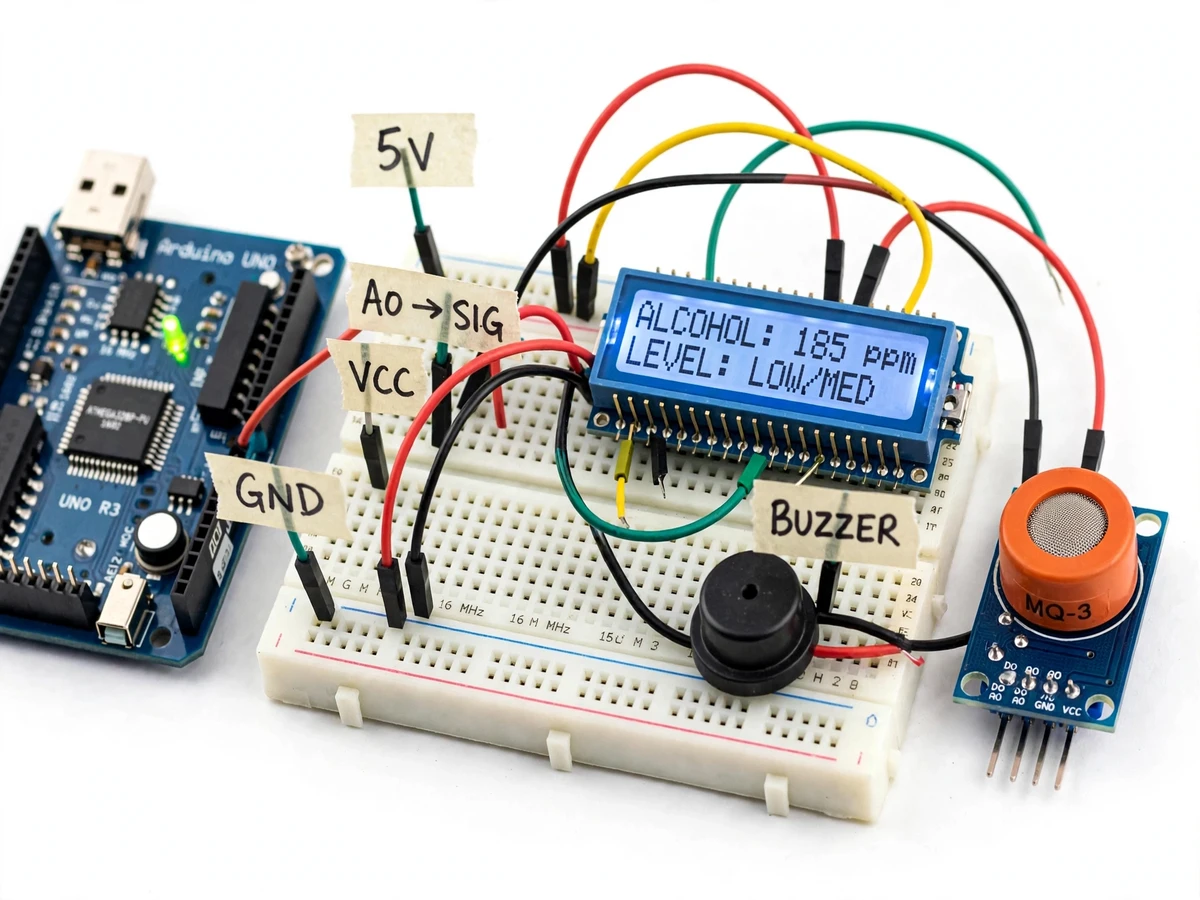
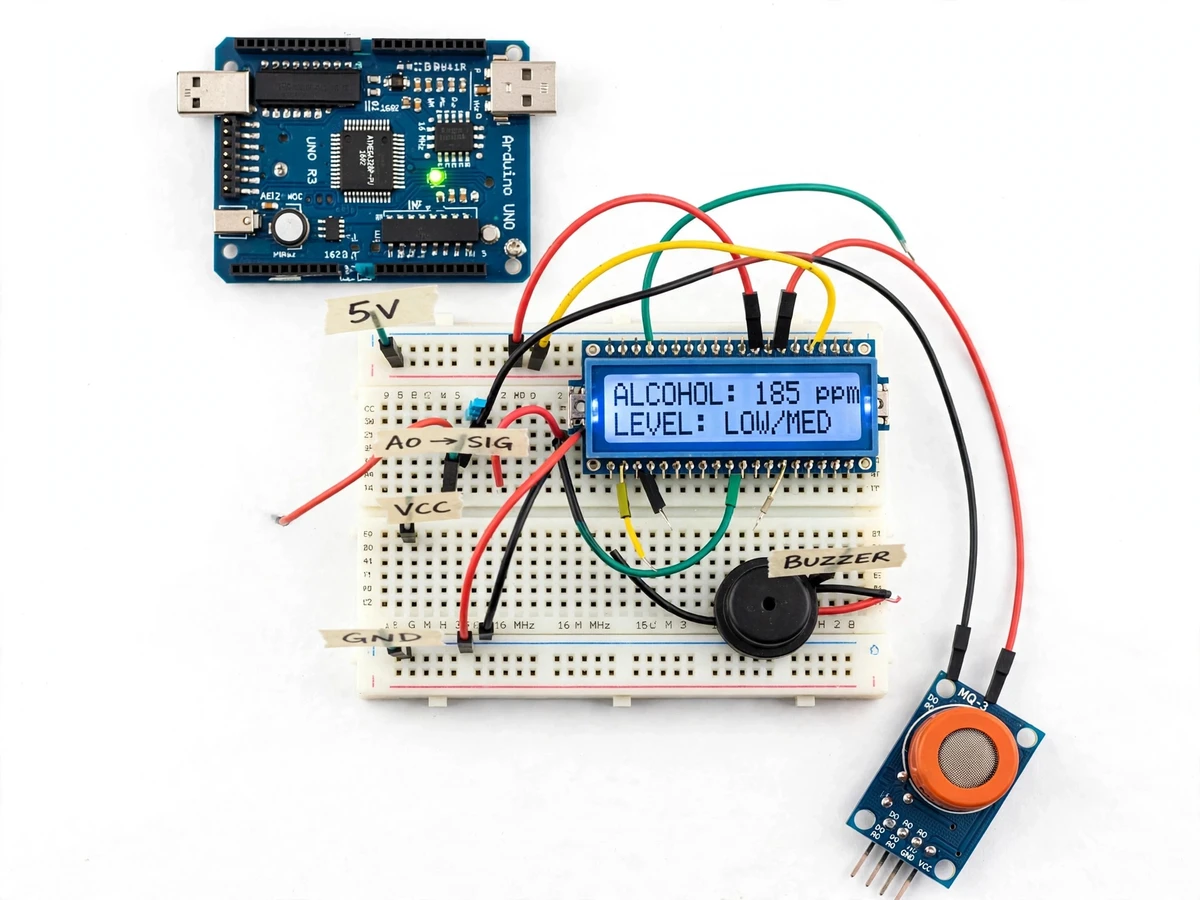
Alcohol-detection projects are popular in embedded courses, but cheap sensor modules are often demoed as "breathalyzers" without saying what the sensor can actually measure. The MQ-3 is a semiconductor alcohol sensor, not a fuel-cell instrument: its heated tin-oxide (SnO2) element responds to alcohol vapor, but also to smoke, gasoline vapor and other gases, drifts with temperature and humidity, and needs significant warm-up before its output means anything. This project builds the honest version of the classic Arduino breath-analyzer demo — an Arduino Uno reads the MQ-3 module's analog output, runs a warm-up countdown, calibrates a clean-air baseline, and shows the result on a 16x2 LCD as an indicative band (CLEAN AIR / LOW / MODERATE / HIGH) with a buzzer alert at a student-set threshold. The readout is relative and indicative only: it demonstrates gas sensing, ADC interfacing and real calibration practice, and it is explicitly not an evidential-grade or legally usable breathalyzer.
How it works
- The MQ-3 module is powered from 5 V; its internal heater warms the tin-oxide sensing element to its operating temperature.
- In clean air the sensor's conductivity is low; alcohol vapor raises it, shifting the analog output voltage across the module's adjustable load resistor.
- The Arduino Uno samples that voltage on an analog pin with its 10-bit ADC (0–1023 steps).
- Firmware waits through the warm-up countdown before trusting any reading, then subtracts the student's clean-air baseline calibration.
- The corrected reading is mapped to an indicative band — CLEAN AIR / LOW / MODERATE / HIGH — and shown on the 16x2 LCD with the raw ADC value.
- Crossing the configured threshold sounds the buzzer, and every reading is mirrored to the serial stream for logging and report plots.
Tech stack:
- Arduino Uno (ATmega328P)
- MQ-3 alcohol sensor module (heater + adjustable load resistor)
- 16x2 character LCD (HD44780)
- Arduino IDE · C/C++ firmware
- Breadboard · jumper wiring · 5 V supply
- Active buzzer module (alert output)
- USB serial monitor (debug + data logging)
Components
- Arduino Uno (ATmega328P) development board
- MQ-3 semiconductor alcohol gas sensor module with on-board load resistor
- 16x2 LCD with I2C adapter (or 6-pin parallel wiring)
- 5 V active buzzer module
- Breadboard, jumper wires, 10 kΩ potentiometer (LCD contrast)
- 5 V, 1 A adapter or USB power supply
- Paper straw / sample cup as a demo blow guide
| Parameter | Value |
|---|---|
| Controller | Arduino Uno (ATmega328P) — datasheet component |
| Sensor | MQ-3 semiconductor alcohol sensor (SnO2 element) — datasheet value |
| Detection range | 25–500 ppm alcohol (datasheet value, Winsen) |
| Heater voltage | 5.0 V ± 0.1 V AC or DC (datasheet value) |
| Heater consumption | ≤ 900 mW (datasheet value) |
| ADC resolution | 10-bit, 0–1023 steps (datasheet value) |
| LCD | 16 × 2 character display (display format) |
| Warm-up time | Approximately 10–20 min in practice; over 48 h full preheat per datasheet |
| Power supply | 5 V DC, 1 A recommended (expected) |
| Readout | Indicative 4-band level display; no legal BAC value |
Project features
- [MQ-3 sensor module interface] The Arduino reads the MQ-3 module's analog output — set by the module's adjustable load resistor — through the Uno's 10-bit ADC, converting the sensor's conductivity change into a relative voltage reading the firmware can work with.
- [Indicative 16x2 LCD readout] The LCD shows the measured level as an indicative band (CLEAN AIR / LOW / MODERATE / HIGH) alongside the raw ADC value, refreshed continuously by the firmware. No BAC value is computed, displayed or claimed anywhere in the build.
- [Warm-up countdown logic] After power-on the firmware shows a warm-up countdown and locks the readout until the timer expires, because the MQ-3's heated sensing element must stabilize before its output means anything.
- [Configurable high-level buzzer alert] A buzzer sounds when the indicative level crosses a student-set threshold in code, demonstrating the threshold-comparator alert logic used in embedded alarm systems.
- [Clean-air baseline calibration] A firmware calibration step captures the clean-air baseline so every reading is relative to the local environment — teaching the drift compensation that real MQ-sensor work demands.
- [Blow-sample measurement routine] The firmware guides the demo: wait for ready, blow across the sensor, hold — and averages the reading over the exhale peak so the demonstration produces repeatable indicative results.
- [Serial debug stream for the report] Raw ADC values and the computed level are streamed over USB serial, so the student can plot response curves and include real measured data in the report.
- [Complete documentation kit] The report, PPT and viva Q&A cover semiconductor gas sensing, the MQ-3's SnO2 principle, heater-circuit operation, and the stated honesty limits of the prototype.
What is included
- Working breadboard prototype (Arduino + MQ-3 module + LCD + buzzer)
- Firmware source code (Arduino C/C++, commented)
- Circuit and wiring documentation with connection diagram
- Step-by-step calibration procedure document
- Project report PDF (sensor theory, interfacing, calibration, results)
- PPT presentation for final review
- Viva Q&A preparation document (gas sensing, ADC, calibration, limitations)
- Demonstration guidance for the blow-sample routine
Limitations & prerequisites
- Warm-up time is real: the datasheet specifies over 48 hours preheat for full stability; practical builds take roughly 10–20 minutes to settle, and readings taken before that are meaningless.
- Cross-sensitivity: the MQ-3 also responds to smoke, gasoline vapor and other gases — it cannot distinguish breath alcohol from other volatile compounds.
- Not legally admissible: readings are relative and indicative only. It is not an evidential-grade breathalyzer, cannot report a legal BAC value, and must never be used for enforcement.
- Calibration drift: the clean-air baseline shifts with temperature, humidity and sensor aging, so re-calibration is needed at the start of every demo session.
- Prototype grade: no accuracy or selectivity claims are made. It is a teaching build for learning sensor interfacing, not a certified measurement instrument.
Frequently Asked Questions
Which controller is used?
An Arduino Uno (ATmega328P). It supplies the 5 V the MQ-3 heater needs, reads the module's analog output through its 10-bit ADC, and drives the 16x2 LCD, buzzer and warm-up timing — all standard embedded interfacing that examiners expect students to explain in the viva.
Can the sensor be replaced or swapped?
Yes. The MQ-3 module can be replaced with another MQ-3 module directly, and the wiring suits other MQ-series modules too — but the calibration baseline and response curve change with every sensor type, so the report's calibration procedure must be re-run for the new device.
What power supply is needed?
A 5 V, 1 A adapter or USB supply (expected). The MQ-3 heater alone can draw up to 900 mW per the datasheet, plus the Uno, LCD and buzzer — so a weak USB port or 9 V battery without a proper regulator is not acceptable power for stable readings.
How long is the warm-up?
The Winsen datasheet specifies over 48 hours of preheat for full stability; in practice, hobbyist builds stabilize in roughly 10–20 minutes. The firmware enforces a configurable warm-up countdown so no reading is shown before the sensor has had time to settle.
Does it measure BAC accurately?
No — and it never claims to. Every reading is relative and indicative only, expressed as a simple level band, not a BAC number. It is not evidential-grade, not legally admissible, and must never be described as a breathalyzer in any legal or enforcement context.
Is this project suitable for a final-year project?
Yes — it fits Electronics / E&TC and Electrical final-year programs well. It demonstrates embedded C programming, analog sensor interfacing, ADC signal conditioning, heater-circuit power design, calibration practice, and honest discussion of sensor limitations, which makes strong viva material.
Components & software requirements
- Arduino Uno (ATmega328P)
- MQ-3 alcohol sensor module (heater + adjustable load resistor)
- 16x2 character LCD (HD44780)
- Arduino IDE · C/C++ firmware
- Breadboard · jumper wiring · 5 V supply
- Active buzzer module (alert output)
- USB serial monitor (debug + data logging)
Components
- Arduino Uno (ATmega328P) development board
- MQ-3 semiconductor alcohol gas sensor module with on-board load resistor
- 16x2 LCD with I2C adapter (or 6-pin parallel wiring)
- 5 V active buzzer module
- Breadboard, jumper wires, 10 kΩ potentiometer (LCD contrast)
- 5 V, 1 A adapter or USB power supply
- Paper straw / sample cup as a demo blow guide
Delivery information
Built-to-order project. Delivery timeline is shared after order confirmation based on current queue.
Support terms
Complete documentation, setup guide, and viva preparation included. Support for setup and explanation provided.
Download free synopsis (PDF)
Enter your name and email — the synopsis PDF downloads immediately. We may send occasional project updates; no spam, unsubscribe anytime.