
More project photos (3)

The problem
Recruiters often receive a large number of resumes for a single job opening, making manual screening slow and inconsistent. Important candidate skills may be missed due to the limitations of traditional keyword-based filtering.
This system automates the initial screening process by analyzing resumes, comparing them with job descriptions, and generating a ranked shortlist. It helps organizations quickly identify candidates whose profiles are closer to the required role.
Uploads candidate resumes in PDF and provides the job description.
Follow the working sequence
How it works
- Recruiter uploads multiple candidate resumes in PDF format.
- The system extracts text content from resumes using PDF parsing techniques.
- NLP preprocessing removes unnecessary text and identifies important information.
- Skills, education details, and experience-related information are extracted.
- The job description is analyzed to identify required skills and keywords.
- Resume content is compared with job requirements using similarity algorithms.
- Candidates are ranked based on matching score and relevant profile information.
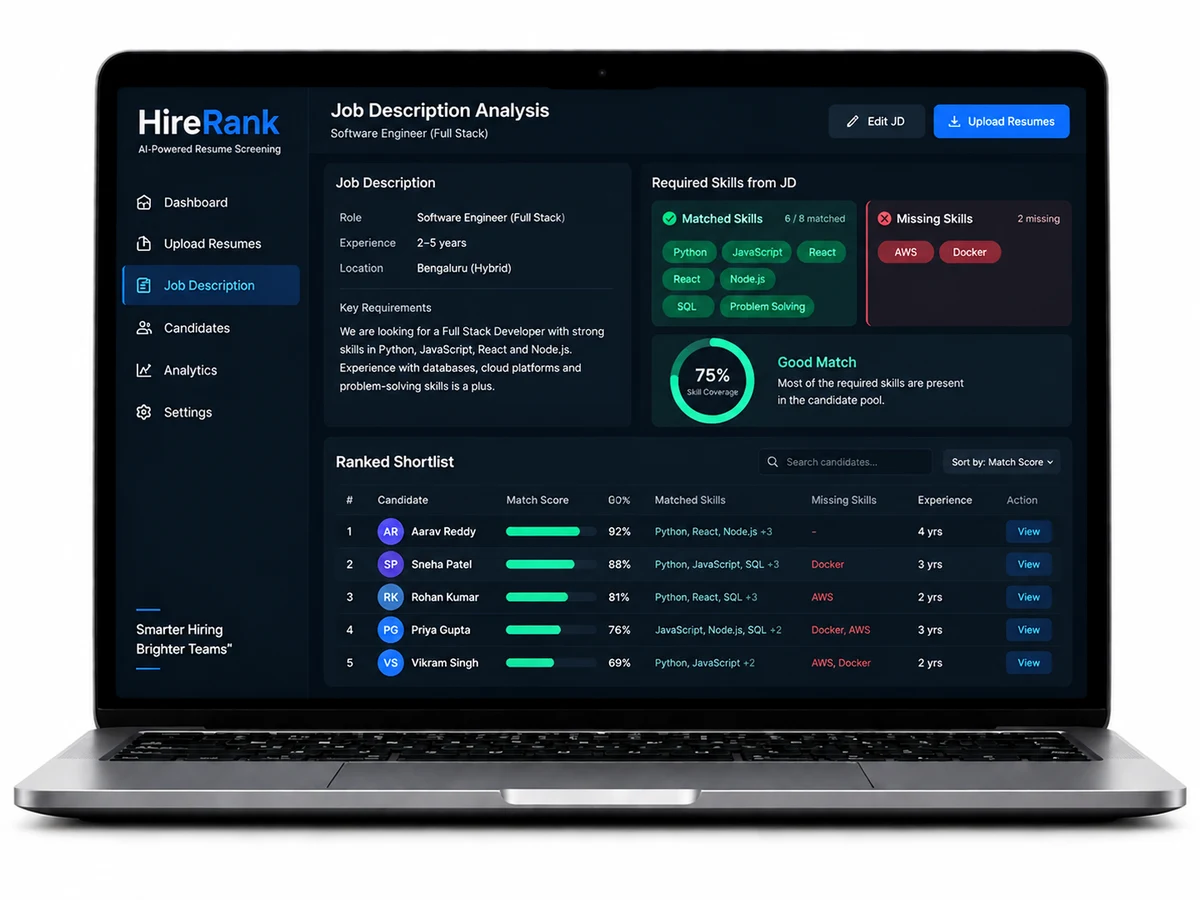
- Dashboard displays rankings, matched skills, and missing skills.
Project features
Upload resumes in PDF format for automatic processing and analysis.
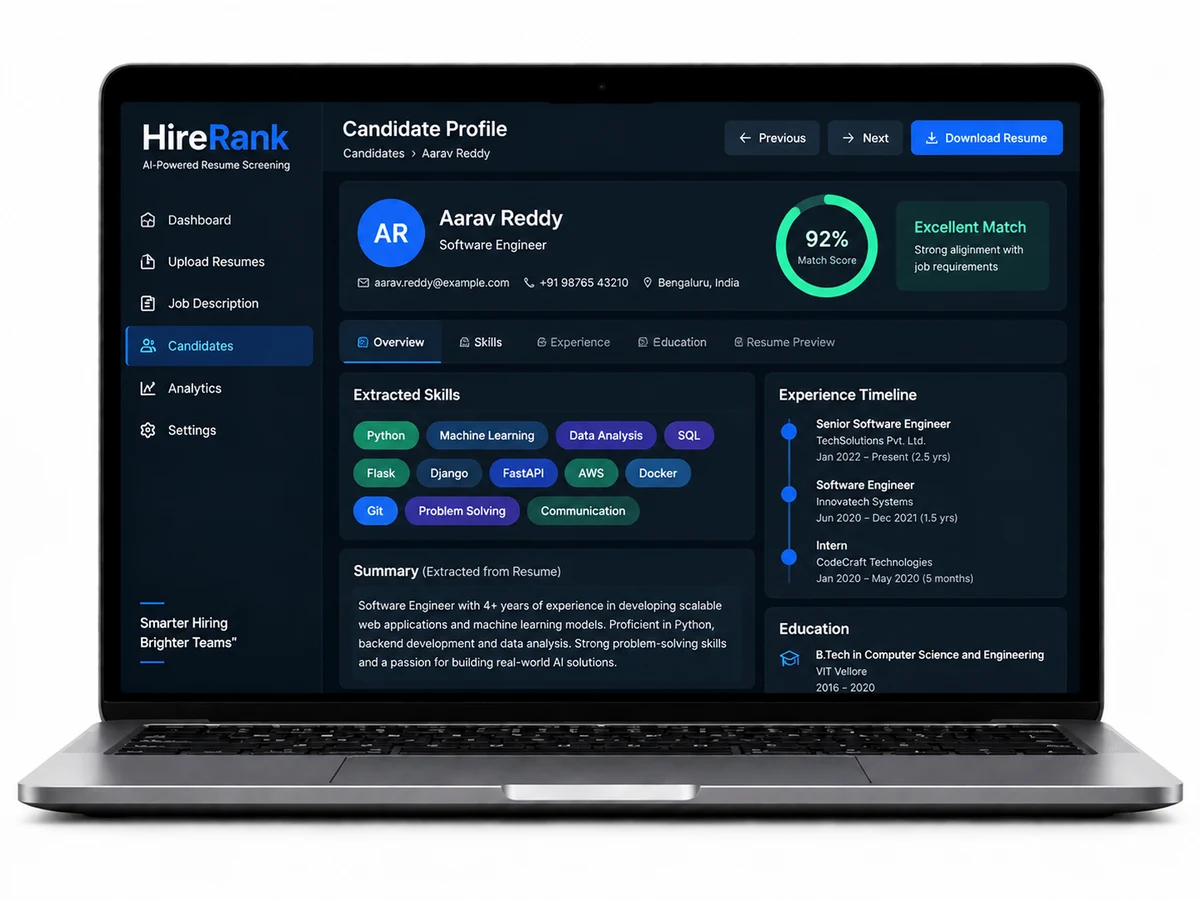
Extract candidate details including education, skills, and experience.
Compare resumes against a given job description using NLP-based matching.
Generate candidate ranking based on skill and requirement similarity.
Highlight matched skills and missing skills for each candidate.
Provide recruiter dashboard with shortlisted candidate information.
Support keyword extraction and resume content analysis.
Improve screening efficiency by reducing manual resume review effort.
What is included
Complete source code of the software system.
Resume upload and processing module.
NLP-based resume analysis engine.
Candidate ranking algorithm implementation.
Recruiter dashboard interface.
Database integration for storing candidate information.
Project documentation and setup guidance.
Basic testing and demonstration support.
Advantages
- PDF resume ingestion with automatic extraction of education, skills, and experience.
- Compares each resume against a job description using NLP-based matching.
- Generates candidate rankings by skill/requirement similarity, highlighting matched and missing skills for each candidate.
- Recruiter dashboard with shortlisted candidate information, keyword extraction, and resume content analysis.
- Reduces manual resume-review effort, speeding up the initial screening stage.
Disadvantages
- Extraction accuracy is affected by resume formatting differences.
- Ranking quality depends on the available data and matching approach; the system may not fully capture complex human experience.
- Bias in resume data can influence ranking results.
- Advanced semantic understanding may need larger language models; human review is still required before final hiring decisions.
Limitations & prerequisites
Prerequisites:
• Basic understanding of Python programming.
• Knowledge of machine learning and NLP concepts.
• Python development environment.
• Database setup knowledge.
• Basic understanding of web application deployment.
Limitations:
- Resume formatting differences may affect extraction accuracy.
- Ranking quality depends on available training/data and matching approach.
- The system may not fully understand complex human experience descriptions.
- Bias in resume data can influence ranking results.
- Advanced semantic understanding may require larger language models.
- Human review is still required before final hiring decisions.
Components & software requirements
- Python Backend
- NLP Processing Module
- PDF Resume Parser
- Machine Learning Matching Engine
- Candidate Database
- Web Dashboard Interface
- Job Description Analyzer
- Ranking Algorithm
Delivery information
Estimated delivery timeline: Needs confirmation based on customization requirements.
Customisation options
• Custom resume formats.
• Different ranking criteria.
• Company-specific skill matching rules.
• Advanced AI/LLM-based analysis.
• User authentication and role-based dashboards.
• Integration with job portals or HR systems.
Download free synopsis (PDF)
Enter your name and WhatsApp number — the synopsis PDF downloads immediately. We may send occasional project updates on WhatsApp; no spam.
Gurjar & Parmar, Automated Resume Screening System Using NLP and ML, IJCOPE